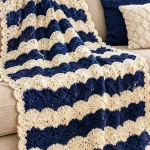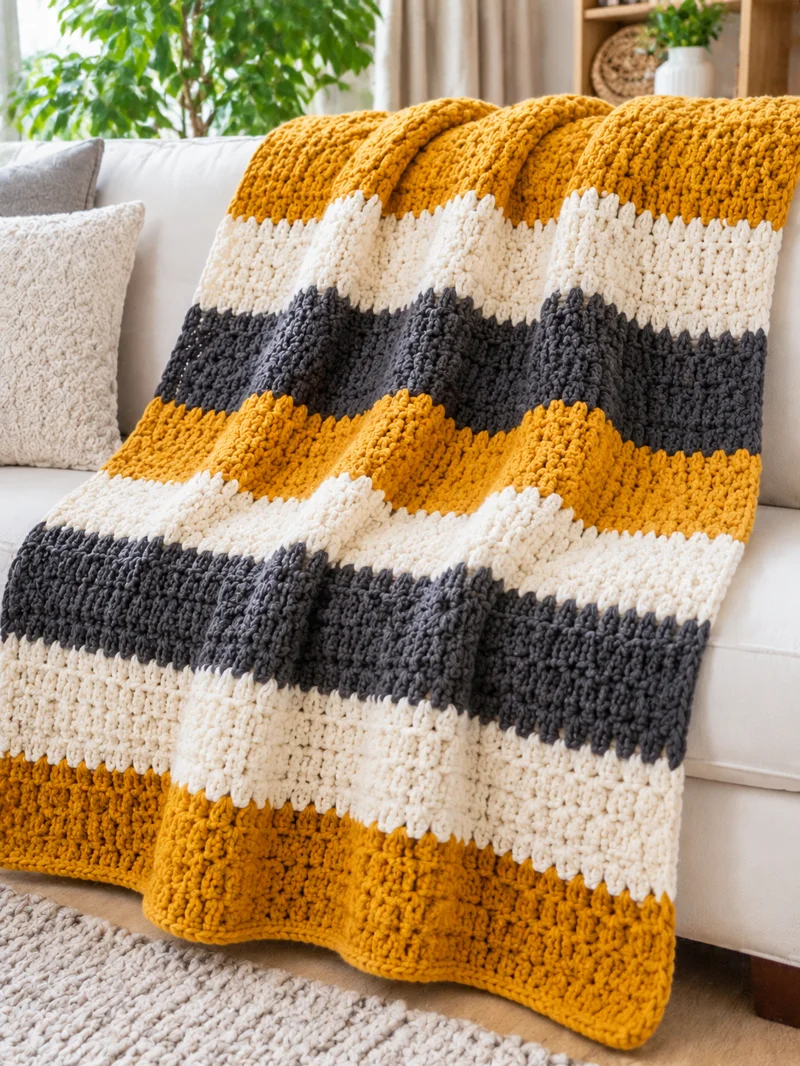
Mustard stripes frame the cream and charcoal bands of this textured throw, creating a repeating three-color layout that stays visible when the blanket is folded. This chunky striped crochet blanket pattern uses super bulky yarn, half double crochet stitches, and an 8–10 mm hook. Designed for confident beginners, the project targets approximately 120 × 150 cm and provides a practical way to make a coordinated sofa throw with a repeatable color sequence.
The Design: What Makes This Striped Blanket Different
This mustard crochet blanket uses three structural decisions to produce a consistent rectangular throw.
First, the stripe widths remain equal throughout the main fabric. Each color occupies twelve rows, allowing you to repeat the sequence without recalculating stitch counts.
Second, the textured crochet blanket uses half double crochet worked through the back loop. This creates horizontal ridges while maintaining a consistent stitch count. The technique also provides a visible reference line for checking whether a row has been skipped.
Third, the blanket is worked as one continuous rectangle rather than assembled from separate panels. This removes the need for joining seams and keeps the charcoal, cream, and mustard sections aligned.
A common mistake with thick chenille yarn is accidentally adding stitches at row ends. Count every row, especially immediately after changing colors.
Project Info at a Glance
| Project Detail | Specification |
|---|---|
| Skill Level | Confident beginner |
| Estimated Time | 12–20 hours |
| Target Finished Size | 120 × 150 cm (47 × 59 inches) |
| Crochet Hook | 10 mm for initial swatch |
| Yarn Weight | Super bulky, category 6 |
| Construction | Flat rows |
| Main Stitch | Half double crochet, back loop only |
| Color Changes | Every 12 rows |
| Best For | Sofa throws and home décor |
| Terminology | US crochet terms |
The finished measurements and working time are estimates. Adjust the foundation stitch count or total rows after measuring your gauge swatch.
Materials and Tools
Yarn
Choose three colors of super bulky chenille yarn with comparable thickness and fiber composition.
- Mustard Yellow – Color A: Category 6 super bulky yarn, approximately 900 g purchasing allowance. Suggested yarn: Bernat Blanket in an available golden-yellow shade.
- Warm Cream – Color B: Category 6 super bulky yarn, approximately 900 g purchasing allowance. Suggested yarn: Bernat Blanket in cream or ivory.
- Charcoal Gray – Color C: Category 6 super bulky yarn, approximately 900 g purchasing allowance. Suggested yarn: Bernat Blanket in dark gray.
The proposed purchasing allowance is 2,700 g in total, divided equally between the three colors. This is not a measured consumption figure. Make and weigh a swatch to calculate the actual requirement before purchasing.
Bernat Blanket is a 100% polyester chenille yarn. A standard ball contains approximately 300 g and 201 m. The manufacturer recommends an 8 mm crochet hook, although this project begins with a 10 mm hook for gauge testing.
Tools
- 10 mm crochet hook – initial hook for swatching.
- 8 mm crochet hook – optional alternative for tighter stitches.
- Large-eye yarn needle – for weaving in chenille yarn ends.
- Two removable stitch markers – to identify row edges.
- Measuring tape – at least 150 cm long.
- Sharp scissors – for cutting yarn.
- Digital kitchen scale – optional, for measuring yarn consumption.
Crochet Abbreviations
| Abbreviation | Meaning |
|---|---|
| ch | Chain |
| sc | Single crochet |
| hdc | Half double crochet |
| BLO | Back loop only |
| sl st | Slip stitch |
| st(s) | Stitch(es) |
| RS | Right side |
| WS | Wrong side |
| rep | Repeat |
| FO | Fasten off |
An invisible decrease is not required because the blanket maintains the same stitch count throughout.
Gauge and Sizing
Before starting the full blanket, make a sample with your chosen yarn and hook.
Chain 16. Work 14 half double crochet stitches across the first row, beginning in the third chain from the hook. Continue in back-loop-only half double crochet for at least 12 rows.
Measure the central portion of the swatch without stretching it. If the fabric feels compressed, use a larger hook. If large gaps appear between stitches, try a smaller hook.
The proposed 120 cm blanket width requires approximately 7 stitches per 10 cm when using 84 stitches across. The 150 cm length requires approximately 7.2 rows per 10 cm when working 108 rows.
These are target gauge values, not measurements from a tested sample. The optional border may also increase the finished dimensions.
How to Adjust the Blanket Size
To calculate the number of stitches required for another width, multiply the desired width in centimeters by the number of stitches in your 10 cm swatch, then divide by 10.
Example: For a 100 cm wide blanket at 7 stitches per 10 cm, work 70 stitches across. Add two chains to the foundation, giving a starting chain of 72.
For the length, multiply the desired length by the number of rows in your 10 cm swatch, then divide by 10. Round the result to a suitable multiple of the number of color sections if you want equal stripes.
Chunky Striped Crochet Blanket Pattern – Step by Step
This blanket is worked in turned rows, not continuous rounds. The original design begins with 86 chains and produces 84 half double crochet stitches in every row.
Important: The turning chain does not count as a stitch. Work the first stitch into the first stitch of the previous row after turning.
Step 1: Foundation Chain
Yarn: Mustard Yellow – Color A
Foundation: Ch 86.
Row 1: Hdc in the third chain from the hook. Hdc in each remaining chain. (84)
Ch 2 and turn.
Count all stitches before continuing. The first row must contain exactly 84 half double crochet stitches, excluding the turning chain.
Step 2: First Mustard Stripe
Yarn: Mustard Yellow – Color A
Rows 2–12: Hdc BLO in each stitch across. (84 stitches per row)
At the end of each row, ch 2 and turn.
Working through the back loop leaves the front loop visible, creating a horizontal ridge. This technique adds surface texture without increasing the stitch count.
Keep the first and last stitches marked to prevent the edges from narrowing or widening.
At the end of Row 12, prepare to introduce cream yarn.
Step 3: First Cream Stripe
Yarn: Warm Cream – Color B
Rows 13–24: Hdc BLO in each stitch across. (84 stitches per row)
Change to cream during the final yarn-over of the last half double crochet stitch of Row 12.
Pull the cream yarn through the remaining loops to complete the stitch. Ch 2, turn, and continue with the new color.
Cut the mustard yarn, leaving a tail approximately 15 cm long for weaving in later.
Avoid tying a bulky knot at the color transition. A knot may create a visible bump along the edge.
Step 4: First Charcoal Stripe
Yarn: Charcoal Gray – Color C
Rows 25–36: Hdc BLO in each stitch across. (84 stitches per row)
Introduce charcoal during the final stitch of Row 24.
Continue working twelve rows in charcoal, maintaining the same stitch count and turning-chain method.
At the end of Row 36, the first complete three-color sequence is finished.
Measure both side edges. If one side is noticeably longer than the other, inspect the row ends for accidental increases or skipped stitches.
Step 5: Second Mustard Stripe
Yarn: Mustard Yellow – Color A
Rows 37–48: Hdc BLO in each stitch across. (84 stitches per row)
Return to mustard after completing Row 36.
Keep the same turning-chain height used in the first three sections. Changes in turning-chain tension can create uneven edges.
Step 6: Second Cream Stripe
Yarn: Warm Cream – Color B
Rows 49–60: Hdc BLO in each stitch across. (84 stitches per row)
Continue working in the back loop of every stitch.
Do not switch to regular half double crochet, because this would interrupt the raised ridge pattern.
After Row 60, measure the blanket length and compare it with the expected row gauge.
Step 7: Second Charcoal Stripe
Yarn: Charcoal Gray – Color C
Rows 61–72: Hdc BLO in each stitch across. (84 stitches per row)
The second complete three-color sequence ends at Row 72.
Check the side edges and place stitch markers at the corners to help with border placement.
Step 8: Third Mustard Stripe
Yarn: Mustard Yellow – Color A
Rows 73–84: Hdc BLO in each stitch across. (84 stitches per row)
Maintain consistent yarn tension and count the stitches after every row.
Step 9: Third Cream Stripe
Yarn: Warm Cream – Color B
Rows 85–96: Hdc BLO in each stitch across. (84 stitches per row)
Introduce cream using the same final-yarn-over method as the previous color changes.
Continue until all twelve cream rows are complete.
Step 10: Final Charcoal Stripe
Yarn: Charcoal Gray – Color C
Rows 97–108: Hdc BLO in each stitch across. (84 stitches per row)
Fasten off after Row 108, leaving approximately 15 cm of yarn for finishing.
The main blanket now contains 108 rows arranged into nine equal color sections.
Complete Crochet Color Chart
| Section | Rows | Color | Stitches Per Row |
|---|---|---|---|
| 1 | 1–12 | Mustard Yellow | 84 |
| 2 | 13–24 | Warm Cream | 84 |
| 3 | 25–36 | Charcoal Gray | 84 |
| 4 | 37–48 | Mustard Yellow | 84 |
| 5 | 49–60 | Warm Cream | 84 |
| 6 | 61–72 | Charcoal Gray | 84 |
| 7 | 73–84 | Mustard Yellow | 84 |
| 8 | 85–96 | Warm Cream | 84 |
| 9 | 97–108 | Charcoal Gray | 84 |
Pattern total: 108 rows, with 84 stitches in each row. The stitch count remains constant throughout the project.
Optional Single Crochet Border
A single crochet border provides a defined edge and may help reduce minor curling around the blanket.
Choose charcoal for a contrasting frame or cream for a lighter finish.
- Join the border yarn at one corner.
- Work one single crochet into each stitch across the top edge.
- At the corner, work three single crochet stitches into the corner space.
- Continue along the side, distributing stitches evenly according to the row height.
- Work three single crochet stitches at the next corner.
- Repeat around the remaining sides.
- Join the final stitch with a slip stitch.
- Fasten off and weave in the yarn tail.
Along the vertical edges, approximately one single crochet per row end is a useful starting point, but the correct number depends on your gauge.
If the border ripples, reduce the number of stitches. If it pulls inward, add stitches.
For a thicker finish, work a second round of single crochet while maintaining three stitches at each corner.
Assembly and Finishing
- Lay the blanket flat on a clean surface.
- Confirm that the pattern contains 108 rows.
- Count the stitches across the final row.
- Inspect each color transition for loose loops.
- Thread the first yarn tail through a large-eye yarn needle.
- Weave the tail through several stitches of the same color.
- Reverse direction and weave through another short section to help secure the end.
- Repeat for all remaining yarn tails.
- Add the optional border and check that the corners lie flat.
- Wash or gently shape the blanket according to the yarn label, then dry fully before measuring.
The completed blanket has nine horizontal color sections and a continuous textured crochet surface.
7 Technical Tips for a Better Chunky Crochet Blanket
- Mark the first and last stitches. A missed final stitch can reduce an 84-stitch row to 83 stitches and gradually narrow the blanket.
- Check tension after each twelve-row section. A stripe that measures 3 cm taller than the previous section may indicate inconsistent loop height or a change in hook grip.
- Avoid pulling chenille yarn tails too tightly. Excessive tension at the color transition can draw the edge inward and create a visible notch.
- Count the turning chain correctly. The ch 2 is not included in the 84-stitch count, and treating it as a stitch can create unwanted increases.
- Measure your swatch before buying all the yarn. A difference of one stitch per 10 cm can change the projected width substantially.
- Pin the blanket without stretching the edges. Pulling one corner farther than the others during shaping can distort the rectangular outline.
- Weave in yarn tails for at least 10–15 cm where the yarn permits. Short tails can work loose during washing, especially when chenille yarn has a slippery polyester core.
How to Customize Your Striped Crochet Blanket
Change the Stripe Width
The original pattern uses twelve rows per color, but narrower or wider stripes are possible.
For six-row stripes, repeat the mustard, cream, and charcoal sequence six times. This produces eighteen color sections and maintains a total of 108 rows.
For wider stripes, work eighteen rows per color and repeat the three-color sequence twice. The finished blanket will contain six broad color sections.
Keep the stitch count consistent when changing the stripe height.
Make a Smaller Crochet Throw
A smaller blanket can be made by reducing the foundation chain and total rows.
For example, a width of approximately 90 cm at the target gauge requires 63 half double crochet stitches. Chain 65 to begin.
For a length near 120 cm, approximately 86 rows are required at the target row gauge. Round to 90 rows if you want nine equal ten-row color sections.
Always measure your swatch before finalizing these adjustments.
Choose a Different Color Palette
The same three-color structure works with olive green, beige, and chocolate brown. Navy, pale gray, and white are another option.
Use one dark color to anchor the design, one light color to separate the stronger tones, and one warm or saturated color for contrast.
When substituting yarn, compare the weight category, recommended hook size, and measured gauge rather than relying only on the color label.
Washing and Care Instructions
For the suggested Bernat Blanket yarn, the manufacturer permits machine washing on a delicate cycle and gentle tumble drying. Bleach, ironing, and dry cleaning are not recommended.
Always check the care label for the exact yarn used in your project. Different chenille yarns may require different washing methods.
Before washing, inspect the woven ends at every color transition.
Place the blanket in a washing machine with enough room to move freely. Avoid overcrowding the drum.
After drying, measure the finished rectangle again. Record any changes in width or length for future projects using the same yarn and hook.
Frequently Asked Questions
Is this crochet blanket suitable for beginners?
Yes, for confident beginners who can make chains, half double crochet stitches, and turn their work. The main challenge is maintaining a consistent stitch count while working with thick yarn.
What crochet hook works best with chunky blanket yarn?
The selected yarn manufacturer recommends an 8 mm hook. This pattern begins with a 10 mm swatch to test a more flexible fabric. Choose the final hook size according to your measured gauge and preferred fabric density.
How many skeins are needed?
The planning allowance is nine 300 g skeins in total, divided equally among the three colors. This is not a tested consumption figure. Make a measured swatch, weigh it, and estimate the total yarn requirement before purchasing.
Can I make this blanket without a border?
Yes. A border is optional because the main fabric is constructed as one rectangle. If the edges remain even and lie flat, weaving in the ends may be sufficient.
Why are the edges of my crochet blanket uneven?
Uneven edges often result from missed stitches, added stitches, or inconsistent turning chains. Place markers in the first and last stitches and count all 84 stitches at the end of every row.
Can I use a different yarn weight?
Yes, but changing the yarn weight will affect the stitch gauge, row gauge, finished dimensions, and yarn requirements.
If you choose worsted or DK yarn, calculate a new foundation chain using a gauge swatch. The original 84-stitch width is intended for a much thicker yarn.
How can I stop the blanket from curling?
Check your hook size and tension first. Very tight stitches can cause the fabric to curl or pull inward.
A single crochet border may help stabilize the edges. If curling remains severe, remake a small swatch with a larger hook before adjusting the full blanket.
Conclusion
This chunky striped crochet blanket pattern combines nine equal color sections with a consistent half double crochet back-loop texture. The 84-stitch width and 108-row structure provide a repeatable starting point, while the final dimensions depend on your measured gauge. Before beginning the full throw, complete a swatch and record the stitches, rows, and yarn weight used.
Save the color chart to Pinterest for reference, or share a finished project on Instagram with #MustardStripedCrochetBlanket. Include your yarn choice and finished measurements so other makers can compare results.
Would you keep the charcoal stripes as shown, or replace them with a softer gray for a lower-contrast blanket?