Introduction
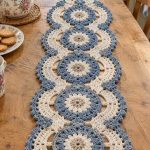
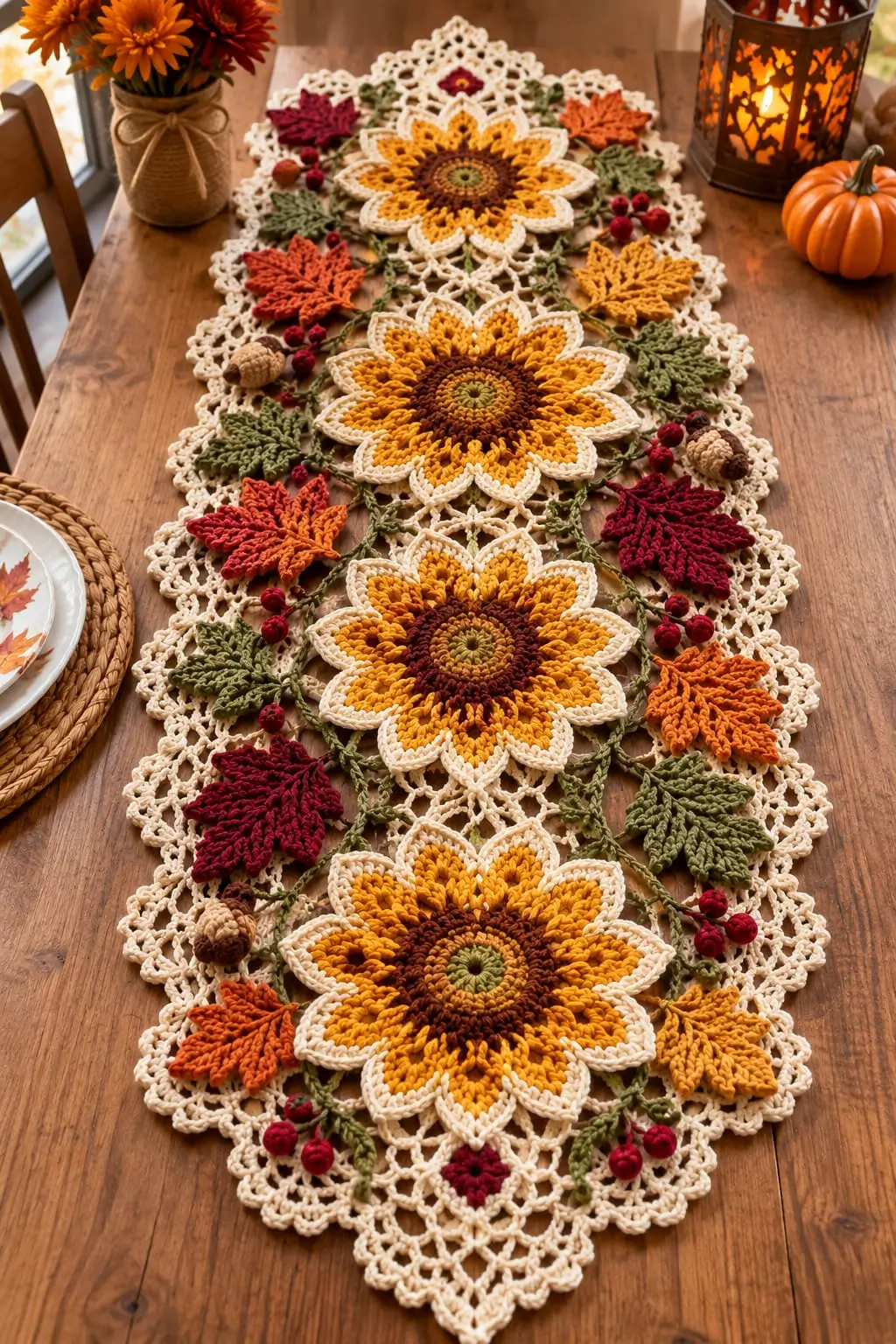
Four oversized sunflowers create the structural rhythm of this autumn table runner, while maple leaves, berries, acorns, and an open cream lattice fill the spaces between them. This autumn sunflower crochet table runner pattern is designed as a photo-inspired modular project using cotton yarn, layered floral motifs, separate leaf appliqués, and a lace border. The suggested finished size is approximately 40 × 150 cm, making it suitable for a dining table, console, or seasonal centerpiece.
The Design: What Makes This Table Runner Different
The runner is constructed as a collection of motifs rather than one dense rectangle. Large sunflowers form the central spine. Each flower combines an olive center, a dark brown ring, golden petals, and a narrow cream outline that separates the flower from the surrounding lattice.
Autumn maple leaves in burgundy, burnt orange, mustard, and olive break up the repeated floral geometry. Small berries and acorns occupy otherwise empty spaces without making the fabric excessively heavy. A cream chain-and-cluster mesh connects the components and finishes in pointed lace ends.
The critical construction decision is to block the large flowers and leaves before joining them. Attaching unblocked motifs directly to the mesh can pull the runner sideways because the dense flowers stretch far less than the open lattice.
Project Info at a Glance
| Skill Level | Construction | Suggested Size | Hook | Best For |
|---|---|---|---|---|
| Intermediate–Advanced | Joined motifs with crochet lace mesh | Approx. 40 × 150 cm | 3.5–4.0 mm | Dining table, console, autumn centerpiece |
Materials and Tools
Yarn
- Warm cream — DK/light worsted cotton — approximately 250–350 g
- Golden yellow — DK/light worsted cotton — approximately 120–160 g
- Dark brown — DK/light worsted cotton — approximately 60–90 g
- Olive green — DK/light worsted cotton — approximately 80–120 g
- Burgundy — DK/light worsted cotton — approximately 50–70 g
- Burnt orange — DK/light worsted cotton — approximately 50–70 g
- Mustard — DK/light worsted cotton — approximately 40–60 g
- Beige or tan — small quantity for acorns
Yarn quantities are project estimates. A longer runner, heavier yarn, additional flowers, or a denser joining mesh will increase consumption.
Tools
- 3.5–4.0 mm crochet hook
- Yarn needle
- Scissors
- Stitch markers
- Measuring tape
- Blocking pins and mats
Abbreviations
- MR — magic ring
- ch — chain
- sc — single crochet
- hdc — half double crochet
- dc — double crochet
- tr — treble crochet
- sl st — slip stitch
- sp — space
- st/sts — stitch/stitches
- BLO — back loop only
- FLO — front loop only
Finished Measurements
The photo-inspired runner is long and relatively narrow. A practical target is approximately 38–42 cm wide and 145–155 cm long.
The pattern can be shortened by using three large sunflowers or extended by adding another flower section.
| Large Sunflowers | Approximate Runner Length |
|---|---|
| 2 | 80–90 cm |
| 3 | 110–125 cm |
| 4 | 145–155 cm |
| 5 | 175–190 cm |
Pattern Construction
Make all components separately first:
- 4 large sunflowers
- 10–14 maple leaves in mixed autumn colors
- 8–12 small olive leaves
- 12–18 berries
- 4–6 acorns
- Cream connecting mesh
- Cream outer lace border
Lay the finished components on a table before joining. The arrangement should remain balanced without becoming perfectly symmetrical.
Large Sunflower Motif — Make 4
Center
Use olive green.
Round 1: Work 10 sc into MR. Join with sl st. (10)
Round 2: Work 2 sc in each stitch around. Join. (20)
Round 3: *Sc in next st, 2 sc in next st.* Repeat around. Join. (30)
Change to dark brown.
Round 4: *Sc in next 2 sts, 2 sc in next st.* Repeat around. Join. (40)
Round 5: Work one sc in each stitch around. (40)
This creates the broad dark sunflower disk visible between the center and petals.
Textured Brown Ring
Round 6: Working in FLO, repeat *sl st in next st, ch 2* around.
Keep the chains compact. They create surface texture without substantially increasing the diameter.
Golden Sunflower Petals
Join golden yellow to an unused loop of Round 5.
The flower uses approximately 12 large pointed petals.
Petal Foundation
Repeat around:
*Sl st in next available stitch, ch 9, sl st into the next suitable base position.*
Distribute 12 loops evenly around the flower.
Petal Round
Into each ch-9 loop work:
sc, hdc, 2 dc, 3 tr, ch 2, 3 tr, 2 dc, hdc, sc
The ch-2 space forms the pointed tip.
Repeat for every petal.
Cream Petal Outline
Join warm cream at the base of any golden petal.
Work sl st or sc evenly around the first side.
At the petal point work:
(sc, ch 2, sc)
Continue down the second side.
Repeat around all petals.
Do not place too many cream stitches along the petal sides. Excess stitches will make the outline ripple.
Optional Second Petal Layer
For a fuller flower closer to the dimensional appearance in the image, add a shorter petal layer behind the main petals.
Join golden yarn behind the first petal foundation.
Create 12 ch-7 loops positioned between the existing petals.
Into each loop work:
sc, hdc, 3 dc, tr, ch 1, tr, 3 dc, hdc, sc
These petals should remain slightly shorter than the front layer.
Blocking the Sunflowers
Pin each sunflower so opposite petal tips measure approximately 20–24 cm.
Keep all four flowers close to the same diameter.
The central disks should remain flat while the petals retain a slight raised texture.
Autumn Maple Leaves
Make leaves in burgundy, burnt orange, mustard, and olive.
Each leaf is worked from a small central base with five lobes.
Leaf Center
Ch 4 and join with sl st to form a ring.
Work 10 sc into the ring.
Join.
Center Lobe
Ch 12.
Starting in the second chain from the hook, work:
sc, hdc, dc, tr, tr, dc, hdc, sc
Use the remaining chains to return toward the center with gradually shorter stitches.
Sl st into the center.
Upper Side Lobes — Make 2
Ch 10.
Work along the chain:
sc, hdc, dc, tr, dc, hdc, sc
Return to the center with sl st.
Lower Lobes — Make 2
Ch 8.
Work:
sc, hdc, dc, tr, dc, hdc, sc
Attach to the central ring.
Stem
Ch 8–10.
Sl st back along the chain.
Fasten off.
Maple Leaf Edging
Join matching yarn at the base of the stem.
Work sc around the leaf.
At each lobe tip work:
(sc, ch 2, sc)
Use sl st in the valleys between lobes.
This combination exaggerates the pointed maple silhouette.
Small Olive Leaves
Ch 10.
Starting in the second chain from the hook, work:
sc, hdc, 2 dc, 2 tr, dc, hdc, sc
Work around the opposite side of the foundation chain using the reverse sequence.
At the tip work (sc, ch 2, sc).
Sl st at the base.
Fasten off leaving a 15 cm tail for attachment.
Leaf Veins
Use a contrasting olive or slightly darker shade.
Surface crochet a line from the base toward the leaf tip.
Optional short diagonal lines can be added from the center vein toward the edges.
Keep these stitches loose enough that the leaf remains flat.
Crochet Berries
Use burgundy yarn.
Round 1: 6 sc in MR. (6)
Round 2: 2 sc in each stitch. (12)
Round 3: Sc around. (12)
Round 4: Sc2tog around. (6)
Insert a very small amount of stuffing before closing if dimensional berries are preferred.
Fasten off.
For flatter table-runner berries, omit the stuffing and pull the final round closed.
Berry Stems
With olive yarn, ch 5–8.
Sl st back along the chain.
Attach one end to a berry.
Group berries in clusters of two or three rather than spacing them individually across the runner.
Crochet Acorns
Acorn Body
With beige or tan yarn:
Round 1: 6 sc in MR. (6)
Round 2: 2 sc in each stitch. (12)
Rounds 3–5: Sc around. (12)
Round 6: Sc2tog around. (6)
Stuff lightly and close.
Acorn Cap
With dark brown:
Round 1: 6 sc in MR. (6)
Round 2: 2 sc in each stitch. (12)
Round 3: BLO sc around. (12)
Fasten off and sew the cap over the wider end of the acorn.
Add a short ch-4 stem if desired.
Planning the Runner Layout
Place the four sunflowers in a straight vertical line with approximately 8–12 cm between neighboring petal tips.
Rotate alternate flowers slightly so the petals do not create rigid horizontal lines.
Position maple leaves along both sides.
Use larger burgundy and orange leaves near the middle sections and smaller mustard or olive leaves near the ends.
Add berries and acorns only after the major motifs are positioned.
Cream Connecting Mesh
The cream mesh forms the actual structural fabric of the runner.
It can be worked directly between motifs after they are pinned into position on a blocking board.
Basic Mesh Unit
Use:
ch 5, sc into the next anchor point
Repeat to form interconnected arches.
For wider gaps use ch 6 or ch 7.
For narrow spaces use ch 3 or ch 4.
The goal is an even lattice rather than identical chain lengths everywhere.
Diamond Mesh Between Sunflowers
Between the large flowers, create a stronger diamond structure.
Join cream at one petal tip.
Ch 7.
Sc into a neighboring mesh arch.
Ch 7 and connect toward the next flower.
On the following pass, work into the center of each ch-7 arch to create staggered diamonds.
Continue until the space is filled without pulling either flower inward.
Attaching the Leaves
Do not sew the entire leaf surface to the mesh.
Attach each leaf at three structural points:
- Base
- Upper left area
- Upper right area
This keeps the leaf stable while allowing the lobes to remain dimensional.
For a flatter table surface, add one small hidden stitch beneath the center lobe.
Attaching Berries and Acorns
Sew berry stems directly to the green connecting lines.
Anchor each berry through its base.
Acorns are heavier, so stitch them through both the cap and the upper body.
Keep dimensional decorations away from the central areas where serving dishes are most likely to sit.
Building the Outer Cream Frame
Once the internal mesh is complete, work around the entire runner.
Frame Round 1
Work sc into each outer mesh arch.
Distribute the stitches so the long sides remain straight.
At the two pointed ends, work additional stitches into the central end space.
Frame Round 2
Repeat:
*ch 5, skip approximately 3 sts, sc in next st.*
Adjust the skipped stitches where necessary so the arches are evenly distributed.
Frame Round 3
Into each ch-5 arch work:
sc, hdc, 3 dc, hdc, sc
This creates the first scalloped lace line.
Pointed End Sections
The narrow ends of the runner can be shaped into decorative points.
Mark the center of each end.
As the lace rounds approach the center, gradually increase the chain arches:
ch 5 → ch 6 → ch 7
At the center point work:
(sc, ch 5, sc)
On the opposite side, reverse the progression:
ch 7 → ch 6 → ch 5
This creates an elongated point without adding a separate triangular motif.
Final Lace Border
For the final border, work into each outer arch:
sc, ch 3, 2 dc, ch 3, sc
At the major end points work:
sc, ch 5, 3 dc, ch 5, sc
Check the runner after every 20–25 cm of border.
If the edge begins to ruffle, reduce the number of stitches or arches. If it pulls inward, add an extra chain to selected arches.
Optional Raised Green Vines
The olive lines connecting the leaves can be added after the cream mesh is finished.
With olive yarn, surface crochet along selected mesh paths.
Use slip stitches for thin vines.
For a more visible stem, work a chain separately and sew it over the mesh.
Keep vines irregular. Perfectly straight lines make the arrangement look more geometric than botanical.
Runner Size Adjustments
Short Table Runner
Use two large sunflowers and approximately six maple leaves. Target a finished length of 80–90 cm.
Standard Runner
Use three large sunflowers and eight to ten maple leaves. Target approximately 110–125 cm.
Long Dining Runner
Use four large sunflowers, ten to fourteen maple leaves, and the full berry-and-acorn arrangement. Target approximately 145–155 cm.
Extra-Long Runner
Add a fifth sunflower section and extend the mesh before working the border.
Color Placement
Keep the sunflowers consistent so they form the main visual sequence.
A useful leaf distribution is:
- 3 burgundy maple leaves
- 3 burnt-orange maple leaves
- 2–3 mustard leaves
- 3–5 olive leaves
Do not place identical leaf colors directly opposite one another in every section. A slightly irregular arrangement produces a more natural autumn composition.
Assembly
- Crochet four sunflower centers and complete both petal layers before adding the cream outlines.
- Make all maple leaves, small olive leaves, berries, stems, and acorns.
- Block the sunflowers to equal diameters and flatten the leaf bases while retaining the pointed lobes.
- Arrange the four sunflowers along the center line with equal spacing between neighboring motifs.
- Position the maple leaves along both sides and place smaller olive leaves in the remaining spaces.
- Build the cream chain mesh between the major motifs, checking that the runner stays flat after every section.
- Add the olive vine lines and secure the leaves at several structural points.
- Sew on berry clusters and acorns after the mesh is stable.
- Work the cream outer frame, pointed end shaping, and final scalloped lace border.
- Weave in all tails, measure both long edges, and block the completed runner to its final dimensions.
7 Technical Tips
- Failure mode: sunflower petals curling upward. Block each finished flower to approximately 20–24 cm before attaching it to the mesh; do not attempt to flatten curled petals by stretching the connecting chains.
- Failure mode: narrow waist between neighboring flowers. Maintain approximately 8–12 cm between petal tips before filling the gap with cream diamond mesh.
- Failure mode: distorted maple leaves. Attach each leaf at a minimum of three points rather than sewing only through the stem.
- Failure mode: berries pulling the lace downward. Keep stuffed berries small, approximately 1.5–2 cm, and attach them close to structural mesh intersections.
- Failure mode: outer border ruffling. Inspect the lace after every 20–25 cm and remove one arch whenever the perimeter begins expanding faster than the runner body.
- Failure mode: flowers twisting after joining. Mark the top and bottom petal of every sunflower before constructing the mesh so all four motifs remain aligned along the center axis.
- Failure mode: uneven finished length. Measure both long sides before the final border; a difference greater than approximately 1 cm should be corrected by adjusting mesh tension before blocking.
Blocking
Blocking is especially important for this project because dense floral motifs are combined with highly flexible lace.
Pin the runner on a large blocking surface.
Start with the four sunflower centers and align them along one straight axis.
Next pin the two long edges to matching measurements.
Shape the pointed ends last.
Spread the maple lobes individually and open the cream mesh until the diamond spaces appear balanced.
Allow the runner to dry completely before removing the pins.
Care
Cotton is practical for a table runner because it tolerates repeated washing and blocks cleanly, but follow the care instructions for the selected yarn.
Wash gently and avoid aggressive agitation around the raised flowers, berries, and acorns.
Reshape the sunflowers and maple leaves while damp.
Dry the runner flat so the weight of the wet cotton does not stretch the lace mesh.
Conclusion
The structure of this autumn sunflower crochet table runner pattern depends on making the large floral motifs first and treating the cream lace as the connecting framework rather than the starting fabric. Crochet one complete sunflower and one maple leaf, block both pieces, and use their finished measurements to calculate the spacing for your table. The runner can then be shortened or extended without changing the individual motifs. For a coordinated autumn table, repeat the sunflower motif on small placemats or coasters. Share the finished runner on Pinterest or Instagram with #AutumnSunflowerTableRunner. Which accent would you use most around the sunflowers: burgundy maple leaves, burnt orange leaves, or olive foliage?