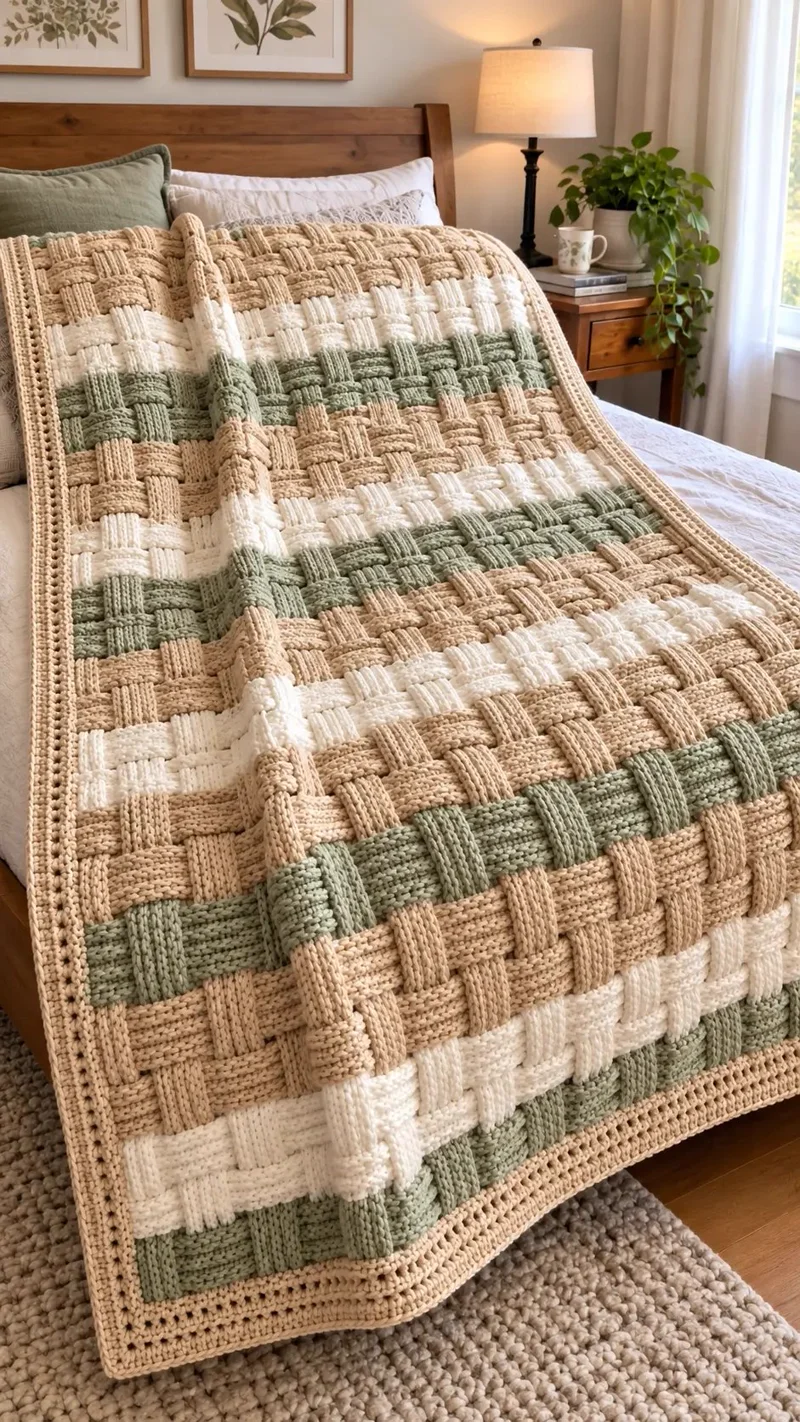
The raised squares of a basketweave blanket depend on alternating the direction of post stitches rather than joining individual crochet blocks. This basketweave crochet blanket pattern combines sage green, warm beige, and ivory cream using worsted-weight yarn and a 6 mm crochet hook. Designed for intermediate crocheters, the finished blanket measures approximately 130 × 170 cm and provides a textured layer for a bed or sofa.
The Design: What Makes This Blanket Different
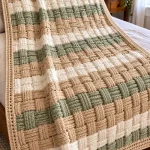
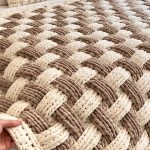
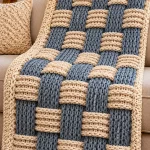
This striped basketweave blanket uses alternating groups of four front post and four back post double crochet stitches. These stitches create raised vertical columns alongside recessed horizontal sections, producing the appearance of interwoven yarn.
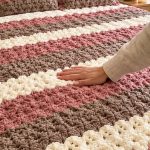
The three-color arrangement separates the textured fabric into repeating horizontal bands. Beige provides a neutral foundation, cream introduces contrast, and sage green adds definition without competing with the stitch texture.
A continuous beige border frames the blanket and stabilizes its edges. An openwork round positioned between solid crochet rounds reproduces the decorative appearance shown in the reference photograph.
One common mistake when making a textured crochet blanket is reversing the post stitches after the wrong number of rows. This interrupts the checkerboard arrangement and produces uneven rectangular sections instead of consistent woven blocks.
Project Information
Skill level: Intermediate
Finished size: Approximately 130 × 170 cm (51 × 67 inches)
Estimated working time: 40–65 hours
Yarn weight: Medium worsted, category 4
Crochet hook: 6 mm
Construction: Worked flat in one piece
Terminology: US crochet terms
Best for: Bedroom blankets, sofa throws, and home decoration
Materials and Tools
Yarn
Choose a smooth worsted-weight acrylic yarn or cotton-acrylic blend. All three colors should have approximately the same thickness and fiber composition.
- Color A – Warm beige: Approximately 1,000 g, including the border.
- Color B – Ivory cream: Approximately 700 g.
- Color C – Sage green: Approximately 700 g.
These quantities are planning estimates. Actual consumption depends on yarn density, stitch tension, and finished dimensions.
Use any smooth category 4 (Aran) yarn in matching neutral shades.
Additional Tools
- 6 mm crochet hook for the blanket body.
- 5.5 mm crochet hook as an optional border hook.
- Tapestry needle for weaving in yarn ends.
- Locking stitch markers for identifying repeat sections.
- Scissors for cutting yarn.
- Measuring tape for checking dimensions.
- Blocking mats and rust-resistant pins for finishing.
Crochet Abbreviations
- ch: Chain
- st: Stitch
- sts: Stitches
- sc: Single crochet
- dc: Double crochet
- hdc: Half double crochet
- FPdc: Front post double crochet
- BPdc: Back post double crochet
- sl st: Slip stitch
- sk: Skip
- sp: Space
- rep: Repeat
- YO: Yarn over
- RS: Right side
- WS: Wrong side
Gauge and Finished Measurements
The target gauge is approximately 13 stitches and 8 rows per 10 cm in the basketweave stitch pattern.
Make a practice swatch before beginning the full blanket. Post stitches compress the fabric more than ordinary double crochet stitches, so a standard double crochet gauge will not provide an accurate measurement.
At the target gauge, the 162-stitch blanket body measures approximately 125 cm across. The border adds approximately 5 cm to each overall dimension, although the final measurement will depend on your border tension.
Practice Swatch
- Chain 20 stitches.
- Work one double crochet into the fourth chain from the hook and each remaining chain. Counting the initial three chains as one stitch gives 18 stitches.
- Work two complete eight-row basketweave repeats using the instructions below.
- Lay the swatch flat without stretching it.
- Measure the central section, avoiding the edge stitches.
If the fabric is excessively stiff or has too many stitches per 10 cm, move to a slightly larger hook. If the stitches are too loose, select a smaller hook and measure another swatch.
Special Crochet Stitches
Front Post Double Crochet – FPdc
Yarn over and insert the hook from the front of the fabric to the back, then bring it forward around the vertical post of the next stitch.
Yarn over and draw up a loop. Yarn over again and pull through two loops, then complete the stitch by pulling yarn through the final two loops.
The finished stitch projects toward the side of the fabric facing you.
Back Post Double Crochet – BPdc
Yarn over and insert the hook from the back of the fabric toward the front. Guide the hook around the vertical post and return it to the back.
Draw up a loop and complete the double crochet normally. This pushes the stitch post away from the side facing you.
Front and back post stitches are worked around the upright portion of the previous stitch rather than through its upper loops.
Basketweave Crochet Blanket Pattern
Work the blanket in turned rows. The initial chain-three counts as one double crochet in the foundation row only. In all subsequent rows, the turning chain-two does not count as a stitch.
Maintain 162 stitches throughout the blanket body. This consists of 160 basketweave stitches and two plain edge stitches.
Foundation Chain
Using Color A – Beige:
Foundation: Chain 164 loosely.
Row 1: Work 1 dc into the fourth chain from the hook. Work 1 dc in each remaining chain across. Turn. (162 sts, including the initial chain-three)
Count the foundation row before proceeding. A missing or additional stitch will prevent the four-stitch post groups from aligning correctly at the opposite edge.
Basketweave Section A
Row 2: Ch 2, dc in the first stitch. Work FPdc around each of the next 4 stitches, then BPdc around each of the following 4 stitches. Repeat this eight-stitch sequence 20 times. Work 1 dc in the final stitch. Turn. (162 sts)
Row 3: Repeat Row 2. (162 sts)
Row 4: Repeat Row 2. (162 sts)
Row 5: Repeat Row 2. (162 sts)
Four rows establish the first horizontal section of raised and recessed crochet blocks. The plain double crochet stitches at each edge provide a more regular surface for attaching the border.
Basketweave Section B
Row 6: Ch 2, dc in the first stitch. Work BPdc around each of the next 4 stitches, then FPdc around each of the following 4 stitches. Repeat this eight-stitch sequence 20 times. Work 1 dc in the final stitch. Turn. (162 sts)
Row 7: Repeat Row 6. (162 sts)
Row 8: Repeat Row 6. (162 sts)
Row 9: Repeat Row 6. (162 sts)
Rows 2–9 complete one full basketweave repeat. The contrasting post directions produce the alternating square arrangement that defines the blanket.
Continuing the Blanket
Repeat Rows 2–9 until the blanket contains 17 complete basketweave repeats. Including the foundation row, the body contains 137 rows.
At the target row gauge, this produces a body measuring approximately 171 cm before the border. Work 16 repeats instead if you prefer a finished length closer to 165–170 cm.
Complete Color Stripe Sequence
Each standard color band contains eight rows, equivalent to one complete basketweave repeat. Keep the raised stitch arrangement consistent across every color change.
| Rows | Yarn Color |
|---|---|
| 1–9 | Beige |
| 10–17 | Cream |
| 18–25 | Sage green |
| 26–33 | Beige |
| 34–41 | Cream |
| 42–49 | Sage green |
| 50–57 | Beige |
| 58–65 | Cream |
| 66–73 | Sage green |
| 74–81 | Beige |
| 82–89 | Cream |
| 90–97 | Sage green |
| 98–105 | Beige |
| 106–113 | Cream |
| 114–121 | Sage green |
| 122–129 | Beige |
| 130–137 | Sage green |
Changing Yarn Colors
Complete the final double crochet of the current color until two loops remain on the hook. Pick up the next color and draw it through both loops.
Cut the previous yarn, leaving a 15 cm tail for finishing. Turn the blanket and begin the next basketweave section with the new color.
Avoid carrying unused yarn across the entire row. Long hidden strands can restrict the natural movement of the textured fabric and create visible color contamination between cream and sage green stripes.
Decorative Beige Crochet Border
The border consists of five rounds combining single crochet, half double crochet, and decorative chain spaces. Work all rounds using Color A.
Round 1 – Foundation Edging
Attach beige yarn near any corner. Ch 1 and work single crochet stitches evenly around the blanket.
Across the horizontal edges, work one sc into each non-corner stitch. Along the vertical edges, distribute approximately 1–2 sc per row end, adjusting the spacing so the fabric remains flat.
Work 3 sc in each corner. Join with a sl st to the first sc.
Round 2 – Solid Border
Ch 1 and work 1 sc in every stitch around. Work 3 sc in the central stitch of each previous corner group. Join with a sl st.
Round 3 – Decorative Openwork
Ch 1 and sc in the first stitch. Repeat ch 1, sk 1, sc in the next stitch along each edge.
At each corner, work (sc, ch 2, sc) into the central corner stitch. Adjust the last repeat on each side if necessary so the corner remains symmetrical.
Join with a sl st to the first sc.
Round 4 – Half Double Crochet
Ch 2 and work 1 hdc in every sc and every chain-one space around the blanket.
Work (hdc, ch 2, hdc) into each corner chain-two space. Join with a sl st to the first hdc.
Round 5 – Final Edge
Ch 1 and work 1 sc into each hdc around. Work 3 sc into each corner chain-two space.
Join with a sl st, fasten off, and leave a 15 cm yarn tail.
The completed edging should frame the basketweave blocks without curling inward or producing visible waves.
Finishing and Blocking
- Lay the completed blanket on a clean, flat surface.
- Inspect each color transition for loose loops.
- Thread the remaining yarn tails onto a tapestry needle.
- Weave each tail through stitches of the corresponding color.
- Change weaving direction at least twice.
- Trim the remaining yarn without cutting the surrounding stitches.
- Measure the blanket along both diagonal lines.
- Arrange the corners into a rectangular shape.
- Block according to the yarn manufacturer’s care instructions.
- Allow the blanket to dry completely before folding it.
The blanket is complete when all yarn ends are secured, the border lies flat, and the textured blocks retain their raised shape.
7 Technical Crochet Tips
- Mark the stitch repeats: Place a locking stitch marker after every 40 basketweave stitches. This divides the working section into four equal groups and makes counting errors easier to locate.
- Prevent foundation-chain puckering: Use a hook 0.5 mm larger for the foundation chain if your chains are unusually tight. A restricted foundation edge can permanently curve the bottom of the blanket.
- Maintain the post-stitch sequence: Reverse the FPdc and BPdc arrangement after every four pattern rows. Reversing after three or five rows produces inconsistent block heights.
- Control color transitions: Leave a minimum 15 cm tail whenever changing yarn colors. Shorter tails may work loose after repeated washing.
- Prevent border waves: If the first border round ripples, reduce the number of stitches along the vertical edges. If it pulls the blanket inward, increase the edge stitch distribution.
- Protect the woven texture: Avoid pressing the raised squares directly with a hot iron. Excessive heat can flatten the post stitches and permanently damage acrylic fibers.
- Check blanket symmetry: Compare the width of the blanket after every four color bands. A noticeable difference indicates tension changes, missed stitches, or accidental increases.
How to Adjust the Blanket Size
The basketweave pattern uses a foundation-chain multiple of eight plus four. Changing the foundation chain by eight stitches adds or removes one complete horizontal repeat.
| Blanket Type | Starting Chain | Approximate Body Width |
|---|---|---|
| Small blanket | 100 | 75 cm |
| Lap blanket | 124 | 94 cm |
| Standard throw | 164 | 125 cm |
| Large bed blanket | 204 | 155 cm |
| Extra-large blanket | 244 | 186 cm |
Adjust the length by adding or removing complete eight-row repeats. Measure the fabric regularly rather than relying exclusively on the row count, particularly when substituting a different yarn brand.
Frequently Asked Questions
Is basketweave crochet suitable for beginners?
An advanced beginner who understands double crochet can practice this technique on a small swatch. The full blanket requires consistent tension and accurate counting across long rows.
Does basketweave crochet use more yarn?
Generally, yes. Working around stitch posts creates a thicker fabric and places more yarn within each section compared with ordinary double crochet.
Can I use chunky yarn instead?
Chunky yarn is suitable, but the foundation chain must be recalculated using a new gauge swatch. A larger hook and fewer stitches will generally be required to achieve the same dimensions.
Why is my blanket becoming narrower?
Check the first and last stitches of every row. Accidentally skipping an edge stitch gradually reduces the width, while tighter post-stitch tension can also compress the fabric.
Is the basketweave stitch reversible?
Yes. Both sides display a textured alternating arrangement, although the front and recessed sections appear reversed on the opposite surface.
How should I wash this blanket?
Follow the care instructions printed on the yarn label. Dry the blanket without excessive stretching, and avoid direct high heat when working with synthetic fibers.
Final Thoughts
This basketweave crochet blanket pattern combines three coordinated colors with a consistent eight-row repeat and a structured decorative border. Its construction requires no separate squares or complicated joining methods, making size adjustments possible without changing the central stitch arrangement.
Before purchasing the full yarn quantity, complete a gauge swatch and weigh it to estimate the amount required for your preferred dimensions. Record your hook size and color sequence for future reference.
Save this pattern on Pinterest or share your finished blanket on Instagram using #SageBasketweaveBlanket.