Chunky Two-Color Basket Weave Crochet Blanket – Free Pattern
Introduction
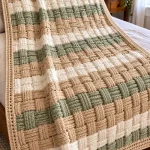
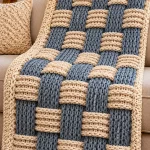
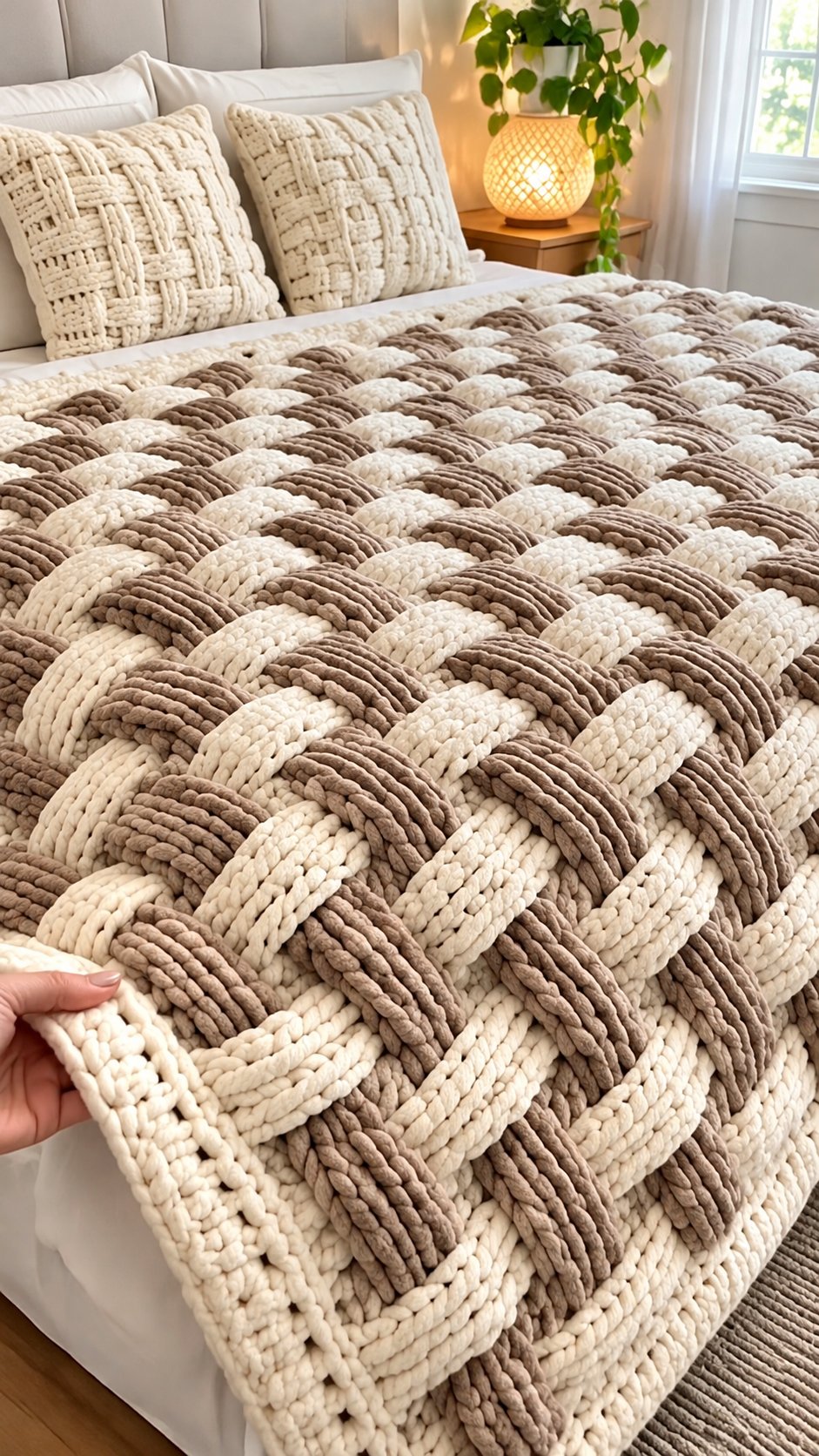
Thick raised crochet bands create the woven appearance of this chunky basket weave crochet blanket, while alternating ivory and taupe sections define its geometric structure. This intermediate-level project uses super bulky yarn, a 9 mm crochet hook and front-post and back-post double crochet stitches. The proposed finished size is approximately 80 × 146 cm. Its dense construction makes it suitable for a sofa throw or an additional decorative layer across a bed. This pattern is an original interpretation of the photographed design and has not been tested on a physical sample — please crochet one motif first and adjust the stitch counts to your yarn and gauge.
The Design: What Makes This Blanket Different
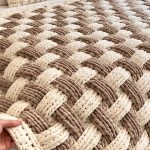
Three construction decisions produce the blanket’s distinctive appearance. First, groups of four front-post and four back-post double crochet stitches create pronounced vertical ribs. Reversing their positions after three rows changes the direction of the raised sections, forming the traditional basketweave texture.
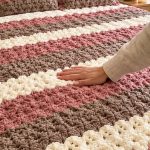
Second, the ivory and taupe yarn sections alternate every three rows. This arrangement separates the textured blocks visually without introducing complicated colorwork or separate crochet panels. The two-color crochet blanket therefore remains a continuous rectangular piece.
Third, the pattern uses a single-crochet border to stabilize the outer edges. Thick yarn can make the sides uneven when post stitches pull against one another. A common mistake is making the post stitches too tightly, which compresses the fabric and causes the finished blanket to narrow.
Project Info at a Glance
| Project Detail | Specification |
|---|---|
| Skill Level | Intermediate |
| Estimated Time | 18–30 hours |
| Finished Size | Approximately 80 × 146 cm |
| Crochet Hook | 9 mm |
| Yarn Weight | Super Bulky #6 |
| Construction | Worked flat in rows |
| Main Stitch | Front-post and back-post double crochet |
| Color Scheme | Ivory and taupe |
| Best For | Sofa throws and decorative bed layers |
The dimensions are calculated from a target gauge of 8 stitches and 5 rows per 10 cm. Actual measurements depend on yarn thickness, hook choice and individual tension.
Materials and Tools
Yarn
Choose two yarns from the same product range. Matching their thickness and elasticity helps maintain consistent stitch dimensions.
- Warm Ivory / Cream — Super Bulky #6 — approximately 900 g. Suggested yarn: Bernat Blanket in an ivory shade or an equivalent plush polyester yarn.
- Taupe / Mocha — Super Bulky #6 — approximately 800 g. Suggested yarn: a matching taupe shade from the same yarn range.
These quantities are provisional purchasing estimates, not verified consumption from a completed sample. The total allowance is approximately 1,700 g. Buy additional yarn if your gauge swatch indicates greater consumption.
A comparable published super-bulky basketweave blanket uses approximately 1,760 yards of yarn, demonstrating how heavily textured blankets can consume material.
Tools
- 9 mm crochet hook for the main fabric.
- 10 mm crochet hook for the foundation chain if your chains are too tight.
- Large-eye tapestry needle for weaving yarn ends.
- Sharp scissors for cutting yarn.
- Locking stitch markers for identifying the first and last stitch.
- Measuring tape for checking dimensions.
- Row counter for tracking the six-row repeat.
- Blocking mats for final shaping, if required.
Abbreviations
The pattern uses US crochet terminology.
| Abbreviation | Meaning |
|---|---|
| ch | Chain |
| st / sts | Stitch / stitches |
| sc | Single crochet |
| dc | Double crochet |
| FPdc | Front-post double crochet |
| BPdc | Back-post double crochet |
| sl st | Slip stitch |
| sk | Skip |
| rep | Repeat |
| RS | Right side |
| WS | Wrong side |
Invisible decrease: Not required for this blanket because the fabric is worked in straight rows without shaping.
Pattern — Step by Step
Pattern Notes
- Work the blanket flat, turning after every row.
- Use US crochet terminology.
- The turning chain of 2 does not count as a stitch.
- Maintain 64 stitches across every row.
- Color A is warm ivory.
- Color B is taupe.
- Each textured color section consists of three rows.
- The basketweave repeat consists of six rows.
- Work the post stitches around the vertical posts of the previous row, not into the stitch tops.
- Use a stitch marker to identify the final stitch of each row.
Gauge
Target gauge:
- 8 stitches = 10 cm.
- 5 rows = 10 cm.
Make a gauge swatch before purchasing the full yarn quantity. If the fabric is too stiff, try a larger hook. If the post stitches leave excessive gaps, test a smaller hook.
Foundation Chain
With Color A, chain 66.
Row 1: Dc in the third chain from the hook and in every remaining chain across. (64 dc)
Turn.
The first row establishes the stitch foundation. Check the stitch count before beginning the textured pattern.
Understanding the Basketweave Stitch
The fabric uses two post-stitch arrangements.
Arrangement A:
- 4 FPdc.
- 4 BPdc.
- Repeat across the row.
Arrangement B:
- 4 BPdc.
- 4 FPdc.
- Repeat across the row.
Each arrangement continues for three rows. Switching between them creates the raised rectangular blocks associated with basketweave crochet.
Basketweave Pattern — Six-Row Repeat
Row 2 — Color A: Ch 2, turn. Work 4 FPdc around the next 4 stitches, then 4 BPdc around the next 4 stitches. Repeat across the row. (64 sts)
Row 3 — Color A: Ch 2, turn. Repeat the Row 2 arrangement, working FPdc around the corresponding raised posts and BPdc around the recessed posts. (64 sts)
Row 4 — Color A: Ch 2, turn. Repeat Row 3. (64 sts)
Row 5 — Color B: Join taupe. Ch 2, turn. Work 4 BPdc around the next 4 stitches, then 4 FPdc around the next 4 stitches. Repeat across. (64 sts)
Row 6 — Color B: Ch 2, turn. Repeat the Row 5 arrangement. (64 sts)
Row 7 — Color B: Ch 2, turn. Repeat Row 6. (64 sts)
Repeat Rows 2–7 twelve times in total, including the first six rows already completed.
This produces 72 textured rows after the foundation row.
The final row count is 73, including the foundation.
Color Change Instructions
The color change happens after each three-row section.
To change from ivory to taupe, complete the final post stitch of Row 4 until two loops remain on the hook. Draw the taupe yarn through those two loops to finish the stitch.
Turn and begin Row 5 with taupe.
Use the same technique when changing back to ivory after Row 7.
Do not carry long unused chenille strands along the blanket edge. Cut the old color, leaving approximately 15–20 cm for weaving.
Keep the color changes at the same edge whenever possible. This makes the side seam cleaner and simplifies finishing.
Row and Color Schedule
| Rows | Color | Stitch Arrangement |
|---|---|---|
| 1 | Ivory | Foundation dc |
| 2–4 | Ivory | Arrangement A |
| 5–7 | Taupe | Arrangement B |
| 8–10 | Ivory | Arrangement A |
| 11–13 | Taupe | Arrangement B |
| 14–16 | Ivory | Arrangement A |
| 17–19 | Taupe | Arrangement B |
| 20–22 | Ivory | Arrangement A |
| 23–25 | Taupe | Arrangement B |
| 26–28 | Ivory | Arrangement A |
| 29–31 | Taupe | Arrangement B |
| 32–34 | Ivory | Arrangement A |
| 35–37 | Taupe | Arrangement B |
| 38–40 | Ivory | Arrangement A |
| 41–43 | Taupe | Arrangement B |
| 44–46 | Ivory | Arrangement A |
| 47–49 | Taupe | Arrangement B |
| 50–52 | Ivory | Arrangement A |
| 53–55 | Taupe | Arrangement B |
| 56–58 | Ivory | Arrangement A |
| 59–61 | Taupe | Arrangement B |
| 62–64 | Ivory | Arrangement A |
| 65–67 | Taupe | Arrangement B |
| 68–70 | Ivory | Arrangement A |
| 71–73 | Taupe | Arrangement B |
Important: The table above lists the foundation as Row 1 and the full 72 textured rows as Rows 2–73. Follow the six-row repeat and twelve-repeat count when working. This gives equal three-row color sections throughout the main fabric.
Finishing Border
The border uses ivory yarn to frame the two-color fabric.
Border Round 1: Attach ivory at any corner. Ch 1 and work sc evenly across the top edge, placing approximately one sc in each stitch.
At each corner, work 3 sc into the same corner space.
Continue down the side, placing approximately one sc around each row end. Work across the foundation edge and up the opposite side.
Join with a sl st.
Border Round 2: Ch 1. Work 1 sc in every stitch around. Place 3 sc in the middle stitch of each corner group.
Join with a sl st and fasten off.
If the border pulls inward, increase the number of side stitches. If it ripples, reduce the number of stitches along the row ends.
Weaving in the Ends
Use a tapestry needle to secure the yarn tails on the wrong side.
Weave each tail through several stitches in one direction, then change direction and pass through another section. Avoid pulling the yarn so tightly that the fabric contracts.
Trim excess yarn after checking that each color change is secure.
Assembly and Finishing
- Check the fabric: Lay the blanket flat and inspect the basketweave sections for missing or incorrectly placed post stitches.
- Measure the width: Compare the top, middle and bottom measurements to identify unwanted narrowing.
- Measure the length: Check the completed rows against the planned 146 cm target.
- Secure color changes: Weave in all ivory and taupe tails on the wrong side.
- Prepare the border: Attach ivory yarn at a corner and work evenly around the perimeter.
- Complete the first round: Add the first single-crochet border round, keeping the corners flat.
- Complete the second round: Repeat the single crochet border to create a thicker frame.
- Inspect the corners: Check that each corner contains the correct increase stitches.
- Shape the blanket: Lay it flat and adjust the edges gently. Follow the yarn manufacturer’s washing and drying instructions.
- Final inspection: Trim remaining ends and check the entire border for gaps or loose stitches.
The finished blanket should have a consistent rectangular shape with raised ivory and taupe basketweave sections and a neat ivory border.
7 Technical Tips for a Better Basketweave Blanket
- Stitch markers: Mark the first and last stitches of every row. Missing one edge stitch can reduce the width by approximately one stitch per affected row.
- Stuffing firmness: Stuffing is not used in this blanket. Instead, check that the fabric is not compressed so firmly by tight post stitches that the finished width falls below the 80 cm target.
- Invisible decreases: Decreases are not part of this design. Avoid accidentally skipping a post stitch, which creates the same visible reduction in row width as an unintended decrease.
- Color-change timing: Change colors after completing Row 4 and Row 7 of each six-row repeat. Changing halfway through a three-row block interrupts the visual structure.
- Chenille tension: Maintain consistent loop height when working the 4-stitch post groups. Excessive tension can pull the side edges inward by several centimeters.
- Border placement: Place approximately one single crochet per row end along the sides. Adjust the spacing if the border waves or draws the blanket inward.
- Tail weaving: Leave 15–20 cm yarn tails at each color transition. Secure them through multiple stitches so that the chenille does not unravel during washing.
Conclusion
This chunky basket weave crochet blanket combines thick post stitches, alternating ivory and taupe sections, and a simple single-crochet border to create a structured rectangular throw. The six-row repeat keeps the texture consistent while allowing the width and length to be adjusted in controlled increments. Before beginning the full project, make a gauge swatch and calculate yarn consumption from its measured weight. This prevents shortages during the final color sections. Share your completed blanket on Pinterest and Instagram using #TwoColorBasketWeaveBlanket. Would you keep the ivory and taupe arrangement, or replace the taupe sections with a darker chocolate brown?