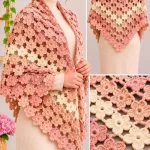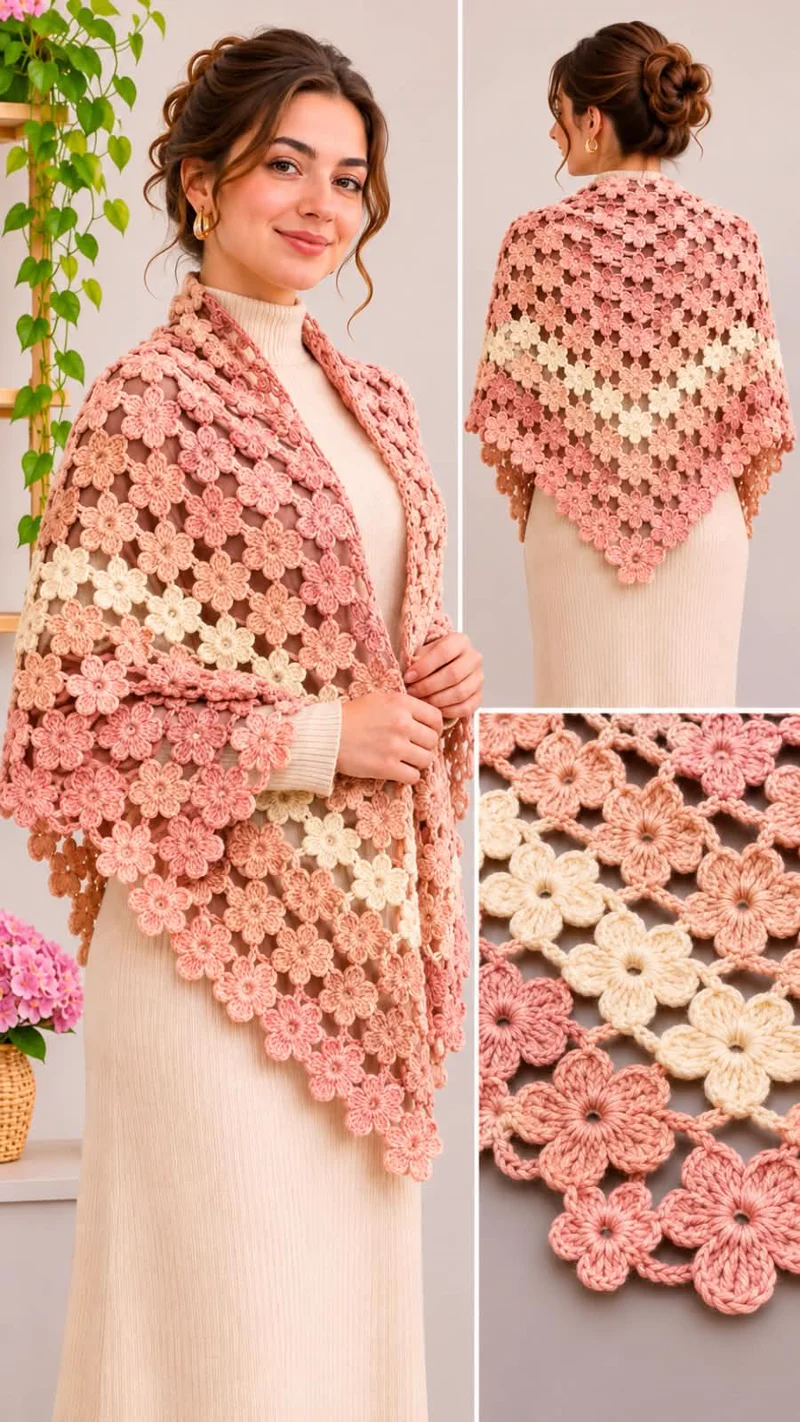
Five-petal flowers form the entire fabric of this triangular shawl, replacing conventional crochet rows with an interconnected floral lattice. This crochet flower shawl pattern combines dusty pink, soft peach, and ivory DK cotton yarn with a 4 mm crochet hook. Designed for intermediate crocheters, the finished wrap targets a wingspan of approximately 160 cm, providing a practical layer for spring and summer clothing.
Pattern Note: This original pattern is inspired by the photographed shawl. Measurements and yarn quantities are estimates that depend on motif gauge and joining tension. Make a sample before beginning the complete project.
The Design: What Makes This Flower Shawl Different?
The individual blossoms create both the decorative surface and the supporting structure of this shawl. Each flower contains five rounded petals worked around a compact circular center. Short crochet bridges connect neighboring motifs while leaving open spaces between them.
Unlike a solid triangular crochet shawl, this floral design distributes its weight through multiple connection points. You can adjust the size by adding complete rows of flowers. The overall shape depends on consistent spacing rather than conventional stitch increases.
A contrasting ivory stripe crosses the pink and peach background, highlighting the triangular construction. The outer flowers remain exposed to produce a naturally scalloped edge without fringe. A common mistake when making a flower motif shawl is shortening the connecting chains excessively, which causes the finished fabric to gather instead of lying flat.
Project Information
| Specification | Details |
|---|---|
| Skill Level | Intermediate |
| Estimated Wingspan | 155–165 cm |
| Estimated Depth | 75–85 cm |
| Hook Size | 4 mm |
| Yarn Weight | DK / Light 3 |
| Construction | Individual joined flower motifs |
| Terminology | US crochet terms |
Materials and Tools
Yarn
Select a smooth DK cotton or cotton-blend yarn with consistent thickness across all four colors. The following quantities provide a provisional purchasing guide for the full-sized shawl.
- Dusty rose pink: 200–250 g.
- Soft peach: 100–150 g.
- Blush pink: 50–75 g.
- Ivory cream: 50–75 g.
- Extra joining yarn: approximately 50 g.
Use any smooth DK-weight yarn of comparable thickness.
Tools
- 4 mm crochet hook.
- 3.5 mm crochet hook for adjusting motif tension if needed.
- Tapestry needle for joining and finishing.
- Scissors.
- Removable stitch markers.
- Measuring tape.
- Blocking mats and rustproof pins.
- Digital kitchen scale for calculating yarn consumption.
Crochet Abbreviations
| Abbreviation | Meaning |
|---|---|
| MR | Magic ring |
| ch | Chain |
| sc | Single crochet |
| hdc | Half double crochet |
| dc | Double crochet |
| tr | Treble crochet |
| sl st | Slip stitch |
| st | Stitch |
| sp | Space |
| rep | Repeat |
| FO | Fasten off |
Gauge and Motif Measurements
Work three complete flowers before starting the shawl. Block them lightly and measure across the widest points. The target diameter is approximately 6–7 cm per flower, with a joined center-to-center spacing of approximately 7 cm.
Join the three sample motifs into a small triangular arrangement. Check that the connecting bridges allow the petals to settle naturally without overlapping or twisting.
A 23-flower upper row requires a horizontal motif spacing of approximately 7 cm to reach the intended wingspan. The vertical row spacing should average approximately 3.5 cm for the proposed shallow triangular shape. Adjust the arrangement and joining points during the sample stage.
Yarn Calculation: Weigh your completed flower. Multiply its weight by 276 and add approximately 10–15% for joining and finishing. This calculation takes priority over the estimated yarn quantities.
Free Crochet Flower Shawl Pattern
All flowers are worked in joined rounds rather than continuous spirals. Complete the center before forming the five petals. Use the same stitch sequence for every color.
Step 1: Crochet the Flower Center
Round 1: Make a magic ring. Ch 1, work 10 sc into the ring, and join with a sl st to the first sc. (10 sc)
Round 2: Ch 1. Repeat [sc in next st, ch 3, skip next st] five times. Join with a sl st to the first sc. (5 sc and 5 ch-3 spaces)
Tighten the magic ring carefully. Leave a small central opening if you prefer the flower centers visible in the reference photograph. Secure the starting tail against the back of the center before continuing.
Step 2: Crochet the Five Rounded Petals
Round 3: Sl st into the first ch-3 space.
Work the following sequence into that same space:
- 1 sc.
- 1 hdc.
- 2 dc.
- 1 tr.
- 2 dc.
- 1 hdc.
- 1 sc.
Sl st into the next sc from Round 2. Repeat the petal sequence in each remaining ch-3 space, working a sl st in the following sc after every petal.
Final count: 5 petals, each containing 9 stitches, plus 5 separating slip stitches.
Fasten off and leave a 15 cm yarn tail.
The central treble crochet forms the highest point of each petal. Double crochet stitches on either side create the rounded shoulders, while the shorter stitches establish the lower edges. Arrange the petals with your fingers before weaving in the yarn ends.
Step 3: Optional Larger Flower Variation
For a slightly fuller blossom, replace the standard petal sequence with the following arrangement. Work every stitch into the same ch-3 space.
Petal: 1 sc, 1 hdc, 2 dc, 3 tr, 2 dc, 1 hdc, 1 sc. (11 stitches per petal)
Repeat five times around the flower, separating the petals with slip stitches. (55 petal stitches)
Use this variation throughout the entire shawl if your standard motifs are too small. Mixing different flower sizes without adjusting the bridge lengths may distort the triangular outline.
Flower Motif Color Arrangement
The dusty rose background is interrupted by a narrow ivory band and softer peach sections. Build the shawl from the bottom point upward, increasing the number of flowers by one in every row.
The standard layout contains 23 rows and 276 individual flowers. Each row contains one more motif than the previous row.
| Rows | Flowers | Color |
|---|---|---|
| 1–6 | 21 | Dusty rose |
| 7–9 | 24 | Peach |
| 10–11 | 21 | Ivory cream |
| 12–14 | 39 | Peach |
| 15–17 | 48 | Blush pink |
| 18–23 | 123 | Dusty rose |
| Total | 276 | 4 colors |
Separate your completed flowers into labeled groups. The ivory rows should remain uninterrupted across the width of the shawl to reproduce the contrasting stripe shown in the photograph.
Triangular Shawl Layout
Row 6:  ✿ ✿ ✿ ✿ ✿ ✿
Row 5:   ✿ ✿ ✿ ✿ ✿
Row 4:    ✿ ✿ ✿ ✿
Row 3:     ✿ ✿ ✿
Row 2:      ✿ ✿
Row 1:       ✿
Continue the same arrangement until Row 23 contains 23 flowers. Center each new row above the previous row so that the outline expands equally on both sides.
Rotate individual flowers as needed to position their petals at suitable joining points. Five-petal motifs do not have the same symmetry as hexagonal motifs, so some petals may support more than one connection.
How to Join the Crochet Flowers
Short crochet bridges connect the flowers without covering their distinctive petal shapes. Assemble the motifs on a flat surface before attaching them permanently.
Step 4: Join Two Neighboring Flowers
- Place two completed flowers side by side with their right sides facing upward.
- Identify two facing petal tips.
- Attach matching yarn with a slip stitch through the central treble crochet of the first petal.
- Ch 4.
- Sl st into the corresponding petal tip on the neighboring flower.
- Fasten off and secure both yarn tails.
Repeat this connection at the neighboring petal shoulders where additional support is required. Use a ch-3 bridge if the shoulder points are closer together than the tips.
Keep the flowers flat while joining. A bridge that is too short pulls the petals inward, whereas an excessively long chain creates an unstable opening between the motifs.
Step 5: Connect the Flower Rows
Begin with the single flower at the bottom point. Position two flowers above it, leaving the lower blossom centered between them.
Connect both upper flowers to the lower flower using separate chain bridges. Add a horizontal connection between the two upper motifs.
For Row 3, position three flowers above Row 2. Connect neighboring flowers horizontally, then attach each new flower to the nearest flower or flowers in the previous row.
Repeat this arrangement for all remaining rows. Interior flowers should be connected both horizontally and diagonally wherever necessary to form a stable fabric.
Construction Tip: Test the fabric after every three rows. Lift the connected section gently and check whether the flowers rotate excessively or the chain bridges pull against the petals. Add a second connection wherever extra stability is required.
Finishing the Shawl Edges
Step 6: Strengthen the Upper Edge
The upper edge supports most of the weight when the shawl is worn across the shoulders. A discreet connecting round can provide additional stability without introducing a heavy border.
Attach dusty rose yarn to an outward-facing petal on the first flower of Row 23.
- Work 1 sc into the selected petal tip.
- Ch 3 or the number of chains required to reach the next outward-facing petal without pulling.
- Work 1 sc into that petal.
- Repeat across the entire upper edge.
- Fasten off and weave in the ends.
Keep the remaining petals exposed. The lower diagonal edges do not require a solid border, allowing the natural floral scallops to remain visible.
Step 7: Secure the Outer Flowers
Inspect every flower along the diagonal sides of the triangle. Outer motifs have fewer neighboring flowers, making their remaining connections especially important.
Add a discreet joining bridge at any unsecured shoulder where the motif folds away from the fabric. Avoid connecting the exposed outer petal tips, because these establish the decorative edge.
Assembly and Finishing Instructions
- Complete three sample flowers and confirm the motif measurements.
- Calculate the yarn needed for the selected shawl size.
- Crochet the flowers according to the color arrangement table.
- Sort the finished motifs into their designated rows.
- Connect the bottom point and the following five rows.
- Add the peach and ivory sections while maintaining equal spacing.
- Complete the remaining blush pink and dusty rose rows.
- Strengthen the upper neckline and inspect the outer connections.
- Weave every yarn tail through several stitches on the reverse side.
- Wet-block the shawl according to the yarn manufacturer’s care instructions.
The completed shawl consists of interconnected five-petal flowers arranged in a symmetrical triangular shape.
How to Block Your Crochet Shawl
Blocking adjusts the flower spacing and helps the rounded petals settle into their final positions. For washable cotton yarn, soak the shawl in lukewarm water for approximately 10–15 minutes.
Remove excess water by pressing the fabric gently between clean towels. Do not twist the chain bridges or wring the flowers.
Arrange the shawl on blocking mats with the widest row positioned horizontally. Pin the upper corners first, followed by the bottom point.
Adjust the diagonal sides, checking that both edges have comparable lengths. Position additional pins between the flowers rather than stretching individual petals beyond their natural shape.
Leave the shawl flat until completely dry before removing the pins.
How to Adjust the Shawl Size
This crochet flower shawl pattern can be resized by changing the number of completed rows. The total motif count follows a triangular number sequence.
| Size | Rows | Total Flowers |
|---|---|---|
| Small | 17 | 153 |
| Medium | 20 | 210 |
| Large | 23 | 276 |
| Extra Large | 26 | 351 |
Calculate the number of flowers using the formula n × (n + 1) ÷ 2, where n represents the total number of rows. Multiply the result by the weight of one completed motif to estimate yarn requirements.
When adjusting the shawl size, reposition the ivory stripe so that it remains approximately halfway between the bottom point and the shoulders.
7 Technical Tips for Better Results
- Maintain consistent motif diameter: A difference of more than 5 mm between neighboring flowers can create uneven rows. Measure every tenth motif before adding it to the completed group.
- Secure the magic ring: Loose center tails may allow the flower opening to expand during washing. Weave each starting tail through the center stitches in at least two directions.
- Control petal height: Incorrect treble crochet tension produces pointed or distorted blossoms. Keep the five central petal stitches at consistent heights.
- Check joining tension: Bridges that are too short cause puckering between the flowers. Begin with four chains and adjust the length against your blocked sample.
- Mark the center line: An off-center lower point develops when successive rows shift to one side. Place a removable marker along the central axis after every three rows.
- Prevent color bleeding: Dark rose yarn may transfer dye onto the ivory flowers during blocking. Wash a small sample of each color together before assembling the shawl.
- Secure finishing tails: Exposed ends can loosen when the openwork fabric stretches. Leave approximately 15 cm for weaving and change direction at least twice inside dense stitches.
Frequently Asked Questions
Can I use acrylic yarn instead of cotton?
Yes. DK acrylic yarn generally produces a lighter, warmer wrap. Make a new gauge sample because acrylic and cotton respond differently to blocking and may produce different flower dimensions.
Can I make the shawl with fewer flowers?
Yes. Stop after any complete row to create a smaller triangular wrap. Maintain the same horizontal and diagonal joining arrangement throughout the project.
Why are my crochet flowers curling?
Curled petals may result from tight center spaces, excessive petal stitches, or uneven tension. Try a larger hook or increase the center chain spaces from three to four chains before repeating the sample motif.
Do I need to add fringe?
No. The exposed outer petals create a decorative scalloped edge. Fringe would change the appearance of the photographed design and increase the total yarn requirement.
How should I store the finished shawl?
Fold the shawl loosely and store it flat. Hanging a heavy cotton wrap for extended periods may stretch the open chain connections and alter its triangular shape.
Final Thoughts
The Rose Garden crochet flower shawl pattern uses repeated five-petal motifs to create an adjustable triangular wrap with a naturally decorative edge. Its dusty rose background, peach accents, and ivory stripe establish a clear color arrangement without requiring complicated color changes within individual flowers.
Begin by completing and weighing three sample motifs before purchasing the remaining yarn. Confirm the joining tension and row spacing against your desired finished measurements. Save this pattern to your Pinterest crochet board and share your completed floral shawl on Instagram using #RoseGardenShawl.
Save This Free Crochet Pattern
Pin the Rose Garden Flower Shawl to your favorite crochet board for your next handmade project.