Introduction
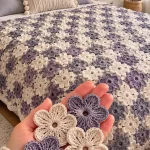
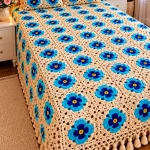
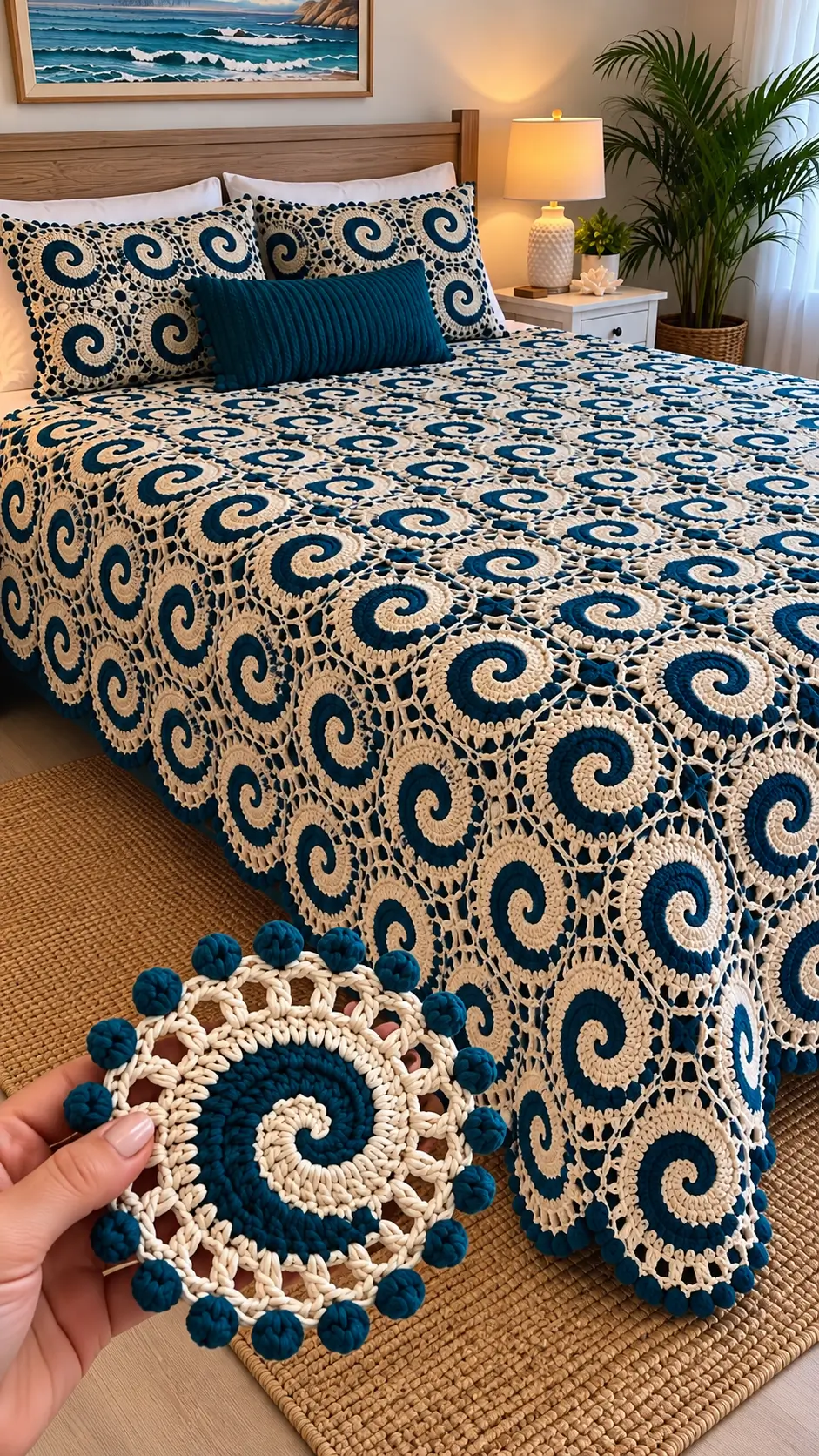
Ocean waves curl into spirals, but a crocheted wave must hold its shape without twisting the surrounding lace. This crochet spiral bedspread pattern guide examines the construction of blue and ivory circular motifs, openwork joins, and decorative bobble edging. Using cotton or acrylic yarn, suitable hooks, and standard crochet tools, an intermediate maker can plan a bed-sized coverlet with matching pillow panels. A measured sample motif determines the final dimensions before full assembly.
The Design: What Makes the Ocean Wave Bedspread Different
Three construction features distinguish this ocean wave crochet blanket from a conventional granny-square coverlet.
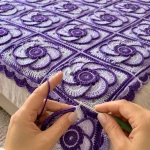
First, the circular motifs contain contrasting spiral arms rather than concentric color rings. This creates directional movement across the fabric. Both colors must expand at compatible rates, or the motif will cup.
Second, the ivory lace joins introduce negative space between the circular medallions. This makes the blue and white crochet blanket visually lighter while allowing the motif edges to remain distinct.
Third, raised teal bobbles mark the perimeter. These provide a dimensional border that contrasts with the flat lace connectors.
A frequent mistake is joining unblocked motifs with inconsistent diameters. Even a difference of 5 mm can accumulate across a wide bedspread, causing uneven edges and distorted joining spaces. The maker should measure and block sample motifs before deciding how many are required.
Project Info at a Glance
| Feature | Details |
|---|---|
| Skill Level | Intermediate to Advanced |
| Estimated Time | Depends on motif count and joining method |
| Reference Finished Size | 158 × 173 cm |
| Reference Hooks | 6 mm and 6.5 mm |
| Construction | Two-color motifs joined into panels |
| Best For | Decorative bedspreads and throws |
The measurements above come from a published spiral throw design. They are reference dimensions, not exact measurements of the pictured bedspread.
Materials and Tools
Yarn
The following yarn quantities come from a published two-color throw and provide a starting point for planning a separate bedspread design.
- Ivory or White Yarn: Caron One Pound, approximately 908 g.
- Ocean Blue Yarn: Caron One Pound, approximately 908 g.
The photographed lace appears finer than the reference throw. DK cotton or cotton-blend yarn may produce a more delicate appearance, but changing the yarn weight affects the finished motif dimensions and total yarn consumption.
For a full-size bedspread with generous side drops, additional yarn may be required. Calculate the total amount after completing and weighing a sample panel.
Tools
- 6 mm Crochet Hook: Reference pattern hook.
- 6.5 mm Crochet Hook: Reference spiral motif hook.
- Locking Stitch Markers: At least four.
- Tapestry Needle: For sewing and finishing.
- Scissors: For cutting yarn tails.
- Measuring Tape: For checking motif dimensions.
- Blocking Mats and Rustproof Pins: For shaping finished motifs.
Crochet Abbreviations
| Abbreviation | Meaning |
|---|---|
| MR | Magic Ring |
| sc | Single Crochet |
| hdc | Half Double Crochet |
| dc | Double Crochet |
| inc | Increase |
| dec | Decrease |
| sl st | Slip Stitch |
| ch | Chain |
| BLO | Back Loop Only |
| st | Stitch |
| sp | Space |
| RS | Right Side |
| WS | Wrong Side |
An invisible decrease works through the front loops of two adjacent stitches to reduce visible bulk.
How to Crochet the Spiral Bedspread: Step by Step
Pattern note: The following instructions explain the construction method and include a practice swatch. They are not a fully tested reproduction of the photographed bedspread. The exact spiral, lace join, and border require separate pattern testing.
Part 1: Two-Color Spiral Center
Yarn: Ocean blue and ivory.
The spiral center is the main decorative feature of this bedspread. Unlike a traditional circular crochet motif, a two-color spiral uses two active yarn sections that develop around one another.
The published Spirals Throw uses two active yarn loops. Each color works across stitches from the opposite section, producing an interlocking spiral rather than closed concentric rounds.
Before attempting the interlocking design, crochet the following single-color expansion swatch to practice flat circular shaping.
- R1: 6 sc in MR (6)
- R2: inc × 6 (12)
- R3: (1 sc, inc) × 6 (18)
- R4: (2 sc, inc) × 6 (24)
- R5: (3 sc, inc) × 6 (30)
- R6: (4 sc, inc) × 6 (36)
- R7: (5 sc, inc) × 6 (42)
Fasten off and measure the sample circle. Check that the stitches lie flat without ruffling or forming a bowl shape.
This swatch demonstrates circular increases only. It does not create the pictured two-color spiral.
For a complete interlocking spiral motif, follow the documented Spirals Throw crochet pattern. Its construction combines single crochet, half double crochet, and double crochet while alternating between two active colors.
Part 2: Ivory Outer Lace Ring
Yarn: Ivory.
The photographed motifs contain an open lace ring surrounding each spiral. This creates the contrast between the dense central medallion and the airy connecting sections.
Measure the finished spiral diameter before designing the lace ring. The correct chain lengths depend on yarn thickness, stitch tension, and the distance between attachment points.
A practical development method is to mark 12 equally spaced positions around the blocked spiral. Test chain arches between these positions, then add a stabilizing round.
For example, a five-chain arch can be tested between adjacent attachment points. This is a sample measurement rather than a verified round from the photograph.
The outer ring should remain flat and circular. If the lace pulls inward, increase the chain length or adjust the attachment spacing. If it ripples, reduce the excess length.
Part 3: Connecting the Spiral Motifs
Yarn: Ivory.
Arrange the completed motifs on a flat surface before joining them. Keep the spiral direction consistent throughout the layout.
The photographed bedspread uses openwork connections that form decorative spaces between neighboring circular motifs.
To develop a similar layout, create four identical blocked motifs and arrange them into a square. Measure the gaps between their edges and test lace connections at evenly distributed points.
The joining structure should support the circular medallions without stretching them into squares.
Work a four-motif test panel before committing to the complete bedspread. Measure the distance between neighboring motif centers to calculate the required number of units.
Planning formula: Number of motifs across = target bedspread width divided by joined motif pitch.
The joined motif pitch is the distance from the center of one motif to the center of the next after assembly.
Part 4: Decorative Blue Bobble Border
Yarn: Ocean blue and ivory.
The blue bobble border is a distinctive finishing element. Raised clusters add dimension along the edge and visually repeat the dark spiral centers.
A five-double-crochet bobble can be made as follows:
- Yarn over and insert the hook into the designated stitch.
- Draw up a loop, yarn over, and pull through two loops.
- Repeat the unfinished double crochet four additional times in the same stitch.
- Yarn over and pull through all remaining loops.
- Work a securing chain if required by the chosen edging design.
This creates a raised crochet cluster. It is a suggested technique, not an exact reconstruction of the photographed bobble.
Measure the full perimeter before distributing the bobbles. Equal spacing helps prevent crowded corners and irregular border sections.
Part 5: Matching Spiral Pillow Covers
Yarn: Ocean blue and ivory.
The matching pillow covers repeat the same circular spiral design used throughout the bedspread.
Begin by measuring the intended cushion insert. Arrange the finished motifs into a panel that matches those dimensions after blocking.
For the backing, use either a plain crochet fabric or a second panel of matching motifs.
Join the front and back panels along three sides, leaving an opening for the cushion insert. A removable closure can be added if desired.
Keep the motif direction consistent between both pillow covers for a coordinated appearance.
How to Assemble the Crochet Bedspread
- Complete one spiral motif and block it to establish the finished diameter.
- Make three additional motifs with the same yarn and hook.
- Add the ivory lace ring to each sample motif.
- Arrange the four motifs into a square test panel.
- Pin the motifs at equal distances with their spiral directions aligned.
- Test the lace connections and measure the assembled panel.
- Calculate the total number of panels required for the planned bedspread dimensions.
- Complete the remaining motifs and join them in consistent rows.
- Work the perimeter edging and distribute the blue bobbles evenly.
- Weave in the yarn tails, block the finished coverlet, and measure its final dimensions.
The bedspread is complete when the joined fabric lies flat and its measurements match the planned bed coverage.
7 Technical Tips for Better Spiral Crochet
- Stitch Marker Placement: Losing the beginning of a color section can shift the spiral alignment. Mark both active yarn loops with different-colored locking markers.
- Flat Motif Control: Too many increases cause ruffling, while too few cause cupping. Measure the sample after each expansion stage and correct the increase distribution before proceeding.
- Invisible Decreases: Visible decreases can leave raised ridges when shaping decorative elements. Use front-loop invisible decreases where the design requires a reduction without a prominent seam.
- Color Transition Timing: Fastening off a spiral arm too early creates an abrupt termination. Compare the lengths of both color sections before securing either yarn tail.
- Yarn Tension: Loose stitches produce oversized openings in the spiral center. Maintain consistent loop height and compare motif diameters within approximately 5 mm.
- Pinning and Blocking: Joining unblocked motifs can create a rippled bedspread edge. Pin each sample to its planned diameter and allow it to dry completely before assembly.
- Tail Weaving: Short yarn tails can loosen under the weight of a large coverlet. Leave approximately 15 cm for weaving and secure each tail through multiple stitch directions.
How to Calculate Your Crochet Bedspread Size
Measure the mattress width, length, and desired drop before calculating the number of crochet motifs.
For example, a mattress measuring 150 × 200 cm with a 30 cm drop on each side requires the following approximate bedspread dimensions:
- Width: 150 + 30 + 30 = 210 cm.
- Length: 200 + 30 = 230 cm, allowing a drop at the foot only.
The planned coverlet would therefore measure approximately 210 × 230 cm.
If each joined motif occupies 15 cm of width and height, divide the desired dimensions by the joined motif pitch.
- Motifs across: 210 ÷ 15 = 14.
- Motifs down: 230 ÷ 15 = approximately 15.3.
Rounding up to 16 rows gives a starting layout of 14 × 16, or 224 motifs.
These figures are illustrative. Actual motif counts depend on the blocked dimensions, connecting lace, and final border width.
Choosing the Right Yarn for a Crochet Spiral Bedspread
Yarn selection affects stitch definition, fabric weight, durability, and the overall appearance of the finished bedspread.
Cotton Yarn
Cotton provides clear stitch definition and works well for decorative openwork. It is particularly useful when the design contains detailed lace arches and raised spiral sections.
However, a large cotton bedspread can become heavy. Calculate the estimated weight before beginning the full project.
Acrylic Yarn
Acrylic is available in many colors and can provide a lighter alternative, depending on the selected yarn. It may also be easier to maintain according to the manufacturer’s care instructions.
For the photographed ocean-inspired design, choose a deep teal blue and warm ivory with similar yarn thicknesses.
Cotton-Acrylic Blends
A cotton-acrylic blend can provide a balance between stitch definition and manageable fabric weight.
Before purchasing the full quantity, make a sample containing one spiral and its surrounding lace. Check the appearance after blocking and compare the resulting dimensions with the planned layout.
How to Keep Spiral Crochet Motifs Flat
Flat motifs are essential for a bedspread assembled from repeated circular units.
When a spiral begins to curl upward, the increase distribution may be insufficient for the stitch height or yarn tension. If the edge becomes wavy, the motif may contain too much fabric around its circumference.
Correct these problems at the sample stage rather than trying to flatten a distorted motif during final assembly.
Blocking helps standardize the dimensions of correctly constructed motifs, but it cannot reliably compensate for major stitch-count errors.
For a large project, record the diameter of the first ten motifs. If their measurements vary significantly, review the tension before producing the remaining units.
Care and Maintenance
A crochet bedspread with open lace connections requires careful handling during washing and drying.
Follow the care instructions on the yarn label. If machine washing is permitted, use an appropriate gentle cycle and avoid overloading the washing machine.
Support the weight of the wet fabric when removing it from the water. Pulling a heavy, saturated bedspread from one edge may stretch the openwork joins.
Dry the coverlet according to the yarn manufacturer’s instructions, reshaping the lace sections while the fabric is damp if necessary.
Store the finished bedspread folded rather than suspended from a narrow hanger, which can cause stretching over time.
Conclusion
A crochet spiral bedspread pattern requires careful planning because every motif affects the alignment of the surrounding lace. Begin with a four-motif sample, record the blocked dimensions, and calculate the full layout before purchasing the remaining yarn. The blue-and-ivory arrangement provides a clear reference for testing contrast, while the bobble edging requires separate spacing calculations.
Save your finished sample to Pinterest or share the completed project on Instagram using #OceanWaveSpiralBedspread. Include the yarn weight, hook size, and finished motif diameter so other makers can compare their results.
Would you keep the open ivory lace between every blue spiral, or choose a denser joining method for your bedspread?