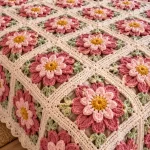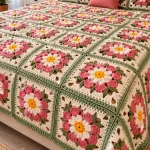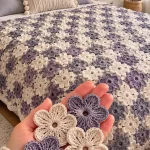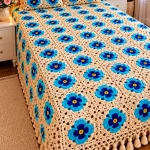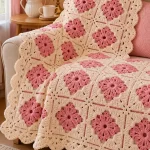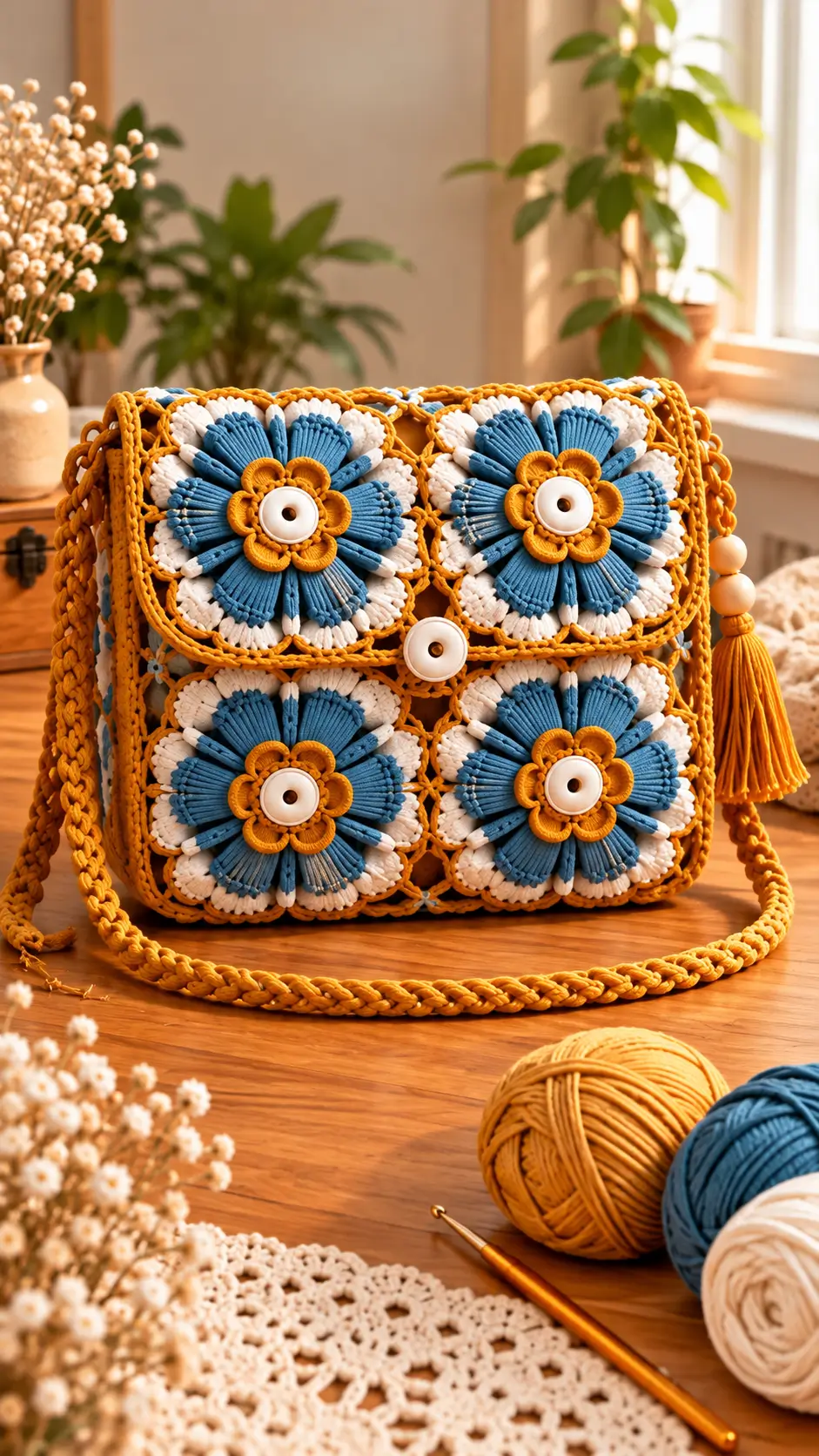
Four blue flowers, each framed by mustard-yellow crochet, form the front of this structured shoulder bag. This crochet flower granny square bag pattern combines raised petals, ivory accents, a rectangular body, a buttoned flap, and a long strap. Use worsted-weight cotton yarn, a 4 mm hook, and basic joining techniques to create an approximately 28 cm-wide bag. The intermediate-level construction allows individual motifs to be replaced without rebuilding the entire accessory.
The Design: What Makes This Floral Granny Square Bag Different
This floral granny square purse uses raised blue petals instead of a flat, single-round flower. The extra height creates definition between the ivory outer petals and the mustard border. A firm cotton yarn keeps those details visible while reducing unwanted stretching.
The second structural decision concerns the bag body. Four large motifs form the front, while a continuous gusset connects the front and back panels. This arrangement produces a more rectangular profile than the rounded base used in many granny square totes.
The third feature is the overlapping flap. Its button closure and reinforced upper edge help keep the opening aligned when the crochet shoulder bag is carried.
A common construction error is joining squares with different finished measurements. Even a 5 mm difference between adjacent motifs can pull the seams diagonally, causing the finished handbag to twist.
Project Info at a Glance
| Specification | Details |
|---|---|
| Skill Level | Intermediate |
| Estimated Time | 10–14 hours |
| Target Finished Size | 28 cm wide × 26 cm tall |
| Approximate Depth | 7 cm |
| Crochet Hook | 4.0 mm |
| Yarn Weight | Worsted-weight cotton |
| Motif Size | 14 × 14 cm after blocking |
| Best For | Everyday shoulder bag or crossbody accessory |
These are target specifications for an original image-inspired design. Final dimensions and gauge require physical sample testing.
Materials and Tools
Yarn
Use smooth, firm cotton for the main bag. Cotton provides stitch definition and is generally less elastic than many acrylic yarns, making it useful for shoulder straps and bag panels.
- Mustard yellow: Worsted-weight cotton, approximately 180–220 g. Suggested yarn: Lion Brand 24/7 Cotton or equivalent.
- Dusty denim blue: Worsted-weight cotton, approximately 70–90 g.
- Ivory white: Worsted-weight cotton, approximately 40–50 g.
Allow additional yarn for gauge differences, strap length, and decorative elements. The total proposed purchase quantity is approximately 300–350 g.
Tools
- 4.0 mm crochet hook
- Tapestry needle for sewing and weaving ends
- Stitch markers for locating corners and panel joins
- Scissors and measuring tape
- Four white decorative buttons, approximately 18–22 mm
- One white closure button, approximately 22–25 mm
- Two wooden beads for the tassel
- Blocking mat and rustproof pins
- Optional cotton fabric lining, matching thread, and sewing needle
Safety note: Buttons and beads must be firmly attached. Avoid detachable decorative hardware on bags intended for young children.
Crochet Abbreviations
All instructions use US crochet terminology.
| Abbreviation | Meaning |
|---|---|
| MR | Magic ring |
| ch | Chain |
| sc | Single crochet |
| hdc | Half double crochet |
| dc | Double crochet |
| tr | Treble crochet |
| inc | Two single crochet in one stitch |
| dec | Single crochet decrease |
| sl st | Slip stitch |
| BLO | Back loop only |
| st / sts | Stitch / stitches |
| sp | Space |
| rep | Repeat |
| FO | Fasten off |
An invisible decrease is made by drawing up the front loops of two adjacent stitches before completing one single crochet; it reduces gaps compared with a conventional decrease.
Pattern – Step by Step
Construction note: Unlike stuffed amigurumi, granny squares are worked in joined rounds. The flower motif uses joined rounds, while the gusset and strap use turned rows. Stitch counts refer to the working stitches stated for each section.
1. Raised Flower Granny Square (Make 8)
Yarn: Mustard yellow, denim blue, and ivory white.
The first six rounds form the central flower. The remaining rounds turn the circular flower into a square.
Flower Center – Mustard Yellow
R1: Work 6 sc in MR. Join with sl st. (6)
R2: Inc ×6. Join. (12)
R3: (1 sc, inc) ×6. Join. (18)
R4: (2 sc, inc) ×6. Join. (24)
R5: (3 sc, inc) ×6. Join. (30)
R6: (4 sc, inc) ×6. Join. (36)
Fasten off the mustard yarn, leaving a 10 cm tail.
Blue Raised Petals
Attach denim blue yarn to any stitch of R6.
R7: Repeat [sl st in next st, ch 3, 3 tr in next st, ch 3, sl st in next st] 12 times. This creates 12 raised petal groups across the 36 foundation stitches.
Count: 12 petal groups. Chains and treble stitches form the petals rather than a continuous circular stitch count.
Fasten off the blue yarn.
Ivory Outer Petals
R8: Attach ivory yarn to the back of one petal base. Work [sc around petal base, ch 5] 12 times. Join to the first sc. (12 sc, 12 ch-5 spaces)
R9: Work [sc, 5 dc, sc] into each ch-5 space. Join. (84 stitches)
Arrange the ivory petal shells behind the blue raised petals.
Mustard Square Foundation
R10: Attach mustard yarn at the back of the ivory petal round. Work four groups of [3 dc, ch 2, 3 dc] as corners, placing them at equal quarter intervals. Between corners, work three 3-dc groups into available spaces, with ch 1 between groups.
R11: Work 3 dc into each side space. In each corner ch-2 space, work [3 dc, ch 2, 3 dc]. Join with sl st.
R12: Repeat the side clusters and corner increases, placing one additional 3-dc group along each side where needed.
R13: Work one sc into each dc and each side chain space. In each corner ch-2 space, work [2 sc, ch 2, 2 sc]. Join.
Pattern testing note: The square-border shaping requires a sample-tested stitch placement chart before it can be considered an exact-count pattern.
Fasten off, leaving a 20 cm tail for joining.
Block each square to a target measurement of 14 × 14 cm. Make all eight motifs the same size.
2. Front Panel (Make 1)
Yarn: Mustard yellow.
Arrange four flower squares in a 2 × 2 grid, with the blue flowers facing outward.
Use a flat slip-stitch seam through the corresponding edge stitches of adjacent squares.
Join the top-left square to the top-right square, then repeat for the bottom pair. Connect the upper and lower rows along their horizontal seam.
Check that the four corners lie flat before weaving in the joining yarn.
3. Back Panel (Make 1)
Yarn: Mustard yellow, denim blue, and ivory white.
Join the remaining four flower squares in the same 2 × 2 arrangement.
For a less textured back, substitute plain mustard granny squares of the same finished dimensions. A plain back reduces bulk against clothing while keeping the floral front unchanged.
Match the height and width of the back panel to the front panel before adding the gusset.
4. Side and Bottom Gusset (Make 1)
Yarn: Mustard yellow.
The gusset creates the bag’s depth. Work in rows using a foundation of 15 chains.
R1: Ch 15. Sc in second ch from hook and across. Ch 1, turn. (14)
R2: Sc in each stitch across. Ch 1, turn. (14)
R3–R130: Repeat R2. (14 stitches per row)
The required number of rows depends on row gauge. Continue until the strip measures approximately 80 cm, corresponding to two 26 cm sides plus a 28 cm base.
Do not rely on the row count alone. Measure the completed strip against the joined panels.
Fasten off, leaving a 35 cm tail.
Pin the gusset around the left side, bottom, and right side of the front panel. Join using a mattress stitch or single crochet seam.
Repeat the process with the back panel.
5. Decorative Flap (Make 1)
Yarn: Mustard yellow.
The flap overlaps the upper portion of the front panel and carries the central closure button.
Foundation: Ch 51.
R1: Sc in second chain from hook and across. Ch 1, turn. (50)
R2–R12: Sc across. Ch 1, turn. (50)
R13: Sc across. Ch 1, turn. (50)
R14: Sc in first 23 sts, ch 4, skip 4 sts, sc in final 23 sts. Ch 1, turn. (46 sc, 4 ch)
R15: Sc in each sc and work 4 sc into the ch-4 space. (50)
Fasten off, leaving a 30 cm sewing tail.
The flap width must be checked against the bag opening. Add or remove foundation chains in pairs if the sample gauge differs.
Sew the upper edge of the flap to the inside of the back opening, allowing the buttonhole section to fold over the front.
6. Shoulder Strap (Make 1)
Yarn: Mustard yellow.
A tightly worked strap is important because cotton bags become heavier after items are placed inside.
Foundation: Ch 8.
R1: Sc in second chain from hook and across. Ch 1, turn. (7)
R2: Sc in BLO across. Ch 1, turn. (7)
R3–R180: Repeat R2. (7)
Continue until the strap reaches the desired length, approximately 105–115 cm for the pictured shoulder-bag proportions.
Fasten off, leaving a 35 cm sewing tail.
For a more braided appearance, make three narrow crochet cords and braid them together. Test the finished strap length after braiding, as the process shortens the cords.
Sew each strap end to the upper side gusset, attaching through at least 3 cm of fabric.
7. Mustard Tassel (Make 1)
Yarn: Mustard yellow.
Cut approximately 30 yarn strands, each 20 cm long.
Fold the strands at the center. Tie a separate 25 cm strand around the folded midpoint to form the hanging loop.
Wrap another yarn strand around the tassel approximately 2 cm below the fold.
Secure the wrapping strand with several knots and hide the ends inside the tassel.
Trim the lower edge to approximately 9–10 cm.
Thread the hanging cord through the wooden beads and attach it to the side of the bag near the flap.
8. Decorative Flower Centers (Make 4 or 8)
Materials: White buttons and mustard yarn.
The reference design shows white circular decorations at the centers of the four visible flowers.
Sew one white button onto each front flower, passing the thread or yarn through the buttonholes and underlying crochet stitches.
If the back panel also uses flower motifs, additional buttons can be attached to the back flowers.
Do not sew the buttons through only the raised petals. The attachment should pass into the firm mustard center beneath them.
9. Closure Button (Make 1)
Materials: White button and sewing thread.
Position the flap over the front of the bag and mark where the buttonhole meets the body.
Sew the closure button to the front panel with several passes of strong thread.
Test the flap by fastening and unfastening it repeatedly.
If the opening is too loose, reduce the buttonhole chain length or use a slightly larger button.
10. Optional Fabric Lining (Make 1)
A lining is recommended for a bag intended to carry keys, pens, or other small objects that could pass through granny square openings.
Cut two fabric rectangles using the finished front-panel dimensions plus a 1 cm seam allowance.
Cut a matching gusset strip, then sew the fabric pieces together with the wrong sides facing outward.
Turn the lining right side out, insert it into the crochet bag, and fold its upper edge inward.
Hand-sew the lining below the crocheted opening without pulling the fabric tight. Leave enough ease for the bag to expand slightly during use.
Assembly – 10 Steps
- Block the flower squares. Check that every motif measures approximately 14 × 14 cm and that the corners form right angles.
- Join the front panel. Arrange four motifs in two rows and connect them using matching edge stitches.
- Construct the back panel. Join the remaining four motifs, matching the dimensions of the front.
- Attach the gusset. Sew the continuous mustard strip around three edges of the front and back panels.
- Prepare the flap. Position the flap at the upper back edge and check its overlap against the front panel.
- Finish the flower centers. Attach the decorative white buttons through the firm center stitches.
- Secure the shoulder strap. Sew both ends to the upper gusset, reinforcing each attachment area.
- Add the tassel. Thread the wooden beads onto its hanging cord and fasten it near the side opening.
- Install the closure. Attach the front button and check that the flap lies flat when fastened.
- Finish the interior. Weave in yarn tails, attach the optional lining, and inspect all seams and hardware.
The completed bag has a four-flower front panel, structured sides, a buttoned flap, a crocheted strap, and a decorative tassel.
7 Technical Tips for Better Results
- Prevent uneven squares. Measure each blocked motif across both diagonals; a difference greater than 5 mm can distort the joining seams. Reblock or remake any square that does not match the others.
- Control flower bulk. Raised petals can fold inward if the center stitches are too loose. Keep the 36-stitch foundation circle firm and distribute the 12 petal groups evenly.
- Avoid visible decreases. If adapting a rounded corner or tapered flap, use invisible decreases to limit gaps. Insert the hook through the front loops of both stitches before completing the decrease.
- Position buttons accurately. Attach each flower-center button only after blocking. Mark the exact center first so the white discs do not pull the blue petals off-axis.
- Control yarn tension. Smooth cotton should produce a firm fabric with limited openings between stitches. If a 4 mm hook produces loose gaps, test a 3.5 mm hook before making all eight squares.
- Pin the gusset before sewing. Place markers at the two lower corners and upper side edges. A misplaced corner can shift the entire front panel by several centimeters.
- Secure yarn tails and strap ends. Weave each yarn tail through at least 5 cm of neighboring stitches, reversing direction once. Reinforce strap attachments through several rows to reduce the risk of the strap tearing away under load.
Common Problems and Corrections
Why Are the Granny Squares Curling?
Curling usually indicates that the outer rounds are too tight relative to the flower center, or that the number of corner stitches is insufficient.
Check the corner placement and the number of side groups. Block a sample before modifying the entire pattern.
Why Is the Shoulder Strap Stretching?
Cotton crochet straps can lengthen when the bag carries weight, particularly if worked loosely.
Use a smaller hook for the strap, shorten the starting length slightly, or sew a nonstretch fabric reinforcement inside the strap.
Why Does the Flap Pull Sideways?
An off-center buttonhole, uneven panel dimensions, or a misaligned flap seam can cause diagonal tension.
Mark the center of the bag opening and flap before sewing. Attach the closure button only after the flap is positioned correctly.
Can Acrylic Yarn Replace Cotton?
Yes, but the bag may behave differently under load. Acrylic often has more stretch and less structural firmness than tightly worked cotton.
Consider adding a lining and reinforcing the strap if using acrylic.
Conclusion
This crochet flower granny square bag pattern combines eight floral motifs with a separate gusset, buttoned flap, shoulder strap, and tassel. Its mustard, blue, and ivory color arrangement depends on consistent motif dimensions and firm joining stitches. Before making the full bag, crochet one sample square, block it to 14 cm, and check the fabric density. Then calculate the gusset and strap measurements from the actual gauge. For WordPress publication, add photographs of the flower rounds, panel layout, and finished closure. Share your completed bag on Pinterest and Instagram with #FlowerGrannySquareBag. Would you keep the white circular flower centers shown in the reference, or replace them with crocheted mustard centers?