A floral lace coaster needs two things to hold its shape: a balanced circular center and evenly spaced scallops. This free crochet lace doily coaster pattern combines both features in a decorative cotton design inspired by traditional crochet doilies. The project uses fine cotton yarn, a 2.5 mm crochet hook, and joined rounds. It is suitable for intermediate crocheters who want to make reusable coasters for cups, mugs, and table settings.
The Design: What Makes These Floral Coasters Different?
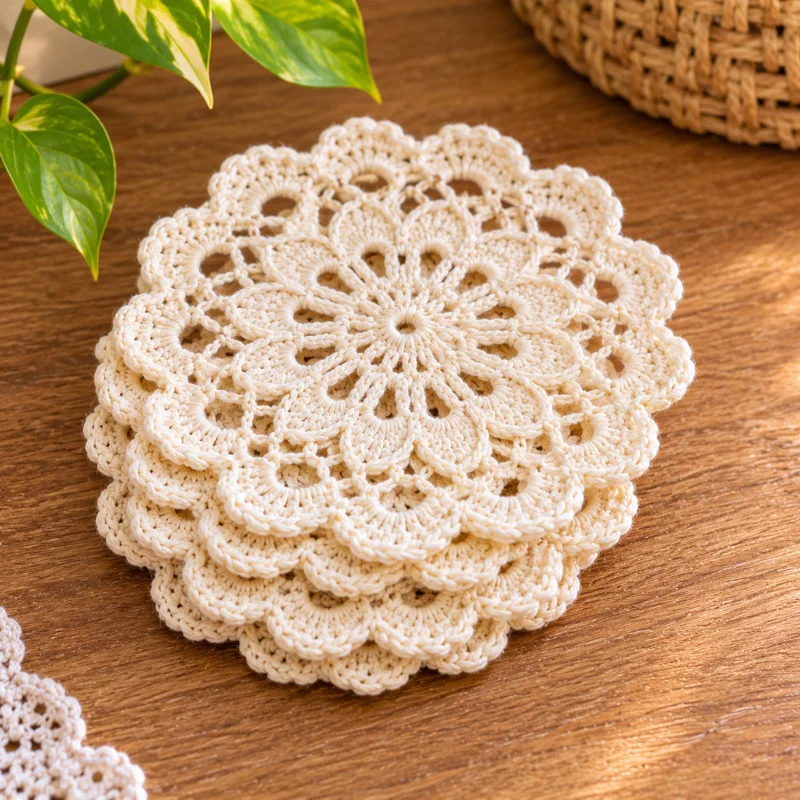
The defining feature of this crochet lace coaster is its layered floral appearance. A small central ring forms the foundation for eight radiating petals. These petals create an openwork arrangement that gives the coaster its decorative center.
The second structural feature is the transition between the flower and the outer border. Chain spaces separate the individual motifs, allowing the lace to expand without creating excessive fabric density.
Finally, the scalloped edging creates the characteristic rounded outline associated with vintage crochet doilies.
One common mistake when crocheting circular lace is adding too many stitches around the outside edge. This causes rippling instead of a flat coaster. The design below uses eight repeated sections to maintain consistent spacing.
The result is a floral crochet coaster with an open center, decorative arches, and a repeating shell border.
Project Information
| Feature | Details |
|---|---|
| Skill level | Intermediate |
| Estimated time | 45–90 minutes per coaster |
| Finished diameter | Approximately 12–15 cm after blocking |
| Crochet hook | 2.5 mm |
| Yarn | Fine cotton, sport or fingering weight |
| Construction | Joined rounds, center outward |
| Terminology | US crochet terms |
Measurements, time, and yarn requirements are estimates for this original design. The pictured coaster has not been physically measured.
Materials and Tools
Yarn
- Ivory or natural cream cotton yarn – fingering or sport weight – approximately 15–25 g per coaster.
- Optional accent cotton yarn – approximately 2–5 g for a contrasting border.
Choose a smooth, tightly twisted cotton yarn that displays individual stitches clearly. Mercerized cotton is especially useful for decorative lace because its stitch definition helps the floral motifs remain visible.
Suitable options include fine cotton crochet yarns from brands such as Scheepjes, DMC, or YarnArt. Check the recommended hook size and yarn thickness before substituting materials.
Tools
- 2.5 mm crochet hook
- Small scissors
- Tapestry needle
- Stitch markers
- Blocking pins
- Blocking mat
- Measuring tape
Crochet Abbreviations
| Abbreviation | Meaning |
|---|---|
| MR | Magic ring |
| ch | Chain |
| sc | Single crochet |
| sl st | Slip stitch |
| dc | Double crochet |
| tr | Treble crochet |
| sp | Space |
| rep | Repeat |
| st | Stitch |
All instructions use US terminology. The beginning chain of a round counts as a stitch only when specifically stated.
Free Crochet Lace Doily Coaster Pattern
This original pattern is inspired by the floral structure and scalloped edges visible in the reference photograph. It is not a stitch-for-stitch reproduction of the photographed item.
Work in joined rounds unless otherwise instructed. Keep the right side facing throughout the project.
Round 1: Foundation Ring
Make a magic ring.
Ch 3 (counts as first dc), work 15 dc into the ring.
Pull the ring closed and join with a sl st to the top of the beginning ch-3.
Stitch count: 16 dc.
The foundation ring should close neatly without a visible opening. Avoid pulling the yarn so tightly that the center becomes distorted.
Round 2: Openwork Foundation
Ch 4 (counts as first dc and ch 1).
*Dc in the next st, ch 1.*
Repeat from * to * around.
Join with a sl st into the third chain of the beginning ch-4.
Stitch count: 16 dc and 16 ch-1 spaces.
This round separates the central stitches and prepares the coaster for its floral arrangement.
Round 3: Eight Floral Sections
Sl st into the first ch-1 space.
Ch 3 (counts as first dc), work 2 dc in the same space, ch 2.
*Skip the next ch-1 space, work 3 dc in the following ch-1 space, ch 2.*
Repeat from * to * until eight groups of 3 dc have been completed.
Join with a sl st to the top of the beginning ch-3.
Stitch count: Eight 3-dc groups and eight ch-2 spaces.
Check that all eight groups are separated by equal chain spaces. These sections determine the spacing of the decorative petals in later rounds.
Round 4: Petal Foundations
Sl st across the next two dc and into the following ch-2 space.
Ch 1, sc in the same ch-2 space.
*Ch 5, sc in the next ch-2 space.*
Repeat from * to * around, replacing the final sc with a sl st into the first sc.
Stitch count: Eight ch-5 loops and eight sc anchors.
The loops should be similar in height and tension. Avoid tightening the anchoring stitches, which can pull the coaster into a shallow bowl shape.
Round 5: First Layer of Flower Petals
Sl st into the first ch-5 loop.
Ch 1, then work (sc, 2 dc, 3 tr, 2 dc, sc) into the same loop.
*Work (sc, 2 dc, 3 tr, 2 dc, sc) into the next ch-5 loop.*
Repeat from * to * around.
Join with a sl st to the first sc.
Stitch count: Eight petals, each containing 9 stitches; 72 stitches total.
Each petal has a taller center and shorter outer stitches. This arrangement creates the rounded floral shape.
Round 6: Decorative Chain Arches
Ch 1, sc in the first stitch.
*Ch 7, skip the remaining 8 stitches of the current petal, sc in the first stitch of the next petal.*
Repeat from * to * around, replacing the final sc with a sl st into the first sc.
Stitch count: Eight ch-7 arches and eight sc anchors.
Check the arches before continuing. All eight should have the same number of chains and similar tension.
Round 7: Outer Lace Fans
Sl st into the first ch-7 arch.
Ch 3 (counts as first dc), work 8 additional dc into the same arch.
*Work 9 dc into the next ch-7 arch.*
Repeat from * to * around.
Join with a sl st to the top of the beginning ch-3.
Stitch count: Eight fans of 9 dc; 72 dc total.
These fans form the foundation of the scalloped outer border. Spread the stitches evenly across each chain arch rather than concentrating them at one end.
Round 8: Scalloped Edge
Ch 1, sc in the first dc.
*Ch 3, skip the next dc, sc in the following dc.*
Repeat from * to * until you have worked four ch-3 loops across the first fan, ending with an sc in its ninth dc.
For each remaining fan, skip its first dc, then work (ch 3, skip the next dc, sc in the following dc) four times.
Join with a sl st to the first sc.
Stitch count: 32 ch-3 loops and 32 sc anchors.
Fasten off and weave in the yarn tail.
The finished edge consists of four small arches across each of the eight fan sections.
How to Block Your Crochet Lace Coaster
Blocking is an important finishing step for circular lace. It opens the chain spaces, separates the floral details, and helps the coaster lie flat.
- Soak the finished coaster briefly in cool or lukewarm water, following the yarn manufacturer’s care instructions.
- Remove it from the water and gently press out excess moisture without twisting the stitches.
- Place the coaster between two clean towels and press lightly.
- Lay it on a blocking mat.
- Arrange the eight floral sections evenly around the center.
- Use a measuring tape to check the diameter in several directions.
- Pin the outer scallops, maintaining equal spacing between adjacent sections.
- Adjust the central petals so that their shapes remain consistent.
- Allow the coaster to dry completely before removing the pins.
- Remove the pins and inspect the finished coaster for uneven edges or loose yarn tails.
The coaster is complete when it lies flat, the lace openings are evenly spaced, and all yarn ends are secured.
7 Technical Tips for Better Crochet Lace Coasters
- Mark the first stitch. A misplaced joining slip stitch can shift the beginning of each round. Mark the first stitch or starting chain of every round to maintain accurate placement.
- Count the floral repeats. The design uses eight repeated sections. Missing one section changes the spacing of the petals and outer border.
- Control chain tension. Tight ch-5 or ch-7 loops can make the lace contract. Keep the loops consistent so that the petals have enough room to spread.
- Check the fan count. Each outer fan contains exactly nine double crochet stitches. An extra stitch can produce an uneven scallop or localized rippling.
- Match yarn thickness. Switching between fingering and sport cotton changes the diameter and density. Make all coasters in a matching set with the same yarn and hook combination.
- Measure before blocking. Compare the diameter at four positions around the coaster. A difference greater than approximately 5 mm may indicate inconsistent tension or an uneven edge.
- Secure the yarn ends. A short tail may work loose during washing. Weave each end through several neighboring stitches and change direction before trimming.
Choosing the Best Cotton Yarn for Lace Coasters
Cotton is a practical choice for decorative crochet coasters because it provides clear stitch definition and can be washed according to the manufacturer’s instructions.
Fine cotton produces smaller, more detailed openings. Thicker cotton creates a larger and more substantial finished coaster.
Mercerized cotton often gives the stitches a defined surface, making the individual petals and chain arches easier to distinguish.
For a traditional appearance similar to the reference photograph, use natural cream, ivory, or off-white cotton.
Bright white produces stronger contrast between the solid stitches and the openwork spaces. Beige and light taupe create a more subdued appearance.
When making a matching set, use yarn from the same dye lot whenever possible. Small color differences become more noticeable when several coasters are stacked together.
How to Keep Crochet Coasters Flat
A flat circular coaster depends on balanced stitch distribution and consistent tension.
If the edges begin to curl upward, the outer rounds may be too tight for the diameter of the center. Check the chain lengths and verify that no decorative repeats were skipped.
If the coaster develops pronounced waves, too much fabric may have been added around the perimeter. Count the stitches in each fan and compare the number of repeated sections.
Blocking can correct minor irregularities, but it cannot reliably compensate for major stitch-count errors.
Always check the coaster on a flat surface before weaving in the final yarn end. Correcting a mistake at this stage is easier than removing an already secured tail.
Making a Matching Set of Crochet Lace Coasters
For a coordinated table setting, make four or six coasters using the same yarn, hook, and pattern.
Complete the first coaster and block it before starting the remaining pieces. Record its finished diameter and approximate yarn consumption.
Use that coaster as a reference for the others. If the finished sizes vary, compare the tension of the chain arches and the height of the double crochet stitches.
To create a contrasting border, change to a second cotton color before beginning the final round. Keep the yarn weight and fiber type consistent to avoid an uneven outer edge.
A finished set can be stacked for storage, but each coaster should be completely dry before stacking.
Care Instructions
Wash the finished coasters according to the cotton yarn label. For delicate lace, gentle handwashing helps limit distortion of the openwork stitches.
Avoid wringing the fabric. Press out excess water with a towel, reshape the floral sections, and dry flat.
Repeated washing may slightly change the dimensions, especially when the coasters are made from untreated cotton. Reblocking can help restore the original outline.
Keep lace coasters away from direct flames and very hot cookware. Their suitability for hot drinks depends on the yarn, fabric thickness, and the temperature of the cup.
Frequently Asked Questions
Can beginners make this crochet lace coaster?
This pattern is best suited to crocheters who already know how to make chains, slip stitches, single crochet, double crochet, and treble crochet. The main challenge is maintaining accurate stitch placement across the eight repeated sections.
What size hook should I use?
A 2.5 mm hook is the suggested starting point for this design. The most suitable hook depends on the thickness of the chosen cotton and your individual tension.
How much yarn is needed for one coaster?
Allow approximately 15–25 g of fine cotton yarn per coaster as a planning estimate. Actual consumption depends on yarn thickness, tension, and finished dimensions.
Can I make the coaster larger?
Using thicker yarn and a larger hook will generally increase the diameter. Adding extra decorative rounds requires additional stitch planning to preserve the eight-section symmetry.
Why does my crochet coaster curl?
Curling may result from tight chains, insufficient expansion, or uneven stitch tension. Verify the stitch counts before attempting to correct the shape through blocking.
Do crochet lace coasters need blocking?
Blocking is recommended for this design because it helps open the lace and define the scalloped edge. It also makes it easier to produce matching dimensions across a set.
Conclusion
This free crochet lace doily coaster pattern uses a central ring, eight floral sections, open chain arches, and a scalloped border to create a decorative circular design. Accurate stitch counts and consistent chain tension are essential for keeping the finished piece flat.
After completing the first coaster, measure its blocked diameter and record the yarn consumption before making a matching set. Use the same hook and cotton yarn for consistent results.
Save the finished project to Pinterest or share a photograph on Instagram with the hashtag #FloralLaceDoilyCoaster.
Which border would you choose for this floral design: matching ivory scallops or a contrasting cotton edge?