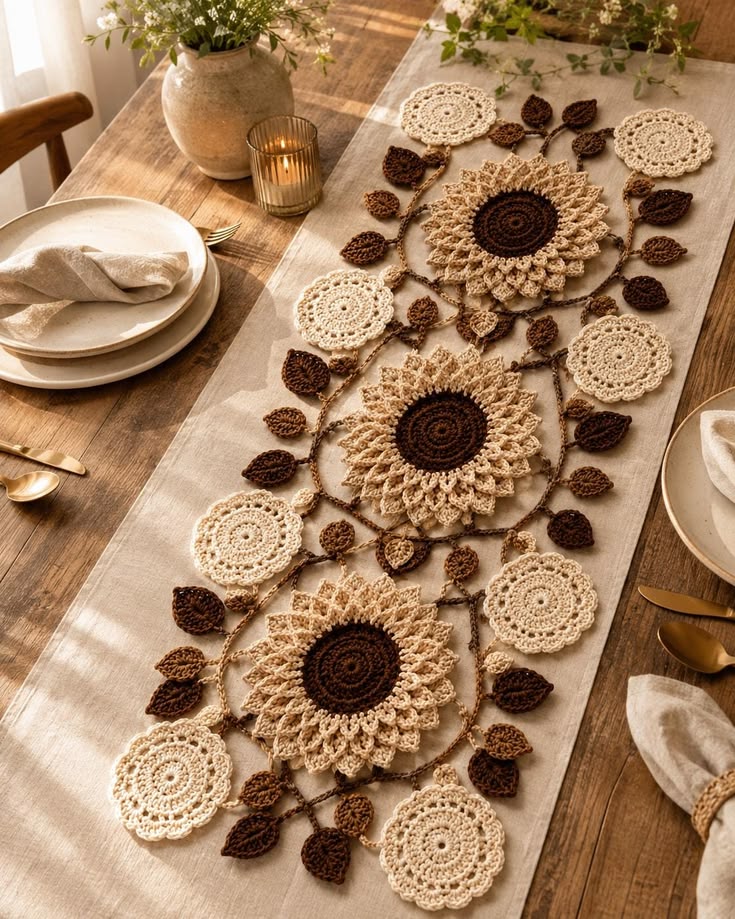
Three large sunflowers form the structural centerline of this crochet sunflower table runner, while brown vines, autumn leaves, and small cream medallions fill the spaces between them. The design is built from separate motifs rather than one continuous fabric, which keeps the runner light and open. Using cotton or a cotton-blend DK yarn with a 3.5–4.0 mm hook produces crisp petals, defined leaves, and a table runner suited to autumn dining-table decoration.
The Design: What Makes This Sunflower Table Runner Different
The runner combines three different crochet structures. Large layered sunflower motifs create the main visual anchors. Smaller round cream motifs balance the empty areas along both sides, while crocheted vines and individual leaves connect everything into a long botanical composition.
The sunflowers use dark brown circular centers surrounded by two layers of pointed beige-gold petals. The leaves alternate between dark chocolate, medium brown, and muted tan, preventing the foliage from becoming one solid color. Instead of filling the entire rectangle with crochet, the motifs are attached over an open vine framework. This reduces weight and lets the table surface remain visible. The main construction risk is attaching the vines before the large flowers have been positioned; even a small alignment error can make the finished runner curve sideways.
Project Information at a Glance
| Skill Level | Construction | Hook | Yarn | Suggested Finished Size |
|---|---|---|---|---|
| Intermediate | Separate motifs joined with vines | 3.5–4.0 mm | DK #3 cotton or cotton blend | Approximately 40 × 150 cm |
Materials and Tools
Yarn
- Dark Chocolate Brown — DK #3 — approximately 100–130 g for sunflower centers, leaves, and vines.
- Medium Brown — DK #3 — approximately 70–100 g for leaves and accents.
- Warm Beige — DK #3 — approximately 180–230 g for sunflower petals.
- Natural Cream — DK #3 — approximately 100–140 g for round medallions and optional edging.
- Muted Olive or Taupe — DK #3 — approximately 30–50 g for optional foliage variation.
Yarn quantities are project estimates. The final amount depends on runner length, yarn thickness, motif diameter, and the number of leaves added to the vine framework.
Tools
- 3.5–4.0 mm crochet hook
- Yarn needle
- Sharp scissors
- Stitch markers
- Measuring tape
- Blocking mats
- Rust-resistant pins
Abbreviations
- MR — magic ring
- ch — chain
- sc — single crochet
- hdc — half double crochet
- dc — double crochet
- tr — treble crochet
- sl st — slip stitch
- st/sts — stitch/stitches
- sp — space
- BLO — back loop only
Pattern Construction
Make all large sunflower motifs first. Block them before beginning the vine framework because their finished diameter determines the spacing of every secondary element.
For a runner approximately 150 cm long, three large sunflowers work well. A longer dining table can take four or five flowers. Keep approximately 10–16 cm of open vine work between neighboring flowers so the individual motifs remain distinct.
Large Sunflower Motif — Make 3
Each sunflower consists of a flat dark center followed by two layers of pointed petals.
Dark Brown Center
With dark chocolate yarn, make an MR.
Round 1: Work 12 dc into MR. Join with sl st. (12)
Round 2: Work 2 dc in each stitch around. Join. (24)
Round 3: *1 dc, 2 dc in next st* around. Join. (36)
Round 4: *2 dc, 2 dc in next st* around. Join. (48)
Round 5: Work 1 hdc in each stitch around. (48)
Check that the center lies flat. If it begins to cup, move to a slightly larger hook rather than adding random increases.
Inner Sunflower Petals
Change to warm beige.
Work the petals into evenly spaced stitches around the outer edge of the brown center.
For each petal:
Ch 7. Beginning in the second chain from the hook, work:
sc, hdc, dc, tr, dc, hdc
Sl st into the next designated base stitch.
Repeat around, keeping the petals evenly distributed. Aim for approximately 16 pointed inner petals.
Outer Sunflower Petals
Join warm beige yarn behind the first petal layer.
Make the second layer slightly longer:
Ch 9.
Beginning in the second chain from the hook, work:
sc, hdc, dc, 2 tr, dc, hdc, sc
Anchor behind the next inner petal.
Repeat around. Position each outer petal between two petals from the first layer rather than directly behind one.
The blocked sunflower should measure approximately 20–24 cm across, depending on yarn and tension.
Optional Petal Definition
If stronger petal outlines are required, work one round of surface slip stitches from the base toward the tip of selected petals.
Keep these stitches loose. Tight surface crochet shortens the petal and causes the outer edge to curl upward.
Cream Round Medallions — Make 8 to 10
The smaller cream circles fill the side spaces without competing with the large sunflowers.
With natural cream yarn, make an MR.
Round 1: 12 dc into MR. Join. (12)
Round 2: 2 dc in each stitch around. (24)
Round 3: *1 dc, 2 dc in next st* around. (36)
Round 4: *Ch 2, skip 1 st, sc in next st* around.
Round 5: Into each ch-2 space work (sc, 3 dc, sc).
Fasten off and block into a flat circle.
Target diameter: approximately 9–11 cm.
Dark Autumn Leaf — Make 10 to 14
Ch 10 with dark chocolate yarn.
Beginning in the second chain from the hook, work:
sc, hdc, dc, 2 tr, dc, hdc, sc, sl st.
Continue along the opposite side of the foundation chain:
sc, hdc, dc, 2 tr, dc, hdc, sc.
Work (sc, ch 2, sc) at the leaf tip if a sharper point is required.
Sl st at the base. Fasten off, leaving a 15 cm tail for attachment.
Medium Brown Leaves — Make 10 to 14
Use the same basic construction as the dark leaves, but begin with ch 8 instead of ch 10.
Work shorter stitch heights:
sc, hdc, dc, tr, dc, hdc, sc along each side.
The variation in leaf size makes the vine structure less repetitive.
Small Accent Leaves — Make 8 to 12
Ch 6.
Work along the chain:
sc, hdc, dc, hdc, sc.
Repeat on the opposite side.
Fasten off with a long tail.
Use medium brown, taupe, or muted olive for these smaller leaves.
Leaf Veins
For more definition, surface crochet a line of sl sts from the leaf base to approximately 1 cm below the tip.
Another option is to embroider the vein with a yarn needle. The embroidered method adds less thickness and works well when the runner must lie very flat.
Small Berry Motifs
The small burgundy-brown circles visible between the foliage can be added as optional berry clusters.
With dark reddish brown yarn:
Round 1: 6 sc into MR. (6)
Round 2: 2 sc in each stitch. (12)
Round 3: Work 1 sc in each stitch. (12)
Fasten off.
For a flatter berry, omit Round 3. Make approximately 12–18 and place them in groups of two or three.
Optional Crochet Acorn
Small acorn motifs can replace some berry groups for a stronger autumn theme.
Acorn Body
With warm beige, make an MR.
Round 1: 6 sc in MR. (6)
Round 2: 2 sc in each stitch. (12)
Rounds 3–4: Sc around. (12)
Round 5: sc2tog around. (6)
Fasten off.
Acorn Cap
With dark brown:
Round 1: 6 sc in MR.
Round 2: 2 sc in each stitch. (12)
Fasten off and stitch the cap over the wide end of the beige body.
Crochet Vine
The vine is the structural connection between the separate motifs.
With dark brown yarn, make a chain long enough to travel from one sunflower toward the next motif. Do not make one complete runner-length chain immediately. Shorter vine sections are easier to position accurately.
After making the chain, work one sl st into each chain on the return pass.
This produces a narrow cord with enough body to hold the leaves.
For a thicker vine, work one sc into each chain instead.
Curved Vine Sections
A perfectly straight crochet cord will resist the curved layout shown in the design. Shape selected sections while working the return row.
Every 5–7 stitches, place 2 sc into one chain. The additional stitch allows the vine to bend gradually.
Do not increase too frequently. Excess increases produce a spiral rather than a gentle botanical curve.
Central Layout
Place the blocked motifs on a table before sewing anything together.
Arrange the three large sunflowers vertically along the center of the intended runner.
Leave approximately 12–16 cm between the outer edges of neighboring flowers.
Position cream medallions along alternating sides. Avoid placing two medallions directly opposite each other at every point because an irregular distribution produces a more natural composition.
Adding the Vines
Run one main vine from the lower sunflower toward the middle flower, then toward the upper flower.
Add secondary curved branches extending toward the cream medallions.
Pin every vine section before sewing.
Keep the complete arrangement within the planned runner width. For a 40 cm finished runner, the outermost leaves should remain approximately 1–2 cm inside that measurement.
Attaching the Leaves
Position large dark leaves near the outer edges and smaller leaves closer to the central vines.
Attach each leaf through its base and central vein rather than sewing around the complete perimeter. Leaving the outer edges free gives the leaf slight dimension.
Alternate leaf direction along each branch:
left → right → left → right.
Break the sequence occasionally near a sunflower or medallion so the layout does not look mechanically repeated.
Connecting the Cream Medallions
Use short beige or brown vine sections to connect the cream circles to the central framework.
Sew each medallion at two or three attachment points. One attachment point alone allows the circle to rotate when the runner is moved.
Keep the medallions flat and do not pull the connecting vines tightly.
Optional Open Crochet Background
The runner can remain as an open motif construction, or a loose cream mesh can be added between selected vines.
For a simple mesh:
Ch 5, sc into the next available attachment point.
Repeat between neighboring vines and motifs.
On the following section, connect adjacent ch-5 loops with additional ch-5 arches.
Use this mesh sparingly. The botanical motifs should remain the dominant feature.
Decorative Outer Lace
If you want a more defined runner outline, connect the outer motifs with cream chain arches.
Work:
Ch 5, sc into the edge of the next leaf or medallion, ch 5.
Continue around the runner.
For the second edging pass, work into each ch-5 loop:
(sc, hdc, 3 dc, hdc, sc).
This creates a small scalloped lace edge while preserving the open appearance.
Suggested Runner Sizes
| Table Runner | Approximate Size | Large Sunflowers |
|---|---|---|
| Small | 35 × 90 cm | 2 |
| Medium | 38 × 120 cm | 3 |
| Large | 40 × 150 cm | 3 |
| Extra Long | 42 × 180 cm | 4 |
| Banquet Length | 45 × 220 cm | 5 |
These dimensions are project targets. The motif layout can be lengthened without changing the individual sunflower construction.
How to Adjust the Length
Measure one complete section consisting of one sunflower plus the vine space leading to the next sunflower.
If that section measures approximately 40 cm, adding another sunflower section increases the runner length by roughly the same amount.
Do not simply extend the end vines by 30–40 cm. Long vine-only sections make the design visually unbalanced and are more likely to stretch.
Color Placement
Keep the sunflower centers consistently dark brown. This gives the runner a strong repeated centerline.
Warm beige petals connect the flowers to the natural cream medallions. Use the darkest brown leaves near the outer edge and mix medium brown leaves toward the center.
For additional autumn color, replace a few brown leaves with:
- Burnt orange
- Rust
- Burgundy
- Mustard
- Muted olive
Limit each additional shade to a small number of leaves so the sunflowers remain the primary motif.
Alternative Sunflower Colorways
A traditional version can use golden-yellow petals with dark chocolate centers and olive foliage.
For a neutral farmhouse version, use ivory petals, medium brown centers, taupe leaves, and natural cream medallions.
A stronger fall palette can combine mustard petals, espresso centers, rust leaves, olive foliage, and burgundy berries.
Assembly
- Make three large sunflower motifs and block them to the same diameter.
- Crochet eight to ten cream medallions and block them flat.
- Make all large, medium, and small leaves in the selected brown and neutral shades.
- Prepare optional berries and acorns before beginning the final layout.
- Arrange the large sunflowers along the centerline and check the total runner length.
- Position the cream medallions along both sides without creating a rigid symmetrical grid.
- Crochet and pin the main vine sections between the large flowers.
- Add secondary branches, leaves, berries, and optional acorns.
- Sew every intersection securely and add the optional cream outer lace.
- Weave in all tails and block the complete runner to its final dimensions.
The finished runner should lie flat with the three sunflower centers aligned, while the surrounding vines remain curved rather than stretched tight.
7 Technical Tips
- Sunflower center cupping: check the motif after every increase round. If the brown center forms a bowl deeper than approximately 5 mm, change hook size or correct the increase distribution before adding petals.
- Petals twisting sideways: block each sunflower before assembly. Pin the tip and both sides of every large petal until the motif is completely dry.
- Runner bending to one side: mark a temporary centerline on the work surface. Keep the centers of all large sunflowers within approximately 5 mm of that line.
- Vines becoming too tight: leave approximately 3–5 mm of relaxed movement between attachment points. A stretched vine can pull neighboring motifs inward after washing.
- Leaves curling excessively: do not surface-crochet the central vein with tight tension. The vein should be approximately the same length as the relaxed leaf center.
- Medallions rotating: attach every cream circle at a minimum of two points. Three attachment points are preferable when the motif is connected to multiple vine branches.
- Uneven outer edge: measure the width at five positions before final sewing. Move leaves or branches if any section differs from the planned width by more than approximately 2 cm.
Blocking the Finished Runner
Blocking is especially important for this project because the runner contains many independently crocheted components.
Place the finished piece on blocking mats and establish the centerline first. Pin all large sunflowers to the same diameter.
Next, shape the cream medallions into circles and arrange the vines into smooth curves. Pin the leaf tips last.
Do not stretch the vines until they become straight. Their curved shape is part of the design.
Allow the runner to dry completely before removing the pins.
Care
Cotton yarn works well for table décor because the finished runner can be blocked with clear definition. Follow the washing instructions supplied with the chosen yarn.
When storing the runner, roll it loosely instead of folding it repeatedly through the large sunflower motifs. A hard fold through the petal layers can leave a permanent crease.
If the leaves curl after washing, reshape them while damp and allow them to dry flat.
Conclusion
This crochet sunflower table runner is constructed as a botanical arrangement rather than a conventional solid rectangle. Start with the three large sunflowers, block them to matching diameters, and establish their centerline before adding any connecting vines. Cream medallions provide lighter secondary shapes, while brown leaves, berries, and optional acorns fill the open spaces without hiding the table beneath the crochet. The next practical step is to make and block one complete sunflower, then use its actual diameter to calculate the runner length. Share the finished autumn table arrangement on Pinterest or Instagram with #SunflowerAutumnTableRunner. Would you make the surrounding leaves entirely brown, or mix rust, burgundy, and olive into the foliage?