Introduction
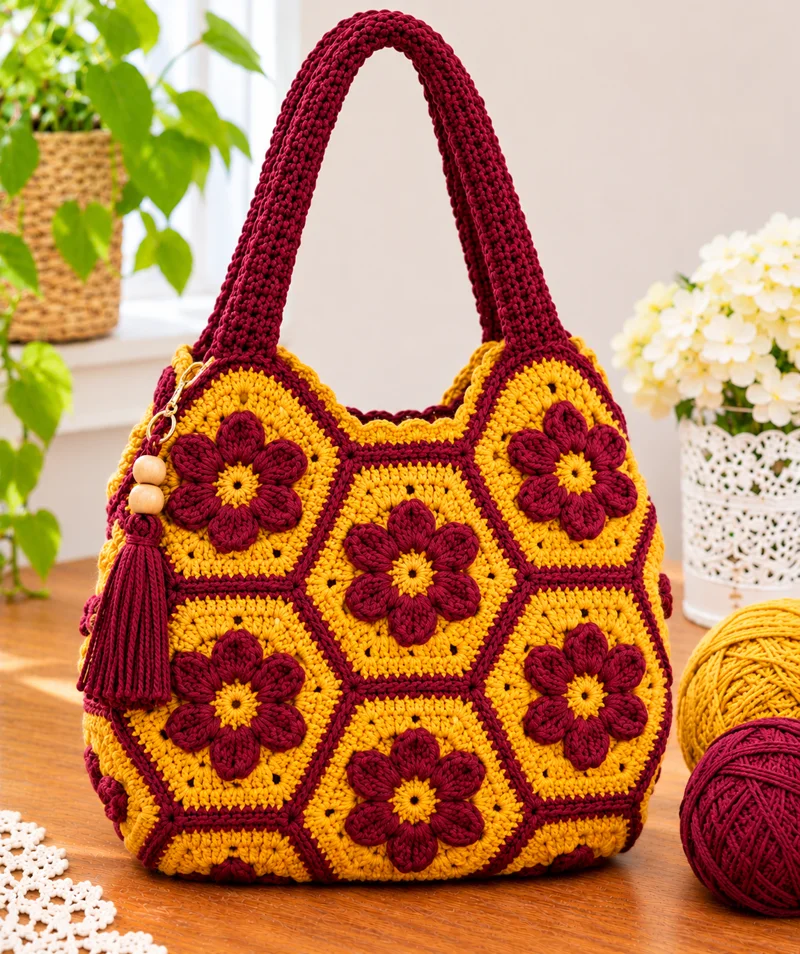
Six burgundy petals rising from every mustard hexagon determine both the geometry and the seam placement of this bag. This crochet flower hexagon bag pattern uses medium-weight yarn, a firm hook gauge, raised floral appliqués and reinforced handles to produce a structured motif handbag. Plan for an intermediate skill level and a body around 25–30 cm wide. The modular construction also makes damaged panels individually replaceable.
The Design: What Makes This Floral Hexagon Bag Different
The photographed bag depends on three structural decisions. First, the mustard hexagons form the load-bearing ground while burgundy flowers sit above that fabric, keeping the petals dimensional rather than burying them inside the joins.
Second, dark contrast seams outline every polygon. Those lines are decorative, but they also make small differences between motifs less visible once the crochet hexagon bag is assembled.
Third, wide crocheted handles distribute weight across several upper motifs instead of concentrating it at one narrow attachment point. The maker therefore gets a more stable floral crochet handbag when carrying ordinary personal items.
A common mistake is sizing the flowers before blocking the hexagons. Oversized petals can cross the burgundy seam line and visually distort the six-sided geometry. Block the ground motifs first, then test one completed flower against a finished panel.
Project Info at a Glance
| Skill Level | Time | Finished Size | Hook | Best For |
|---|---|---|---|---|
| Intermediate | 12–18 hours estimated | 25–30 cm wide target | 3.5–4 mm | Shoulder handbag / everyday motif bag |
Materials and Tools
Yarn
- Mustard yellow — worsted/medium weight — allow approximately 150–200 g for a larger photo-inspired bag.
- Deep burgundy — worsted/medium weight — allow approximately 120–170 g for flowers, seams, edging, handles and tassel.
- Optional lining fabric — medium-weight woven cotton.
- Sewing thread — coordinating mustard or burgundy.
Yarn consumption changes when motifs, handles and raised flowers become larger or denser.
Tools
- 3.5–4 mm crochet hook
- Yarn needle
- Locking stitch markers
- Rust-resistant pins
- Scissors
- Measuring tape
- Two wooden beads, approximately 18–22 mm
- One metal ring or swivel clip
- Lining fabric and sewing needle, optional but recommended
Abbreviations
- MR — magic ring
- sc — single crochet
- hdc — half double crochet
- dc — double crochet
- inc — increase
- sl st — slip stitch
- ch — chain
- sp — space
- BLO — back loop only
- st / sts — stitch / stitches
- RS — right side
- WS — wrong side
An invisible decrease is primarily an amigurumi technique and is not required in this flat-motif construction.
Pattern — Step by Step
This is an original photo-inspired recipe. Make a test motif first. The target finished hexagon is approximately 9–11 cm across after blocking; changing yarn, hook or tension changes the final bag dimensions.
Mustard Hexagon Ground — Make 13–17 as Required
Yarn: mustard. Construction based on standard six-corner crochet geometry.
R1: MR, ch 3, work 11 dc into ring; sl st to top of beginning ch-3. (12 dc)
R2: Ch 3, dc in same st, ch 2, 2 dc in same st; *skip 1 st, (2 dc, ch 2, 2 dc) in next st* around; sl st to beginning ch. (24 dc + 6 ch-2 corner spaces)
R3: Sl st to first corner sp. Ch 3, dc, ch 2, 2 dc in same corner; dc in each of next 4 dc; *(2 dc, ch 2, 2 dc) in corner, dc in each of next 4 dc* around. Join. (48 dc + 6 corner spaces)
R4: Sl st to corner. Ch 3, dc, ch 2, 2 dc in corner; dc across the side to the next corner; *(2 dc, ch 2, 2 dc) in corner, dc across next side* around. Join.
Keep the structural rule fixed: six equal sides, six ch-2 corners and four corner double crochets at every point.
Fasten off. Block every motif to the same measurement.
Raised Burgundy Flower — Make One per Visible Hexagon
Yarn: burgundy with mustard center.
R1: With mustard, MR, ch 1, 12 sc into MR; sl st to first sc. (12)
Fasten off mustard and join burgundy to any stitch.
R2: *Ch 7, beginning in second ch from hook work sc, hdc, dc, 2 dc in next ch, hdc; sl st into next 2 center sts.* Repeat six times. (6 petals)
Each petal uses the same chain length and anchoring interval. The result is a raised six-petal flower rather than a flat color-change motif.
Fasten off, leaving a 25 cm sewing tail.
Pin the flower centrally to a blocked mustard hexagon. Sew around the base of each petal while leaving the outer petal edges free so the relief remains visible.
Contrast Hexagon Border
Yarn: burgundy.
Join burgundy at any corner.
R1: Ch 1, sc evenly along first side, (sc, ch 1, sc) in corner; repeat around all six sides. Join with sl st.
Keep the same number of sc on every straight side. If one motif needs an extra stitch to lie flat, correct the mustard ground before joining rather than hiding the discrepancy in the border.
Fasten off with a 30–40 cm tail if the tail will be used for seaming.
Side and Bottom Motifs
The photograph shows motifs wrapping around the sides and lower body. Make enough complete hexagons to create a front panel, matching back panel, side depth and bottom transition.
For a compact version, begin with 13 motifs and dry-layout them before joining. For a fuller rounded handbag similar to the reference image, expect approximately 15–17 motifs, depending on the selected hexagon diameter and whether partial motifs are added along the opening.
Do not permanently join anything until the entire arrangement lies flat on a table.
Joining Seams
Yarn: burgundy.
Place two motifs WS together with corners aligned.
Join burgundy through corresponding border stitches.
R1: Sl st through both layers across one complete side, maintaining one join for every matched pair of border stitches.
Fasten off at the corner.
Repeat across the panel.
For a more pronounced seam like the photographed handbag, work one surface-sl-st line over the completed join from the RS. Do not pull these stitches tight; a shortened seam cups the motifs and can twist the whole bag.
Upper Opening
Yarn: mustard and burgundy.
Join mustard at one upper edge.
R1: Sc evenly around the entire opening, placing one stitch into each border stitch and reducing only where a deep motif valley needs to be raised.
R2: Sc around. At each inward valley, work sc2tog if the opening still flares.
Change to burgundy.
R3: Sl st loosely around the full opening.
Fasten off.
Measure the opening before starting the handles. Both sides must have matching stitch counts between handle attachment points.
Wide Handles — Make 2
Yarn: burgundy.
Foundation: Ch 9.
Row 1: Sc in second ch from hook and across. (8)
Rows 2–80: Ch 1, turn, sc BLO across. (8)
Continue until each handle measures approximately 45–55 cm, or the length needed for the preferred shoulder drop.
Fold the strip lengthwise and slip stitch the long edges together, creating a thick doubled handle. Alternatively, leave it flat and sew cotton webbing to the WS before attachment.
Fasten off with a 40 cm tail.
Attach each handle across at least 5–7 cm of the upper bag edge. Sew a rectangle around the attachment area, then sew a diagonal line through that rectangle. The load should pass through the border and upper motif structure rather than through a single crochet stitch.
Burgundy Tassel
Yarn: burgundy.
Cut 35–45 strands approximately 24 cm long.
Lay the strands together. Fold them at the midpoint over a 30 cm tie strand and knot securely.
Wrap another strand around the bundle approximately 2 cm below the fold 8–10 times. Tie, thread the ends into the tassel and trim the bottom evenly.
Thread two wooden beads above the tassel. Attach the top loop to a metal ring or swivel clip.
The photographed tassel hangs close to the left handle base rather than from the center of the bag.
Optional Fabric Lining
Cut two lining pieces using the assembled bag as the template, adding approximately 1.5 cm seam allowance.
Sew the side and bottom seams. Turn the upper raw edge toward the WS by 1–1.5 cm and press.
Insert the lining with WS facing the crochet interior. Hand-sew the folded lining edge beneath the upper crochet border using small stitches.
A lining limits stretch and prevents narrow objects from pushing through motif joins.
Assembly
- Block every mustard hexagon to one common measurement before adding the final seams.
- Sew one raised burgundy flower to the center of each floral motif.
- Add the burgundy border to every complete hexagon.
- Arrange the front motifs on a flat surface and photograph the layout for reference.
- Join the front, back, side and bottom sections with matching corners aligned.
- Work the mustard upper opening rounds, correcting only genuine flare at the valleys.
- Add the burgundy finishing round around the opening.
- Attach both reinforced handles at symmetrical points and verify equal shoulder drop before final stitching.
- Insert and hand-sew the optional fabric lining below the crochet border.
- Add the beaded burgundy tassel beside one handle and weave every remaining yarn tail through several directional changes.
The completed bag should stand symmetrically when empty and carry its load through the upper border rather than individual flower motifs.
7 Technical Tips for a Better Crochet Hexagon Bag
- Motif mismatch: A 5 mm difference between hexagons compounds across several joined panels and can skew the bag opening. Block every motif against one paper or cardboard template before seaming.
- Loose seam failure: A slip-stitch seam with mismatched stitches creates puckers or small holes. Count the stitches on both edges before joining and pair them one-for-one.
- Handle stretch: An unsupported crochet handle can lengthen noticeably under load. Keep the handle near 45–55 cm initially and reinforce the inside with webbing or a second crocheted layer when the bag will carry heavier items.
- Petal distortion: Sewing around the complete outside edge flattens a raised flower. Stitch only around the petal bases and central anchoring area, leaving the rounded ends free.
- Opening flare: Hexagon valleys can produce an uneven scalloped top when too many stitches are added. Use an sc2tog only at a valley that visibly projects beyond the intended opening line.
- Lining sag: A lining cut much larger than the crochet shell pools inside the bottom. Use approximately 1.5 cm seam allowance and test the sewn lining inside the bag before attaching its upper edge.
- Tail escape: Short yarn tails can work toward the surface at high-stress joins. Leave at least 15 cm for ordinary finishing and 30–40 cm where a tail also functions as structural seaming yarn.
Conclusion
The defining construction problem in this bag is not the flower itself; it is controlling six-sided geometry while adding raised petals, visible seams and load-bearing handles. Make one complete test hexagon first, block it, and record its exact point-to-point measurement before calculating the final motif layout. That single measurement determines the eventual width, depth and yarn requirement more reliably than a generic bag-size estimate. Save the crochet flower hexagon bag pattern to Pinterest, or share the finished mustard-and-burgundy version on Instagram with #MustardBurgundyHexagonBag. For your next version, would you keep the six burgundy petals shown here, or reverse the palette and make burgundy hexagons with mustard flowers?