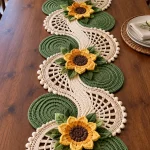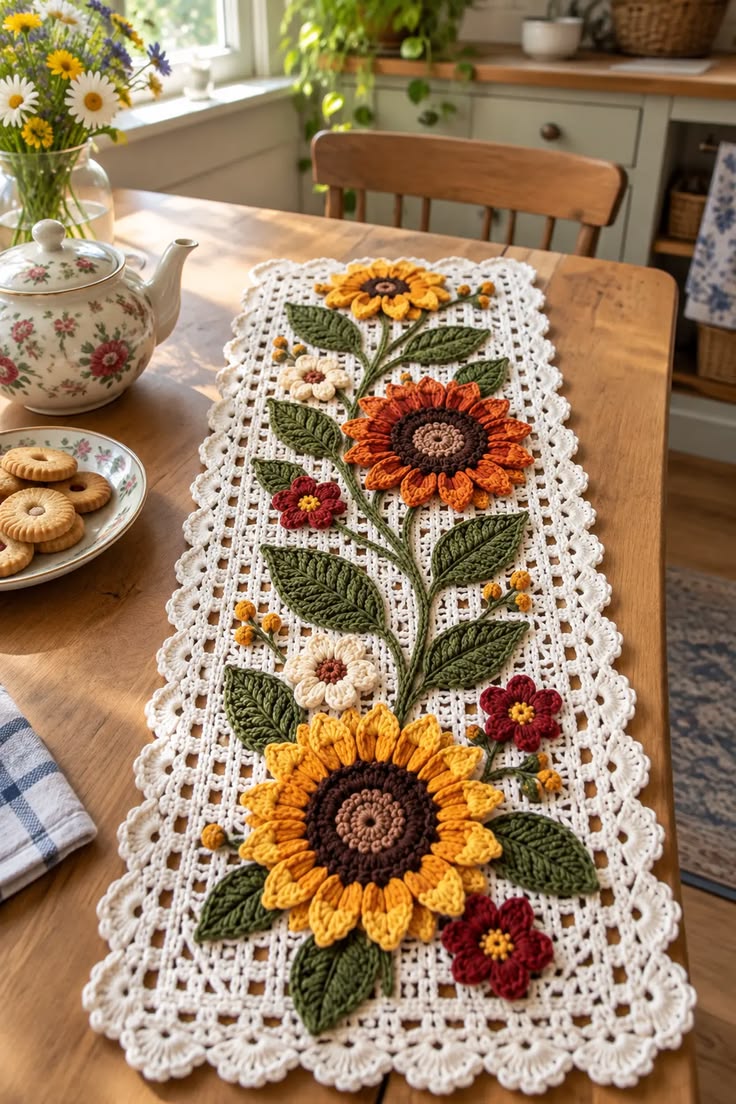
Three large sunflowers establish the scale of this runner before a single leaf is attached. This sunflower crochet table runner pattern combines a white open-grid foundation with dimensional flowers, olive-green leaves, branching stems and a scalloped lace border. Using medium-weight cotton yarn and a 4 mm hook, the photo-inspired version targets approximately 120–140 cm long by 38–45 cm wide. The construction is best suited to an intermediate crocheter.
The Design: What Makes This Sunflower Runner Different
The white foundation is deliberately restrained because the botanical appliqués provide most of the surface texture. An open crochet grid gives the runner enough structure to support the flowers without competing visually with the raised petals.
Three large sunflowers form the primary vertical line. They are not identical in apparent size: the lower and middle blossoms dominate the composition, while the upper flower is smaller. This variation prevents the crochet sunflower table runner from reading as a repeated motif strip.
Olive leaves and narrow stems connect the flowers. Smaller cream and burgundy blossoms occupy gaps between those branches. The main construction error with this type of 3D flower crochet runner is attaching every appliqué before blocking the foundation. A distorted grid becomes difficult to correct once heavily textured flowers have been sewn across it.
Project Info at a Glance
| Skill Level | Time | Target Size | Hook | Construction |
|---|---|---|---|---|
| Intermediate | 12–16 hours | Approx. 120–140 × 38–45 cm | 4 mm | Open-grid base with sewn appliqués |
The dimensions above are a working target for this photo-inspired version rather than a measurement taken from the photograph. Comparable published sunflower runners range considerably in size and construction, so the blocked foundation should be measured before the floral pieces are attached.
Materials and Tools
Yarn
- White/Cream: medium-weight cotton or cotton blend — approximately 250–300 g for the foundation and border
- Mustard/Golden Yellow: medium-weight yarn — approximately 80–100 g for sunflower petals and buds
- Dark Brown: medium-weight yarn — approximately 50–70 g for sunflower centers
- Tan/Light Brown: medium-weight yarn — approximately 25–40 g for inner sunflower centers
- Olive Green: medium-weight yarn — approximately 100–130 g for leaves and stems
- Burgundy: medium-weight yarn — approximately 30–40 g for small flowers
Yarn quantities are estimates for the photographed style. Actual consumption depends on the runner dimensions, yarn composition, tension and number of botanical appliqués.
Tools
- 4 mm crochet hook
- Tapestry needle
- Scissors
- Stitch markers
- Blocking mats
- Rust-resistant pins
- Tape measure
Abbreviations
- MR — magic ring
- ch — chain
- sc — single crochet
- hdc — half double crochet
- dc — double crochet
- tr — treble crochet
- sl st — slip stitch
- st/sts — stitch/stitches
- sp — space
- sk — skip
- inc — two stitches worked into one stitch
- rep — repeat
An invisible decrease is unnecessary because the runner consists of flat and dimensional appliqué components rather than stuffed crochet pieces.
Sunflower Crochet Table Runner Pattern — Step by Step
The instructions below are an original reconstruction based on the visible design. Make the white foundation first, block it to its final dimensions, and only then position the flowers, stems and leaves.
White Open-Grid Foundation
Yarn: white or cream.
Ch 81, or make an odd-numbered foundation chain that produces the desired runner width.
Row 1: Dc in 5th ch from hook. *Ch 1, sk 1 ch, dc in next ch.* Repeat across. Turn.
Row 2: Ch 4. *Dc in next dc, ch 1.* Repeat across, ending with dc in turning chain. Turn.
Repeat Row 2 until the foundation reaches approximately 110–125 cm before the border is added.
The foundation should form an even rectangular grid. Do not stretch it to the final length while measuring.
Foundation Stabilizing Round
Yarn: white.
Round 1: Ch 1 and sc evenly around the entire rectangle. Work 3 sc into each corner.
Round 2: Ch 3 and dc in each stitch around. At each corner work 5 dc into the center corner stitch.
Join with sl st and fasten off.
Block the foundation now. Check the width at the top, center and bottom before proceeding.
Large Sunflower Center — Make 2
Yarn: tan and dark brown.
R1: With tan, work 6 sc in MR. (6)
R2: Inc ×6. (12)
R3: (sc, inc) ×6. (18)
R4: (2 sc, inc) ×6. (24)
Change to dark brown.
R5: (3 sc, inc) ×6. (30)
R6: (4 sc, inc) ×6. (36)
R7: (5 sc, inc) ×6. (42)
Fasten off.
Keep the center flat during construction. The dimensional effect should come primarily from the petal layer rather than a heavily cupped center.
Large Sunflower Petals — Make 16 to 18 Per Large Flower
Yarn: mustard/golden yellow.
Join yellow to the outer edge of the brown center.
Petal 1: Ch 8. Starting in second ch from hook, work sc, hdc, dc, 3 tr, dc. Sl st into the next available center stitch.
Repeat the petal sequence around the center, spacing the petals evenly.
For a fuller flower, add a second layer behind the first.
Back Petal Layer: Join yellow behind the first petal round. Ch 9. Starting in second ch from hook, work sc, hdc, dc, 4 tr, dc. Anchor behind the next petal with sl st.
Repeat around.
Fasten off with a long tail for attaching the flower.
Medium Sunflower — Make 1
Yarn: dark brown and golden yellow.
R1: With dark brown, 6 sc in MR. (6)
R2: Inc ×6. (12)
R3: (sc, inc) ×6. (18)
R4: (2 sc, inc) ×6. (24)
R5: (3 sc, inc) ×6. (30)
Change to golden yellow.
Work approximately 14–16 petals using the following sequence:
Each Petal: Ch 7. Starting in second ch, sc, hdc, dc, 2 tr, dc. Sl st into the next available center stitch.
Distribute the petals evenly around the center and fasten off.
Large Olive Leaves — Make 10 to 12
Yarn: olive green.
Ch 16.
Row 1: Starting in second ch from hook, work sl st, sc, hdc, dc, 7 tr, dc, hdc, sc, sl st.
Continue around the opposite side of the foundation chain.
Work sl st, sc, hdc, dc, 7 tr, dc, hdc, sc, sl st.
Row 2: Ch 1. Sc around the complete leaf, placing 3 sc at the pointed end.
Surface Vein: Using a slightly darker green if available, work surface sl sts along the center chain from the base toward the point.
Fasten off with a 20 cm tail.
Medium Olive Leaves — Make 5 to 7
Yarn: olive green.
Ch 12.
Starting in second ch from hook, work sl st, sc, hdc, dc, 4 tr, dc, hdc, sc.
Continue along the opposite side with sc, hdc, dc, 4 tr, dc, hdc, sc, sl st.
Work one round of sc around the perimeter, placing 3 sc at the leaf tip.
Fasten off.
Green Stems
Yarn: olive green.
Make several stem cords of different lengths rather than one continuous straight stem.
For each stem, ch to the required length.
Return Row: Starting in second ch from hook, sl st into every chain.
For a thicker main stem, work a second row of sc along the cord.
Make one main stem approximately 70–85 cm long and several branches measuring approximately 8–25 cm.
Do not sew the stems to the runner until all flowers and leaves have been temporarily positioned.
Burgundy Flowers — Make 3
Yarn: burgundy and yellow.
Center R1: With yellow, 6 sc in MR. (6)
Center R2: Inc ×6. (12)
Change to burgundy.
Petal Round: *Sl st in next st, ch 5, work 2 tr, dc and hdc back toward center, sl st into next center stitch.* Repeat to create 5 petals.
Fasten off, leaving a tail for sewing.
Small Cream Flowers — Make 2
Yarn: cream with rust or brown center.
R1: With rust/brown, 6 sc in MR. (6)
R2: Inc ×6. (12)
Change to cream.
Petals: *Ch 4, 2 dc in same st, ch 4, sl st in next st.* Repeat around to produce 6 rounded petals.
Fasten off.
Small Yellow Buds — Make 8 to 12
Yarn: mustard yellow and olive green.
R1: 6 sc in MR. (6)
R2: Inc ×6. (12)
R3: Sc around. (12)
Fasten off and lightly flatten the piece rather than stuffing it.
Attach each bud to a short green chain cord. Group the buds in clusters of two or three along selected branches.
White Scalloped Lace Border
Yarn: white/cream.
Join yarn in any corner of the stabilized foundation.
Round 1: Ch 4, *sk 2 sts, dc in next st, ch 1*. Repeat around. At each corner work (dc, ch 3, dc).
Round 2: Sl st into first ch-1 space. *Sc in ch-1 sp, ch 3.* Repeat around. Work (sc, ch 5, sc) into each corner.
Round 3: Sl st to the next ch-3 space. Work 7 dc into the space, then sc into the following space. Repeat around to create scallops.
Round 4: Over each 7-dc scallop work sc, ch 2, sc between successive dc stitches. Place a slightly larger ch-3 point over the center dc of each fan.
Fasten off and weave the tail into the dense section of the border rather than through an open chain space.
Floral Layout
Do not attach the appliqués as soon as they are completed. The runner depends on asymmetrical botanical placement, so every major component should be pinned first.
Position one large sunflower near the lower third of the runner. Place the second large sunflower slightly above the center, offset toward the opposite side.
The medium sunflower belongs near the upper end. This creates three primary visual points instead of an evenly spaced row of identical flowers.
Run the main olive stem diagonally through the composition. Branch it toward each sunflower, then distribute large leaves on alternating sides.
Fill selected open spaces with burgundy flowers, cream flowers and yellow bud clusters. Leave some white grid visible. Covering every opening weakens the contrast between the lace foundation and dimensional crochet.
Assembly
- Block the completed white foundation to its final rectangular dimensions and allow it to dry completely.
- Pin the two large sunflowers and one medium sunflower in their approximate positions without sewing.
- Lay the main olive stem between the three flowers, introducing slight curves instead of pulling the cord into a rigid straight line.
- Position the largest leaves first, alternating their direction along the main stem.
- Add medium leaves where the branches would otherwise expose large empty sections of grid.
- Position the burgundy and cream flowers between the sunflower groups without creating a symmetrical repeating sequence.
- Add yellow bud clusters to two or three branch tips, keeping approximately 2–4 cm between individual buds.
- Sew the stems to the white grid first, followed by the leaves. Stitch through the center vein while leaving the outer leaf edges slightly raised.
- Attach the small flowers and sunflowers last. Secure each sunflower through its center and inner petal bases rather than sewing every petal tip flat.
- Steam or lightly wet-block the foundation and border again without flattening the dimensional petals, buds or leaf edges.
The finished runner should retain a flat white foundation while the sunflower petals, leaves and smaller blossoms remain visibly raised.
7 Technical Tips for Dimensional Sunflower Crochet
- Foundation skew: Measure the open-grid rectangle every 15–20 rows. A difference greater than about 1 cm between the two long edges indicates that stitches are being added or lost.
- Sunflower cupping: If the brown center forms a bowl before the petals are added, the expansion rate is too low for the yarn and tension. Correct the center before attaching petals because sewing will not flatten severe cupping cleanly.
- Petal crowding: Pin the first petal layer before making a second layer. Too many petals forced into the same circumference make the center buckle.
- Leaf twisting: Keep the foundation chain relaxed when making each leaf. A tight center chain pulls the two sides inward and produces a corkscrew shape after blocking.
- Visible attachment stitches: Sew leaves through the central vein rather than around their complete perimeter. Matching olive sewing yarn keeps attachment points away from the white grid openings.
- Scalloped-border rippling: Lay the runner flat after every 6–8 shell repeats. If the border develops waves, reduce the number of shells instead of relying on aggressive blocking.
- Flattened appliqués: Keep stitches within approximately the inner third of each sunflower petal. Sewing through the pointed outer ends removes the dimensional effect visible in this design.
How to Adjust the Runner Length
The white grid controls the dimensions, so resizing does not require changing the individual flower patterns. Crochet fewer foundation rows for a shorter coffee-table runner or continue the grid for a longer dining-table version.
A practical target for the photographed proportions is approximately 120–140 cm long and 38–45 cm wide. The border adds several centimeters to both dimensions, so stop the central grid before reaching the intended finished measurement.
For a runner below approximately 100 cm long, use two large sunflowers instead of three primary sunflower motifs. On a runner approaching 150 cm, three large flowers plus smaller blossoms maintain the elongated botanical composition.
Do not increase every component proportionally. Enlarging the leaves, flowers and grid simultaneously can make the runner look like a scaled blanket panel rather than table linen.
Choosing Yarn for the Sunflowers and Lace Base
Cotton or a cotton-rich blend provides useful definition for this construction. The white grid needs to remain stable under the weight of the appliqués, while the leaves require enough stitch definition for their pointed outlines and center veins.
A 4 mm hook is a practical starting point for medium-weight yarn. If your yarn produces a dense, rigid grid, increase the hook by 0.5 mm. If the foundation stretches excessively under the flowers, reduce the hook size or select a firmer yarn.
Color contrast matters structurally. Dark brown centers define the sunflower disks, golden petals separate them from the olive foliage, and the white foundation leaves visual space between the botanical elements.
Use the same green for most stems and leaves unless a second green is being used deliberately for surface veins. Too many unrelated green shades can break the continuous stem-and-leaf structure.
Blocking the White Lace Foundation
Block the foundation twice: once before assembly and once after the botanical elements have been attached.
For the first blocking, pin all four corners and establish the final length. Measure the width at intervals along the runner and correct any narrowing before pinning the scallops.
Shape corresponding border fans on opposite sides in pairs. This prevents one long edge from acquiring more stretch than the other.
During the second blocking, concentrate on the white grid and border. Avoid pressing the raised sunflowers directly. Re-form the petals by hand while the piece is still slightly damp.
The leaves should not be completely flat. A small amount of lift along their outer edges reproduces the dimensional botanical effect visible in this style of runner.
Finishing the Sunflower Crochet Table Runner
Check the reverse side before trimming the final yarn tails. No dark brown, burgundy or olive strand should travel openly across a white grid space. Weave each tail into stitches of its own color and reverse direction once before cutting.
Place the finished runner on a flat table and inspect the floral arrangement from both ends. The three sunflowers should form a connected botanical line without appearing mechanically centered or equally spaced.
Record the blocked foundation dimensions, yarn quantities and hook size before storing your project notes. Those measurements make it much easier to reproduce the same proportions with a different color palette.
Save this sunflower crochet table runner pattern to Pinterest or share the completed runner on Instagram with #SunflowerGardenTableRunner. For this specific design, would you keep the smaller flowers burgundy and cream, or replace them with additional miniature yellow sunflowers? “`2