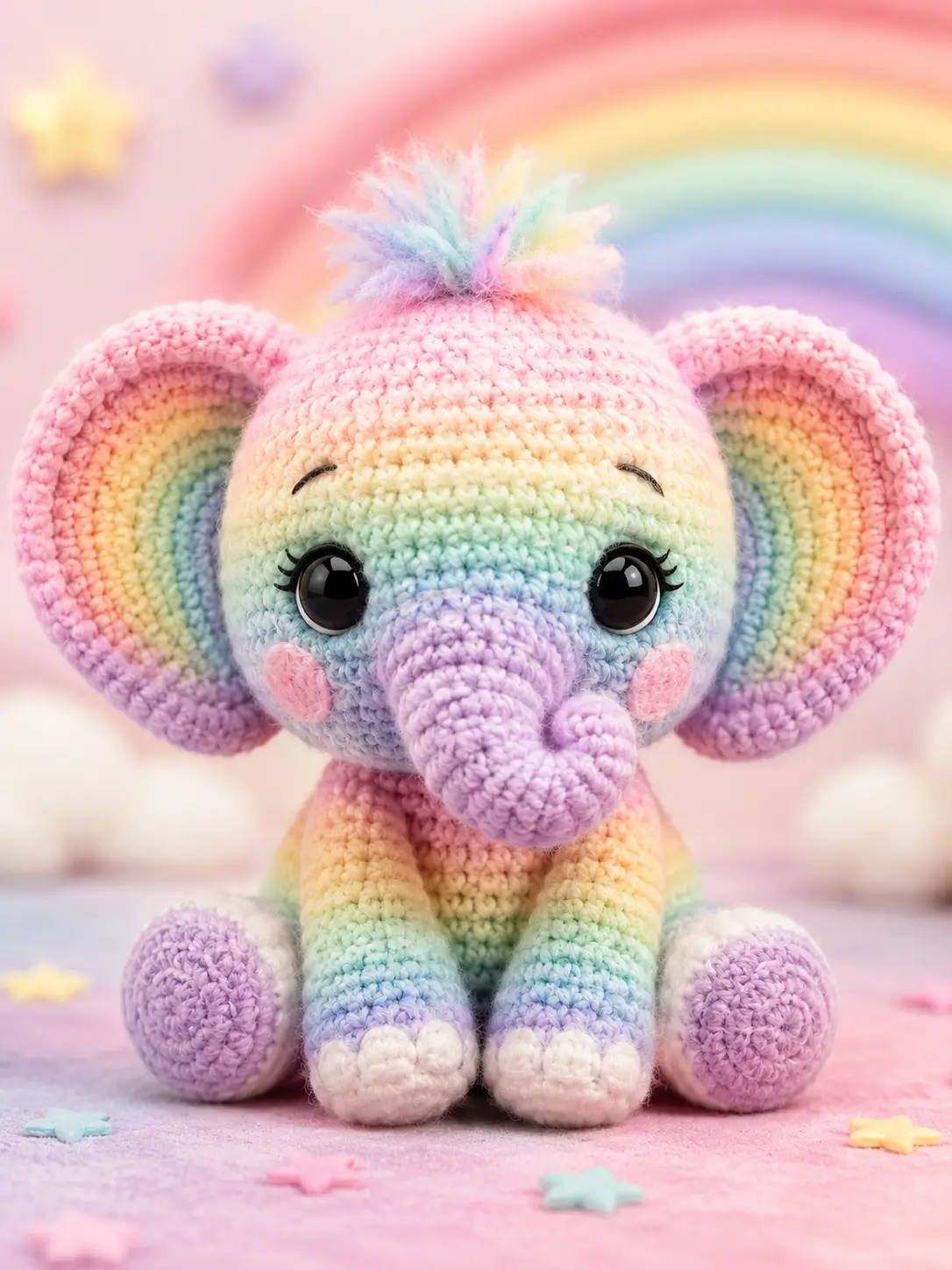
An elephant’s trunk has to read as flexible, heavy, and lifted before the ears even matter. This elephant amigurumi crochet pattern builds a pastel rainbow toy with DK yarn, a 2.5 mm hook, 10 mm eyes, and a 20 cm sitting height. The skill level is intermediate because shaping the trunk, ears, toes, cheeks, and tuft requires controlled tension. Make it for nursery décor or market display.
The Design: What Makes Rainbow Ellie Different
You build this rainbow elephant crochet pattern around three visual anchors: a wide head, oversized ears, and a short curled trunk. The head uses a 42-stitch plateau so the eyes can sit low without flattening the face. A smaller body keeps the toy in a seated pose and stops the trunk from making it tip forward. The maker then adds flat 42-stitch ears, not stuffed ears, because flat circles hold the rounded elephant silhouette better at DK scale. The trunk is a tube with a wider base, then it is curved by sewing tension rather than complex shaping. One common mistake in crochet elephant amigurumi work is placing the eyes too high. That turns the trunk into a beak shape and makes the ears look oversized for the wrong reason.
Project Info at a Glance
| Skill Level | Time | Finished Size | Hook | Best For |
|---|---|---|---|---|
| Intermediate | 2–3 sessions | 20 cm sitting | 2.5 mm | Nursery shelf, rainbow animal set, craft table sample |
Benchmarks for 20 cm DK sizing, DK yarn, 2.5 mm hook, and 10 mm eyes come from comparable elephant pattern listings. Source
Materials and Tools
Yarn
- Pastel rainbow DK yarn — DK / light-worsted — 115–125 g — suggested brands: Paintbox Cotton DK, Stylecraft Special DK, or any even self-striping DK.
- Lilac DK yarn — DK / light-worsted — 8–12 g — trunk tip, trunk body, and foot accents.
- Soft pink DK yarn — DK / light-worsted — 15–18 g — cheeks and optional ear border.
- White DK yarn — DK / light-worsted — 3–5 g — toe bobbles and eye highlights.
- Black embroidery thread — thread weight — under 1 g — eyelashes and brows.
The main and accent gram ranges are scaled from published elephant yarn-use data listing 121 g main yarn, 16 g pink, and 2 g white in a larger worsted elephant. Source
Tools
- Hook 2.5 mm
- 10 mm black safety eyes, 1 pair
- Polyester stuffing
- Yarn needle
- Stitch markers
- Pins
- Small slicker brush or comb for the top tuft
- Scissors
Safety eyes are measured in millimeters and are not classed as safe for children under age 3 or pets; embroider the eyes for that use case. Source
Abbreviations
MR = magic ring; sc = single crochet; inc = 2 sc in one stitch; dec = invisible decrease over 2 stitches; sl st = slip stitch; ch = chain; BLO = back loop only; bo = bobble stitch with 5 partial double-crochet pulls closed as 1 stitch.
Use invisible decreases on all closing rounds because standard decreases create diagonal holes on stuffed DK amigurumi.
Pattern — Step by Step
Work in a continuous spiral unless a section says otherwise. Count every round before starting the next one.
Head — Make 1
Yarn: pastel rainbow DK — Source: standard amigurumi sphere math, sized against DK elephant benchmarks.
R1: 6 sc in MR (6)
R2: inc ×6 (12)
R3: (sc, inc) ×6 (18)
R4: (2 sc, inc) ×6 (24)
R5: (3 sc, inc) ×6 (30)
R6: (4 sc, inc) ×6 (36)
R7: (5 sc, inc) ×6 (42)
R8–R15: sc around (42)
R16: (5 sc, dec) ×6 (36)
R17: (4 sc, dec) ×6 (30)
Insert 10 mm eyes between R11 and R12, 10 stitches apart, centered above the future trunk placement. Stuff the head firmly before the opening narrows.
R18: (3 sc, dec) ×6 (24)
R19: (2 sc, dec) ×6 (18)
R20: (sc, dec) ×6 (12)
R21: dec ×6 (6)
Fasten off. Close through front loops and hide the tail inside the head.
Body — Make 1
Yarn: pastel rainbow DK — Source: standard amigurumi body math with medium 36-stitch plateau.
R1: 6 sc in MR (6)
R2: inc ×6 (12)
R3: (sc, inc) ×6 (18)
R4: (2 sc, inc) ×6 (24)
R5: (3 sc, inc) ×6 (30)
R6: (4 sc, inc) ×6 (36)
R7–R12: sc around (36)
R13: (4 sc, dec) ×6 (30)
R14: sc around (30)
R15: (3 sc, dec) ×6 (24)
R16: sc around (24)
Stuff the lower body until it sits flat, then add lighter stuffing near the neck opening.
R17: (2 sc, dec) ×6 (18)
R18: sc around (18)
R19: (sc, dec) ×6 (12)
R20: dec ×6 (6)
Fasten off. Leave a 45 cm tail for sewing the body to the head.
Front Legs / Arms — Make 2
Yarn: white for sole and toe bobbles, then pastel rainbow DK — Source: standard amigurumi limb math.
R1: 6 sc in MR with white (6)
R2: inc ×6 (12)
R3: (sc, inc) ×6 (18)
R4: BLO sc around (18)
R5: Change to pastel rainbow: sc 4, [change to white, bo, change to rainbow, sc] ×3, sc 8 (18)
R6–R10: sc around (18)
R11: (sc, dec) ×6 (12)
R12–R15: sc around (12)
Stuff the foot firmly. Leave the upper half lightly stuffed so the legs hang forward instead of flaring outward.
Fasten off. Leave a 30 cm tail.
Back Legs — Make 2
Yarn: lilac and pastel rainbow DK — Source: standard amigurumi limb math.
R1: 6 sc in MR with lilac (6)
R2: inc ×6 (12)
R3: (sc, inc) ×6 (18)
R4: sc around (18)
R5: Change to pastel rainbow and sc around (18)
R6: (sc, dec) ×6 (12)
R7–R9: sc around (12)
Stuff each back leg firmly enough to hold a round foot shape. Do not overstuff the final round.
Fasten off. Leave a 30 cm tail.
Ears — Make 2
Yarn: pastel rainbow DK with soft pink final border — Source: elephant ear benchmark patterns use separate flat ear sections. Source
R1: 6 sc in MR (6)
R2: inc ×6 (12)
R3: (sc, inc) ×6 (18)
R4: (2 sc, inc) ×6 (24)
R5: (3 sc, inc) ×6 (30)
R6: (4 sc, inc) ×6 (36)
R7: (5 sc, inc) ×6 (42)
R8: Change to soft pink and sc around (42)
R9: sl st around loosely (42)
Keep the ears flat. Steam lightly only if the circles cup more than 1 cm at the edge.
Fasten off. Leave a 35 cm tail on each ear.
Curled Trunk — Make 1
Yarn: lilac DK — Source: comparable elephant patterns use a separate trunk section. Source
R1: 6 sc in MR (6)
R2–R5: sc around (6)
R6: inc ×6 (12)
R7–R14: sc around (12)
R15: (sc, inc) ×6 (18)
R16–R17: sc around (18)
Stuff the base only. Leave the tip almost empty so it can curl without a hard bend.
Fasten off. Leave a 45 cm tail. Curve the final 5 cm upward by sewing two small anchor stitches along the inner curve.
Cheek Patches — Make 2
Yarn: soft pink DK — Source: standard flat circle math.
R1: 6 sc in MR (6)
R2: inc ×6 (12)
R3: sl st around loosely (12)
Fasten off. Leave a 20 cm tail for sewing.
Top Tuft — Make 1
Yarn: pastel rainbow scraps — Source: photo-matched accessory method.
Cut 18 strands of pastel rainbow yarn, each 8 cm long. Pull each strand halfway through a stitch between head R1 and R3, knot it once, then repeat until the crown is full. Brush the strands outward and trim the tuft to 3 cm high.
Eyelashes and Brows
Yarn: black embroidery thread — Source: photo-matched face detail.
Stitch one shallow brow above each eye over 4 stitches. Add three short lashes to the outer edge of each eye, each lash no longer than 1 stitch width. Knot inside the head if it is still open; otherwise bury the thread through the lower back of the head.
Assembly
- Pin the head to the body with the body centered under head R18–R21.
- Sew the body to the head with the 45 cm body tail, catching one stitch from the body and one stitch from the head each time.
- Place the trunk centered between the eyes, with the upper trunk edge touching head R12.
- Sew the trunk base in an oval, then add two inner-curve stitches to hold the curl upward.
- Pin the ears to the sides of the head between R8 and R16, leaving the lower edge slightly behind the cheek line.
- Sew each ear around the inner third only, so the outer rim stays soft and round.
- Place cheek patches below the eyes and outside the trunk base, then sew around R2 of each patch.
- Sew front legs to the front body line between body R8 and R13, spaced 4 stitches apart.
- Sew back legs low on each side of the body, with the lilac foot tips facing forward.
- Add the top tuft last, trim loose strands, and bury all yarn tails through stuffed sections.
The finished elephant sits with the trunk lifted, ears spread, and front feet visible.
7 Technical Tips
- Stitch marker drift: If the marker moves more than 2 stitches by head R10, the ears will sit unevenly. Count all 42 stitches on every head plateau round before moving on.
- Eye placement failure: Eyes placed above R10 make the trunk look too low. Set 10 mm eyes between R11 and R12 with exactly 10 stitches between posts.
- Stuffing lump risk: A hard-packed trunk base pulls the snout downward. Fill only the base 2 cm and leave the tip soft.
- Invisible decrease gap: Standard decreases leave visible holes on R18–R21 of the head. Work every decrease through front loops only and tighten the following sc.
- Velvet or fuzzy yarn tension: Fuzzy DK can hide skipped stitches near color changes. Pause after each pastel stripe shift and recount before the next round.
- Pinning error: Ears pinned too far forward cover the cheeks. Keep the front ear edge at least 2 stitches behind the outer edge of each eye.
- Tail weaving weakness: Short buried tails can work out through the fuzzy halo. Weave every sewing tail through at least 5 cm of stuffed fabric before trimming.
Conclusion
This rainbow elephant is built from simple amigurumi math, but the final shape depends on exact placement: low eyes, a wide head, flat ears, forward feet, and a trunk that curls from sewing tension rather than heavy stuffing. Make one test ear before cutting into the main rainbow cake, then check whether the striping lands evenly across both sides of the head. For the next step, photograph the toy from the front and side before sharing it on Pinterest and Instagram. Use the main keyword in your pin text: elephant amigurumi crochet pattern. Hashtag: #RainbowElephantAmigurumi. Would you keep this elephant’s trunk lifted, or curve it closer to the cheek?