Introduction
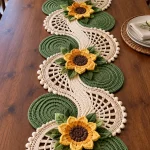
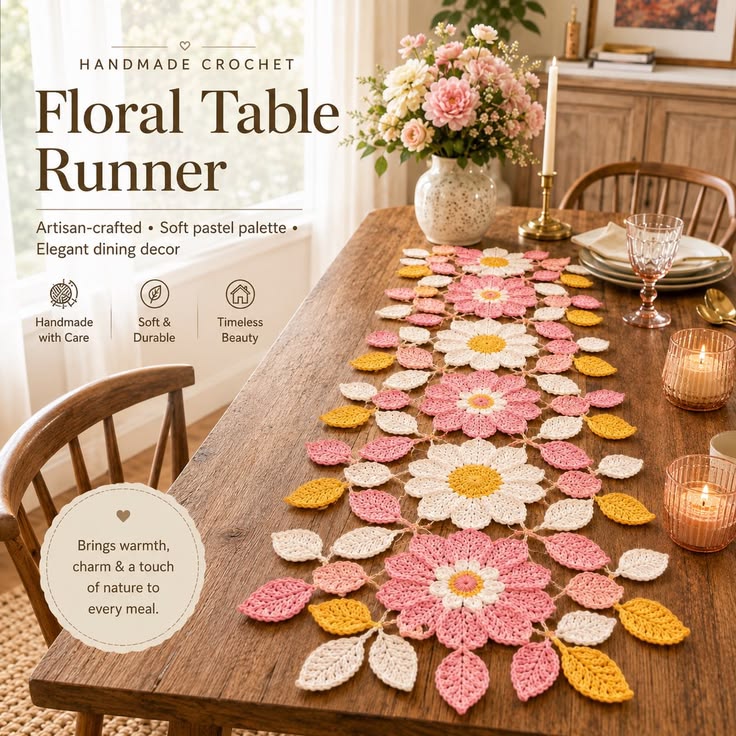
Six oversized daisies form the runner’s central spine while dozens of detached leaves replace the solid fabric normally found beneath table crochet. This pink daisy crochet floral table runner pattern uses worsted cotton, a 4 mm hook, pink and ivory flower motifs, mustard centers, and linked leaf branches. The intermediate reconstruction targets approximately 30 × 150 cm and works as a lightweight dining-table centerpiece.
The instructions below are an original photo-inspired reconstruction based on visible structure; published patterns cited later are used only for sizing, gauge, and material benchmarks.
The Design: What Makes This Floral Runner Different
The reference is essentially an open botanical garland rather than a conventional rectangular runner. Six large flowers establish a straight central axis, while pairs of pink, ivory, and mustard leaves widen the composition without filling the spaces between motifs. Short chain connectors carry the structural load, allowing the wooden tabletop to remain visible. Two flower constructions provide the second major distinction: ivory daisies use long separate petals around mustard centers, while pink flowers use broad layered petals and smaller contrasting centers. This crochet flower table runner with leaves therefore depends on motif placement more than background stitch texture. A frequent mistake is making every connecting chain the same length. That forces the leaves into rigid rows and can make the narrow runner twist instead of lying flat along the table.
Project Info at a Glance
| Skill Level | Time | Finished Size | Hook | Best For |
|---|---|---|---|---|
| Intermediate | Approx. 12–16 hours | Reconstruction target: approx. 30 × 150 cm | 4 mm | Dining tables, sideboards, spring and summer centerpieces |
The 30 × 150 cm dimensions are reconstruction targets inferred from the photograph rather than measurements of an identified pattern. Jessie Rayot’s published Floral Motif Table Runner uses worsted cotton and a 4 mm hook and measures approximately 28 × 94 cm. Jessica Underwood’s Boho Floral Table Runner uses cotton Aran yarn with a 5.5 mm hook and measures approximately 28 × 241 cm, showing how readily floral runners can be extended for long dining tables.
Materials and Tools
Yarn
- Dusty pink — worsted #4 cotton — approximately 120–140 g
- Warm ivory / cream — worsted #4 cotton — approximately 90–110 g
- Mustard yellow — worsted #4 cotton — approximately 35–45 g
- Pale blush — worsted #4 cotton — approximately 15–20 g
- Light tan — worsted #4 cotton — approximately 30–40 g for connectors
A smooth mercerized or tightly twisted cotton gives the leaves enough body to remain recognizable without adding stuffing. Jessie Rayot’s floral runner uses Lion Brand 24/7 Cotton and approximately 250 g total for a 28 × 94 cm project, providing a useful worsted-cotton material benchmark.
Tools
- 4 mm crochet hook
- 3.5 mm hook — optional for firmer small leaves
- Tapestry needle
- Locking stitch markers
- Blocking mats
- Rust-resistant pins
- Scissors
- Measuring tape
Abbreviations
- MR — magic ring
- ch — chain
- sl st — slip stitch
- sc — single crochet
- hdc — half double crochet
- dc — double crochet
- tr — treble crochet
- dtr — double treble crochet
- st/sts — stitch/stitches
Invisible decreases are unnecessary because every component is worked flat and shaped through stitch height rather than amigurumi decreases.
Pattern — Step by Step
Large Ivory Daisy — Make 3
Yarn: mustard center and warm ivory petals.
The three ivory daisies provide the brightest large motifs. Target approximately 13–14 cm diameter.
Center R1: With mustard, make 6 sc in MR. Join with sl st. (6)
Center R2: Ch 1. Inc ×6. Join. (12)
Center R3: Ch 1. (1 sc, inc) ×6. Join. (18)
Center R4: Ch 1. (2 sc, inc) ×6. Join. (24)
Fasten off mustard.
Join ivory in any stitch.
Petal Round: Each petal consumes two center stitches. Work *sl st in next st, ch 9; starting in second ch from hook work sc, hdc, dc, tr, tr, dc, hdc, sc; sl st in next center st*. Repeat 12 times. (12 petals)
Fasten off with a 35 cm tail.
Block the petals radially, keeping approximately equal space between neighboring tips.
Large Pink Daisy — Make 3
Yarn: mustard, ivory and dusty pink.
The pink motifs alternate with the ivory daisies along the runner’s center line.
R1: With mustard, 6 sc in MR. Join. (6)
R2: Inc ×6. Join. (12)
Change to ivory.
R3: *Sl st in next st, (ch 3, 3 dc, ch 3, sl st) in next st*. Repeat ×6. (6 small ivory petals)
Fasten off ivory.
Turn the flower over. Join dusty pink around a post between two ivory petals.
R4: *Ch 5, sl st around the next available post space behind the following ivory petal*. Repeat six times to create six rear loops.
R5: Into each ch-5 loop work sc, hdc, dc, 3 tr, dc, hdc, sc. Repeat around. (6 large pink petals)
R6: Sl st to the middle tr of the first large petal. Ch 1, work sc, ch 2, sc into the middle tr, then sl st along the remaining petal edge. Repeat around to give each large petal a shallow pointed tip.
Fasten off with a 40 cm tail.
Target approximately 14–15 cm diameter.
Small Pink Flower — Make 4
Yarn: pale blush center and dusty pink petals.
R1: With pale blush, 6 sc in MR. (6)
Change to pink.
R2: In each stitch work sl st, ch 3, 3 dc, ch 3, sl st. Repeat in all six stitches. (6 petals)
Fasten off with a 25 cm tail.
Target approximately 5–6 cm.
Small Ivory Flower — Make 3
R1: With mustard, 6 sc in MR. (6)
Change to ivory.
R2: In each stitch work sl st, ch 3, 2 dc, ch 3, sl st. Repeat six times. (6 petals)
Fasten off.
Target approximately 4.5–5.5 cm.
Large Pointed Leaf
The reference uses many detached oval-pointed leaves. The following construction gives an exact mirrored leaf around one foundation chain.
Large Leaf — Make 20 Total
Suggested distribution: 8 dusty pink, 7 ivory, 5 mustard.
Ch 13.
Starting in second ch from hook work:
sl st, sc, hdc, dc, dc, tr, tr, dc, dc, hdc, sc, sl st.
Ch 2 at the tip.
Working down the unused loops on the opposite side of the foundation chain:
sl st, sc, hdc, dc, dc, tr, tr, dc, dc, hdc, sc, sl st.
Sl st to the starting point.
Fasten off with a 25 cm tail.
Target approximately 8–9 cm long × 4–4.5 cm wide.
Small Leaf — Make 18 Total
Suggested distribution: 8 pink, 6 ivory, 4 mustard.
Ch 10.
Starting in second chain work:
sl st, sc, hdc, dc, tr, dc, hdc, sc, sl st.
Ch 2 at the tip.
Mirror the same sequence along the opposite side:
sl st, sc, hdc, dc, tr, dc, hdc, sc, sl st.
Fasten off with a 20 cm tail.
Target approximately 6–7 cm long.
Optional Raised Leaf Vein
For a more defined leaf, rejoin the matching color at the base.
Surface sl st along the foundation chain toward the tip.
Fasten off at the point.
Do not pull the surface stitches tighter than the foundation. A shortened vein will fold the leaf along its center.
Central Connector Cord
Yarn: light tan.
The photographed runner has no solid background. A narrow connector system links the flowers and leaves while leaving substantial table surface exposed.
Ch 230.
Starting in second chain from hook, sl st in every chain. (229 sl sts)
Fasten off.
Block the cord to approximately 145 cm. The end flowers and leaves will extend the finished runner to roughly 150 cm.
Side Branch Connector — Make 16
Ch 14.
Starting in second chain, sl st in all 13 chains.
Fasten off with a 15 cm tail at both ends.
Each branch should measure approximately 7–8 cm after blocking.
Short Connector — Make 12
Ch 9.
Starting in second chain, sl st in all 8 chains.
Fasten off with sewing tails.
These short links attach smaller leaves and flowers without widening the runner excessively.
Establishing the Six-Flower Spine
Block the long tan connector cord straight.
Mark its midpoint.
Place the six large flowers along the cord in this order:
Pink → Ivory → Pink → Ivory → Pink → Ivory.
Reverse the order if desired; the structural spacing remains the same.
Leave approximately 18–20 cm between flower centers.
Position the first and last large flower approximately 12–15 cm inside the finished tips of the runner.
Sew the connector to the wrong side of each flower center using three or four small stitches.
Adding the Side Branches
Attach one 14-chain branch approximately halfway between neighboring large flowers.
Angle the branches alternately toward the left and right.
Add a second branch on the opposite side approximately 4–5 cm farther along the main cord.
This offset placement prevents the leaves from forming rigid horizontal pairs.
Attach two additional branches near each end flower to create the wider botanical tips visible in the photograph.
Attaching the Large Leaves
Sew one large leaf to the outer end of each long branch.
Use the leaf tail to stitch through approximately 1.5 cm of its base.
Leave the outer portion free.
Rotate neighboring leaves between approximately 25 and 50 degrees from the central axis.
Alternate pink and ivory frequently, placing mustard leaves more selectively near the outer edges.
Attaching Small Leaves
Use the eight-stitch connector cords to place smaller leaves between the large branch points.
Some small leaves can be sewn directly beside a flower without a separate branch.
Keep approximately 3–5 cm of open space between neighboring leaf tips wherever possible.
The negative space is part of the runner’s design.
Adding the Small Flowers
Place one small flower in several of the larger gaps between leaf branches.
Do not center every small flower directly between the large motifs.
Offset them toward alternating sides.
Secure each through its center only, adding one concealed stitch beneath a petal if the flower rotates.
End Arrangement
At each end, place one large flower closest to the central spine.
Extend two or three leaves beyond it.
Add one small flower or contrasting leaf slightly off-center.
The end should taper rather than finish as a straight horizontal line.
Target an overall end width of approximately 28–30 cm.
Assembly
- Crochet three large ivory daisies and three large pink flowers, block them to approximately 13–15 cm diameter, and confirm that all six lie flat before building the runner.
- Make four small pink flowers and three small ivory flowers, leaving at least 20–25 cm of sewing yarn on each motif for attachment.
- Crochet twenty large pointed leaves and eighteen smaller leaves in the specified pink, ivory, and mustard distribution, then block every leaf to its intended pointed shape.
- Make the 229-slip-stitch central connector and block it to approximately 145 cm without stretching the cord until the stitches become visibly open.
- Position the six large flowers along the central connector with approximately 18–20 cm between centers, alternating pink and ivory motifs.
- Attach the sixteen long side branches between the large flowers, alternating their direction and offsetting opposite branches by approximately 4–5 cm.
- Sew large leaves to the long branches, then use the twelve short connectors to position smaller leaves in remaining gaps without creating rigid horizontal rows.
- Add the seven small flowers asymmetrically between leaf groups, sewing through their centers and leaving the outer petal edges free.
- Build each end into a tapered botanical point using two or three projecting leaves and confirm that the maximum runner width remains near 30 cm.
- Weave every tail through at least 5 cm of matching crochet, steam or wet-block the complete runner to approximately 30 × 150 cm, and verify that the central connector remains straight.
The finished runner should form a narrow open botanical garland with six dominant flowers, multicolored pointed leaves, smaller blossoms, and visible tabletop between its branches.
7 Technical Tips
- The central runner curves sideways: block the 229-slip-stitch connector to a straight 145 cm line before attaching motifs. Sewing flowers onto an unblocked cord can lock several centimeters of twist into the completed piece.
- The large daisies cup upward: keep all twelve ivory petals attached to the 24-stitch center at exactly two center stitches per petal. Adding extra attachment stitches around only part of the circle forces the flower edge to rise.
- The leaves fold lengthwise: keep any surface-slip-stitch vein equal in length to the original foundation chain. A vein shortened by approximately 5 mm is enough to pull a cotton leaf into a pronounced central crease.
- The runner becomes too wide: keep long branches near 7–8 cm and rotate the attached leaves diagonally instead of directly sideways. Two opposing 9 cm leaves can push the finished width beyond the 30 cm reconstruction target.
- A flower rotates around the connector: use at least three attachment points across approximately 2 cm of its center. A single stitch creates a pivot and allows a 14 cm flower to turn during handling.
- The openwork looks like a rigid ladder: offset opposite branch attachment points by approximately 4–5 cm. Branches attached at identical positions on both sides create repeated horizontal bars rather than the irregular botanical structure in the reference.
- The runner shortens after assembly: measure the central connector after every two large flowers are attached. If the motif stitches gather more than approximately 1 cm per section, loosen the attachment before adding further leaves.
Why Cotton Works for This Construction
The runner contains very little continuous fabric, so each motif has to hold its own outline.
Cotton provides the stitch definition needed for pointed leaves and long daisy petals. It also blocks predictably and has enough weight to help the garland remain flat on a dining table.
Jessie Rayot’s published Floral Motif Table Runner uses worsted 100% cotton with a 4 mm hook, while Jessica Underwood’s 2024 Boho Floral Table Runner uses Aran-weight 100% cotton. Both provide relevant material benchmarks for a motif-based table runner.
Published Worsted Floral Runner Benchmark
Jessie Rayot’s Floral Motif Table Runner specifies Lion Brand 24/7 Cotton, worsted weight, a 4 mm hook, and approximately 250 g total yarn.
The published finished size is approximately 11 × 37 inches / 28 × 94 cm, with a gauge of 17 stitches × 20 rows per 10 cm in single crochet.
The designer notes that the ends can be extended to make a longer table runner. That modular approach is particularly relevant to the elongated reconstruction shown here.
Published Long Table Runner Benchmark
Jessica Underwood’s Boho Floral Table Runner was published in 2024 and uses Aran-weight cotton with a 5.5 mm hook.
The published runner measures approximately 95 × 11 inches / 241 × 28 cm and is designed to be customizable for different table sizes.
Its extreme length demonstrates that a narrow floral runner can extend well beyond 150 cm without needing additional width.
Published Modular Flower-and-Leaf Benchmark
The Delilah Table Runner by Alexandra of EyeLoveKnots and Cre8tion Crochet is assembled from floral motifs with leaves added around them.
The published notes specify approximately 12 yards of yarn per flower and 4 yards per full leaf.
Those quantities provide useful planning data for a design containing many independent motifs, although the flower and leaf instructions in this reconstruction are original.
Published Sport-Cotton Floral Benchmark
Helda Panagary’s Floral Table Runner uses sport-weight 100% cotton and a 2.5 mm hook.
The pattern is modular and motif-based, demonstrating another method for creating table crochet from independent botanical components rather than a single rectangular fabric.
Using worsted cotton here enlarges the motifs and reduces the number required to cover a long dining table.
Published Fine-Lace Runner Benchmark
Raine Eimre’s Floral Table Runner uses mercerized cotton thread, a 1.75 mm hook, and approximately 229 m of thread.
Its finished size is approximately 20 × 79 cm.
That runner uses continuous lace rather than detached leaves, so the figures are useful mainly for comparing how yarn thickness changes the physical scale and material consumption of table crochet.
Published 3.5 mm Motif Benchmark
Annamarie Esterhuizen’s Retro Flower Table Runner uses fingering-weight cotton/bamboo yarn and a 3.5 mm hook.
The published yardage is approximately 850–875 m, and the design uses fourteen octagonal flower motifs joined into a runner.
Its high meterage compared with this open reconstruction reflects the difference between full lace motifs and widely spaced leaves connected by narrow cords.
Flower Spacing Math
Six flower centers distributed over approximately 120 cm of the interior runner require five primary spaces.
120 ÷ 5 = 24 cm.
Because the large flowers themselves measure 13–15 cm across, a center-to-center interval around 18–24 cm produces slight visual overlap between surrounding leaves without allowing the flower heads themselves to collide.
Begin near 20 cm and refine the spacing during dry layout.
Why the Runner Has No Solid Background
A cream lace rectangle underneath these motifs would change the visual character significantly.
The photographed design relies on the table itself as the negative background.
Connector cords therefore have two jobs: they hold the motifs together and establish the elongated runner outline.
Keep them narrow and close in color to the light motifs so they do not become a competing graphic element.
Changing the Runner Length
Add or remove one large flower section.
Each additional section requires approximately 18–22 cm of central connector plus one large flower, two or three side branches, and four to six leaves.
For a 120 cm runner, use five large flowers.
For approximately 170 cm, use seven.
Preserve the alternating pink-and-ivory sequence as the central line grows.
Changing the Runner Width
Width is controlled almost entirely by branch length and leaf angle.
Shorten each 14-chain branch to 10 chains for a runner closer to 24–25 cm wide.
For a wider centerpiece, increase the branch to 18 chains and add one extra leaf near selected outer tips.
Do not enlarge every branch simultaneously without checking the table width.
Making the Pink Flowers Larger
Add a second rear petal layer.
Join yarn behind R5 and create six ch-7 loops.
Into each loop work sc, hdc, dc, tr, 3 dtr, tr, dc, hdc, sc.
This increases both diameter and depth.
Use the larger treatment only if the runner is intended for a wide dining table, because oversized petals reduce the open spaces between neighboring leaves.
Making Smaller Daisies
Stop the mustard center after 18 stitches.
Make nine petals, each consuming two center stitches.
Reduce the petal foundation from ch 9 to ch 7.
The finished flower should measure approximately 9–11 cm, making it suitable for a narrower runner or matching placemat.
Changing the Palette
Dusty pink, ivory, and mustard match the visible reference most closely.
For a cooler version, replace mustard leaves with muted sage while retaining yellow flower centers.
A monochrome cream runner can use three shades of natural cotton.
Maintain at least one high-contrast center color so the large daisies remain readable from across the table.
Correcting a Twisted Connector
Remove the nearest two motifs before attempting to block the twist out.
Lay the cord straight and pin it every 5 cm.
Reattach the motifs while the cord is held flat.
Trying to rotate an already assembled section usually transfers the twist into the adjacent branches instead of correcting it.
Correcting a Cupped Flower
Check the center before altering the petals.
If the center lies flat but the petals rise, block each petal separately.
If the center itself cups, the final center round contains too few stitches for the tension used.
Remake that motif rather than stretching a severe cup into a larger circle.
Correcting Uneven Leaf Sizes
Measure from the foundation-chain base to the point, not across the curved outer edge.
Large leaves should stay within approximately 5 mm of one another.
If a particular yarn color consistently works smaller, move up 0.5 mm in hook size for that color rather than adding unplanned stitches.
Correcting a Runner That Will Not Lie Flat
Inspect the central connector first.
Then check the branch attachments.
If both are flat, examine overlapping leaves and flowers for sewing stitches that were pulled too tightly.
Loosen those attachment points before blocking. Blocking can refine a flat structure, but it cannot reliably correct motifs that have been gathered by tight sewing.
Care and Blocking
Follow the care instructions for the selected cotton.
After washing, pin the central line first.
Set the six large flowers next.
Then position branch ends and leaf tips.
Measure the maximum width at several points and keep it near the intended 30 cm.
Allow the runner to dry completely before removing pins.
Sources
Ravelry — Floral Motif Table Runner by Jessie Rayot — worsted 100% cotton, 4 mm hook, 250 g material benchmark, 28 × 94 cm finished size, and published gauge.
Ravelry — Boho Floral Table Runner by Jessica Underwood — Aran cotton, 5.5 mm hook, intermediate construction, and approximately 28 × 241 cm published size.
Ravelry — Delilah Table Runner — modular flowers with separately added leaves and published estimates of approximately 12 yards per flower and 4 yards per full leaf.
Ravelry — Floral Table Runner by Helda Panagary — modular motif construction using sport-weight 100% cotton and a 2.5 mm hook.
Ravelry — Floral Table Runner by Raine Eimre — 1.75 mm hook, approximately 229 m of mercerized cotton thread, and an approximately 20 × 79 cm finished size.
Ravelry — Retro Flower Table Runner by Annamarie Esterhuizen — fingering cotton/bamboo yarn, 3.5 mm hook, 850–875 m, and fourteen joined flower motifs.
Ravelry — Flower Table Runner by Meladoras Creations — published flower-runner reference with 8 cm flower motifs and a 6 mm hook.
Conclusion
Build the runner around its central line rather than sewing a pile of finished motifs together without a placement plan. Make the six large flowers first, block the 145 cm connector, and test 18–20 cm center spacing before producing all thirty-eight leaves. That single dry layout establishes the final proportions and shows which leaf colors are needed in each section. The next step is one pink flower, one ivory daisy, and two leaf sizes as a scale test. Save this pink daisy crochet floral table runner pattern to Pinterest or share the finished runner on Instagram with #PinkDaisyFloralRunner. Would you keep the mustard outer leaves or replace them with sage green? “`0