Introduction
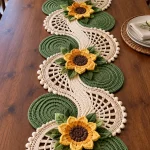
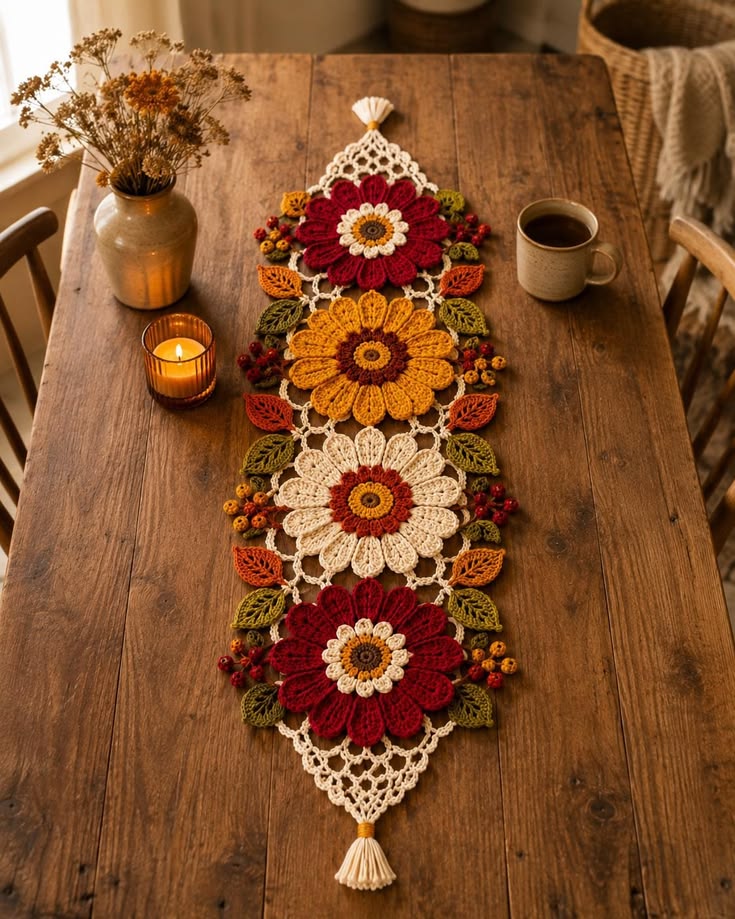
Four giant flower heads have to share one narrow lace spine without the burgundy petals colliding with the olive and rust leaves. This autumn sunflower crochet table runner pattern uses DK cotton, a 3.5 mm hook, layered floral motifs, openwork joining, berries, pointed leaves, and tassels. The intermediate reconstruction targets approximately 28 × 120 cm, suitable for a long dining-table centerpiece.
The instructions below are an original photo-inspired reconstruction based on visible structure; published patterns cited later are used only for sizing, gauge, and material benchmarks.
The Design: What Makes This Autumn Runner Different
The photographed runner has no conventional rectangular background. Four large flowers create the central axis: two burgundy blooms frame a mustard flower and a cream flower, while an ivory chain-space network holds the composition together. Olive and rust leaves occupy the outer edges, and small red, mustard, and olive berries fill selected junctions without closing the negative space. Triangular lace points and cream tassels finish both ends. This autumn sunflower crochet table runner pattern therefore depends on motif diameter, connector tension, and balanced side placement rather than rows of continuous fabric. One common maker error is attaching the flowers before blocking them to matching diameters. A difference of only 1–2 cm can shift the lace network sideways and make the runner appear crooked when viewed along the table.
Project Info at a Glance
| Skill Level | Time | Finished Size | Hook | Best For |
|---|---|---|---|---|
| Intermediate | Approx. 14–18 hours | Reconstruction target: approx. 28 × 120 cm | 3.5 mm | Fall dining tables, Thanksgiving centerpieces, sideboards |
The 28 × 120 cm measurement is a reconstruction target inferred from the photograph, not a verified measurement of an identified pattern. A currently published autumn floral runner on Etsy lists DK/light #3 cotton, a 3–3.5 mm hook, and a finished size of approximately 90–96 × 24–28 cm. Raine Eimre’s smaller filet Sunflower Table Runner measures approximately 46 × 22 cm and uses size-10 cotton thread with a 1.75 mm hook.
Materials and Tools
Yarn
- Warm ivory — DK/light #3 cotton — approximately 90–110 g
- Deep burgundy — DK/light #3 cotton — approximately 80–100 g
- Mustard gold — DK/light #3 cotton — approximately 55–70 g
- Rust / burnt orange — DK/light #3 cotton — approximately 30–40 g
- Dark olive — DK/light #3 cotton — approximately 50–65 g
- Dark brown — DK/light #3 cotton — approximately 15–20 g
- Berry red — DK/light #3 cotton — approximately 15–20 g
Plan approximately 335–425 g total yarn. These are reconstruction estimates rather than published requirements for the photographed piece. Cotton is useful here because the pointed petals, leaves, lace connectors, and triangular ends all benefit from crisp blocking.
Tools
- 3.5 mm crochet hook
- 3 mm crochet hook — optional for compact berries
- Tapestry needle
- Locking stitch markers
- Blocking mats
- Rust-resistant pins
- Scissors
- Measuring tape
- Card approximately 8 cm wide — for tassels
Abbreviations
- MR — magic ring
- ch — chain
- sl st — slip stitch
- sc — single crochet
- hdc — half double crochet
- dc — double crochet
- tr — treble crochet
- dtr — double treble crochet
- inc — 2 sc in one stitch
- st/sts — stitch/stitches
An invisible decrease is not required because the flowers, leaves, lace, and berries are constructed as flat or minimally dimensional motifs rather than closed stuffed amigurumi.
Pattern — Step by Step
Large Burgundy Flower — Make 2
Yarn: brown, mustard, ivory, and burgundy.
Target approximately 19–21 cm diameter after blocking.
Center
R1: With dark brown, 6 sc in MR. Join with sl st. (6)
R2: Inc ×6. Join. (12)
R3: (1 sc, inc) ×6. Join. (18)
Change to mustard.
R4: (2 sc, inc) ×6. Join. (24)
Change to ivory.
R5: *Sl st in next st, (ch 3, 3 dc, ch 3, sl st) in next st.* Repeat ×12. (12 small ivory petals)
Fasten off ivory.
Burgundy Outer Petals
Turn the flower over. Join burgundy around the base of one ivory petal.
R6: *Ch 7, sl st around the base of the next ivory petal.* Repeat ×12. (12 ch-7 loops)
R7: Into each ch-7 loop work sc, hdc, dc, tr, 3 dtr, tr, dc, hdc, sc. Repeat ×12. (12 large petals)
R8: Sl st along each petal edge to the middle dtr. In the middle dtr work sc, ch 2, sc, then sl st down the opposite edge. Repeat around.
Fasten off with a 45 cm sewing tail.
Blocking the Burgundy Flowers
Pin the center first.
Position the twelve outer tips approximately 30 degrees apart.
Measure across opposite petal tips and keep the two burgundy flowers within approximately 5 mm of one another.
Do not stretch the ivory inner petals flat against the burgundy layer. Their smaller raised ring should remain visible.
Large Mustard Sunflower — Make 1
Yarn: dark brown, rust and mustard.
R1: With brown, 6 sc in MR. (6)
R2: Inc ×6. (12)
Change to mustard.
R3: (1 sc, inc) ×6. (18)
Change to rust.
R4: (2 sc, inc) ×6. (24)
Change to mustard.
R5: *Sl st in next st, ch 8; starting in second ch from hook work sc, hdc, dc, tr, dc, hdc, sc; sl st in next center st.* Repeat ×12. (12 petals)
Fasten off with a 45 cm tail.
Target approximately 19–21 cm diameter.
Large Cream Sunflower — Make 1
Yarn: brown, mustard, rust and ivory.
R1: With brown, 6 sc in MR. (6)
R2: Inc ×6. (12)
Change to mustard.
R3: (1 sc, inc) ×6. (18)
Change to rust.
R4: (2 sc, inc) ×6. (24)
Change to ivory.
R5: *Sl st in next st, ch 8; starting in second ch from hook work sc, hdc, dc, tr, dc, hdc, sc; sl st in next center st.* Repeat ×12. (12 petals)
Fasten off with a 45 cm tail.
Block to approximately 19–21 cm.
Why the Flowers Use 12 Outer Petals
The photographed flowers have broad, elongated petals rather than the dense 20–30-petal construction of a realistic sunflower head.
A 24-stitch outer center divides exactly into twelve two-stitch attachment sections:
24 ÷ 2 = 12 petals.
This produces a reproducible radial layout without squeezing extra petals into the final few stitches.
Large Openwork Leaf — Make 16
Suggested colors: 10 olive and 6 rust.
Published crochet-leaf references use worsted yarn with hooks around 3.5 mm; the construction below is an original DK reconstruction.
Ch 15.
Starting in second ch from hook work:
sl st, sc, hdc, dc, dc, tr, tr, tr, dc, dc, hdc, sc, sl st, sl st.
Ch 2 at the tip.
Working into the unused loops along the opposite side of the foundation chain, mirror the sequence:
sl st, sl st, sc, hdc, dc, dc, tr, tr, tr, dc, dc, hdc, sc, sl st.
Join at the base.
Do not fasten off.
Leaf Openwork Round
Ch 1.
Work toward the tip using *sc in next 2 sts, ch 2, skip 1 st* four times.
Sc in the remaining stitches before the tip.
At the point work sc, ch 2, sc.
Repeat the same openwork treatment down the opposite side.
At the base ch 4, then sl st back through all four chains to make the stem.
Fasten off with a 25 cm tail.
Target approximately 8–9 cm long.
Small Olive Leaf — Make 8
Ch 10.
Starting in second chain work sl st, sc, hdc, dc, tr, dc, hdc, sc, sl st.
Ch 2 at the tip.
Mirror the same nine-stitch sequence along the opposite side.
Ch 3 for the stem and sl st back through the chains.
Fasten off with a 20 cm tail.
Target approximately 5–6 cm long.
Red Berry — Make 18
Yarn: berry red.
R1: 6 sc in MR. (6)
R2: Sc around. (6)
Fasten off with a 15 cm tail.
Pull the tail through all six stitches and close the tiny motif.
Flatten rather than stuff.
Mustard Berry — Make 12
Repeat the red berry construction in mustard:
R1: 6 sc in MR. (6)
R2: Sc around. (6)
Fasten off and close.
Olive Berry — Make 8
Repeat:
R1: 6 sc in MR. (6)
R2: Sc around. (6)
Fasten off and flatten.
Berry Clusters
Arrange berries in groups of three to five.
Thread one long matching tail through neighboring berry centers.
Leave approximately 5–8 mm between individual berries rather than packing them into one solid ball.
Make approximately ten small clusters from the 38 berries.
Mix mustard with red in selected clusters, while keeping several clusters single-color.
Ivory Joining Cord — Make 3
Yarn: warm ivory.
Ch 42.
Starting in second chain, sl st in every chain. (41 sl sts)
Fasten off with a 25 cm tail at each end.
These short cords link the four large flowers while providing attachment points for the surrounding mesh.
Joining the Four Main Flowers
Arrange the flowers in this order:
Burgundy → Mustard → Cream → Burgundy.
Place approximately 5–7 cm between neighboring petal tips before joining.
Center one ivory cord in each gap.
Sew approximately 3 cm of cord beneath the edge of each neighboring flower.
After joining, the flower centers should form one straight longitudinal line.
Side Lace Mesh
The photographed background uses an irregular chain-space network. For a reproducible reconstruction, build separate mesh strips and sew them behind the flower edges.
Left Mesh Strip — Make 1
Ch 9.
Row 1: Sc in second ch from hook, *ch 5, skip 2 ch, sc in next ch* twice, ch 5, sc in final ch. (3 ch-5 spaces)
Row 2: Ch 5, turn. Sc in first ch-5 space, ch 5, sc in next ch-5 space, ch 5, sc in final ch-5 space. (3 spaces)
Rows 3–32: Repeat Row 2. (3 ch-5 spaces per row)
Fasten off with a 40 cm tail.
Right Mesh Strip — Make 1
Repeat the left mesh strip exactly.
Block both strips to matching lengths before attachment.
Attaching the Side Mesh
Place one strip along each side of the four-flower spine.
Pin each strip so its inner edge passes behind the outer third of the large petals.
Sew the mesh to every second or third petal base rather than every petal tip.
Keep the outside mesh edge approximately 3–5 cm beyond the flower edges where leaves will be added.
The two strips should remain parallel and should not pull the flower centers away from the runner’s longitudinal axis.
Top Triangular Lace Point
Join ivory to the upper end of both side mesh strips.
Row 1: Create 7 ch-5 loops across the full width, anchoring each loop with sc into the existing mesh edge. (7 loops)
Row 2: Ch 5, turn. Sc in first loop, then *ch 5, sc in next loop* across, omitting the final outside loop. (6 loops)
Row 3: Repeat the decrease principle. (5 loops)
Row 4: 4 loops.
Row 5: 3 loops.
Row 6: 2 loops.
Row 7: 1 loop.
Row 8: Ch 8 and sl st into the same point to form a tassel loop.
Fasten off.
Bottom Triangular Lace Point
Repeat the eight-row triangular lace point at the opposite end.
Block both points to approximately the same depth.
Tassels — Make 2
Wrap ivory yarn around an 8 cm card 22 times.
Thread a separate 20 cm strand beneath the wraps and tie firmly at the top.
Remove the bundle from the card.
Wrap another strand approximately 1.5 cm below the top six times to form the tassel neck.
Knot securely.
Cut the lower loops and trim the tassel to approximately 7 cm.
Attach one tassel to each ch-8 end loop.
Leaf Placement
Position the sixteen large leaves before sewing.
Use olive leaves around every flower.
Place rust leaves mainly between the flower units, where their color can separate the burgundy and mustard petals.
Angle leaves diagonally at approximately 30–50 degrees rather than pointing them straight outward.
Place the eight small olive leaves beside berry clusters and in gaps where a full-size leaf would exceed the 28 cm target width.
Berry Placement
Place clusters near the gaps between large flowers.
Avoid attaching berries directly over the large flower petals.
Use red berries beside cream and mustard motifs.
Mustard berries work particularly well near burgundy flowers.
Leave some mesh intersections undecorated so the ivory lace remains visible.
Attaching the Leaves
Sew each leaf stem completely to the mesh.
Add one concealed attachment stitch approximately 1.5 cm up the center of a large leaf.
Leave the remaining leaf body free.
Small leaves require only the stem plus one center stitch.
Do not sew around the full perimeter because the photograph retains dimensional lift at the leaf edges.
Attaching Berry Clusters
Secure each cluster through its connecting thread or through the center of the lowest berry.
Add two attachment points approximately 1 cm apart.
Allow the outer berries to remain free.
This keeps the cluster visible without forcing every small berry flat against the lace.
Assembly
- Crochet two burgundy flowers, one mustard sunflower, and one cream sunflower, then block all four to approximately 19–21 cm across before joining any motifs.
- Arrange the flowers in the order burgundy, mustard, cream, burgundy and align all four centers along one straight longitudinal line.
- Join neighboring flowers with the three ivory slip-stitch cords, maintaining approximately 5–7 cm of visible space between adjacent petal tips.
- Crochet two matching 32-row ivory mesh strips, block them to equal lengths, and sew one behind each side of the four-flower spine.
- Add the seven-loop triangular lace section to each end, decreasing by exactly one loop per row until one loop remains, then make the ch-8 tassel attachment loop.
- Crochet sixteen large leaves and eight smaller olive leaves, block their pointed tips, and position them along the side mesh without exceeding the approximately 28 cm target width.
- Make eighteen red, twelve mustard, and eight olive berries, combine them into small clusters, and position those clusters near selected flower-to-flower junctions.
- Sew each leaf through its stem and first 1.5 cm of center structure, then secure each berry cluster at two points while leaving its outer berries dimensional.
- Make two matching 7 cm ivory tassels from twenty-two wraps each and attach one through the ch-8 loop at each triangular end.
- Weave every tail through at least 5 cm of matching crochet, block the complete runner to approximately 28 × 120 cm, and verify that all four flower centers remain on one straight axis.
The finished runner should contain four dominant autumn flowers, twenty-four leaves, small berry clusters, ivory openwork side mesh, pointed lace ends, and two matching tassels.
7 Technical Tips
- The four flower centers drift out of line: stretch a measuring tape through all four centers before sewing the ivory connectors. A sideways shift of even 1 cm at each junction becomes conspicuous over a 120 cm runner.
- The outer petals overlap neighboring flowers: maintain approximately 5–7 cm between blocked petal tips before fixing the connectors. Joining the unblocked flowers first can reduce this gap when cotton relaxes during finishing.
- The mesh strip puckers: keep every ch-5 loop at the same relaxed height and compare the two strips after every eight rows. A cumulative 5 mm difference per section can leave one side visibly shorter.
- The leaves curl along the center: block the foundation-chain axis before sewing the stem to the mesh. A leaf that is already 5–8 mm shorter through its center will not lie flat after attachment.
- The berries pull the lace downward: keep each cluster to approximately three to five unstuffed berries. Larger or stuffed groups place concentrated weight on a single chain-space junction.
- The triangular ends lean sideways: decrease by exactly one ch-5 loop per row from seven loops to one. Removing two loops from one side on the same row moves the tassel point away from the runner’s center axis.
- The tassels finish at different lengths: wrap both on the same 8 cm card and trim them together after attachment. A difference greater than approximately 5 mm is visible because the tassels sit directly on the longitudinal center line.
Published Autumn Floral Runner Benchmark
A current autumn sunflower runner listing specifies DK/light #3 cotton and a 3–3.5 mm hook. Its published finished measurement is approximately 90–96 cm long × 24–28 cm wide. The listed design includes large sunflower motifs, burgundy flowers, cream daisies, autumn leaves, buds, and a joining network.
That combination closely supports the yarn category, hook range, and approximate width used for this reconstruction. The instructions here remain an independently developed photo-based layout rather than a transcription of that commercial pattern.
Published 4 mm Sunflower Runner Benchmark
StitchAndGlamBy Kiana’s Sunflower Table Runner, published in 2025, specifies a 4 mm hook and acrylic yarn.
The published materials call for approximately half a skein of brown, one skein each of yellow and green, and two skeins of white. Its listed stitches include chain, single crochet, double crochet, treble crochet, and slip stitch.
The pattern is classified as intermediate, which aligns with the motif construction and assembly skills needed for a multi-component floral runner.
Published Fine-Thread Sunflower Benchmark
Raine Eimre’s Sunflower Table Runner uses size-10 cotton thread, a 1.75 mm hook, and approximately 183 m of thread.
The published runner measures approximately 18 × 8.5 inches / 46 × 22 cm, with a gauge of 9 stitches × 7 rows per 2 inches.
That project is worked in filet crochet rather than assembled flower motifs, so its stitch instructions are not applicable to this reconstruction. Its size demonstrates the much finer physical scale produced by crochet thread compared with DK cotton.
Published Adjustable Sunflower Runner Sizes
A current sunflower lace runner listing recommends DK or light-worsted cotton and a 3.5–4.5 mm hook, with a 4 mm sample hook.
Its published sizes range from approximately 12 × 36 inches through 14–16 × 72 inches, with an optional approximately 16 × 90 inch extra-long version.
This broad range supports building a table runner in modular sections rather than treating one finished length as mandatory.
Published Leaf Benchmark
Uma M Natarajan’s Crochet Leaf Appliqué specifies worsted yarn, a 3.5 mm hook, and approximately 5–7 yards / 5–6 m per leaf.
The published gauge is approximately 4 stitches × 4 rows per inch.
The reconstruction uses lighter DK cotton with the same nominal hook size, producing a thinner leaf that integrates more readily into open lace mesh.
Why DK Cotton Fits the Photograph
The large flowers need enough structure to hold pointed petals, but the runner also contains delicate chain mesh.
Super-bulky yarn would make the flowers disproportionately heavy.
Fine thread would require many more stitches to reach the photographed 19–21 cm flower scale.
DK cotton occupies the useful middle range: it supports defined petals and leaves while keeping the connector mesh visually light.
Why Four Large Flowers Work
The image contains four dominant motifs rather than a continuous row of identical sunflowers.
The alternating sequence also prevents the palette from becoming repetitive:
Burgundy → Mustard → Cream → Burgundy.
Using two burgundy end flowers visually brackets the lighter middle section. The mustard and cream flowers then separate the two dark motifs.
Flower Diameter and Runner Length
Four flowers at approximately 20 cm each account for roughly 80 cm of visual length.
Three 5–7 cm gaps add approximately 15–21 cm.
The two lace points and tassel transitions provide the remaining length required to approach the 120 cm reconstruction target.
That arithmetic is why flower size should be established before the mesh ends are crocheted.
Changing the Runner Length
For a shorter runner around 90–100 cm, use three large flowers.
A balanced sequence is burgundy, mustard, burgundy or burgundy, cream, burgundy.
Reduce each side mesh strip proportionally and retain both triangular ends.
For a runner around 145–150 cm, add one cream or mustard flower plus another pair of leaf-and-berry sections.
Changing the Runner Width
The large flowers already establish most of the width.
To keep the runner near 24 cm, use the smaller 5–6 cm leaves and angle them along the longitudinal direction.
For approximately 32–35 cm of width, retain the 8–9 cm leaves and let selected motifs point almost horizontally.
Measure across the runner after pinning but before sewing.
Making a Five-Flower Version
Use the sequence:
Burgundy → Mustard → Cream → Mustard → Burgundy.
Add one extra ivory connector cord.
Extend each mesh strip by approximately eight rows.
Make four additional large leaves, two small leaves, and approximately eight additional berries.
Dry-layout the complete runner before deciding whether a longer table also requires larger triangular end sections.
Making the Burgundy Flowers More Dimensional
Add a second rear petal layer behind R7.
Join burgundy behind the existing petals and create twelve ch-8 loops.
Work one broad petal into each loop.
Keep the additional layer slightly wider than the first.
Use this treatment selectively because doubling both burgundy flowers substantially increases their weight against the open mesh.
Making Flatter Flowers
Omit R8 from the burgundy flowers.
Block the outer petals fully flat.
For the mustard and cream flowers, tack every third petal approximately 1 cm from its base after assembly.
This version is more practical if serving dishes may overlap the runner.
Changing the Autumn Palette
Deep burgundy can be replaced with plum or dark brown.
Mustard can shift toward ochre or muted gold.
Keep ivory in the mesh and tassels because the light framework separates neighboring dark motifs.
For a greener version, replace the rust leaves with sage but retain several berry-red accents.
Adding More Rust Leaves
Rust leaves are strongest between the cream flower and burgundy flower.
Avoid surrounding the mustard flower entirely with orange because the similar warm values can merge visually.
If increasing the rust count, remove an equal number of olive leaves rather than adding motifs beyond the intended 28 cm width.
Changing the Tassels
The tassels can be omitted for a shorter formal runner.
Finish each triangular point with a ch-5 picot instead.
For larger tassels, use a 10 cm card but retain approximately 22 wraps.
Increasing both length and wrap count can make the end heavier than the lace triangle supporting it.
Correcting a Flower That Cups
Check the center before stretching the petals.
If the 24-stitch ring lies flat, block each petal separately.
If the center itself forms a bowl, the tension is too tight for the specified increase sequence.
Move up 0.5 mm in hook size for that flower rather than forcing the center flat under extreme blocking tension.
Correcting Unequal Flowers
Measure every flower across two perpendicular diameters after blocking.
Large motifs should fall within the approximately 19–21 cm range.
If one is more than 1 cm smaller, change its blocking tension or remake it with a slightly larger hook.
Do not compensate by making its neighboring connector longer because that moves the flower center away from the established spacing rhythm.
Correcting Mesh That Is Too Loose
Switch from ch-5 loops to ch-4 loops only if the entire mesh strip is being remade.
Do not alternate loop sizes randomly.
Mixed loop lengths create visible tension changes along the side edge.
A smaller hook can also tighten the mesh without changing its stitch architecture.
Correcting a Crooked Triangular End
Count the loops after every row:
7 → 6 → 5 → 4 → 3 → 2 → 1.
Place a marker in the first and final loop before working the next row.
If the point drifts to one side, undo to the first incorrect decrease rather than attempting to correct the final row with a longer chain.
Correcting an Overcrowded Side Edge
Remove berry clusters before removing leaves.
If the side still appears dense, rotate one large leaf toward the runner’s end.
Only then replace a large leaf with a small one.
Visible ivory mesh should remain between several of the botanical motifs.
Correcting a Runner That Twists
Lay the four flower centers over a straight measuring tape.
Check the three joining cords first.
Next, compare the two side mesh strips.
If one strip is shorter, detach it from the nearest flower and restore its length before blocking. Strong blocking cannot reliably correct unequal structural sides.
Yarn Planning
Make one complete burgundy flower and weigh it.
Do the same with one large leaf, one berry cluster, and a 10-row mesh sample.
Multiply those weights by the required motif counts and add approximately 15% for sewing tails, tassels, swatching, and tension variation.
This project contains too much open space for solid-runner yardage alone to predict consumption accurately.
Blocking the Complete Runner
Block the individual flowers and leaves before assembly.
After joining, pin the four flower centers first.
Set the two triangular points on the same center line.
Next, pin the outside mesh edges to approximately 28 cm maximum width.
Shape the leaves last.
Keep the tassels outside the wet-blocking area so their strands do not dry in flattened bundles.
Care and Storage
Follow the yarn manufacturer’s care label.
Support the complete runner when wet because the large flowers place more weight on the lace network than the small leaves do.
Reshape flower petals and triangular points while damp.
For storage, roll the runner around a fabric-covered tube rather than folding directly through the large flower centers.
Comb the tassels with your fingers after unrolling.
Sources
Etsy — Autumn Sunflower Crochet Table Runner Pattern — current autumn floral runner reference using large sunflowers, burgundy flowers, cream daisies, fall leaves, buds, and a joining network; published size approximately 90–96 × 24–28 cm with DK/light #3 cotton and a 3–3.5 mm hook.
Etsy — Crochet Sunflower Table Runner, Autumn Floral Vine — modular autumn runner reference combining sunflowers, cream and burgundy flowers, textured leaves, and connecting stems.
Ravelry — Sunflower Table Runner by StitchAndGlamBy Kiana — 4 mm hook, acrylic yarn, intermediate skill classification, and published sunflower-runner material guidance.
Ravelry — Sunflower Table Runner by Raine Eimre — 1.75 mm hook, approximately 183 m of size-10 cotton thread, 46 × 22 cm published dimensions, and gauge information.
Handmade by Raine — Sunflower Table Runner — free companion reference documenting the 1.75 mm hook, size-10 cotton thread, blocking method, and approximately 18 × 8.5 inch finished measurement.
Etsy — Sunflower Crochet Table Runner Pattern — DK/light-worsted cotton recommendation, 3.5–4.5 mm hook range, and published adjustable runner sizes from approximately 36 to 90 inches long.
Ravelry — Crochet Leaf Appliqué by Uma M Natarajan — worsted yarn, 3.5 mm hook, 5–7 yards per motif, and published leaf gauge benchmark.
Conclusion
The flower diameter controls almost every later measurement, so block all four 19–21 cm motifs before building the ivory mesh around them. Align their centers first, add the side strips second, and treat leaves and berries as edge decoration rather than structural supports. Your next step is to crochet one burgundy flower and one mustard flower, block both, and confirm their scale against the 28 cm target width. Save this autumn sunflower crochet table runner pattern to Pinterest or share the completed runner on Instagram with #AutumnSunflowerRunner. For this specific four-flower layout, would you keep the cream center flower or change it to burnt orange? “`0