Introduction
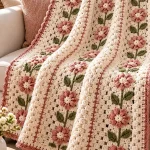
Every petal in this bedspread has an open teardrop running through its center, so closing that opening by even a few stitches changes the entire flower. This Irish lace crochet flower bedspread pattern uses large six-petal motifs in dusty pink and ivory, small connector flowers and open joins. Cotton yarn and a 3.5–4.0 mm hook create a substantial intermediate-to-advanced bedspread with matching floral pillow fronts.
The Design: What Makes This Floral Bedspread Different
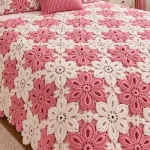
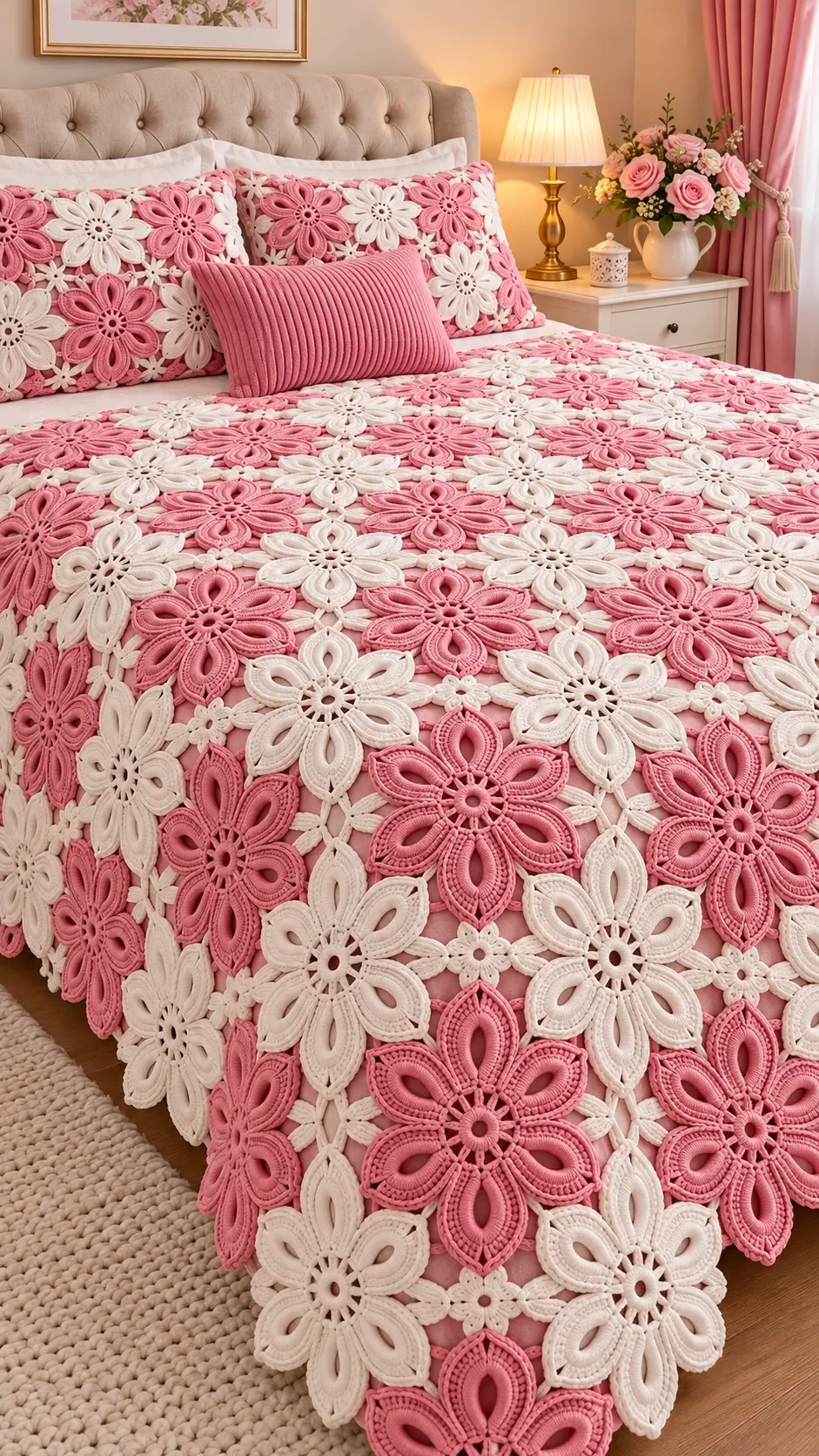
The fabric is assembled from flowers rather than conventional granny squares. Each main motif has a small circular center surrounded by six elongated petals. Every petal contains a large teardrop opening, while dense crochet along both sides gives the motif enough structure to support neighboring flowers. Small ivory connector flowers occupy the spaces where four larger motifs approach one another.
Irish crochet traditionally uses separately constructed floral elements, and contemporary Irish-lace patterns continue to use flowers as individual motifs. Published examples range from fine thread worked with 1.25–1.8 mm hooks to DK versions using hooks up to 4 mm. 0 A flower motif worked with size-3 cotton thread and a 3.5 mm hook is documented at about 8.25 cm across; heavier yarn can produce substantially larger motifs. 1
Project Info at a Glance
| Skill Level | Construction | Target Main Flower | Hook | Best For |
|---|---|---|---|---|
| Intermediate–Advanced | Separate six-petal motifs with connector flowers | 18–22 cm | 3.5–4.0 mm | Bedspreads, throws and matching pillow fronts |
The 18–22 cm flower measurement is a project target based on the proportions of the reference rather than a measured specification of the photographed bedspread. For comparison, a worsted-weight flower blanket pattern uses a 4.5 mm hook and produces motifs around 9.5 cm square, demonstrating how strongly motif size changes with construction and yarn. 2
Materials and Tools
Yarn
- Dusty rose pink — DK/light worsted cotton or cotton blend — approximately 45–50% of the motif yarn
- Warm ivory — DK/light worsted cotton or cotton blend — approximately 50–55% of the motif yarn
Use the same yarn range for both colors. The finished flowers need matching stitch height and firmness so pink and ivory motifs occupy identical spaces after blocking.
Do not calculate a full bedspread from a generic gram estimate. Crochet and block one pink flower, one ivory flower and one connector motif, then weigh them individually. Published floral-motif projects vary dramatically in consumption: one fine Irish-lace flower may require only 5–10 m of thread, while large blanket motifs in heavier yarn consume substantially more. 3
Tools
- 3.5–4.0 mm crochet hook
- DK/light worsted cotton or cotton-blend yarn
- Yarn needle
- Scissors
- Locking stitch markers
- Tape measure
- Blocking mats
- Rust-resistant pins
- Digital kitchen scale
Abbreviations
- MR — magic ring
- ch — chain
- sl st — slip stitch
- sc — single crochet
- hdc — half double crochet
- dc — double crochet
- tr — treble crochet
- sp — space
- st/sts — stitch/stitches
- FO — fasten off
Pattern — Large Six-Petal Flower Motif
This is an original photo-inspired construction. The reference image establishes the visual direction—six open petals, circular center and direct motif joins—but the stitch sequence below is independently constructed rather than copied from a published Irish-lace pattern.
Flower Center
Use dusty pink for a pink motif or warm ivory for an ivory motif.
Make a MR.
Round 1: Ch 1, work 12 sc into MR. Join with sl st. (12)
Round 2: Ch 1, work 2 sc in each stitch around. Join. (24)
The 24-stitch center divides evenly into six four-stitch sections.
Petal Foundation — Six Loops
Place a marker every four stitches around Round 2.
Beginning at the first marker:
Ch 18.
Skip the next three stitches.
Sl st into the fourth stitch.
Repeat around.
You should have exactly 6 large ch-18 loops.
These loops form the internal openings of the petals. Keep them equal in length; a one-chain difference becomes visible after the petals are outlined.
First Side of Petal 1
Work around the first ch-18 loop rather than into individual chain stitches.
Beginning at its base, work:
3 sc, 3 hdc, 4 dc, 3 tr.
You are now approaching the outer point.
Petal Point
At the center of the loop work:
2 tr, ch 3, 2 tr.
The ch-3 space marks the petal tip.
Second Side of Petal 1
Continue down the opposite half of the same loop:
3 tr, 4 dc, 3 hdc, 3 sc.
Sl st into the anchoring point at the petal base.
One elongated petal is complete.
Remaining Five Petals
Repeat the same sequence around each remaining ch-18 loop:
3 sc, 3 hdc, 4 dc, 3 tr, (2 tr, ch 3, 2 tr), 3 tr, 4 dc, 3 hdc, 3 sc.
Sl st at each petal base.
After the sixth petal, join and inspect the motif.
Each petal should have one open elongated center with no stitches crossing the opening.
Petal Reinforcement Round
The broad outlines in the reference make the flowers appear corded rather than delicate.
Join the same color at the base of any petal.
Sc around the first side of the petal.
At the ch-3 tip work:
(sc, ch 2, sc).
Sc down the second side.
Sl st into the valley between petals.
Repeat around all six petals.
FO.
Optional Raised Petal Outline
For a more pronounced corded effect, join the same color at a petal base and work surface slip stitches along the inside edge of the dense petal border.
Follow the teardrop opening.
Stop approximately 5 mm before the tip.
Restart on the opposite side and return toward the base.
Repeat for all petals.
Keep these surface stitches loose. Tight outlining will pull the open center closed.
Blocking the Main Flower
Block the first flower before making the full set.
Pin the six petal tips at equal angles of approximately 60 degrees.
Target approximately 18–22 cm from one petal tip to the opposite petal tip.
Measure three opposite-petal diameters.
Keep the difference between those measurements below approximately 5 mm.
Maintaining the Teardrop Openings
Insert one pin near the widest section of each petal opening during blocking.
The opening should be widest near the outer third of the petal and narrower at the base and tip.
Do not stretch it into a uniform oval.
The tapered opening is one of the main visual characteristics of this design.
Pink Flower — Make as Required
Use dusty rose for the complete six-petal motif.
Keep the center, petals and reinforcement rounds in the same color.
The photograph uses pink as one of two equal major motif colors rather than as a narrow accent.
Ivory Flower — Make as Required
Repeat the exact large-flower instructions using warm ivory.
Do not change hook size for the ivory motifs.
Block them against the same master template used for the pink flowers.
Small Connector Flower
The small flowers occupy the gaps between large motifs and stabilize the open network.
With ivory, make a MR.
Round 1: Work 12 sc into MR. Join. (12)
Round 2: Repeat the following six times:
Sl st in next st, ch 5, skip 1 st, sl st in next st.
You now have 6 ch-5 loops.
Connector Flower Petals
Into each ch-5 loop work:
(sc, hdc, 3 dc, hdc, sc).
Repeat six times.
FO leaving a 25–30 cm tail if the connector will be sewn into position.
Target approximately 4–6 cm diameter, depending on the final gap between the main flowers.
Optional Pink Connector Flowers
Most connector motifs should remain ivory so they visually disappear into the open background.
A small percentage can be made in pink if additional color is wanted around the bedspread perimeter.
Keep their dimensions identical to the ivory version.
Testing the Four-Flower Unit
Make two pink and two ivory large flowers.
Block all four.
Arrange them in a square formation with alternating colors.
Turn each motif until adjacent petal tips almost meet.
Place one small ivory flower in the central opening.
This four-flower sample determines the repeat dimensions of the full bedspread.
Joining Two Large Flowers
Place the motifs flat with one petal tip from each flower touching.
Using matching yarn and a needle, sew through approximately 1–1.5 cm of dense crochet at the tips.
Do not sew down the entire side of either petal.
The reference depends on visible negative space between neighboring flowers.
Join-As-You-Go Option
Floral motifs can also be connected while the final motif round is worked; contemporary motif patterns document join-as-you-go construction specifically for blankets and other modular lace projects. 4
At the ch-2 tip of the reinforcement round, work:
ch 1, sl st into the corresponding tip of the neighboring motif, ch 1.
Continue around the current flower.
Use this technique only after confirming the final layout. Sewn joins are easier to reposition.
Attaching the Connector Flower
Place the small flower in the opening between four main motifs.
Attach one small petal to each surrounding large flower.
Use the remaining two petals as visual fillers or attach them diagonally if the surrounding geometry allows.
Keep each attachment zone under approximately 10 mm.
The connector should stabilize the opening without filling it completely.
Recommended Color Layout
Alternate pink and ivory main flowers like a checkerboard.
For example:
Row 1: Pink – Ivory – Pink – Ivory – Pink
Row 2: Ivory – Pink – Ivory – Pink – Ivory
Row 3: Pink – Ivory – Pink – Ivory – Pink
Continue the sequence.
This keeps same-color flowers from forming large solid patches.
Planning the Bedspread
The final dimensions depend on the blocked motif and how much adjacent petals overlap.
Do not calculate bed size from the full flower diameter alone.
Arrange three motifs in a row and measure from the first outer tip to the last.
Divide by three to obtain the actual average repeat measurement.
Example Layouts
| Layout | Main Flowers | Suggested Use |
|---|---|---|
| 5 × 6 | 30 | Small throw |
| 7 × 8 | 56 | Large throw / small bed |
| 8 × 10 | 80 | Medium bedspread |
| 10 × 12 | 120 | Large bedspread |
| 11 × 13 | 143 | Generous bedspread with drop |
These counts are planning examples, not fixed bed-size specifications. Measure the intended mattress and the blocked four-flower sample before selecting a grid.
Estimating Yarn by Weight
Weigh one blocked large flower.
Suppose one motif weighs 24 g.
For 80 large motifs:
24 g × 80 = 1,920 g
Next weigh one connector flower.
If a connector weighs 4 g and the layout requires 63:
4 g × 63 = 252 g
The sample calculation gives:
1,920 g + 252 g = 2,172 g
Add approximately 10% for joins, test motifs, gauge variation and finishing.
The weights in this example demonstrate the calculation method only.
Calculating Pink and Ivory Separately
If the large flowers alternate evenly, approximately half of the main-motif yarn will be pink and half ivory.
Connector flowers add extra ivory consumption.
For an 80-flower layout, begin with:
40 pink main motifs
40 ivory main motifs
Then calculate the connector flowers separately as ivory.
This prevents underestimating the cream color.
Matching Pillow Front
The photographed set repeats the same flowers across the pillow fronts.
For a large square pillow, arrange approximately 3 × 3 main motifs, adjusting the count to your actual blocked dimensions.
Alternate pink and ivory.
Add small ivory connector flowers between them.
Measure the completed lace panel before making the pillow back.
Pillow Back Option
A solid crochet back makes the cover more practical.
Using pink or ivory, chain to the required width.
Row 1: Hdc in third chain from hook and across.
Row 2: Ch 2, turn, hdc across.
Repeat until the panel matches the floral front.
Block the solid panel before assembly.
Joining Pillow Front and Back
Place the floral front over the solid panel.
Pin around the perimeter.
Using matching yarn, sc through both layers along three sides.
Insert the pillow form.
Close the final side permanently or add a removable closure.
Keep the joins behind the outer flower tips so the floral silhouette remains visible.
Creating a Straight Bedspread Edge
A field of six-petal flowers naturally creates an irregular perimeter.
The reference keeps that floral outline rather than forcing the motifs into a rectangular solid border.
For a cleaner edge, rotate outer flowers so one petal points outward.
Fill only the largest perimeter gaps with connector flowers.
Do not add a dense straight border unless a rectangular finish is specifically required.
Optional Half Motif
If a straighter top edge is needed near the pillows, make half flowers.
Create the normal 24-stitch center foundation but work only three adjacent petal loops.
Complete those three petals normally.
Work sc along the unfinished straight edge.
Use half motifs only along one designated bedspread edge rather than mixing them randomly through the layout.
Creating a Denser Floral Fabric
Reduce the distance between neighboring petal tips.
Join each main flower to its neighbor at two adjacent petals instead of one.
This produces smaller openings and greater structural stability.
Test a four-motif sample first. Too many joining points can pull the flowers out of their six-fold symmetry.
Creating a Lighter Lace Fabric
Join only at the main petal tips.
Use small connector flowers at alternate intersections rather than every opening.
This increases negative space and reduces yarn weight.
The trade-off is a more flexible fabric that requires careful handling when wet.
Using Cotton for Definition
Fine and medium cottons are common in Irish-lace flower work. Published examples include 100% cotton thread, and contemporary Irish-lace designers explicitly recommend natural yarns with a hook appropriate to the yarn size. 5
For a bedspread, choose a yarn with enough body to hold the elongated petal openings after blocking. Very soft loosely spun yarn can make the petal outlines collapse inward.
Assembly
- Crochet one pink six-petal flower, block it to the 18–22 cm target and record three opposite-petal measurements.
- Make one ivory flower with the same hook and compare it directly with the blocked pink master before producing additional motifs.
- Crochet two more large flowers and one small ivory connector, then arrange the five pieces as a test section to establish the actual repeat measurement.
- Produce the required pink and ivory main motifs, blocking them against the master template before joining.
- Lay the motifs out in alternating pink-and-ivory rows and check the color distribution from several meters away.
- Join neighboring large flowers at corresponding petal tips using 1–1.5 cm attachment zones or the tested join-as-you-go method.
- Position small ivory connector flowers in the larger intersections and attach them without closing the surrounding negative space.
- Complete all horizontal motif rows first, then connect those rows while checking the bedspread width after each new section.
- Build matching pillow fronts from the same alternating motifs and add solid backs only after measuring the completed floral panels.
- Weave all tails, block the assembled bedspread flat and reshape every outer petal opening before the fabric dries.
The finished bedspread should remain an open floral lattice with alternating pink and ivory six-petal flowers and small connector motifs stabilizing the spaces between them.
7 Technical Tips
- Keep opposite flower diameters within 5 mm of each other. A distorted six-petal motif creates progressively larger gaps when dozens of flowers are joined.
- Pin every petal at approximately 60-degree intervals. Unequal petal angles make the connector flowers sit off-center even when all six petals have identical stitch counts.
- Keep the central teardrop opening visible through the entire petal. Surface stitches that are too tight pull the two petal sides together and can close the opening after washing.
- Limit direct joins to roughly 1–1.5 cm at each petal tip. Sewing several centimeters down both sides makes the bedspread look like a solid floral mat instead of open lace.
- Size connector flowers from the blocked four-motif sample. A connector more than about 5 mm larger than the available gap pushes the surrounding flowers outward and causes rippling.
- Check the complete fabric after every two joined motif rows. A row that contracts by even 1 cm should be corrected before additional rows multiply the alignment error.
- Weave structural tails through at least 5 cm of dense petal edging. Do not hide joining tails along the open teardrop loops because those sections provide too little friction.
Color Balance
Use approximately equal numbers of dusty-pink and ivory large flowers. The connector motifs can remain predominantly ivory, which gives the pink flowers slightly more visual emphasis without increasing their actual count.
A useful starting distribution for 80 large motifs is 40 pink and 40 ivory. Alternate the first color at the beginning of every row.
Before joining, photograph the complete layout from above. Look specifically for accidental runs of three or more flowers in the same color caused by shifted rows.
Care and Final Blocking
Follow the washing instructions for the selected yarn.
Support the entire bedspread when wet because an open motif network can stretch significantly under its own weight.
Lay the piece flat. Align the central rows first, then work toward the perimeter.
Shape every sixth or eighth main flower rather than pinning only the outer edge. Check the six petal tips and reopen any teardrop centers that contracted during washing.
Shape the small connector flowers last. Allow the bedspread to dry completely before moving it from the blocking surface.
Conclusion
The open center of each petal is the structural measurement that controls this Irish lace crochet flower bedspread pattern. Make one pink and one ivory 18–22 cm master flower first, then build a four-flower sample with a small connector before calculating the complete bed size. Keep all six petals at equal angles, limit joins to their dense tips and weigh the blocked samples for an accurate yarn estimate. Your next step is to test the pink and ivory motifs side by side and confirm that both colors block to identical dimensions. Share the finished layout on Pinterest or Instagram with #PinkIvoryFlowerBedspread. Would you alternate every flower as shown, or use ivory flowers around the perimeter with pink concentrated through the center?