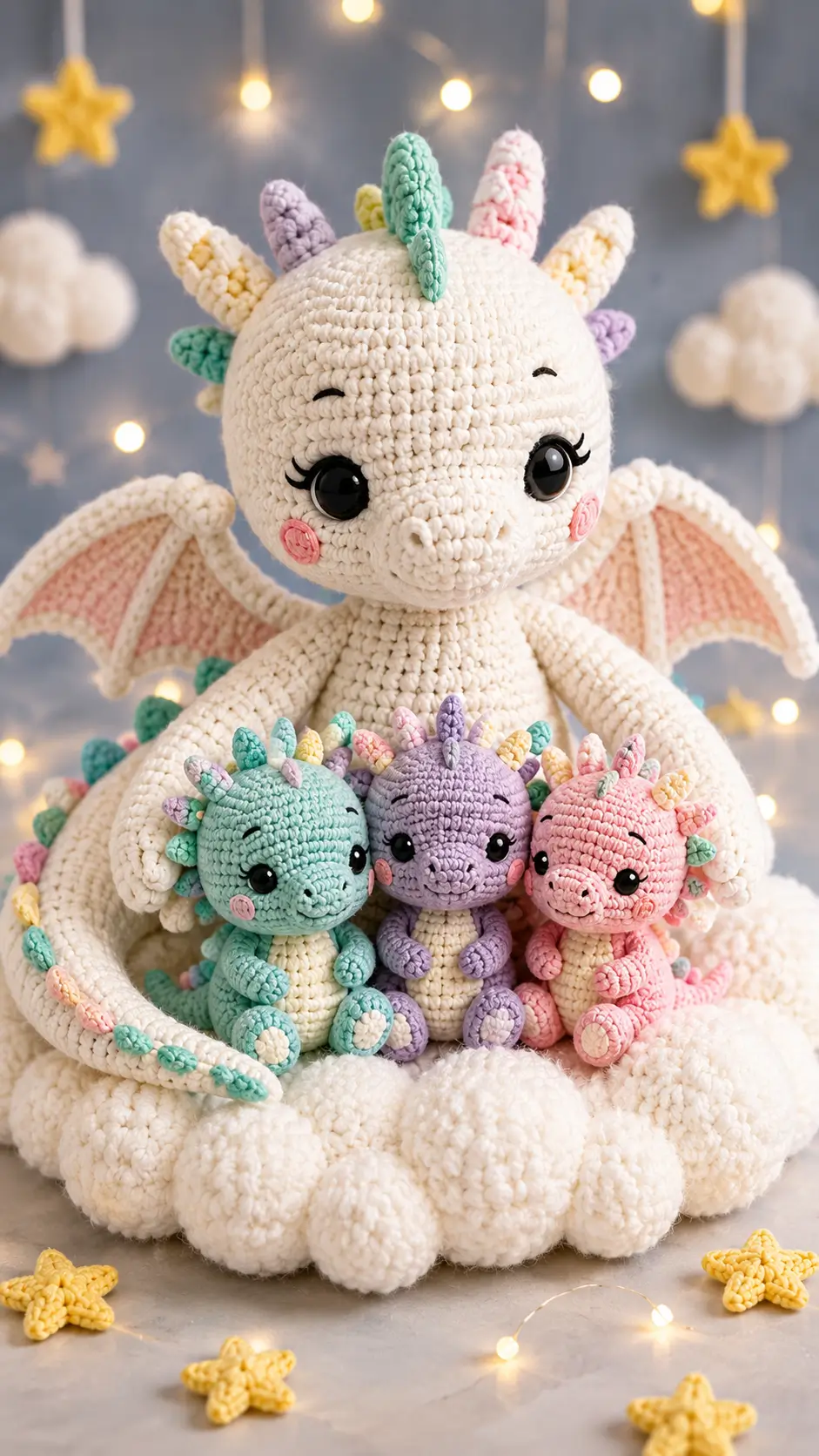
A dragon without a brow ridge reads as a dinosaur before the wings can correct it. This dragon amigurumi crochet pattern builds a pastel cloud dragon with a rounded snout, small horns, soft wings, cheek patches, and a cloud base. Use medium velvet or chenille yarn, a 4 mm hook, and 12 mm safety eyes for an intermediate project sized for nursery shelf display.
The Design: What Makes Pastel Cloud Dragon Different
The photo’s dragon depends on three structural choices: an oversized head, a short vertical body, and wings that sit wide instead of high. The head takes the large plateau because the eyes and cheeks need open face space; the body stays one size smaller so the toy sits without tipping. Horns and pastel dorsal spikes are kept narrow, since bulky spikes would fight the soft cloud shape.
Use blush cheek circles instead of embroidery alone; flat circles keep the kawaii face visible on velvet yarn. A common error in a crochet dragon with wings is setting the wings too close to the neck. The maker then gets a bat silhouette, not a baby dragon amigurumi. Pin the wing roots low, around the upper back, and let the wing tips angle outward.
Project Info at a Glance
| Skill Level | Time | Finished Size | Hook | Best For |
|---|---|---|---|---|
| Intermediate | 7–9 hours | 18 cm tall in cotton; up to 34 cm nose-to-tail in velvet scale | 4 mm for medium velvet/chenille | Pastel dragon shelf display |
Medium velvet or chenille with a 4 mm hook and 12 mm eyes matches current plush dragon material data, while cotton kit data confirms an 18 cm tall dragon can be made with finer yarn and a 2.5 mm hook.
Materials and Tools
Yarn
- Cream white — medium velvet or chenille — 80–120 g — brand suggestion: Bohème Velvet Double equivalent
- Blush pink — medium velvet or chenille — 10–15 g — cheeks and wing membrane
- Mint — medium velvet or chenille — 10–15 g — horns, spikes, optional baby color
- Lilac — medium velvet or chenille — 10–15 g — horns and spikes
- Butter yellow — medium velvet or chenille — 10–15 g — horns and stars
- Pale pink — medium velvet or chenille — 10–15 g — horns, spikes, optional baby color
Hardicraft’s kit data gives a useful small-scale yarn reference: 50 g main cotton, 25 g secondary cotton, and 10 g accent cotton. Plush yarn yardage rises with gauge, so buy extra cream for the head, body, wings, and cloud base.
Tools
- Hook 4 mm
- 12 mm safety eyes
- Polyester stuffing
- Yarn needle
- Locking stitch markers
- Pins
- Black embroidery thread
- Pink embroidery thread
Abbreviations
MR = magic ring; sc = single crochet; inc = 2 sc in one stitch; dec = invisible decrease; sl st = slip stitch; ch = chain; BLO = back loop only; FLO = front loop only; hdc = half double crochet. Work invisible decreases through front loops only to reduce holes; do not over-tighten the closing round.
Pattern — Step by Step
Continuous spiral unless noted. This original stitch plan follows standard amigurumi math: 6 sc MR starts, +6 increase rounds, and −6 decrease rounds.
Head
Yarn: cream white — Source: Standard amigurumi math.
R1: 6 sc in MR (6)
R2: inc ×6 (12)
R3: (sc, inc) ×6 (18)
R4: (2 sc, inc) ×6 (24)
R5: (3 sc, inc) ×6 (30)
R6: (4 sc, inc) ×6 (36)
R7: (5 sc, inc) ×6 (42)
R8–R15: sc around (42)
Place safety eyes between R10 and R11, 7 stitches apart. Add eyelash embroidery before stuffing blocks access.
R16: (5 sc, dec) ×6 (36)
R17: sc around (36)
R18: (4 sc, dec) ×6 (30)
R19: (3 sc, dec) ×6 (24)
R20: (2 sc, dec) ×6 (18)
Stuff firmly at the forehead and less firmly at the lower jaw.
R21: (sc, dec) ×6 (12)
R22: dec ×6 (6)
Fasten off. Leave 20 cm tail.
Body
Yarn: cream white — Source: Standard amigurumi math.
R1: 6 sc in MR (6)
R2: inc ×6 (12)
R3: (sc, inc) ×6 (18)
R4: (2 sc, inc) ×6 (24)
R5: (3 sc, inc) ×6 (30)
R6: (4 sc, inc) ×6 (36)
R7–R12: sc around (36)
R13: (4 sc, dec) ×6 (30)
R14–R15: sc around (30)
R16: (3 sc, dec) ×6 (24)
R17: sc around (24)
Stuff the base firmly so the dragon sits. Keep the neck area flexible for sewing.
R18: (2 sc, dec) ×6 (18)
R19: (sc, dec) ×6 (12)
R20: dec ×6 (6)
Fasten off. Leave 35 cm tail.
Snout
Yarn: cream white — Source: Standard amigurumi math.
R1: 6 sc in MR (6)
R2: inc ×6 (12)
R3: (sc, inc) ×6 (18)
R4: (2 sc, inc) ×6 (24)
R5–R6: sc around (24)
R7: (2 sc, dec) ×6 (18)
Stuff lightly. Flatten the back edge before sewing.
Fasten off. Leave 30 cm tail.
Arms / Front Legs
Yarn: cream white — Make 2 — Source: Standard amigurumi math.
R1: 6 sc in MR (6)
R2: inc ×6 (12)
R3: (sc, inc) ×6 (18)
R4–R5: sc around (18)
R6: (sc, dec) ×6 (12)
R7–R10: sc around (12)
Stuff only the paw half. Flatten the final round to 6 stitches across.
Fasten off. Leave 25 cm tail.
Back Legs
Yarn: cream white — Make 2 — Source: Standard amigurumi math.
R1: 6 sc in MR (6)
R2: inc ×6 (12)
R3: (sc, inc) ×6 (18)
R4: (2 sc, inc) ×6 (24)
R5–R6: sc around (24)
R7: (2 sc, dec) ×6 (18)
R8: (sc, dec) ×6 (12)
R9–R10: sc around (12)
Stuff the foot firmly and the upper leg lightly.
Fasten off. Leave 30 cm tail.
Wings
Yarn: cream white border, blush pink membrane — Make 2 — Source: Standard amigurumi math.
With blush pink, crochet in rows.
Row 1: ch 2, 2 sc in second ch from hook (2)
Row 2: ch 1, turn, inc ×2 (4)
Row 3: ch 1, turn, sc across (4)
Row 4: ch 1, turn, inc, 2 sc, inc (6)
Row 5: ch 1, turn, sc across (6)
Row 6: ch 1, turn, inc, 4 sc, inc (8)
Row 7: ch 1, turn, sc across (8)
Row 8: ch 1, turn, inc, 6 sc, inc (10)
Row 9: ch 1, turn, sc across (10)
Switch to cream.
Row 10: ch 1, turn, sc across top edge, 2 sc in corner, sc down side edge, sl st at base (24 edge stitches)
Fasten off. Leave 40 cm tail.
Horns
Yarn: mint, lilac, pale pink, or butter yellow — Make 4–6 — Source: Standard amigurumi math.
R1: 6 sc in MR (6)
R2–R3: sc around (6)
R4: inc ×6 (12)
R5–R6: sc around (12)
Stuff with a pea-size amount only. Keep horn tips pointed.
Fasten off. Leave 20 cm tail.
Dorsal Spikes
Yarn: mixed pastels — Make 9 large and 6 small — Source: Standard amigurumi math.
Large spike:
R1: 6 sc in MR (6)
R2: sc around (6)
R3: inc ×6 (12)
R4: sc around (12)
Fasten off. Leave 20 cm tail.
Small spike:
R1: 6 sc in MR (6)
R2–R3: sc around (6)
Fasten off. Leave 18 cm tail.
Side Ears / Cheek Fins
Yarn: mint or lilac — Make 2 — Source: Standard amigurumi math.
R1: 6 sc in MR (6)
R2: inc ×6 (12)
R3–R4: sc around (12)
Do not stuff. Flatten into a teardrop before sewing.
Fasten off. Leave 20 cm tail.
Tail
Yarn: cream white — Source: Standard amigurumi math.
R1: 6 sc in MR (6)
R2–R3: sc around (6)
R4: inc ×6 (12)
R5–R6: sc around (12)
R7: (sc, inc) ×6 (18)
R8–R12: sc around (18)
R13: (sc, dec) ×6 (12)
R14: sc around (12)
Stuff lightly from base to tip. The tail must bend around the cloud base, not lift it.
Fasten off. Leave 35 cm tail.
Cheek Patches
Yarn: blush pink — Make 2 — Source: Standard amigurumi math.
R1: 6 sc in MR (6)
R2: inc ×6 (12)
R3: (sc, inc) ×6 (18)
sl st to next stitch (18)
Fasten off. Leave 20 cm tail.
Belly Patch
Yarn: buttercream or pale yellow — Source: Standard amigurumi math.
R1: 6 sc in MR (6)
R2: inc ×6 (12)
R3: (sc, inc) ×6 (18)
R4: (2 sc, inc) ×6 (24)
R5–R6: sc around (24)
sl st to next stitch (24)
Fasten off. Leave 30 cm tail.
Cloud Puffs
Yarn: cream white — Make 12–16 — Source: Standard amigurumi math.
R1: 6 sc in MR (6)
R2: inc ×6 (12)
R3: (sc, inc) ×6 (18)
R4: sc around (18)
R5: (sc, dec) ×6 (12)
Stuff each puff before the last round.
R6: dec ×6 (6)
Fasten off. Leave 15 cm tail.
Five-Point Stars
Yarn: butter yellow — Make 3 — Source: Standard crochet accessory construction.
R1: ch 5, join with sl st to form ring, 10 sc into ring (10)
R2: [sl st in next st, ch 4, sl st in second ch from hook, sc, hdc, sl st in next st] ×5 (5 points)
Fasten off. Leave 20 cm tail.
Assembly
- Sew the head to the body with the head tilted slightly forward.
- Attach the snout between the eyes, centered over R10–R14 of the head.
- Sew cheek patches below the eyes and embroider two small nostrils on the snout.
- Place horns across the top of the head in pastel order: mint, lilac, pink, yellow.
- Sew side ears or cheek fins halfway between eye line and back of head.
- Attach front legs at the upper body and back legs at the lower front base.
- Sew wings to the upper back with 4–5 cm between inner wing roots.
- Add dorsal spikes from forehead to tail, alternating large and small spikes.
- Join cloud puffs into an oval base, then tack the dragon and tail onto the cloud.
- Sew yellow stars near the cloud edge or attach hanging loops for display.
The dragon is complete when all seams are hidden and the cloud base lies flat.
7 Technical Tips
- Shifted stitch marker: A one-stitch drift on the 42-stitch head plateau moves the snout off center. Count R8, R11, and R15 before placing the eyes.
- Loose stuffing at the neck: A soft neck makes the head sag after wing attachment. Pack a 3 cm column of stuffing between the head base and body top.
- Visible decrease holes: Velvet yarn exposes gaps when the hook catches both loops during decreases. Work invisible dec through FLO only and pull the next sc tight.
- Wrong eye timing: Safety eye backs cannot be added after R18 on the head. Insert eyes after R15, then test the snout position before locking washers.
- Wing curl failure: A single-layer wing curls when the border is too tight. Add 2 sc in each outer corner and block each wing flat before sewing.
- Unbalanced tail weight: A firmly stuffed tail can tip the seated body backward. Stuff the tail at 50% firmness and tack the tail to two cloud puffs.
- Weak cheek placement: Cheeks sewn beside the nostrils widen the snout. Place cheek circles one round below the eyes and at least 2 stitches away from the snout seam.
Conclusion
Block the wings flat for 10 minutes under a dry towel, then check the face from eye level before taking photos. This dragon amigurumi crochet pattern works best when the snout stays centered and the cheek circles sit below the eyes, not beside the nostrils. The next step is to make one baby version at 70% scale by stopping the head at 30 stitches and shortening every limb by two rounds. Share the finished dragon on Pinterest with a vertical cloud-base photo, then post a front-facing reel on Instagram. Hashtag: #PastelCloudDragon. Which pastel horn color should sit above the left eye: mint, lilac, yellow, or pink?