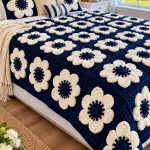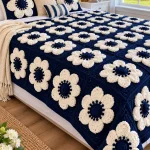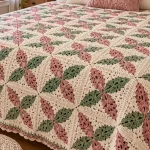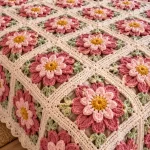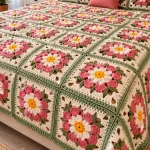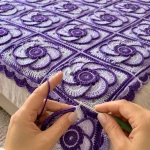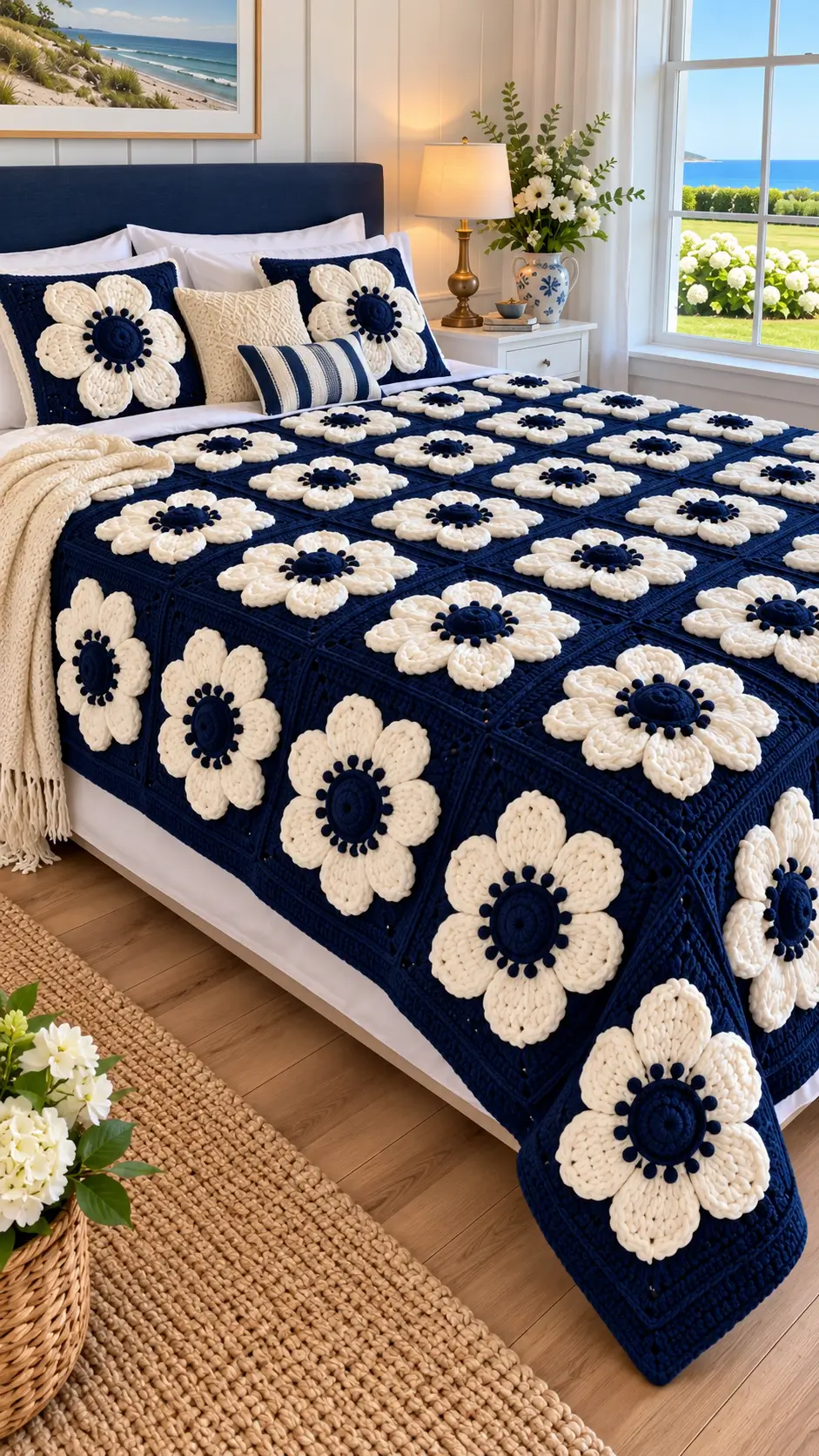
Five oversized cream petals rising from a navy crochet square give this blanket its defining structure. This 3D flower crochet blanket pattern combines individual granny-style squares, raised floral motifs, dark circular centers, and contrasting petals to create a large bedspread with strong geometric repetition. The project uses two main colors and modular construction, making each square separately before joining the completed motifs into the final blanket.
The Design: Navy and Cream 3D Flower Crochet Blanket
The blanket is built from repeating square motifs rather than crocheted as one continuous piece. Each motif begins with a dark navy square base. A large dimensional flower sits in the center, using five rounded cream petals around a raised navy center.
The contrast is important. Navy creates the background, joining lines, and flower centers, while cream is restricted primarily to the petals. This makes every flower clearly visible even when dozens of squares are assembled together.
The petals should remain thick enough to project above the square without becoming excessively stiff. The center is also raised rather than completely flat, creating another layer of texture.
Consistent square dimensions are critical. Even small gauge differences become noticeable when several motifs are joined into long rows.
Project Info at a Glance
| Skill Level | Construction | Colors | Hook | Best For |
|---|---|---|---|---|
| Intermediate | Joined square motifs | Navy Blue + Cream | Match to yarn weight | Large throw or bedspread |
Materials and Tools
Yarn
- Deep navy blue yarn — for square backgrounds, flower centers, joining, and outer border.
- Cream/ivory yarn — for the five raised petals on every flower.
Choose yarns from the same weight category and preferably the same product line. Different yarn thicknesses can change the diameter of the flower and make completed squares difficult to join evenly.
Tools
- Crochet hook appropriate for the selected yarn
- Tapestry needle
- Scissors
- Locking stitch markers
- Measuring tape
- Blocking pins and mats, optional
Abbreviations
- MR — magic ring
- ch — chain
- sl st — slip stitch
- sc — single crochet
- hdc — half double crochet
- dc — double crochet
- tr — treble crochet
- inc — increase
- st/sts — stitch/stitches
- sp — space
- rep — repeat
Pattern — Step by Step
This is a photo-inspired crochet construction. Make one complete test square before calculating the number of motifs required for your blanket.
Navy Flower Center
Yarn: deep navy blue.
Round 1: Make MR. Work 6 sc into MR. Join with sl st. (6)
Round 2: Ch 1. Work 2 sc in each st around. Join. (12)
Round 3: Ch 1. *Sc in next st, 2 sc in next st.* Repeat around. Join. (18)
Round 4: Ch 1. *Sc in next 2 sts, 2 sc in next st.* Repeat around. Join. (24)
Round 5: Ch 1. *Sc in next 3 sts, 2 sc in next st.* Repeat around. Join. (30)
The center should form a firm circular disk. Keep the tension consistent because the petals will be positioned around this circle.
Decorative Navy Loops Around the Center
Yarn: deep navy blue.
Join navy yarn around the outer edge of the center.
Decorative Round: *Ch 3, sl st into the next suitable stitch or space.* Repeat evenly around the flower center.
Keep every loop approximately the same size. These small navy loops form the decorative ring visible between the center disk and cream petals.
Fasten off and weave in the tail securely.
Cream Petal — Make 5
Yarn: cream/ivory.
Each flower uses five broad petals. Their rounded shape is created by increasing toward the widest section and decreasing toward the outer tip.
Row 1: Ch 5. Sc in second ch from hook and across. Turn. (4)
Row 2: Ch 1. 2 sc in first st, sc across to final st, 2 sc in final st. Turn. (6)
Row 3: Ch 1. 2 sc in first st, sc across, 2 sc in final st. Turn. (8)
Row 4: Ch 2. Hdc across. Turn. (8)
Row 5: Ch 2. 2 hdc in first st, hdc across to final st, 2 hdc in final st. Turn. (10)
Rows 6–7: Ch 2. Hdc across. Turn. (10)
Row 8: Ch 1. Sc first 2 sts together, sc across to final 2 sts, sc final 2 sts together. Turn. (8)
Row 9: Ch 1. Sc first 2 sts together, sc across to final 2 sts, sc final 2 sts together. Turn. (6)
Row 10: Ch 1. Sc first 2 sts together, sc in next 2 sts, sc final 2 sts together. (4)
Fasten off, leaving a long tail for attaching the petal.
Make five identical cream petals for each square.
Shaping the Five-Petal Flower
Place the navy center on a flat surface. Position five cream petals evenly around it before sewing anything permanently.
The base of each petal should sit underneath or immediately beside the outer edge of the navy center. Space all five petals evenly.
Use stitch markers to hold them temporarily.
Sew each petal securely at its base while leaving most of the petal unattached. This preserves the raised 3D appearance seen in the finished blanket.
Attach the navy center over the inner petal edges if necessary. The center should hide the joining points and create a clean transition from navy to cream.
Navy Square Base
Yarn: deep navy blue.
The flower needs a square background large enough to leave a visible navy frame around all five petals.
Round 1: MR, ch 3, work 2 dc, ch 2. *3 dc, ch 2.* Repeat three more times. Join with sl st.
Round 2: Sl st to corner space. Ch 3, 2 dc, ch 2, 3 dc in same corner. Work dc across each side. In every corner work 3 dc, ch 2, 3 dc.
Round 3: Continue working dc across each side. Work 2 dc, ch 2, 2 dc or the established corner sequence into each corner space.
Round 4: Repeat the square expansion while maintaining four clearly defined corners.
Round 5: Continue until the square is large enough for the flower to sit inside it without the cream petals extending beyond the edges.
Add additional rounds when required. The exact number depends on yarn thickness, hook size, and the finished diameter of the flower.
Attaching the Flower to the Square
Place the completed five-petal flower in the center of the navy square.
Measure from the flower center to all four edges. Correct the position before attaching it.
Secure the center firmly to the square.
Add several hidden attachment stitches near the inner section of each petal. Do not sew the entire petal flat against the square.
The outer sections should remain slightly raised. This creates the dimensional flower effect that defines the blanket.
Final Square Border
Yarn: navy blue.
Join navy yarn in any corner.
Border Round 1: Ch 1. Sc evenly around the complete square. Work 3 sc into each corner.
Border Round 2: Ch 1. Sc or hdc in every stitch around. Work 3 stitches into each corner stitch.
Fasten off.
Measure the completed motif and record its exact width and height.
How Many Crochet Squares Do You Need?
Make one finished and blocked square before calculating the full blanket.
For example, if one square measures approximately 25 cm and you want a blanket close to 200 × 225 cm, an arrangement around 8 squares wide by 9 squares long provides a useful starting calculation.
That would require approximately 72 flower squares.
This is only a sizing example. Your actual number depends on the dimensions of your finished motif and the desired mattress coverage.
For a smaller throw, reduce both the number of columns and rows. For a bedspread with a substantial drop over the mattress edges, add additional rows before joining.
Joining the Crochet Flower Squares
Block the motifs to matching dimensions before joining them. Do not attempt to correct significantly different square sizes during assembly.
Arrange all squares on a large flat surface.
Check that every flower faces the same direction and that the navy borders form uninterrupted lines between motifs.
A slip-stitch join works particularly well for this design because the joining seam becomes another dark structural line.
Joining Horizontal Rows
Place two squares with corresponding edges aligned.
Join navy yarn at the corner.
Work sl st through matching stitches along both square edges.
Do not skip stitches on one motif while working every stitch on the other. The two edges must remain aligned.
Continue joining squares until one complete horizontal row has been assembled.
Joining the Rows
Once individual rows are complete, place two rows together with their square boundaries aligned.
Join with navy yarn across the full width.
At every four-square intersection, check the alignment before continuing. Misaligned intersections are much more noticeable than minor differences along an ordinary seam.
Outer Navy Blanket Border
After joining all motifs, add a continuous navy border around the complete blanket.
Round 1: Join navy yarn at any corner. Sc evenly around the entire perimeter. Work 3 sc into each corner.
Round 2: Ch 1. Hdc in each stitch around. Work 3 hdc into each corner.
Round 3: Ch 1. Sc in every stitch around. Work 3 sc into each corner.
Additional rounds can be added for a wider frame.
The final border should remain navy so it visually connects with the square backgrounds and joining seams.
Assembly and Finishing
- Make one complete navy square and confirm its finished dimensions.
- Crochet five matching cream petals for each flower motif.
- Make the raised navy flower center and decorative loop ring.
- Position the five petals evenly around each center.
- Attach each completed flower to the middle of a navy square.
- Block all finished squares to matching measurements.
- Arrange the motifs into the required number of rows and columns.
- Join neighboring squares with navy yarn while keeping all intersections aligned.
- Add the continuous navy perimeter border after all squares have been joined.
- Weave in every yarn tail securely and block the completed blanket if the selected fiber permits it.
The completed blanket should show evenly spaced cream five-petal flowers over a continuous navy geometric background.
7 Technical Tips for Better 3D Crochet Flowers
- Prevent different square sizes: Measure every five completed motifs rather than waiting until the entire batch is finished. A difference of even 1 cm per square can create significant distortion across a long bedspread.
How to Keep the Raised Flowers Consistent
The dimensional flowers are the most important visual element of this blanket. Their diameter, petal spacing, and center placement should remain consistent across every square.
Make the first completed flower your measurement sample.
Record the width of one petal, the total flower diameter, and the diameter of the navy center. Compare later flowers against these measurements instead of relying only on visual judgment.
Petal tension also matters. A tightly worked petal may become smaller and stiffer, while a loose petal can spread farther across the navy square.
If one flower is significantly different, correct it before joining the motif into the blanket. Replacing one square is much easier before the rows have been assembled.
Choosing Colors for the Flower Blanket
Navy and cream create the strong contrast visible in this design. The dark background makes the dimensional petals immediately recognizable, while repeating the navy in the flower centers visually connects each motif with its square.
If substituting colors, preserve that contrast.
A dark green background with cream flowers can produce a botanical variation. Charcoal with ivory creates a more neutral version, while burgundy with pale pink changes the design without altering its construction.
For the closest match to the pictured blanket, use a deep navy rather than medium blue and a warm ivory rather than bright optical white.
Yarn Quantity Planning
Large modular blankets can require substantial yarn, particularly when each motif includes a dense square background and dimensional petals.
Instead of estimating the complete quantity from appearance alone, weigh one finished motif.
Make one complete square, including its flower. Weigh the motif on a digital kitchen scale before weaving away any remaining yarn that would distort the measurement.
Multiply that weight by the total number of required squares. Then add yarn for joining and the perimeter border.
Calculate navy and cream separately because this design uses considerably more navy for the backgrounds, seams, centers, and border.
Buying the main color from the same dye lot also reduces visible color changes across the large navy field.
Conclusion
The construction of this navy blue and cream 3D flower crochet blanket depends on repetition: matching navy squares, five consistently shaped cream petals, centered raised flower motifs, and accurately aligned seams. Make and block one complete test motif first, record its dimensions, and use that measurement to calculate the final number of squares. Only begin batch production after the test square fits the intended blanket dimensions. When the motifs are complete, arrange the entire layout before joining them permanently. Save the pattern to Pinterest and share your finished blanket on Instagram with #NavyFlowerCrochetBlanket. Would you keep the navy-and-cream combination or make the flowers in a second contrasting color?