Pattern status: Original photo-inspired, untested crochet design prototype. Measurements and fit must be checked before infant use.
Introduction
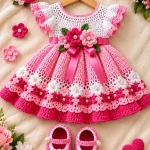
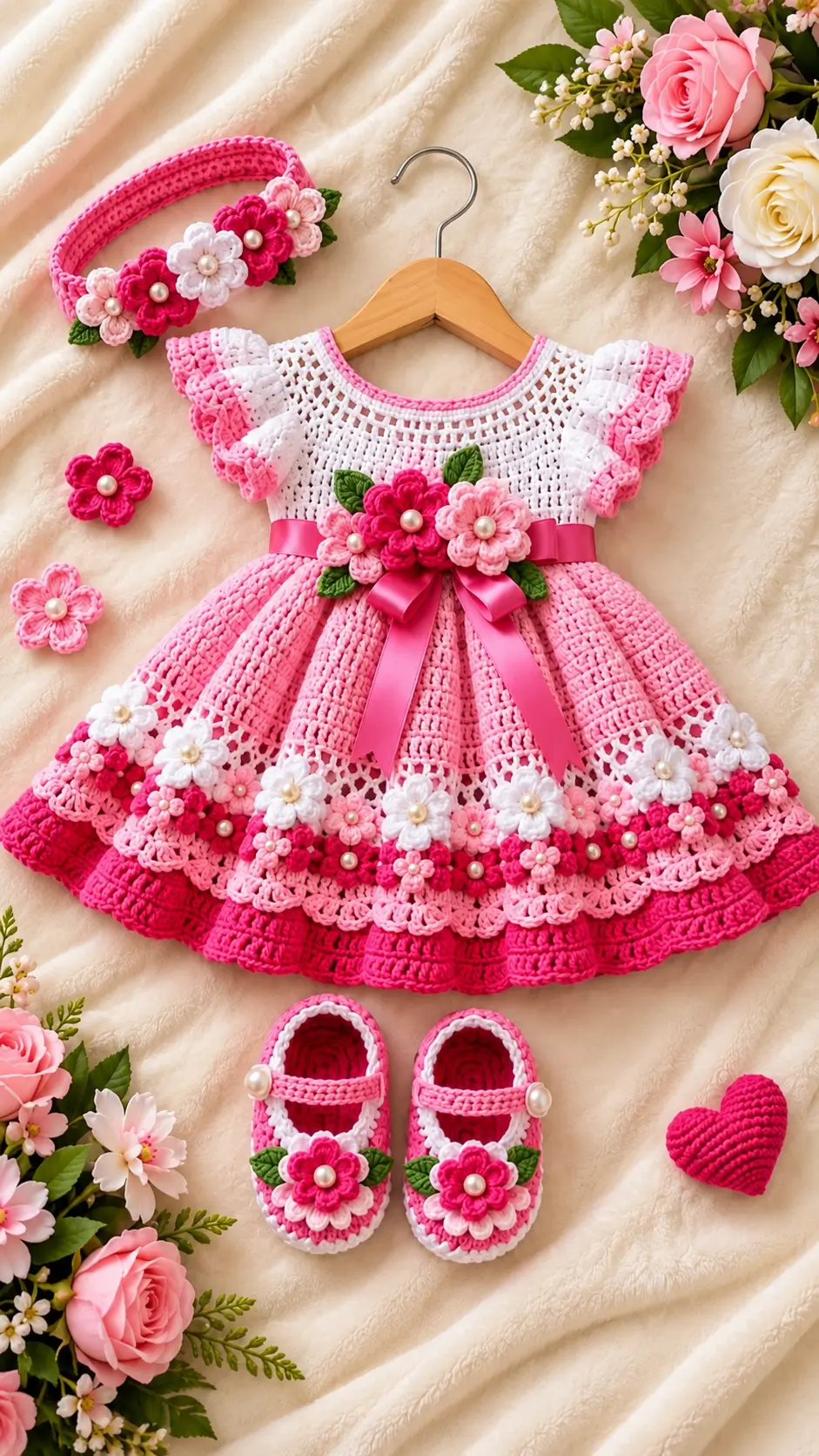
The layered flower border on this pink baby dress must follow the skirt’s flare without pulling its scalloped hem inward. This crochet baby girl dress pattern combines a white openwork yoke, pink skirt, flutter sleeves, floral headband, and matching Mary Jane booties. Designed as an intermediate-level project using DK yarn and a 4 mm hook, the outfit targets approximately 6–12 months. Coordinated construction makes it useful for developing a complete garment-and-accessory set.
The Design: What Makes This Pink Floral Dress Different
The first structural feature is the contrast between the openwork bodice and the fuller skirt. A relatively stable yoke supports the garment at the shoulders, while the skirt increases below the underarms to produce its wider silhouette.
Second, the flutter sleeves are constructed separately along the armhole edges. You can adjust their depth without changing the bodice circumference. Excessive sleeve increases can distort the shoulder line.
Third, the decorative flowers are attached after the garment is blocked and measured. The maker can distribute appliqués evenly rather than allowing flower placement to determine skirt tension.
A common mistake with a pink crochet baby dress is adding too many heavy embellishments near the hem. This crochet baby dress with flowers uses lightweight appliqués and a separate decorative waist treatment.
Project Info at a Glance
| Skill Level | Intermediate |
|---|---|
| Estimated Time | 14–22 hours |
| Intended Size | 6–12 months; fit unverified |
| Hook | 4 mm and 3.5 mm |
| Yarn | DK cotton or cotton blend |
| Construction | Top-down yoke, joined flared skirt |
| Accessories | Headband and Mary Jane booties |
Materials and Tools
Yarn
- Baby pink DK yarn — 150 g: Main skirt, headband, booties.
- White DK yarn — 90 g: Yoke, sleeves, lace, petals.
- Fuchsia DK yarn — 50 g: Hem and flower accents.
- Light pink DK yarn — 30 g: Flower petals.
- Leaf green DK yarn — 15 g: Leaves.
These are planning allowances, not measured yarn consumption.
Tools
- 4 mm crochet hook for the dress.
- 3.5 mm crochet hook for small appliqués.
- Stitch markers for shaping and counting.
- Tapestry needle for sewing.
- Measuring tape for sizing.
- Scissors and blocking supplies.
Infant safety: Omit pearl beads, buttons, loose ribbons, and detachable embellishments from wearable infant garments. Use embroidered yarn details. Remove headbands before sleep and whenever direct adult supervision is unavailable.
Abbreviations
| MR | Magic ring |
|---|---|
| ch | Chain |
| sc | Single crochet |
| hdc | Half double crochet |
| dc | Double crochet |
| sl st | Slip stitch |
| inc | Increase |
| dec | Decrease |
| BLO | Back loop only |
| FLO | Front loop only |
| st(s) | Stitch(es) |
| rep | Repeat |
US crochet terminology is used throughout. An invisible decrease is made through the front loops of two adjacent stitches before completing one single crochet.
Gauge and Sizing
Begin with a washed and dried gauge swatch. A published DK baby dress provides a comparison gauge of 16 single crochet stitches and 19 rows over 10 cm. The double crochet and openwork sections need separate gauge checks.
Measure the intended wearer’s chest, shoulder-to-hem length, and armholes. This prototype has not been graded or fit-tested to verify a 6–12-month size.
Pattern — Step by Step
Part 1: White Crochet Yoke
Yarn: White DK. Hook: 4 mm. Work back and forth.
Foundation: Ch 64.
R1: Dc in fourth chain from hook and each remaining chain. (61 dc)
R2: Ch 2, dc across, turn. (61 dc)
R3: Ch 2, dc in first stitch, *ch 1, skip 1 stitch, dc in next stitch* across, adjusting the edge repeat. Turn.
R4: Ch 2, dc in each dc and chain space, turn.
R5: Repeat openwork arrangement from R3.
R6: Repeat R4.
R7: Dc across, increasing at four marked shoulder divisions.
R8: Dc across, increasing at the same divisions.
R9: Repeat openwork arrangement while maintaining shoulder increases.
R10: Dc across with shoulder increases.
R11–R12: Repeat the preceding two-row sequence.
Testing note: The shoulder divisions and increases require size-specific calculation. This is a shaping outline, not a fully verified yoke chart. Measure the depth and armholes before proceeding.
Part 2: Joining the Bodice
Yarn: White DK. Hook: 4 mm.
Mark the sleeve sections. Crochet the first back section, chain across the first underarm, skip sleeve stitches, crochet the front, chain across the second underarm, skip the second sleeve, and finish the remaining back section.
Keep a suitable back opening for dressing. Work two rounds of double crochet around the joined bodice. Count and record the resulting waist stitches before beginning the skirt.
Part 3: Pink Flared Skirt
Yarn: Baby pink DK. Hook: 4 mm. Sample foundation: 120 stitches.
Important: The 120-stitch sample must be reconciled with the actual fitted bodice. It is not a verified continuation of the yoke.
R1: Dc around. (120)
R2: *4 dc, inc* around. (144)
R3: Dc around. (144)
R4: *5 dc, inc* around. (168)
R5: Dc around. (168)
R6: *6 dc, inc* around. (192)
R7–R10: Dc around. (192 each round)
R11: *7 dc, inc* around. (216)
R12–R15: Dc around. (216 each round)
R16: *8 dc, inc* around. (240)
R17–R20: Dc around. (240 each round)
R21: *9 dc, inc* around. (264)
R22–R25: Dc around. (264 each round)
R26: *10 dc, inc* around. (288)
R27–R30: Dc around. (288 each round)
Check skirt length after R30. The sample increase rounds each add 24 stitches.
Part 4: White Lace Band
Yarn: White DK. Hook: 4 mm.
R1: *Ch 3, skip 2 stitches, sc in next stitch* around. (96 chain-3 spaces)
R2: Work 4 dc in each chain-3 space. (384 dc)
R3: Sc in each stitch. (384 sc)
Fasten off and weave in ends.
Part 5: Fuchsia Scalloped Hem
Yarn: Fuchsia DK. Hook: 4 mm.
R1: Sc around. (384)
R2: *Skip 1 stitch, 5 dc in next stitch, skip 1 stitch, sl st in next stitch* around. (96 shells)
Fasten off, leaving approximately 12 cm of yarn tail.
Part 6: Flutter Sleeves (Make 2)
Yarn: White and baby pink DK. Sample armhole: 48 stitches.
R1: Work 48 sc evenly around the armhole. (48)
R2: *Dc, inc* around. (72)
R3: Dc around. (72)
R4: Change to baby pink; *2 dc, inc* around. (96)
R5: Dc around. (96)
R6: *Skip 1 stitch, 5 dc in next stitch, skip 1 stitch, sl st in next stitch* around. (24 shells)
Repeat on the second armhole. Adjust the foundation count to the measured armhole before following the sample increases.
Part 7: Layered Crochet Flowers (Make 9–15)
Yarn: Fuchsia, pink, and white. Hook: 3.5 mm.
R1: 6 sc in MR. (6)
R2: In five successive stitches, work *sl st, ch 2, 2 dc, ch 2, sl st* to form five petals.
For the second layer, join contrasting yarn behind the petals. Make five chain-3 loops, then work (sc, hdc, 3 dc, hdc, sc) into each loop.
Fasten off with a 15 cm sewing tail. Use embroidered centers rather than beads for infant use.
Part 8: Green Crochet Leaves (Make 12–20)
Yarn: Leaf green DK. Hook: 3.5 mm.
Ch 8. Work sc in second chain, hdc in next, dc in next 3, hdc in next, 3 sc in last chain. Continue on the opposite side with hdc, dc in next 3, hdc, and sc in final chain. Sl st to finish.
Leave a 12 cm tail and sew behind the flowers.
Part 9: Matching Floral Headband
Yarn: Baby pink DK. Hook: 4 mm.
Measure head circumference and account for stitch stretch. Chain to the required band length.
R1: Sc in second chain and across.
R2: Ch 1, turn, sc in BLO across.
R3–R6: Repeat R2.
Join the short ends with a flat seam. Sew three layered flowers and green leaves to the front.
Safety: Use only under direct adult supervision and remove before sleep.
Part 10: Mary Jane Booties (Make 2)
Yarn: Baby pink, fuchsia, white. Hook: 3.5 mm.
Target a measured sole length; approximately 10.2 cm is a published reference for some 6–12-month designs.
Sample oval sole:
Foundation: Ch 12.
R1: 2 sc in second chain, sc in next 9, 4 sc in last chain, sc in next 9 on opposite side, 2 sc at the end. (26)
R2: Inc in next 2, sc in next 9, inc in next 4, sc in next 9, inc in next 2. (34)
R3: *Sc, inc* twice, sc in next 9, *sc, inc* four times, sc in next 9, *sc, inc* twice. (42)
Upper:
R4: Sc in BLO around. (42)
R5–R6: Sc around. (42 each round)
R7: Work sc around, decreasing evenly over the marked toe section.
R8: Repeat toe decreases until the opening fits the measured foot.
R9: Sc around the remaining opening.
Make a strap by chaining 14–18 stitches and returning with single crochet. Sew the strap securely to the opposite side. Add white slip-stitch trim and a small flower with green leaves. Mirror the second bootie.
Testing note: Toe decreases and strap lengths require fit-specific validation. Do not treat the sample as a fully graded shoe pattern.
Assembly — 10 Steps
- Lay the white yoke flat and check symmetry.
- Measure the skirt, waist, and finished dress length.
- Finish the neckline with single crochet.
- Finish the back opening with an appropriate, tested closure.
- Arrange three large flowers across the front waist.
- Stitch green leaves behind the flower cluster.
- Distribute remaining flowers along the lower skirt.
- Attach the floral cluster to the headband.
- Finish the bootie straps, trim, and toe flowers.
- Weave in all ends and inspect every seam and embellishment.
The sample set includes one dress, one headband, and two booties.
7 Technical Tips
- Stitch markers: Mark the four yoke divisions and the beginning of every skirt round. A misplaced increase can distort the bodice.
- Gauge: Measure a washed 10 cm swatch. A difference of two stitches per 10 cm can significantly change chest width.
- Skirt counts: Check every increase round. Missing a 24-stitch repeat group changes the following lace layout.
- Sleeve balance: Measure both armholes. A four-stitch difference can make the ruffles asymmetrical.
- Flower attachment: Secure large flowers at four or more points. Center-only attachment lets petals lift.
- Ribbon hazards: Avoid loose ribbon tails on infant garments. Use stitched yarn details instead.
- Tail weaving: Leave 12–15 cm tails and weave in multiple directions. Short ends can loosen during washing.
Care and Washing
Follow the selected yarn label. Wash a gauge swatch before completing the garment to check for shrinkage and texture changes. Inspect flower attachments, shoe straps, and seams after laundering. Blocking can flatten lace but cannot correct major fit errors.
Customization Ideas
Replace the pink skirt with white for a lighter color arrangement, or use fuchsia for stronger contrast. Reduce the number of skirt flowers to simplify finishing. Shorten the flutter sleeves by omitting a ruffle round, then check the resulting armhole opening.
Related Crochet Patterns
- Easy Crochet Baby Dress — Maisie and Ruth. [INTERNAL LINK NEEDED: Easy Crochet Baby Dress]
- Baby Dress Patterns — Yarnspirations. [INTERNAL LINK NEEDED: Ruffled Baby Dress]
- Crochet Mary Jane Booties — Crochet 365 Knit Too. [INTERNAL LINK NEEDED: Crochet Baby Booties]
- Crochet Baby Dress Patterns — Ravelry. [INTERNAL LINK NEEDED: Crochet Flutter Sleeve Dress]
Frequently Asked Questions
What yarn works best for a crochet baby girl dress?
Soft DK cotton or cotton-blend yarn provides visible stitch definition. Check laundering instructions and make a gauge swatch before beginning.
Can this dress be made for a newborn?
Not by simply switching to a smaller hook. Newborn sizing requires separate neckline, chest, armhole, and length measurements and a tested grading process.
How many flowers are needed?
Approximately 9–15 larger flowers can cover the main decorative positions. Additional small flowers increase finishing time and garment weight.
Can the booties be made without straps?
Yes, but a strapless opening requires a separate fit check because it may be too loose to stay on the foot.
Is this pattern suitable for beginners?
Individual flowers and leaves use basic stitches, but the full outfit requires garment shaping, counting, measuring, and fitting skills.
Conclusion
This crochet baby girl dress pattern combines several construction methods: an openwork yoke, expanding skirt, scalloped border, flutter sleeves, layered flowers, and coordinated accessories. The most important next step is to crochet and measure a gauge swatch, then test the yoke and bootie dimensions before producing a wearable version. The sample instructions provide a design framework rather than a fully graded and fit-tested garment. Photograph the finished sample from the front and back to document its proportions. Share the project on Pinterest or Instagram with #PinkFloralBabyDress and include the yarn, hook size, and finished measurements. Would you keep the fuchsia scalloped hem or replace it with a white floral border?