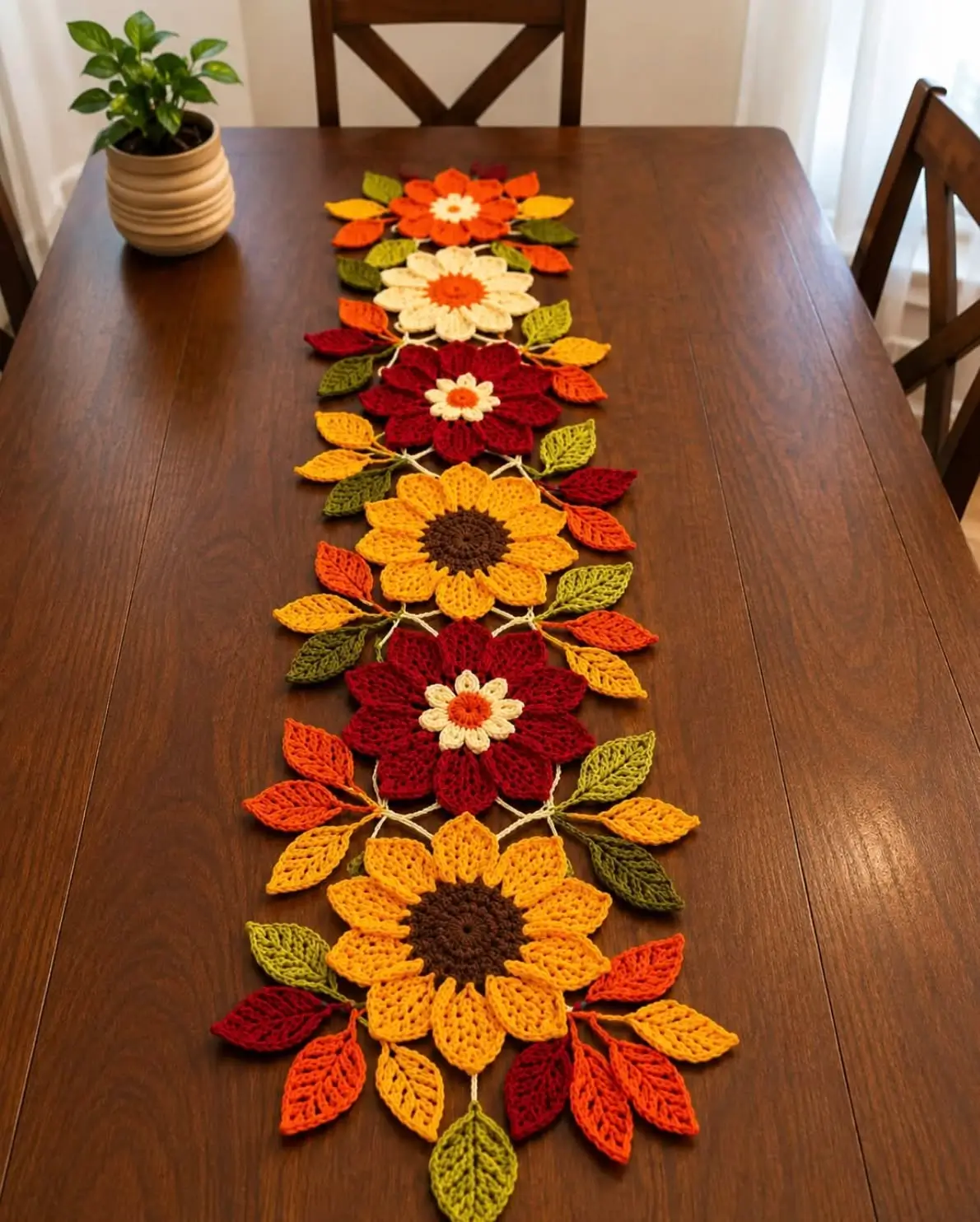
A sunflower needs a dark seed disc wide enough to keep twelve pointed golden petals from collapsing into one another. This crochet sunflower table runner pattern applies that structure to an autumn floral vine made with worsted yarn and a 4.5 mm hook. The comparable finished scale is about 150 × 35 cm. Intermediate crochet skills are appropriate. Modular construction also lets you alter the runner length before final joining.
The Design: What Makes This Sunflower Runner Different
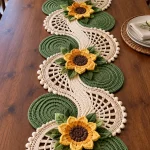
This runner is assembled from separate botanical components rather than crocheted as one rectangular fabric. Large sunflowers establish the width; burgundy, cream and orange flowers break up the repeated yellow, while pointed leaves extend beyond the central axis. A branching cord connects those motifs without hiding the table surface underneath.
The open arrangement matters structurally. Too many leaves placed directly under a flower produce a thick intersection that will not block flat. Too few connecting branches allow the motifs to rotate when the runner is moved.
Unlike a conventional crochet flower table runner built from squares, this autumn crochet table runner uses negative space as part of the design. A frequent mistake is sewing every motif down before checking the full composition. Pin the entire runner to its target dimensions first, then join from the center outward.
Project Info at a Glance
| Skill Level | Time | Finished Size | Hook | Best For |
|---|---|---|---|---|
| Intermediate | 12–18 hours, estimated | Approx. 150 × 35 cm | 4.5 mm | Dining tables, sideboards, autumn displays |
The 150 × 35 cm benchmark and 4.5 mm hook are based on comparable dimensional sunflower-vine runner specifications rather than a direct measurement extracted from the photograph.
Materials and Tools
Yarn
A #4 worsted yarn provides enough body for separate motifs while keeping the runner practical to block. A 4.5 mm crochet hook works as a useful starting point for this yarn weight.
- Golden yellow — worsted #4 — approximately 90 g — cotton or cotton/acrylic suggested
- Dark brown — worsted #4 — approximately 30 g — sunflower centers
- Burgundy — worsted #4 — approximately 70 g — large flowers and leaves
- Burnt orange — worsted #4 — approximately 50 g — flowers, centers and leaves
- Cream — worsted #4 — approximately 45 g — flowers and joining cord
- Olive green — worsted #4 — approximately 45 g — leaves
- Yellow-green — worsted #4 — approximately 30 g — contrasting leaves
These quantities are project-planning allowances for this photo-inspired version rather than measurements taken from the photographed runner. Purchase additional yarn when matching dye lots.
Tools
- 4.5 mm crochet hook
- Tapestry needle
- Locking stitch markers
- Scissors
- Rustproof blocking pins
- Blocking mats
- Tape measure
No stuffing or safety eyes are required. This project uses flat botanical crochet components.
Abbreviations
- MR — magic ring
- ch — chain
- sc — single crochet
- hdc — half double crochet
- dc — double crochet
- tr — treble crochet
- inc — 2 stitches in one stitch
- sl st — slip stitch
- st/sts — stitch/stitches
- sp — space
- BLO — back loop only
- FO — fasten off
Invisible decrease is an amigurumi shaping technique and is not required for these flat motifs.
Crochet Sunflower Table Runner Pattern — Step by Step
The photographed runner contains several flower styles, so this adaptation uses two large sunflowers, three large contrast flowers, three small accent flowers, pointed leaves and a branching cord.
Large Sunflower Center — Make 2
Yarn: dark brown.
R1: 6 sc in MR (6)
R2: inc ×6 (12)
R3: (sc, inc) ×6 (18)
R4: (2 sc, inc) ×6 (24)
R5: (3 sc, inc) ×6 (30)
R6: (4 sc, inc) ×6 (36)
Sl st to the first stitch. Fasten off.
The 36-stitch circumference creates twelve three-stitch sectors for the petals.
Large Sunflower Petals — 12 Per Flower
Yarn: golden yellow.
Join golden yellow to the brown center.
Petal repeat: Ch 7, sc in second ch from hook, hdc, dc, 2 tr, dc; skip 2 center sts, sl st in next st.
Repeat 12 times around the sunflower center.
Each petal is worked outward and back toward the center, removing the need to sew twelve separate petals. For a broader petal, work two dc before the treble section. Keep the petals consistent within each sunflower.
Fasten off. Weave the color-change tails toward the center.
Large Burgundy Flower — Make 2
Yarn: burgundy.
R1: 6 sc in MR (6)
R2: inc ×6 (12)
R3: (sc, inc) ×6 (18)
R4: (2 sc, inc) ×6 (24)
Do not cut the yarn.
Petal repeat: Ch 8, sc in second ch, hdc, dc, 3 tr, dc; sl st into the next 3 center sts.
Repeat eight times.
Fasten off after completing the eighth petal. The broad petals reproduce the large red floral shapes positioned between the yellow sunflowers.
Orange Top Flower — Make 1
Yarn: cream and burnt orange.
Begin with cream.
R1: 6 sc in MR (6)
R2: inc ×6 (12)
R3: (sc, inc) ×6 (18)
Change to burnt orange.
Petal repeat: Ch 7, sc in second ch, hdc, 3 dc, hdc; sl st into the next 2 center sts.
Repeat nine times around the 18-stitch center.
Fasten off and weave the tail into the reverse side.
Small Cream Accent Flower — Make 3
Yarn: burnt orange and cream.
Begin with burnt orange.
R1: 6 sc in MR (6)
R2: inc ×6 (12)
Change to cream.
Petal repeat: Sl st in next st, ch 4, 2 dc in same st, ch 4, sl st in same st.
Skip one stitch and repeat around to create six small petals.
Fasten off. Leave approximately 15 cm of yarn when the flower will be sewn directly onto a larger burgundy flower.
Cream Daisy-Style Flower — Make 1
Yarn: burnt orange and cream.
Begin with burnt orange.
R1: 6 sc in MR (6)
R2: inc ×6 (12)
R3: (sc, inc) ×6 (18)
Change to cream.
Petal repeat: Ch 6, sc in second ch, hdc, 2 dc, hdc, sl st into the next 2 center sts.
Repeat nine times.
Fasten off. Keep this motif flatter than the burgundy flowers so the center section of the table runner does not develop a raised ridge.
Pointed Crochet Leaves — Make Approximately 26
Yarn: olive green, yellow-green, burgundy, burnt orange and golden yellow.
Foundation: Ch 11.
R1: Sc in second ch from hook, hdc, dc, dc, tr, tr, dc, dc, hdc, 3 sc in final ch.
Continue down the opposite side of the foundation chain:
Hdc, dc, dc, tr, tr, dc, dc, hdc, sc. Join with sl st.
R2: Ch 1. Work sc around the leaf perimeter, placing 3 sc in the tip stitch.
Fasten off, leaving approximately 20 cm of yarn when the leaf will be sewn directly to a vine.
For a more open leaf resembling those visible in the photograph, replace the solid second round with spaced chain loops: ch 2, skip 1 st, sc in next st. Keep the central foundation chain visible so it functions as the leaf vein.
Main Vine Cord
Yarn: cream or muted green.
Ch 250 for an initial cord suitable for a runner near 150 cm long. Actual finished length depends on gauge and how much the vine curves between flowers.
R1: Sl st into the second chain from hook and every chain across.
Fasten off.
Keep the slip stitches relaxed. Excessively tight stitches contract the chain and can make the assembled runner curl.
Side Branches — Make 16–20
Yarn: cream, olive or another vine color.
Ch 12–22 according to the required distance between each leaf and the main vine.
Sl st back along the chain.
Fasten off with approximately 15 cm of sewing yarn at both ends.
Change the branch lengths throughout the runner. Identical branches can force the leaves into two rigid rows instead of the irregular botanical arrangement shown in the reference image.
Optional Secondary Vine
Ch 100–130 and work one slip stitch into every chain.
Position the shorter cord beside the main vine where two large flowers meet. Tack the cords together only at their intersections.
Sizing and Layout
A target measurement of approximately 150 × 35 cm works well for a dimensional sunflower-vine runner of this type. The exact dimensions should be adjusted to the dining table where the finished piece will be displayed.
Begin with a target length of 140–150 cm. Position one large sunflower around the lower third and another near the center. Place burgundy flowers between and beyond them, then use cream and orange flowers to interrupt repeated blocks of color.
The leaves establish much of the final width. Aim for approximately 30–35 cm from the tip of a leaf on one side to the farthest leaf tip on the opposite side.
For a shorter table runner, remove one complete large-flower section with its adjacent leaves instead of reducing every gap. This keeps the proportions of the floral arrangement intact.
Assembly
- Block every flower and leaf separately before joining the components.
- Lay the main vine along the center of a blocking mat and form shallow curves instead of keeping it completely straight.
- Position the two large sunflowers first, leaving enough open space that their golden petals do not overlap neighboring large flowers.
- Add the burgundy and orange flowers between the sunflowers, then position the cream flower where the sequence needs a lighter section.
- Sew the small cream accent flowers onto the burgundy motifs through their centers only, leaving their petals free.
- Arrange the leaves in irregular pairs and single branches, alternating olive, yellow-green, burgundy, orange and golden yellow.
- Connect each leaf to the main structure with a side branch. Sew through only the lower 10–15 mm of the leaf instead of stitching across its entire surface.
- Tack each large flower to the vine at two or three concealed points on its reverse side. Do not sew through the outer petal tips.
- Pin the complete runner to its target dimensions, correct twisted branches, then weave each yarn tail through at least 4 cm of matching stitches.
- Wet-block or steam according to the yarn manufacturer’s care instructions, pinning the sunflower petals and pointed leaf tips individually.
The completed table runner should lie flat while maintaining visible spaces between the individual flowers, leaves and connecting branches.
7 Technical Tips for a Better Crochet Flower Table Runner
- Mark every motif center before assembly. A flower shifted more than about 15 mm from the central vine can make one side of the runner appear substantially heavier than the other.
- Control the sunflower diameter before making the second copy. If the first blocked sunflower measures 16 cm, keep the second within approximately 5 mm of that measurement so the repeated motifs remain consistent.
- Do not over-tighten the slip-stitch vines. The failure mode is a cord that contracts into a spiral and lifts the attached leaves from the table. Try a hook 0.5 mm larger for the vine if your slip stitches run tight.
- Pin every leaf before sewing. Attaching leaves without checking the complete layout can accumulate too much width on one side and distort the intended 30–35 cm outline.
- Keep the sunflower centers flat. If a 36-stitch center cups upward, the tension is too tight or the circle needs blocking. Correct the center before adding the golden petals.
- Weave long tails through matching colors. A cream tail carried behind an open burgundy petal may remain visible. Weave approximately 4 cm through the same color and reverse direction once before trimming.
- Measure the runner after blocking. Petals, leaves and curved cords can change the overall dimensions when pinned into position, so the unblocked length should not be treated as the final measurement.
Adjusting the Crochet Sunflower Table Runner
The modular construction makes length adjustment easier than it would be with a single rectangular crochet panel. Instead of recalculating every row, add or remove complete flower-and-leaf sections.
For a compact runner, use one large sunflower as the central motif and place two contrasting flowers on either side. A longer dining-table version can repeat the sequence of sunflower, contrast flower and leaf cluster until the required length is reached.
Width should be changed through leaf placement rather than by enlarging every flower. Longer side branches create a wider silhouette while preserving the scale of the main motifs.
Color can also change without altering the stitch structure. Keep the brown sunflower centers and golden petals if the sunflower identity needs to remain dominant, then replace burgundy and orange with colors suited to the intended season.
Finishing and Blocking
Lay the assembled runner on blocking mats and measure its overall length before adding pins. Start with the large flowers, correcting their centers and petal spacing. Pin the outer point of each sunflower petal so adjacent petals maintain similar spacing.
Move next to the leaves. Pull each leaf gently along its central vein and pin the tip. The side edges should remain symmetrical rather than being stretched sideways.
Finish with the connecting vines. They should form controlled curves between motifs without pulling a flower or leaf away from its pinned position.
Allow the piece to dry completely before removing the pins when wet blocking is used. Check the yarn label before applying heat or steam because fiber types react differently to high temperatures.
Conclusion
Block one complete sunflower and one pointed leaf before committing the remaining yarn; those two measurements determine the final scale more reliably than an unblocked chain. For a 150 × 35 cm target, arrange every finished motif on a measured surface before sewing the branches. That step also makes color distribution easier to correct while components are still movable. Save the finished crochet sunflower table runner pattern to Pinterest with a full-length overhead photograph, then share a close-up of the joined vines on Instagram using #AutumnSunflowerRunner. The next practical step is to crochet the first 36-stitch brown sunflower center. Which leaf color would you place directly beside the lower golden sunflower: burgundy or olive?