Introduction
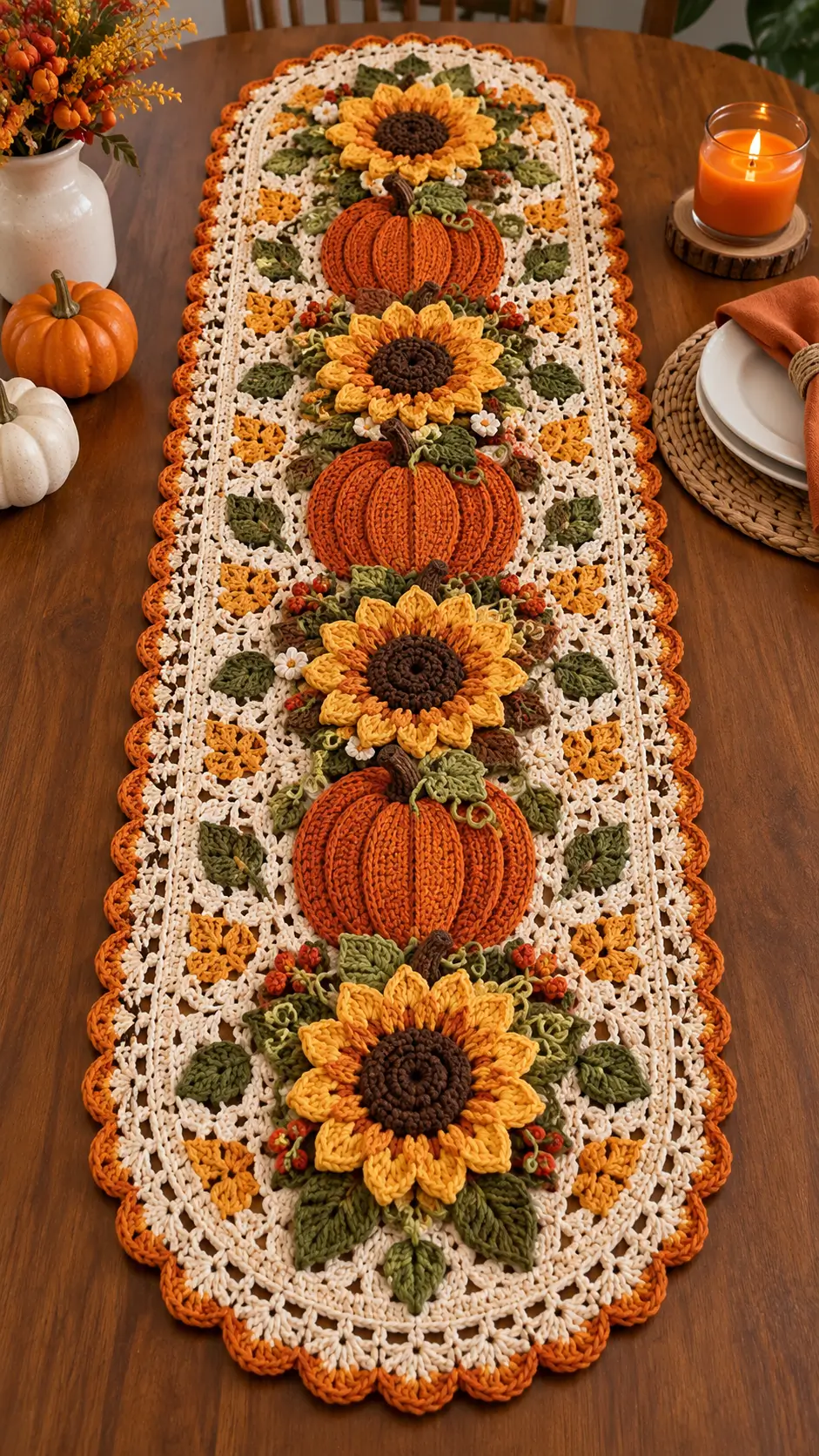
Three ribbed pumpkins down the center of a lace table runner create a problem a flat pumpkin motif never has: their weight must be spread across open crochet without distorting it. This crochet pumpkin table runner pattern uses worsted cotton, a 4 mm hook, and a finished target near 33 × 183 cm. It suits an advanced beginner moving into intermediate assembly and provides reusable autumn table decor.
The Design: What Makes This Pumpkin Runner Different
The first structural decision is modular construction. Crochet the cream foundation separately, then make pumpkins, sunflowers, leaves, vines, and smaller accents before attachment. This keeps the lace flat during blocking and permits accurate placement.
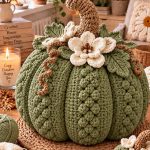
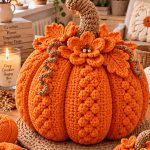
Second, each large pumpkin is dimensional rather than a conventional crochet pumpkin applique. Its 36-stitch circumference creates enough volume for pronounced ribs without making the motif excessively tall.
Third, foliage sits between the heavy central motifs and the open mesh. On a sunflower crochet table runner, these leaves do more than fill empty space: their attachment stitches spread load across a larger section of the foundation. A frequent error is sewing a stuffed pumpkin through one narrow mesh opening. The weight then pulls that opening out of shape.
Project Info at a Glance
| Skill Level | Time | Finished Size | Hook | Best For |
|---|---|---|---|---|
| Advanced beginner/intermediate | 18–26 hours | Approx. 33 × 183 cm | 4.00 mm | Autumn dining table or sideboard |
The size and hook are based on a comparable 72-inch worsted-cotton pumpkin runner.
Materials and Tools
Yarn
- Cream/ivory — worsted #4 cotton — about 965 yd / 508 g equivalent for the long foundation and border allowance.
- Pumpkin orange — worsted #4 cotton — 70 yd minimum, with 100–150 yd more practical for three stuffed motifs and edging.
- Golden yellow — worsted #4 cotton — approximately 40–60 g for four large sunflowers.
- Dark brown — worsted #4 cotton — approximately 20–30 g for flower centers and stems.
- Olive/sage green — worsted #4 cotton — approximately 60–80 g for leaves and vines.
- Rust/red — worsted #4 cotton — approximately 15–25 g for berry clusters and small accents.
The comparable farmhouse runner specifies worsted cotton, 965 yd main color, 70 yd pumpkin color, and 10 yd for stems. The extra flower and foliage quantities above are estimates for reproducing the photographed composition.
Tools
- 4.00 mm crochet hook
- Polyester stuffing
- Tapestry needle
- Stitch markers
- Scissors
- Blocking pins
- Blocking mats
- No safety eyes required
Abbreviations
MR — magic ring
sc — single crochet
inc — 2 sc in one stitch
dec — single-crochet decrease
sl st — slip stitch
ch — chain
hdc — half double crochet
dc — double crochet
tr — treble crochet
BLO — back loop only
For an invisible decrease, insert the hook through the front loops of the next two stitches and complete one sc through both.
Pattern — Step by Step
The dimensional pieces use continuous spirals unless a joined round is specified.
Cream Lace Runner Base
Yarn: cream.
Ch 66.
Row 1: Dc in 6th ch from hook, ch 2, skip 2 ch, dc in next ch across. Turn.
Row 2: Ch 3, 2 dc in next ch-2 space, ch 1, skip next dc across; dc in final turning chain. Turn.
Row 3: Ch 5, dc in next ch-1 space, ch 2, dc in next ch-1 space across. Turn.
Row 4: Ch 3, 2 dc in each ch-2 space across; dc in final stitch. Turn.
Repeat Rows 3–4 until the center measures about 173 cm.
Work sc evenly around all four edges, placing 3 sc at each corner.
Do not force a fixed row count if gauge differs. The runner depends more on maintaining rectangular proportions than reproducing an arbitrary number of repeats.
Large Ribbed Pumpkin — Make 3
Yarn: pumpkin orange.
R1: 6 sc in MR (6)
R2: inc ×6 (12)
R3: (sc 1, inc) ×6 (18)
R4: (sc 2, inc) ×6 (24)
R5: (sc 3, inc) ×6 (30)
R6: (sc 4, inc) ×6 (36)
R7: sc around (36)
R8: sc around (36)
R9: sc around (36)
R10: sc around (36)
R11: sc around (36)
R12: sc around (36)
R13: (sc 4, dec) ×6 (30)
R14: (sc 3, dec) ×6 (24)
R15: (sc 2, dec) ×6 (18)
Add stuffing. Keep the underside flatter than the crown.
R16: (sc 1, dec) ×6 (12)
R17: dec ×6 (6)
Fasten off with a 60 cm tail. Pass the tail through the pumpkin center and around the exterior six times at equal intervals. Pull each pass enough to form pronounced pumpkin ribs.
Pumpkin Stem — Make 3
Yarn: dark brown.
R1: 6 sc in MR (6)
R2: sc BLO around (6)
R3: sc around (6)
R4: sc around (6)
R5: sc around (6)
Fasten off. Leave a 20 cm tail and attach vertically to the pumpkin crown.
Sunflower Center — Make 4
Yarn: dark brown.
R1: 6 sc in MR (6)
R2: inc ×6 (12)
R3: (sc 1, inc) ×6 (18)
R4: (sc 2, inc) ×6 (24)
Sl st and fasten off.
Sunflower Petals — Make 4 Sets
Yarn: golden yellow.
Join yellow to the brown center.
Petal round: Ch 6, sc in second ch from hook, hdc in next ch, dc in next 2 ch, hdc in final ch, sl st in next center stitch.
Repeat around all 24 center stitches.
For the fuller layered appearance, add a second rear layer of 12 longer petals:
Ch 7, sc in second ch, hdc, dc in next 3 ch, hdc in final ch; sl st behind the next two center stitches.
Repeat 12 times.
Fasten off with a 35 cm sewing tail.
Large Olive Leaves — Make 16–20
Yarn: olive green.
Ch 11.
Side 1: sl st in second ch, sc, hdc, dc in next 4 ch, hdc, sc, sl st.
Ch 2 at tip.
Side 2: work back along the opposite side: sl st, sc, hdc, dc in next 4 ch, hdc, sc, sl st.
Fasten off with a 20 cm tail.
Small Leaves — Make 12
Yarn: sage or olive.
Ch 8.
Work sl st, sc, hdc, dc 2, hdc, sc down one side. Ch 2. Repeat the sequence along the opposite side.
Fasten off with a 15 cm tail.
Curled Tendrils — Make 8–12
Yarn: sage green.
Ch 20–25.
Starting in the second chain from the hook, work 3 sc in every chain.
The increased stitch density forms the spiral automatically. Fasten off with a 15 cm tail.
Berry Clusters — Make 8–12
Yarn: rust/orange.
R1: 6 sc in MR (6)
R2: inc ×6 (12)
R3: sc around (12)
R4: dec ×6 (6)
Do not stuff heavily. Close the opening and leave a 15 cm tail. Group three small pieces together to reproduce the compact orange-red accents around the foliage.
Small Cream Flowers — Make 6–10
Yarn: cream.
R1: 6 sc in MR (6)
For each stitch of R1: ch 3, hdc in same stitch, ch 2, sl st in same stitch.
Repeat six times for six petals.
Fasten off with a 15 cm tail.
Orange Scalloped Border
Yarn: pumpkin orange.
First work one preparation round of sc around the blocked cream foundation.
For the decorative round:
Skip 1 st, 5 dc in next st, skip 1 st, sl st in next st.
Repeat around the perimeter.
At corners, adjust the skipped stitch spacing by one stitch when necessary so a shell sits at the center of the curve rather than pulling the corner inward.
Fasten off and weave the tail through at least 5 cm of neighboring stitches.
Assembly
- Block the cream foundation to approximately 33 × 183 cm, adjusting the final length to the intended table.
- Place the three pumpkins along the longitudinal centerline before sewing any one pumpkin permanently.
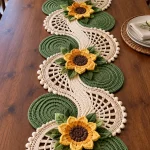
- Position the four sunflowers between and beyond the pumpkins, following the alternating flower-pumpkin rhythm visible in the reference design.
- Sew each pumpkin through its lower quarter, catching several neighboring lace posts rather than one mesh opening.
- Attach the brown stems after the pumpkin positions are fixed, then arrange the sunflower centers so the flowers remain visually centered.
- Pin large olive leaves beneath each sunflower and beside each pumpkin; vary their angles to prevent rigid bilateral symmetry.
- Add smaller leaves and curled tendrils between the major motifs, keeping the outer lace zones comparatively open.
- Sew berry clusters and cream flowers into gaps only after the main foliage is attached.
- Work or attach the orange scalloped border, checking every 15–20 cm for rippling or inward draw.
- Weave load-bearing tails in two directions, trim the remaining ends, and complete a final light blocking of the exposed lace.
The completed runner has a flat openwork perimeter and a deliberately raised central harvest arrangement.
7 Technical Tips
- Marker drift: Move the stitch marker immediately after completing the first stitch of every pumpkin round. A one-stitch error before R13 rotates all six decrease points and makes the rib spacing visibly uneven.
- Stuffing firmness: Leave roughly 10–15 mm of compressibility in the bottom of each pumpkin. Packing the base completely firm creates a rounded underside that makes the motif rock above the runner.
- Invisible decrease gaps: Work front-loop invisible decreases from R13 through R17. Ordinary decreases can expose stuffing through six repeated gaps as the circumference contracts.
- Pumpkin placement: Pin all three pumpkins before attaching the first. An offset of only 2–3 cm from the runner centerline becomes conspicuous when repeated over a 183 cm length.
- Lace tension: Measure the foundation width after approximately every 20 cm of length. Gradual tightening can turn a nominal rectangle into a trapezoid long before the difference is obvious while crocheting.
- Sunflower pinning: Use at least four pins per flower, positioned approximately at 12, 3, 6, and 9 o’clock. Attaching one petal quadrant before securing the opposite side can rotate the entire flower layer.
- Tail weaving: Carry pumpkin attachment tails through at least 5 cm of foundation stitches and reverse direction once. Short vertical tails can pull free when a dimensional runner is folded or moved.
Conclusion
Measure the intended tabletop before committing to the final foundation length, because the raised pumpkins and sunflowers are much easier to reposition before attachment than after sewing. Block the cream lace first, establish the three-pumpkin centerline, then distribute the four flowers and foliage through the remaining spaces. Photograph the finished crochet pumpkin table runner pattern from directly overhead for Pinterest; an angled Instagram photograph will show the pumpkin ribs and layered sunflower petals more clearly. Share finished versions with #PumpkinSunflowerTableRunner. For the next variation, decide one construction detail first: should the center pumpkin remain burnt orange, or would an ivory pumpkin create a stronger break in the repeated orange sequence?