Introduction
A bonnet carrying nine-petal flowers across an openwork crown needs enough structure to stop those appliqués from pulling the fabric out of shape. This crochet floral bonnet pattern uses an ivory DK base, a 4 mm hook, raised flowers, leaves and scalloped edging for an approximately 56 cm adult fit. The intermediate construction creates a practical head covering while providing stable attachment points for dimensional decoration.
The Design: What Makes This Floral Bonnet Different
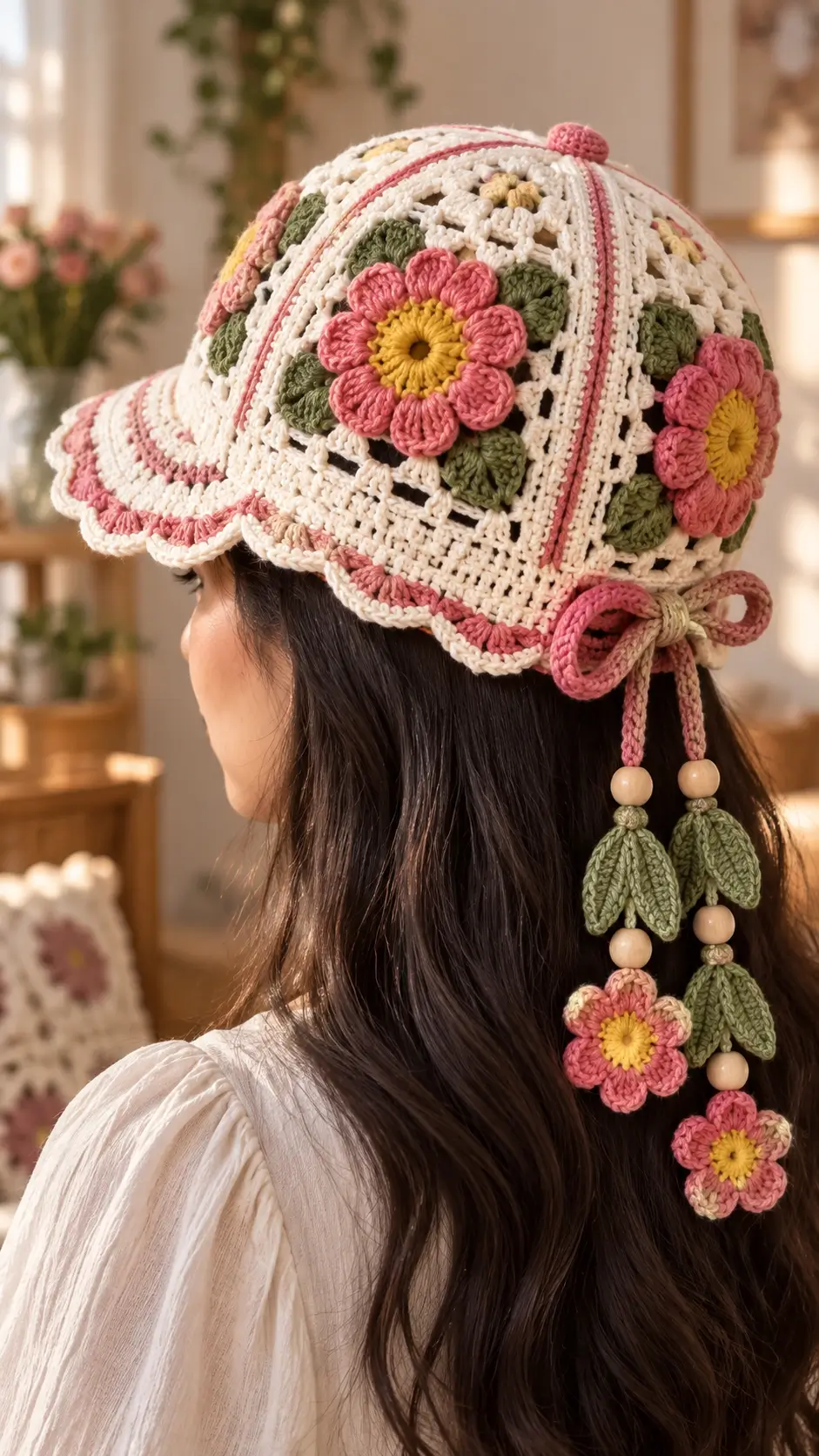
The reference bonnet combines three structures that normally compete with one another: open lace, heavy appliqués and a shaped brim. A relatively firm lower band is therefore used to stabilize the crochet flower bonnet, while the crown receives open spaces that keep the floral crochet hat visually close to the photograph.
Raised flowers are attached across solid sections rather than the largest lace openings. That choice prevents individual petals from dragging the mesh downward. Leaves extend beyond the flowers to break up the circular motifs and cover attachment stitches.
The scalloped front edge also needs restraint. Too many stitches across the brim create uncontrolled ruffling rather than defined lobes. A common mistake with this type of adult crochet bonnet is adding flowers before blocking the base; once the appliqués are sewn down, correcting crown dimensions becomes much harder.
Project Info at a Glance
| Skill Level | Time | Finished Size | Hook | Best For |
|---|---|---|---|---|
| Intermediate | 10–14 hours | Approx. 56 cm head | 4.0 mm | Adult decorative headwear |
The pattern is designed around an approximately 56 cm adult head circumference. Check the crown and face-opening measurements during construction because yarn fiber, tension and blocking can change the final fit.
Materials and Tools
Yarn
- Ivory — DK/light worsted cotton or cotton blend — approximately 100 g.
- Dusty rose — DK cotton — approximately 25 g for flowers, crown stripes, brim details and ties.
- Sage green — DK cotton — approximately 15 g for leaves and hanging ornaments.
- Mustard yellow — DK cotton — approximately 5 g for flower centers.
- Beige — DK cotton — approximately 5 g for optional flower accents.
Tools
- 4.0 mm crochet hook
- Tapestry needle
- Scissors
- Locking stitch markers
- Flexible measuring tape
- Rustproof pins
- Blocking mat
- 4–6 wooden beads, approximately 12–15 mm
The wooden beads are decorative rather than structural. This beaded version is intended for adult wear and should not be treated as an infant bonnet.
Abbreviations
- ch — chain
- MR — magic ring
- sc — single crochet
- hdc — half double crochet
- dc — double crochet
- tr — treble crochet
- sl st — slip stitch
- sp — space
- st/sts — stitch/stitches
- inc — increase
- dc2tog — double crochet two together
- BLO — back loop only
- RS — right side
- WS — wrong side
An invisible decrease is worked through the front loops of the next two stitches before completing one single crochet through both loops.
Crochet Floral Bonnet Pattern — Step by Step
Bonnet Back Crown
Yarn: ivory.
Unlike an amigurumi sphere, a bonnet crown does not need the fixed six-stitch increase system used for stuffed toys. Double-crochet crown shaping requires a flatter expansion rate.
R1: MR, ch 3, 11 dc in ring; join with sl st. (12)
R2: Ch 3, dc in same st, 2 dc in each remaining st; join. (24)
R3: Ch 3, 2 dc in next st, *dc in next st, 2 dc in next st* around; join. (36)
R4: Ch 3, dc in next st, 2 dc in next st, *dc in next 2 sts, 2 dc in next st* around; join. (48)
R5: Ch 3, dc in next 2 sts, 2 dc in next st, *dc in next 3 sts, 2 dc in next st* around; join. (60)
R6: Ch 3, dc in next 3 sts, 2 dc in next st, *dc in next 4 sts, 2 dc in next st* around; join. (72)
Measure the circle before continuing. For the adult version, stop increasing when the crown measures approximately 17.5–18 cm across.
R7: Ch 3, dc in each st around. (72)
Fasten off.
Main Openwork Bonnet Panel
Yarn: ivory.
Leave approximately 14 stitches unworked at the lower back to create the neck opening.
Row 1: Join ivory at the first stitch after the neck opening. Ch 3, dc across the working section. Turn. (58)
Row 2: Ch 3, dc in next st, *ch 1, skip 1 st, dc in next 2 sts* across, adjusting the final repeat when necessary. Turn.
Row 3: Ch 3, dc in each dc and 1 dc into each ch-1 sp across. Turn. (58)
Row 4: Repeat Row 2.
Row 5: Repeat Row 3.
Row 6: Ch 1, sc in each st across. Turn. (58)
Row 7: Ch 4, skip 1 st, *dc in next st, ch 1, skip next st* across. Turn.
Row 8: Ch 1, sc in every dc and ch-1 sp. Turn.
Rows 9–14: Repeat Rows 7–8 three times.
Rows 15–16: Repeat Rows 2–3 once.
Place the unfinished bonnet over a 56 cm head form or compare it against the intended wearer’s head measurement. The front edge should extend from one lower side of the face, over the crown and to the opposite side without pulling.
Fasten off.
Dusty Rose Crown Stripes
Yarn: dusty rose.
The narrow pink lines divide the ivory lace into vertical sections without adding significant bulk.
Stripe 1: Attach rose at the lower edge and surface sl st along a selected vertical column toward the crown.
Stripes 2–5: Repeat on four additional evenly spaced columns.
Keep the surface stitches loose enough that the ivory bonnet remains flat. Fasten off after each stripe and weave the ends into the wrong side.
Large Flower Appliqués — Make 4 to 6
Yarn: mustard yellow and dusty rose.
R1: With mustard, MR, 12 sc into ring; join. (12)
R2: Ch 1, 2 sc in each st around. (24)
Change to dusty rose.
R3: *Sl st in next st, ch 3, 3 dc in next st, ch 3, sl st in next st* around, distributing the petal groups evenly.
R4: Working behind the petals where possible, add short securing sl sts between neighboring petals.
Fasten off. Leave approximately 25 cm for sewing.
The petals should remain raised rather than being pressed completely flat against the bonnet.
Small Hanging Flowers — Make 2
Yarn: mustard yellow, dusty rose and optional beige.
R1: With mustard, MR, 10 sc; join. (10)
Change to dusty rose.
R2: *Sl st in next st, ch 2, 3 dc in next st, ch 2, sl st in next st* five times around.
For an optional beige accent, work several surface slip stitches around the upper curve of each petal.
Fasten off and leave approximately 20 cm for attachment.
Sage Leaves — Make 12 to 16
Yarn: sage green.
Foundation: Ch 9.
Row 1: Starting in second ch from hook: sl st, sc, hdc, dc, dc, hdc, sc, 3 sc in final ch. Rotate the work.
Row 2: Work down the opposite side of the foundation chain: sc, hdc, dc, dc, hdc, sc, sl st.
Join at the base of the leaf.
Fasten off with a 15–20 cm sewing tail.
For the longer leaves on the hanging decorations, begin with ch 11 and add one additional dc to each side.
Scalloped Front Brim
Yarn: ivory with dusty rose accent.
Row 1: Join ivory at one lower front corner. Work sc evenly around the entire face opening. Keep the edge flat rather than forcing a fixed stitch count.
Row 2: Ch 1, *skip 1 st, 5 dc in next st, skip 1 st, sl st in next st* across.
If the last shell does not fit correctly, redistribute one or two skipped stitches across the preceding repeats.
Row 3: Join dusty rose near the first shell. Work surface sl sts or loose sc across the middle section of each ivory scallop.
Row 4: Rejoin ivory and work a restrained slip-stitch edging along the outer scalloped line.
Fasten off.
Side Ties — Make 2
Yarn: dusty rose.
Attach yarn to one lower corner of the bonnet.
Foundation: Ch 75 or continue until the cord measures approximately 45–50 cm.
Row 1: Beginning in the second ch from hook, sl st loosely in every chain.
Fasten off and repeat on the opposite side.
Longer ties allow the bonnet to form the visible side bow while retaining enough length for decorative elements.
Decorative Hanging Cords — Make 2
Yarn: dusty rose.
Chain until the cord measures approximately 30–35 cm.
Row 1: Sl st back along the complete chain.
Fasten off.
Thread a wooden bead onto the lower section. Secure it with a firm knot beneath the bead, then attach two sage leaves.
Add a small crochet flower below the leaves on one cord. Position the second flower lower on the other cord so the ornaments finish at different heights.
Side Bow
Yarn: dusty rose.
Foundation: Ch 55.
Row 1: Sc in second ch from hook and each remaining ch. (54)
Row 2: Ch 1, turn, sc in each st. (54)
Fasten off.
Fold the strip into two loops with two short tails. Crochet a 10–12 cm green or beige cord and wrap it around the center several times.
Sew through the back layers to lock the bow shape. Attach it near the lower side of the bonnet through the dense border stitches rather than through the open mesh.
Optional Small Crown Button
Yarn: dusty rose.
R1: 6 sc in MR. (6)
R2: Inc ×6. (12)
R3: Sc around. (12)
R4: Dec ×6. (6)
Add a very small amount of yarn scrap inside if a raised shape is required.
Fasten off and sew the button to the upper back section of the crown.
Assembly
- Block the ivory bonnet base to fit approximately a 56 cm head circumference. Shape the crown and face opening before attaching appliqués.
- Position the largest dusty-rose flower slightly off-center on the side crown and pin it through its mustard center.
- Arrange the remaining large flowers around the crown while leaving visible openwork between the motifs.
- Place two or three sage leaves behind each large flower. Sew primarily through the center vein so the outer leaf edges remain slightly raised.
- Stitch each flower through its center and inner petal bases instead of sewing around the complete outer perimeter.
- Check the scalloped brim. Each shell should project outward without folding underneath the face opening.
- Secure one dusty-rose tie at each lower corner if the ties were made separately.
- Attach the side bow near the lower side edge, sewing through solid border stitches.
- Add the botanical hanging cords behind the bow and test every bead attachment by pulling firmly on the cord.
- Weave all yarn tails through at least 4 cm of matching stitches on the wrong side before trimming.
The finished bonnet should retain a stable crown, open lace sections, dimensional flowers and a clearly defined scalloped face edge.
7 Technical Tips for a Better Crochet Floral Bonnet
- Prevent stitch-marker drift: Mark both ends of the approximately 14-stitch neck opening before beginning the main panel. Moving either marker by two stitches can make one side visibly longer at the jaw.
- Control crown buckling: Stop increasing when the crown reaches approximately 17.5–18 cm in diameter for the 56 cm target. Visible waves indicate that circumference has been added faster than the crown can lie flat.
- Prevent appliqué sagging: Do not attach a large flower only to chain spaces. Catch at least three solid stitch columns behind its center and inner petals.
- Control brim ruffling: Pin the unfinished face edge flat before adding five-dc shells. If the foundation edge already flares by more than approximately 1 cm, correct the edge before adding the scallops.
- Keep flowers dimensional: Sew petals near their bases rather than around the complete perimeter. Stitching every outer edge down converts the raised flower into a flat disk.
- Secure decorative beads: Leave at least a 4 cm secured yarn tail below every bead and pass the yarn through the knot twice. Because this design contains beads and long cords, keep the finished bonnet away from babies and small children.
- Hide yarn tails: Weave rose ends through rose stitches and green ends through leaf centers for at least 4 cm. A dark tail carried across an ivory openwork section can remain visible from the right side.
Conclusion
Block the bonnet base before committing to the floral layout, then photograph the pinned arrangement from the front, side and back. This makes uneven flower spacing easier to identify before sewing. For the next variation, change one structural element at a time: flower diameter, leaf length or scallop depth. Keep the 56 cm sizing and crown dimensions unchanged until the fit has been tested. Save this crochet floral bonnet pattern to Pinterest and share the finished version on Instagram with #FloralGardenBonnet. For the closest match to the reference, combine dusty rose flowers with mustard centers and muted sage leaves. Which crown section will hold your largest flower?