Pink Floral Crochet Baby Dress Pattern with Ruffle Sleeves
Introduction
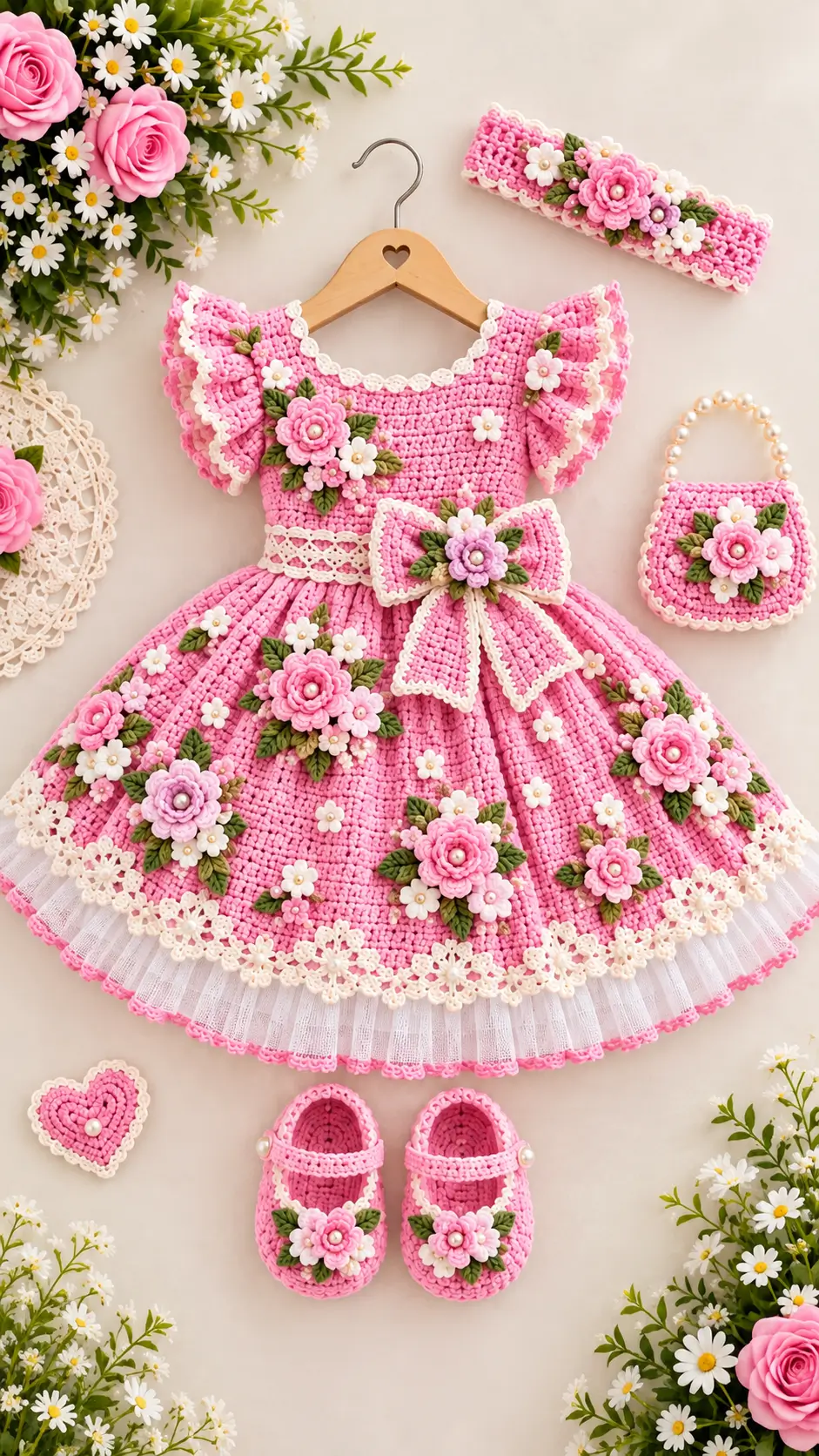
Thirty-plus raised flowers turn this pink skirt into a placement problem before the first rose is sewn down. This crochet baby dress pattern recreates that floral architecture with sport-weight yarn, a 4 mm hook and a target length of about 38 cm for a 6–12-month garment. Intermediate garment skills are appropriate. The coordinated construction also provides a practical framework for using small quantities of leftover pink, cream and green yarn.
The Design: What Makes This Floral Dress Different
The photographed dress depends on three structural decisions. First, the bodice stays comparatively close-fitting while the skirt gains considerable circumference at the waist. That prevents the pink crochet baby dress from becoming oversized merely to obtain the photographed flare.
Second, the sleeves use concentrated increases at their outer edges. The resulting folds create the ruffled cap silhouette rather than an ordinary flat sleeve.
Third, the largest roses are distributed asymmetrically across the skirt while small white blossoms fill the spaces between them. This keeps the crochet baby dress with flowers visually distributed across the full skirt rather than forming one heavy appliqué panel.
A common construction error is attaching dimensional flowers before blocking the garment. The maker then has little control over final spacing because the blocked skirt can change width and length.
Project Info at a Glance
| Skill Level | Time | Finished Size | Hook | Best For |
|---|---|---|---|---|
| Intermediate | Multi-session project | Approx. 38 cm long | 4 mm | 6–12-month decorative/photo garment |
The 38 cm target and 4 mm hook are based on comparable published baby-dress specifications. Always check the intended wearer’s measurements before beginning the garment.
Materials and Tools
Yarn
- Rose pink — Category 2/sport — approximately 150–200 g — smooth cotton or cotton-blend yarn.
- Ivory — Category 2/sport — approximately 30–50 g — for borders, bow edging and flowers.
- White — Category 2/sport — approximately 20–30 g — for small flowers.
- Leaf green — Category 2/sport — approximately 20 g — for foliage.
- Pale pink — Category 2/sport — approximately 20 g — for secondary roses.
Yarn quantities are working estimates for the highly flared skirt, ruffles and dimensional appliqués. Actual consumption depends on gauge, garment size and the number of flowers added.
Tools
- 4 mm crochet hook
- Tapestry needle
- Locking stitch markers
- Scissors
- Measuring tape
- Blocking pins
- Matching sewing thread
- Lightweight ivory tulle — optional
Pearl-style centers can reproduce the photographed appearance, but small detachable beads should not be used on an infant garment because they can become choking hazards. Embroidered or crocheted flower centers are a safer alternative.
Abbreviations
- MR — Magic ring
- sc — Single crochet
- hdc — Half double crochet
- dc — Double crochet
- inc — Increase
- dec — Decrease
- sl st — Slip stitch
- ch — Chain
- BLO — Back loop only
- st/sts — Stitch/stitches
- sp — Space
Invisible decreases are primarily used for three-dimensional crochet pieces and are not required for the main dress construction.
Pattern — Step by Step
Infant garment sizing depends on gauge, so the bodice should be built to measurements rather than an assumed universal stitch count. This pattern is a reconstruction framework inspired by the photographed design.
Gauge Swatch
Yarn: rose pink.
With the 4 mm hook, make a swatch measuring at least 12 × 12 cm in the intended bodice stitch. Block it using the same method planned for the finished dress, then measure the central 10 cm.
A useful working target for this type of baby garment is approximately 18 stitches across 10 cm in half double crochet, but your measured gauge takes priority.
Calculate the bodice using:
Stitches per cm × required finished circumference = approximate bodice stitch count.
Add any stitches required for the chosen back opening, button band or closure.
Bodice
Yarn: rose pink.
Work a top-down rectangular or raglan-style yoke to the required neckline measurement. Increase evenly at the four shaping points until the front and back sections reach the underarms.
Join beneath both arm openings.
Continue the bodice in hdc or compact dc until it reaches the natural waist. The reference dress uses a dense, relatively opaque fabric, so avoid large open lace stitches through this section.
Check the chest measurement before beginning the skirt. For a 6–12-month reconstruction, approximately 48 cm can be used as a reference target, but the actual child’s measurement should determine the final circumference.
Fasten off only if the skirt will be joined separately.
Ruffle Sleeves — Make 2
Yarn: rose pink with ivory edge.
R1: Join pink yarn around the armhole. Work an even round of sc around the opening. Join with sl st.
R2: Ch 2. Work 2 hdc into each stitch around to create concentrated fullness.
R3: Work 1 hdc in each stitch around.
R4: Change to ivory. Work a decorative sequence of sl st, ch 3, sl st at regular intervals around the edge.
For a wider ruffle, repeat the hdc body row before adding the ivory border. The sleeve should project outward from the shoulder rather than hang like a conventional short sleeve.
Fasten off and weave the yarn tail into the bodice seam.
Flared Skirt
Yarn: rose pink.
R1: Join pink yarn at the lower bodice edge and work evenly around the waist.
R2: Increase approximately every second or third stitch, depending on the amount of flare required.
R3: Work even without increases.
R4: Distribute another set of increases evenly around the skirt.
Continue working in rounds. Add increases at controlled intervals instead of stacking every increase directly above the previous one. This distributes the flare across the complete circumference.
Lay the skirt flat periodically. If the fabric forms pronounced waves, the increase rate is too high. If the skirt pulls inward, additional increases are required.
Measure from the shoulder while working. Stop the structural pink skirt early enough to leave room for the ivory lace border and optional tulle underlayer.
A finished shoulder-to-hem length of approximately 38 cm can be used as the target for this 6–12-month reconstruction.
Floral Hem Border
Yarn: ivory.
R1: Join ivory yarn and sc evenly around the final pink skirt round.
R2: Repeat ch 3, skip 2 sts, sc in next st around. Adjust the final repeat where necessary.
R3: Into each ch-3 space work 2 dc, ch 2, 2 dc.
R4: Work small picots or five-petal decorative motifs across the outer edge.
Fasten off. Block the complete border before attaching dimensional flowers.
Layered Rose — Make 8–12
Yarn: rose pink or pale pink.
R1: 6 sc in MR (6).
R2: Inc ×6 (12).
For the first petal layer, work grouped hdc and dc stitches around the center. Form the next petal layer behind the first by creating chain spaces attached to the back of the flower.
Work progressively larger petals into those spaces. Each outer layer should extend beyond the preceding petal layer to create the raised rose structure visible on the dress.
Fasten off. Leave a 20 cm sewing tail.
Alternate rose pink and pale pink flowers rather than making every rose identical.
Small Five-Petal Flowers — Make 20+
Yarn: white or ivory.
R1: 5 sc in MR (5).
R2: In each stitch work sl st, ch 2, 2 hdc, ch 2, sl st to create five petals.
Fasten off. Leave a 15 cm sewing tail.
Use embroidered or crocheted centers when making the dress for an infant.
Leaves — Make 20–30
Yarn: leaf green.
R1: Ch 7.
Starting in the second chain from the hook, work: sl st, sc, hdc, dc, hdc, sc.
Continue around the opposite side of the foundation chain and work: sc, hdc, dc, hdc, sc, sl st.
Fasten off. Leave a 15 cm sewing tail.
Arrange the leaves beneath the roses so that their pointed ends radiate outward from each floral cluster.
Oversized Floral Bow
Yarn: rose pink with ivory edging.
Crochet a rectangle approximately 18–22 cm wide, adjusting the final measurement to the finished dress.
Work rows of hdc until the rectangle reaches the required height. Edge all four sides with ivory sc followed by a small picot or scalloped border.
Pinch the rectangle firmly at its center.
For each lower ribbon tail, crochet a tapered rectangle approximately 12–16 cm long. Add the same ivory edging.
Wrap a narrow crocheted band around the center of the bow and stitch through all layers.
Attach one layered rose to the center, then position small white flowers and green leaves around it.
Floral Headband
Yarn: rose pink and ivory.
Measure the intended head circumference before making the band. Do not determine the finished circumference solely from an age label.
Work pink hdc rows until the band reaches the required length and width.
Add ivory scallops along both long edges.
Join the ends after checking the finished circumference.
Attach one medium rose near the center front. Place smaller flowers and leaves on both sides to create the elongated floral arrangement visible in the reference set.
Mini Handbag
Yarn: rose pink with ivory trim.
Make two matching rectangular panels in compact sc or hdc.
Join the bottom and both side edges with sc, leaving the top open.
Add an ivory scalloped border around the opening.
For a fully crocheted handle, make a firm foundation chain to the desired length and work sl st back across it.
Attach the handle securely to both upper corners.
Make a central floral cluster using one rose, several small flowers and green leaves. Sew it to the front panel without stitching through the back of the bag.
Mary Jane Shoes — Make 2
Yarn: rose pink.
Begin each shoe with an oval sole based on the intended foot length.
Work around both sides of a foundation chain, placing multiple stitches into the first and last chains to create the rounded heel and toe.
Continue until the sole reaches the required dimensions.
Work one round in BLO to turn the sidewall upward.
Continue evenly around the shoe, then decrease across the toe area until the opening develops the required Mary Jane shape.
For the strap, join yarn on one side of the shoe, chain across the instep and secure it on the opposite side.
Attach one small layered flower and two green leaves to the toe of each shoe.
Fasten off and weave all yarn tails securely into the inside structure.
Crochet Heart
Yarn: rose pink with ivory edging.
R1: 6 sc in MR (6).
The heart is a flat appliqué rather than a stuffed piece. Shape the two upper lobes with groups of taller stitches, then reduce the stitch height toward the lower point.
Add an ivory sc or picot border around the perimeter.
Fasten off and weave in the remaining yarn tails.
Assembly
- Block the completed bodice and skirt to the required measurements before attaching dimensional decorations.
- Attach both ruffled sleeves and compare their upper and lower edges to confirm symmetrical placement.
- Add the ivory waist band or openwork trim around the transition between the bodice and skirt.
- Lay the dress completely flat and pin the largest rose clusters across the skirt before sewing any of them permanently.
- Position green leaves beneath the large roses, then use small white and pink flowers to fill the remaining spaces.
- Sew the oversized bow into position and reinforce its center through the underlying dress fabric.
- Add the optional tulle layer beneath the crochet skirt, keeping its attachment seam behind the decorative hem.
- Complete the headband, handbag and two shoes separately, then inspect every flower and yarn end.
- Remove or replace detachable pearls and beads when the finished set will be worn or handled by an infant.
- Block the finished garment according to the yarn fiber instructions, then check the chest circumference and shoulder-to-hem measurement again.
The finished set consists of one floral crochet dress, two Mary Jane shoes, one floral headband, one miniature handbag and an optional crochet heart decoration.
7 Technical Tips for a Better Floral Crochet Dress
- Control skirt rippling. Adding too many increases in a single round creates horizontal waves that become more pronounced near the hem. Spread the increases across several rounds and place the skirt flat after each major increase section.
- Prevent flower sag. A large rose sewn only through its center can rotate or fold forward under its own weight. Secure each large rose at three or four concealed points around the lower petal layer.
- Match the sleeves. Starting the second ruffle at a different point can make one sleeve appear fuller than the other. Mark the underarm and shoulder centers of both armholes before beginning the ruffle rounds.
- Protect the bodice shape. Too many heavy appliqués across the chest can stretch the fabric vertically. Concentrate the largest roses on the skirt and bow while using smaller flowers on the bodice.
- Pin before sewing. Attaching flowers individually makes it easy to produce an unbalanced arrangement. Pin every large rose first, check the dress from several angles, and only then begin permanent attachment.
- Avoid detachable infant embellishments. Pearl beads and similar small components can separate from the garment. Replace them with tightly worked crochet centers or securely embroidered yarn centers when the dress is intended for infant wear.
- Secure every yarn tail. Cutting an appliqué tail close to the knot can allow repeated movement to loosen the flower. Weave each tail through several wrong-side stitches before trimming the remaining yarn.
Finishing the Pink Floral Crochet Baby Dress
Finish this project by blocking the skirt first, then pinning every large rose before committing to the final floral arrangement. That sequence matters because the wide skirt changes both the spacing and apparent density of the appliqués after blocking. For a wearable infant version, substitute crocheted or embroidered centers for detachable pearls and size the bodice from an actual chest measurement.
The next practical step is making and measuring a 10 cm gauge swatch before calculating the bodice foundation. Save this crochet baby dress pattern to Pinterest and share the completed coordinated set on Instagram with #PinkFloralBabyDress.
Which detail would you reproduce from this dress: the layered ruffle sleeves, oversized floral bow, or flower-covered hem?
8
⁸