Introduction
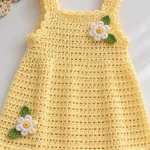
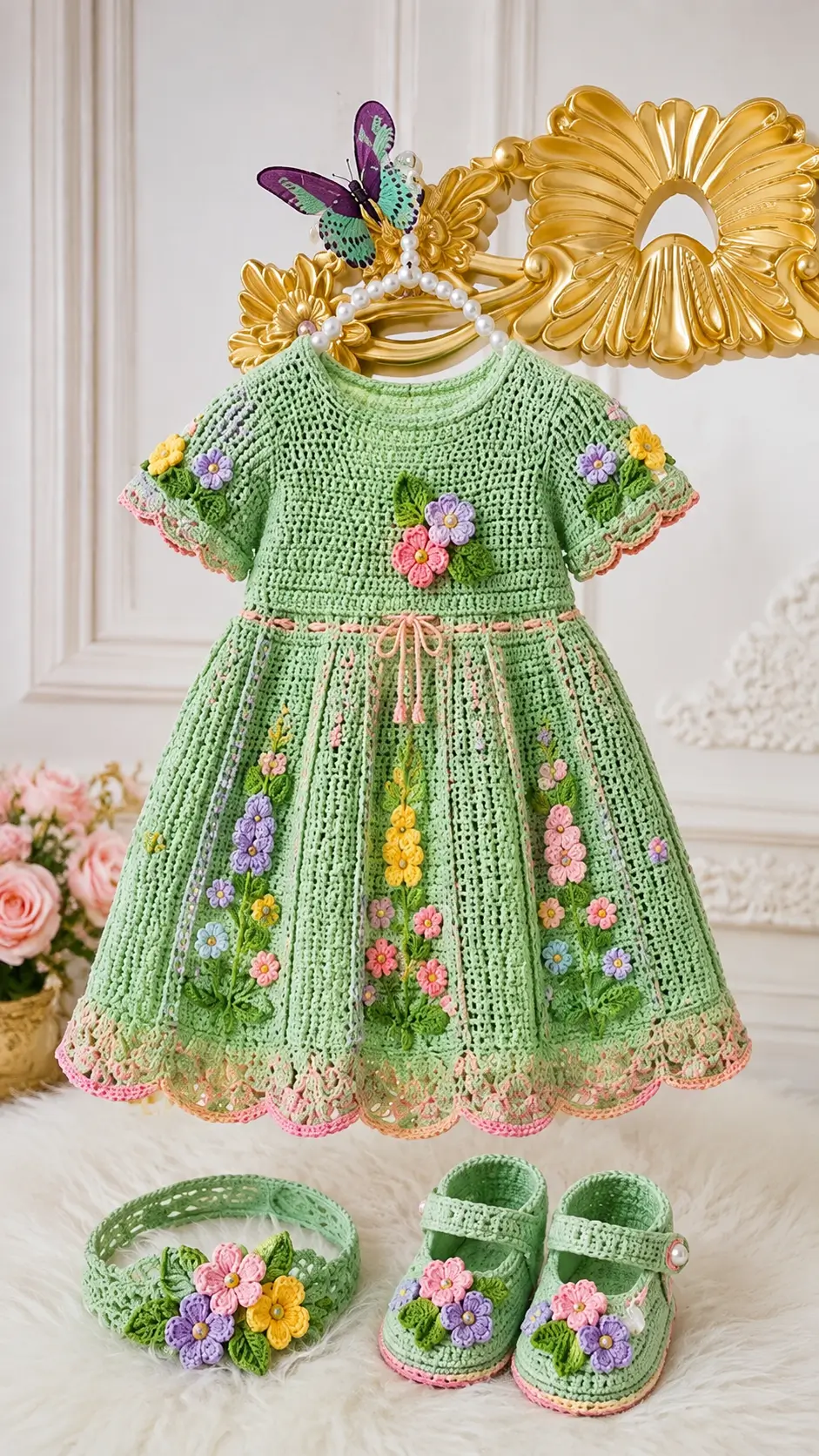
This dress carries its flower garden vertically: the appliqués climb the skirt instead of sitting only at the yoke. The crochet floral baby dress pattern below uses DK cotton, a 3.5 mm hook, and a 2-year reference size measuring about 56 cm around the bust and 48 cm long. It is an intermediate, image-inspired reconstruction designed as a coordinated dress, headband, and Mary Jane shoe set for a single matching outfit.
The Design: What Makes the Mint Garden Set Different
Three structural decisions control this garment. First, the round-neck raglan yoke expands before the sleeves are separated, which keeps the upper body smooth enough to carry floral appliqués without distorting the neckline. Second, the skirt expands sharply at the waist and then alternates solid double-crochet rounds with mesh rounds; that creates the vertical openness visible in the photographed mint green crochet baby dress while keeping the hem wide enough for a scalloped border. Third, flowers are grouped into vertical trails instead of being scattered evenly. That arrangement gives a flower applique baby dress recognizable direction from waist to hem. A common mistake is attaching every flower before blocking the skirt. Once lace relaxes, motifs sewn to an unblocked panel can tilt, pucker, or shift several centimeters from the intended line.
Pattern note: This is an original, image-derived reconstruction rather than the unpublished source pattern for the photographed garment.
Project Info at a Glance
| Skill Level | Time | Finished Size | Hook | Best For |
|---|---|---|---|---|
| Intermediate | Approximately 12–18 hours with appliqués | 56 cm bust × 48 cm length | 3.5 mm | Top-down baby/toddler dress construction |
Materials and Tools
Yarn
- Mint green — DK / Light #3 — approximately 250 g — Paintbox Cotton DK or DROPS Muskat
- Dark leaf green — DK — approximately 15 g
- Pink — DK — approximately 10 g
- Lavender — DK — approximately 10 g
- Yellow — DK — approximately 10 g
- Light blue — DK — approximately 5 g
- Peach/coral — DK — approximately 10 g for waist and hem accents
- Deeper pink — DK — approximately 5 g for final edging
Paintbox Cotton DK and DROPS Muskat are suitable DK cotton options for this type of baby dress. For the 2–3 year reference size, plan on roughly 250 g of the main color before adding the smaller quantities needed for flowers and leaves.
Tools
- 3.5 mm crochet hook
- Tapestry needle
- Scissors
- Stitch markers — at least 6
- Measuring tape
- Blocking pins
- Two securely sewn shoe buttons or crocheted button substitutes
- Polyester sewing thread for heavily handled appliqués
The photograph shows pearl-like centers and a pearl-style shoe fastening. For garments intended for children under three, loose beads can present a choking risk. Embroidered knots, tightly worked crochet bobbles, or other securely attached yarn details are better choices.
Abbreviations
MR — magic ring
ch — chain
sc — single crochet
hdc — half double crochet
dc — double crochet
tr — treble crochet
sl st — slip stitch
inc — two stitches worked into one stitch
dec — decrease
BLO — back loop only
sk — skip
sp — space
st / sts — stitch / stitches
An invisible decrease can replace a standard sc2tog at the shoe toe by working through the front loops of the next two stitches before completing one sc.
Pattern — Step by Step
Pattern status: One-size, image-inspired technical reconstruction. The gauge target is approximately 20 dc × 10 rows = 10 cm using DK yarn and a 3.5 mm hook.
The garment is not worked as an amigurumi spiral. The yoke is turned in rows; the bodice and skirt continue in joined rounds.
Raglan Yoke
Yarn: mint green.
Ch 63.
Row 1: Dc in 4th ch from hook and establish: 11 dc, ch 1, 8 dc, ch 1, 22 dc, ch 1, 8 dc, ch 1, 11 dc. Turn. (60 dc + four ch-1 raglan spaces)
The sections are back half / sleeve / front / sleeve / back half.
Row 2: Ch 3, dc to first ch-1 sp, (dc, ch 1, dc) in raglan sp, continue across each section and repeat at all four corners. Turn. (68 dc)
Row 3: Repeat Row 2. (76 dc)
Row 4: Repeat Row 2. (84 dc)
Row 5: Repeat Row 2. (92 dc)
Row 6: Repeat Row 2. (100 dc)
Row 7: Repeat Row 2. (108 dc)
Row 8: Repeat Row 2. (116 dc)
Row 9: Repeat Row 2. (124 dc)
Row 10: Repeat Row 2. (132 dc)
Row 11: Repeat Row 2. (140 dc)
Row 12: Repeat Row 2. (148 dc)
Row 13: Repeat Row 2. (156 dc)
Row 14: Repeat Row 2. (164 dc)
Row 15: Repeat Row 2. (172 dc)
After Row 15, the approximate solid sections are 25 back, 36 sleeve, 50 front, 36 sleeve, and 25 back.
Do not fasten off.
Bodice
Yarn: mint green.
Round 16: Ch 3, dc across first 25 back stitches, ch 6, skip 36 sleeve stitches, dc across 50 front stitches, ch 6, skip second 36-stitch sleeve, dc across last 25 back stitches. Join. (112)
Place the round marker at center back.
Round 17: Ch 3, dc in every stitch and underarm chain. Join. (112)
Round 18: Dc around. (112)
Round 19: Dc around. (112)
Round 20: Dc around. (112)
Round 21: Dc around. (112)
Round 22: Dc around. (112)
Round 23: Dc around. (112)
Measure from the shoulder. The yoke plus bodice should reach approximately the natural waist before the skirt increase.
Waistband Eyelet Round
Yarn: mint green.
Round 24: Ch 1, (sc in next 3 sts, ch 1, sk 1) ×28. Join. (84 sc + 28 ch-1 spaces; 112 positions)
Do not insert the waist cord until the dress has been blocked.
Full Lace Skirt
Yarn: mint green.
Round 25: Ch 3, (dc in next st, 2 dc in next st) ×56. Join. (168)
Round 26: Dc in first st, (ch 1, sk 1, dc in next st) around. Join. (84 dc + 84 ch-1 spaces)
Round 27: Dc in each dc and each ch-1 sp. (168)
Round 28: Repeat Round 26. (168 positions)
Round 29: Dc in every stitch and space. (168)
Round 30: Repeat mesh round. (168 positions)
Round 31: Dc in every stitch and space. (168)
Round 32: Repeat mesh round. (168 positions)
Round 33: Dc in every stitch and space. (168)
Round 34: (Dc in next 6 sts, 2 dc in next st) ×24. (192)
Round 35: Dc in first st, (ch 1, sk 1, dc in next st) around. (96 dc + 96 spaces)
Round 36: Dc in every stitch and space. (192)
Round 37: Repeat mesh round. (192 positions)
Round 38: Dc in every stitch and space. (192)
Round 39: Repeat mesh round. (192 positions)
Round 40: Dc in every stitch and space. (192)
Round 41: Repeat mesh round. (192 positions)
Round 42: Dc in every stitch and space. (192)
Check the dress length before starting the border. The target finished length is approximately 48 cm after blocking.
Scalloped Hem
Yarn: mint green, peach, then pink.
Round 43 — mint: (Sk 2 sts, 5 dc in next st, sk 2 sts, sc in next st) ×32. (32 shells)
Round 44 — peach: Join at the center dc of a shell. (Ch 4, sl st into center dc of next shell) ×32. (32 arches)
Round 45 — pink: In each ch-4 arch work (sc, hdc, 3 dc, hdc, sc). (32 scallops)
Fasten off. Weave the tail through at least 5 cm of adjacent stitches before trimming.
Flutter Sleeves — Make 2
Yarn: mint green with peach and pink trim.
Join mint at the center of the 6-chain underarm.
Round 1: Dc in each underarm chain and each of the 36 held sleeve stitches. Join. (42)
Round 2: (Sk 2, 5 dc in next st, sk 2, sc in next st) ×7. (7 shells)
Round 3 — peach: Sl st to center dc of first shell, (ch 4, sl st into center dc of next shell) ×7. (7 arches)
Round 4 — pink: Work 5 sc into each ch-4 arch. (35 sc)
Fasten off. Leave a 10 cm tail and weave it inside the sleeve.
Waist Tie
Yarn: peach.
Ch 220.
Row 1: Sl st in second ch from hook and in every chain across. (219 sl sts)
Fasten off. Add a 3 cm tassel or small crocheted knot at each end. Thread the cord through the 28 waistband eyelets only after the dress has been blocked.
Six-Petal Flowers
Make approximately 28–30 in mixed pink, lavender, yellow, and blue.
Round 1: 6 sc in MR. Join. (6)
Round 2: In each sc work (sl st, ch 2, 2 dc, ch 2, sl st). (6 petals)
Fasten off. Leave a 15 cm sewing tail.
For larger bodice, headband, and shoe flowers, work the same motif with a 4 mm hook or add one extra petal layer behind Round 2.
Layered Feature Flowers — Make 7
Suggested distribution: three bodice, two headband, one on each shoe.
Round 1: 6 sc in MR. (6)
Round 2: (Sl st, ch 2, 2 dc, ch 2, sl st) in each stitch. (6 petals)
Round 3: Working behind the first petals around the base of each Round 1 stitch, (sl st, ch 3, 3 tr, ch 3, sl st) six times. (6 back petals)
Fasten off. Embroider the center with contrasting yarn instead of attaching a loose bead on a garment for a young child.
Leaves — Make 30–36
Yarn: dark green.
Ch 8.
Row 1: Sc in 2nd ch, hdc in next ch, dc in next, 2 dc in next, dc in next, hdc in next, 3 sc in final ch; rotate to work along the opposite side of the foundation chain, hdc, dc, 2 dc, dc, hdc, sc. (17)
Fasten off. Leave a 15 cm tail.
Flower Placement Map
Do not sew motifs randomly. Pin the complete arrangement first.
Place three layered flowers slightly off-center on the upper bodice, supported by four to six leaves. Add two or three small flowers per sleeve and position them toward the outer upper arm rather than directly under the arm.
For the skirt, establish five vertical garden trails. Start each trail roughly 5–8 cm below the waist, then alternate flowers and leaves toward the hem. Keep neighboring trails uneven in height; the photographed dress uses an organic vertical arrangement rather than identical columns.
Reserve the smallest flowers for gaps close to the hem.
Floral Headband
Yarn: mint green; flowers in pink, lavender, and yellow.
Ch 91.
Row 1: Hdc in second ch and across. (90)
Row 2: Ch 1, turn, hdc BLO across. (90)
Row 3: Ch 1, turn, hdc BLO across. (90)
Row 4: Ch 1, sc across. (90)
Fasten off with a 25 cm tail. Sew the short ends together to form the band.
Pin two layered flowers plus one small flower over the join. Add four leaves behind them and sew through the band fabric rather than only through the surface loops.
Mary Jane Shoe Soles — Make 2
Yarn: mint green.
Ch 24.
Round 1: 2 hdc in second ch from hook, hdc in next 21 ch, 5 hdc in final ch; rotate and work down opposite side, hdc in next 21, 3 hdc into the first-chain base. Join. (52)
Round 2: 2 hdc in each of next 2 sts, hdc in next 21, 2 hdc in each of next 5, hdc in next 21, 2 hdc in each of final 3. (62)
Round 3: (Hdc in next st, 2 hdc in next) ×2, hdc in next 21, (hdc, 2 hdc in next) ×5, hdc in next 21, (hdc, 2 hdc in next) ×3. (72)
The completed sole should be checked against the wearer before continuing. For the photographed toddler proportion, aim for approximately 13.5–14 cm rather than relying on age labeling alone.
Mary Jane Shoe Upper — Make 2
Round 4: Sc BLO around. (72)
Round 5: Sc around. (72)
Round 6: Sc in next 24, (sc2tog, sc in next 2) ×6, sc in final 24. (66)
Round 7: Sc in next 23, (sc2tog, sc) ×6, sc in final 25. (60)
Round 8: Sc in next 22, sc2tog ×6, sc in final 26. (54)
Round 9: Sc around. (54)
Change to pink.
Round 10: Sl st loosely around the opening. (54)
Fasten off.
Shoe Straps — Make 2
Yarn: mint.
Ch 21.
Row 1: Sc in second ch and across. (20)
Row 2: Ch 1, turn, sc across. (20)
At the button end, ch 4 and sl st back into the final stitch to form a loop. Fasten off.
Sew the opposite end securely to the outer side of each shoe. Before attaching a button, test that the loop cannot slip over it under light pulling force. A crocheted bobble closure is preferable when the set is intended for very young children.
Shoe Flowers and Leaves
Attach one layered flower and two leaves to each toe, positioned slightly toward the outside edge. Keep the cluster above the sole line so repeated floor contact does not abrade the sewing stitches.
Assembly
- Block the dress body to approximately 56 cm finished bust circumference and 48 cm shoulder-to-hem length, without stretching the mesh vertically.
- Block both sleeves with the scallops opened to equal widths.
- Thread the peach waist cord through the 28 waistband eyelets and center both tails at the front.
- Pin the three large bodice flowers and supporting leaves, then sew each motif through several foundation stitches.
- Attach the sleeve flowers, keeping all sewing knots on the inside and outside the underarm contact zone.
- Mark five skirt trails with removable stitch markers before placing any lower flowers.
- Sew skirt leaves first, then layer the flowers over selected leaf bases so the attachment stitches remain hidden.
- Join the headband ends, add its flower cluster, and check that no hard fastening sits directly against the wearer’s forehead.
- Finish both shoes, attach straps, then add toe flowers and leaves only after sole length has been checked.
- Weave every remaining tail through multiple stitches, trim excess yarn, and inspect all appliqués and fastenings by hand before the set is worn.
The completed set consists of one lace dress, one floral headband, and two matching Mary Jane shoes.
7 Technical Tips
- Stitch-marker drift: Keep a marker in the center-back join and move it every round. A one-stitch shift repeated through 15 skirt rounds can move a flower trail visibly off-center, so count the 112-stitch bodice again before Round 25.
- Overstuffed appliqués: These flowers are flat motifs and need no fiberfill. Padding a flower center can produce a hard lump against the child’s body and make the surrounding skirt mesh pucker.
- Decrease ridges at the shoe toe: Standard sc2tog can create six visible bars across Round 8. Replace those decreases with front-loop invisible decreases if a flatter toe surface is required.
- Flower placement timing: Pin every bodice and skirt flower only after blocking. A 2–3 cm relaxation in lace length can alter the complete vertical arrangement.
- Tension mismatch: Switching from smooth DK cotton to velvet changes gauge and motif scale sharply. Keep the dress and main appliqués in a yarn that produces approximately 20 dc per 10 cm with the selected