Introduction
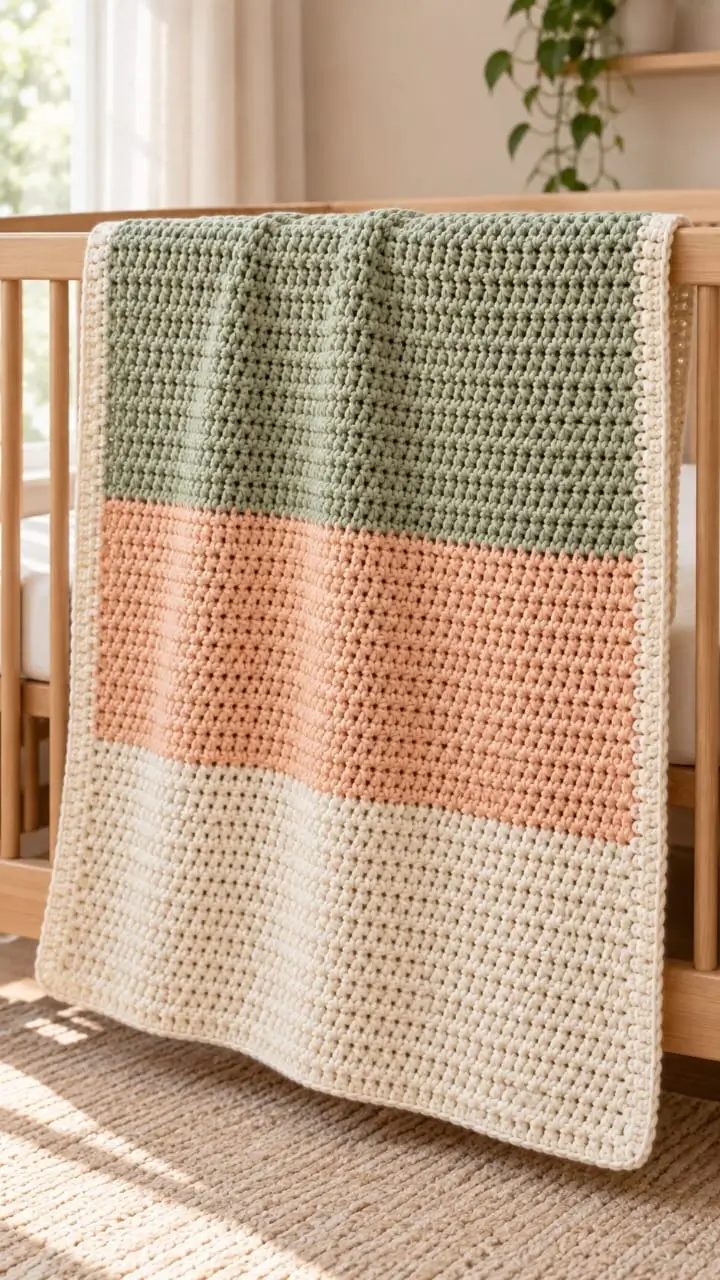
Three uninterrupted bands of sage, peach and cream are what give this blanket its unusually graphic nursery-scale proportions. This color block crochet baby blanket uses DK yarn, a 4.5 mm hook and a simple alternating-stitch fabric, with a target size near 91 cm square. The skill level is advanced beginner. Its three large sections also make color substitutions easier than patterns containing frequent stripe changes.
The Design: What Makes This Color Block Blanket Different
The photograph depends on proportion more than complicated stitchwork. Sage occupies the upper field, peach forms the visual center, and cream finishes the lower field before continuing around the perimeter. Keeping each section large prevents the sage green crochet baby blanket palette from reading as ordinary narrow stripes.
A compact stitch is used because widely spaced lace would change the character of the photographed blanket. The narrow border has a second job: it visually connects the cream lower section to all four edges.
The common mistake with a three color crochet blanket of this type is changing colors according to an arbitrary row count before checking actual depth. Gauge affects vertical measurements too. A maker should measure each band while working because yarn substitution can alter the final proportions even when the stitch count remains correct.
Project Info at a Glance
| Skill Level | Time | Finished Size | Hook | Best For |
|---|---|---|---|---|
| Advanced beginner | Approx. 12–18 hours | Approx. 91 × 91 cm | 4.5 mm | Crib-side display, stroller use, floor play |
The 91.44 cm square reference size and 4.5 mm hook are documented for a DK color-block baby blanket.
Materials and Tools
Yarn
Use DK/#3 yarn for the written version. A comparable 36-inch square color-block blanket uses approximately 675 g of DK yarn in total.
- Cream / warm ivory — DK/#3 — approximately 275 g — Stylecraft Special DK or comparable smooth washable DK
- Sage green — DK/#3 — approximately 200 g — smooth acrylic or acrylic-blend DK
- Soft peach — DK/#3 — approximately 200 g — smooth acrylic or acrylic-blend DK
These individual color quantities are working estimates for this three-color layout. Buy additional yarn when dye-lot matching matters.
Tools
- 4.5 mm crochet hook
- DK/#3 yarn
- Yarn needle
- Locking stitch markers
- Scissors
- Flexible tape measure
- Blocking mats and rust-resistant pins — optional
Abbreviations
- ch — chain
- sc — single crochet
- dc — double crochet
- sl st — slip stitch
- st/sts — stitch/stitches
- RS — right side
- WS — wrong side
Color Block Crochet Baby Blanket Pattern
The blanket is worked flat in turned rows. The written version uses a foundation of 135 chains to create 134 working stitches. The sage, peach and cream proportions are based on the appearance of the photographed blanket.
Foundation
Yarn: sage green.
Before beginning the full blanket, make a gauge swatch in the alternating single crochet and double crochet pattern. Adjust the hook if necessary before committing to the complete foundation chain.
With sage green, ch 135.
Row 1: Sc in second ch from hook, dc in next ch; repeat sc in next ch, dc in next ch across. Ch 1, turn. (134 sts)
The working count is 67 single crochet stitches and 67 double crochet stitches.
Sage Green Section
Yarn: sage green.
Row 2: Sc in first st, dc in next st; repeat sc in next st, dc in next st across. Ch 1, turn. (134 sts)
Rows 3 onward: Repeat Row 2, placing sc into the previous row’s dc and dc into the previous row’s sc. (134 sts)
Continue until the sage section measures approximately 30 cm from the foundation edge.
Use the physical measurement rather than relying exclusively on a fixed number of rows. Differences in yarn and tension can change the vertical gauge.
At the end of the final sage row, complete the last stitch and change to peach.
Peach Center Section
Yarn: soft peach.
First peach row: Sc in first st, dc in next st; repeat the established alternating pattern across. Ch 1, turn. (134 sts)
Following rows: Repeat the established alternating sc/dc pattern. (134 sts each row)
Continue until the peach section measures approximately 25–27 cm.
Keep the transition line level. A missed edge stitch becomes particularly noticeable where the sage and peach sections meet.
Change to cream at the end of the final peach row.
Cream Lower Section
Yarn: warm ivory or cream.
First cream row: Work the established sc/dc sequence across. Ch 1, turn. (134 sts)
Following rows: Continue in the established pattern. (134 sts each row)
Work until the main rectangle measures approximately 88–89 cm from the foundation edge.
Fasten off after the final row. The border will add additional width and height toward the approximately 91 cm finished target.
Cream Border
Yarn: cream.
The border should remain narrow so that it frames the three large color fields rather than becoming a separate dominant section.
Join cream yarn in one corner.
Border Round 1: Ch 1. Work sc evenly around all four sides. Across the top and bottom, work approximately one stitch into each stitch. Along the side edges, distribute the stitches evenly so the fabric remains flat. Work 3 sc in each corner. Join with sl st to the first sc.
Border Round 2: Ch 1, sc in each st around, working 3 sc in the center corner stitch at each corner. Join with sl st.
Border Round 3: Repeat Border Round 2 if a slightly wider cream frame is required.
Fasten off. Leave approximately a 15 cm tail and weave it through several stitches in one direction, reverse direction, then trim.
How to Make Clean Color Changes
A clean transition is especially visible in a blanket built from three large uninterrupted blocks.
Begin the last stitch of the old color normally. Stop before completing the final yarn-over. Place the new color on the hook and use it to complete the stitch.
Turn the work and continue with the new yarn.
This method positions the new shade directly at the row boundary rather than carrying part of the previous color into the next band. Leave sufficiently long tails for weaving.
Avoid tying a bulky knot at the color transition. It can distort the side edge and become more noticeable after the cream border is added.
How to Adjust the Blanket Width
The written pattern begins with ch 135 to create 134 working stitches.
The alternating stitch sequence requires an even number of working stitches. Because the first stitch is placed into the second chain from the hook, use an odd-numbered starting chain.
For a narrower stroller blanket, reduce the foundation chain in multiples of two while retaining an odd total starting-chain number. For a larger blanket, add chains in pairs.
Always make a gauge swatch when the final measurements matter. Changing yarn weight, hook diameter or personal tension without recalculating the foundation will change the finished width.
Adjusting the Three Color Sections
This design depends on broad fields rather than narrow stripes. Measure the sections in centimeters to preserve that structure.
- Sage: approximately 30 cm
- Peach: approximately 25–27 cm
- Cream: continue until the main panel reaches approximately 88–89 cm
- Border: approximately 1–2 cm around the perimeter
These measurements reproduce the visual proportions of the photographed blanket rather than documenting the construction method of the original item.
When increasing the total blanket length, distribute the additional depth between the three sections. Adding all extra rows to one color changes the balance of the design.
Finishing and Assembly
- Complete the sage field and check the full width before changing colors.
- Join peach during the final yarn-over of the last sage stitch.
- Work the peach field while maintaining the 134-stitch count.
- Join cream at the final stitch of the last peach row.
- Complete the cream lower field to the target main-panel measurement.
- Lay the rectangle flat and check all four edges for accidental increases or missing stitches.
- Join the cream border yarn at one corner and work the first perimeter round.
- Add the second border round, placing the corner increases consistently.
- Weave each color-change tail through fabric of the matching color.
- Measure the finished blanket after washing or blocking according to the yarn manufacturer’s care instructions.
The completed blanket consists of one continuous rectangular panel surrounded by a narrow cream border.
7 Technical Tips for a Cleaner Blanket
- Mark the first and last stitch of every row. The specific failure mode is edge loss: repeatedly dropping one stitch can turn a 134-stitch rectangle into a visible trapezoid.
- Count to 134 at regular intervals. A single accidental increase can remain unnoticed for several centimeters before the side begins to flare.
- Measure every color section in centimeters. A vertical gauge difference of only a few rows per 10 cm can noticeably alter the sage-to-peach proportion.
- Change colors during the final yarn-over. Changing yarn only after completing the final stitch can leave a visible segment of the previous color at the beginning of the new band.
- Pin all four corners before judging border tension. A center that bows while the corners remain flat can indicate too few side stitches, while rippling generally indicates too many.
- Keep the border near 1–2 cm when matching this design. A 5 cm border substantially changes the color proportions and makes cream dominate the composition.
- Weave yarn tails at least 5–7 cm before reversing direction. A short tail positioned directly beside a color boundary can migrate into the contrasting section during washing.
Why DK Yarn Works for This Blanket
DK yarn provides enough stitch definition for the alternating single crochet and double crochet texture without making the blanket excessively bulky. A 4.5 mm hook also has published precedent in DK color-block baby blanket patterns.
Heavier yarn can still be substituted, but the foundation count must be reconsidered. Using Aran or worsted yarn with the same 134 working stitches will normally produce a wider blanket.
The same principle applies to hook size. A larger hook generally creates larger stitches and a more open fabric, while a smaller hook creates a denser fabric and may reduce the finished dimensions.
Conclusion
The defining calculation in this project is the ratio between three broad color fields, not a complicated stitch repeat. Work the sage section first, preserve the 134-stitch width, measure the peach band physically, then finish the lower panel and narrow border in cream. Before starting, make a DK swatch with the 4.5 mm hook and record its width; that measurement determines whether the 134-stitch count suits your yarn. Save the color block crochet baby blanket to Pinterest, and share a finished version on Instagram with #SagePeachColorBlockBlanket. Which proportion would you change first: the deep sage top field or the narrower peach center band?