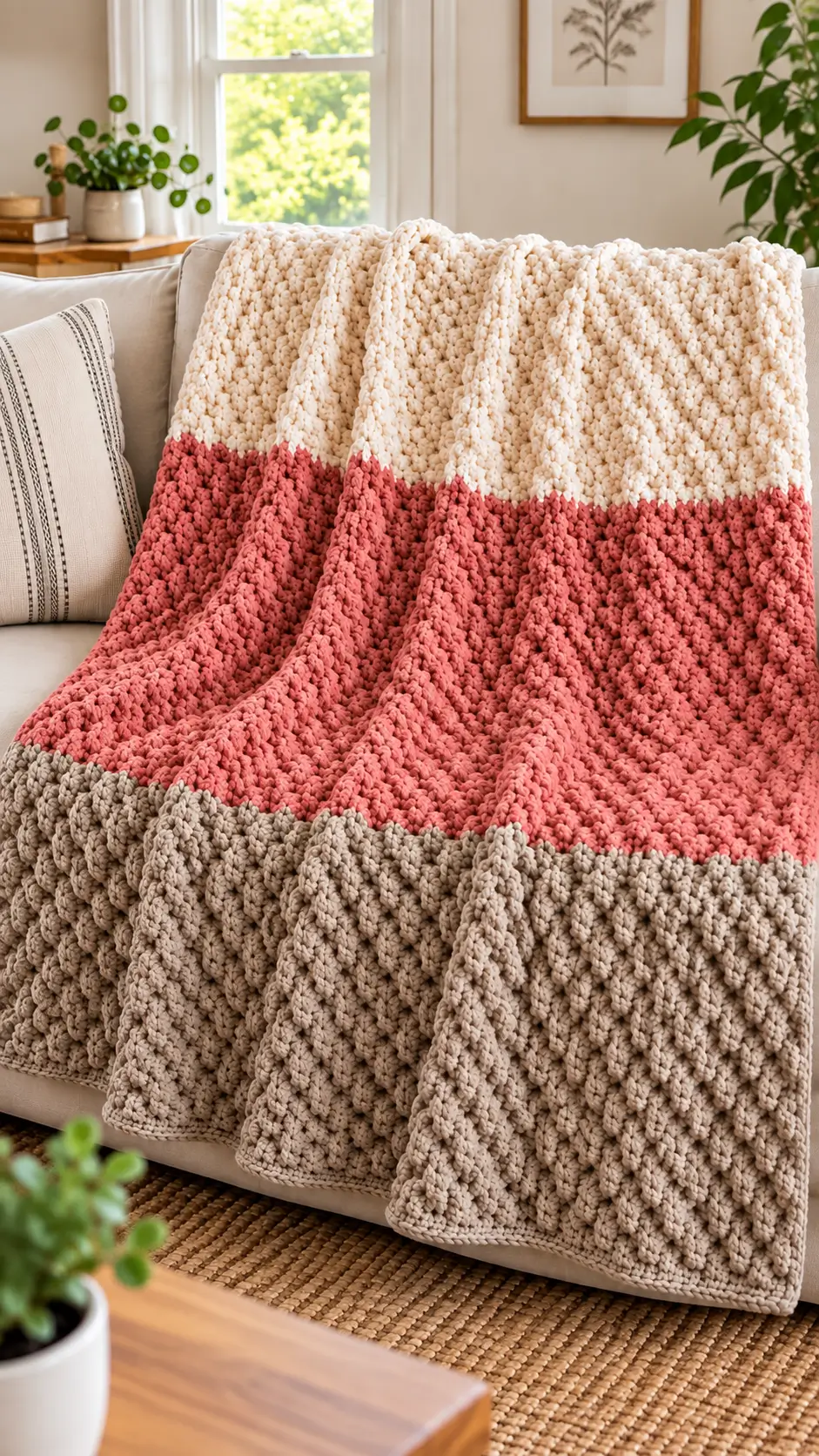
Three horizontal fields—not ordinary narrow stripes—control the proportions of this blanket. This chunky color block crochet blanket uses super-bulky yarn, an 8 mm hook, and three large sections to produce an approximately 120 × 140 cm throw. The skill level is advanced beginner because consistent tension and clean color transitions matter. Its one-piece construction also avoids joining separate panels.
The Design: What Makes This Color Block Blanket Different
The photographed throw depends on proportion more than complicated shaping. Cream occupies the upper section, dusty rose dominates the center, and taupe forms a visually heavier lower block. That uneven distribution prevents the project from reading as a conventional striped afghan.
A dense textured stitch is used for this chunky crochet blanket pattern because broad areas of one color need surface definition. The narrow edging has a separate job: stabilizing the perimeter without creating another dominant color band.
The primary mistake with a three color crochet blanket is changing shades without controlling row tension. A tighter first row after a color change can pull the sides inward. The maker should therefore check width after every transition. The photographed blanket also has relatively straight sides, so adding accidental stitches at row ends must be avoided.
Project Info at a Glance
| Skill Level | Time | Finished Size | Hook | Best For |
|---|---|---|---|---|
| Advanced beginner | Approx. 12–18 hours | Approx. 120 × 140 cm | 8 mm | Sofa throw / bed accent |
The finished-size target is based closely on Yarnspirations’ published 120.5 × 137 cm Bernat color-block throw specification.
Materials and Tools
Yarn
Use #6 super-bulky polyester blanket yarn or another yarn that meets the swatched gauge.
- Dusty rose — #6 super bulky — approx. 900 g — Bernat Blanket or equivalent
- Warm cream — #6 super bulky — approx. 600 g — Bernat Blanket or equivalent
- Mushroom taupe — #6 super bulky — approx. 600 g — Bernat Blanket or equivalent
Bernat Blanket is commonly supplied in 300 g skeins with approximately 201 m of yarn. Do not substitute purely by skein count because yardage and weight vary between manufacturers.
Tools
- 8 mm crochet hook
- Locking stitch markers
- Large-eye tapestry needle
- Scissors
- Tape measure
- Digital kitchen scale — optional but useful for yarn calculations
Make a 15 cm square test swatch before buying the full yarn quantity when using an unfamiliar yarn. Dense stitches can consume substantially more yarn than open stitches covering the same area.
Abbreviations
- ch — chain
- sc — single crochet
- hdc — half double crochet
- sl st — slip stitch
- st/sts — stitch/stitches
- RS — right side
- WS — wrong side
- BLO — back loop only
This blanket is worked flat in rows rather than in a continuous spiral.
Chunky Color Block Crochet Blanket Pattern
Gauge and Sizing
The pattern target is approximately 120 cm wide × 140 cm long after the edging. Because super-bulky yarn varies considerably, the foundation count must be treated as subordinate to gauge.
Make a swatch first. If 85 working stitches do not produce approximately 116–118 cm of unbordered width at your gauge, change the starting chain until that width is reached.
Chunky and super-bulky yarns can produce substantially different gauges even when the yarn labels place them in similar weight categories. Measure the actual fabric rather than relying only on the yarn classification.
Foundation
Yarn: mushroom taupe.
Ch 86.
Row 1: Sc in second ch from hook and in each ch across. Turn. (85)
The 85-stitch width is original to this version. Measure the foundation section now. Adjust the starting chain before continuing if the fabric is materially narrower or wider than the target.
Taupe Lower Color Block
Yarn: mushroom taupe.
Row 2: Ch 1, sc in first st, hdc in next st; repeat [sc, hdc] across, ending with sc. Turn. (85)
Row 3: Ch 1, hdc in first st, sc in next st; repeat [hdc, sc] across, ending with hdc. Turn. (85)
Rows 4–27: Repeat Rows 2–3 twelve times. (85 each row)
The alternating short and taller stitches create the broken, pebbled surface visible across the blanket rather than a completely flat field of uniform single crochet.
Check the section depth. Aim for approximately 38–40 cm before changing color.
Do not fasten off until the final stitch is ready for its last yarn-over.
Dusty Rose Center Block
On the final yarn-over of Row 27, complete the stitch with dusty rose.
Row 28: Ch 1, sc in first st, hdc in next st; repeat [sc, hdc] across, ending with sc. Turn. (85)
Row 29: Ch 1, hdc in first st, sc in next st; repeat [hdc, sc] across, ending with hdc. Turn. (85)
Rows 30–65: Repeat Rows 28–29 eighteen times. (85 each row)
The dusty rose block is deliberately deeper than either neutral section. Target approximately 55–58 cm for this band.
Changing color during the last yarn-over produces a cleaner boundary than fastening off and introducing the new shade after turning.
Check both edges after Row 40 and again after Row 55. Each row must still contain 85 stitches.
Cream Upper Color Block
Complete the final yarn-over of Row 65 with warm cream.
Row 66: Ch 1, sc in first st, hdc in next st; repeat [sc, hdc] across, ending with sc. Turn. (85)
Row 67: Ch 1, hdc in first st, sc in next st; repeat [hdc, sc] across, ending with hdc. Turn. (85)
Rows 68–91: Repeat Rows 66–67 twelve times. (85 each row)
Measure the complete fabric before adding the border. The target unbordered length is approximately 136–138 cm, allowing the edging to bring the project close to 140 cm.
If the required length is reached before Row 91, stop after completing a full row. If more length is required, continue the established two-row texture repeat.
Fasten off.
Narrow Perimeter Edging
Yarn: choose cream for a light frame or taupe for stronger definition.
Join yarn in one corner.
Round 1: Ch 1. Work sc evenly around the complete perimeter. Place 3 sc in each corner. Along row ends, distribute stitches evenly without crowding the edge. Join with sl st to first sc.
Fasten off and weave in the tail for at least 8–10 cm through several directions of the dense fabric.
The important structural requirement is adding enough corner stitches for the border to turn without cupping while avoiding excessive stitches along the sides.
Color Placement and Proportions
The three sections should not be equal. To reproduce the photographed composition, use approximately:
- Taupe: 28% of total length
- Dusty rose: 42% of total length
- Cream: 30% of total length
Those percentages are design targets derived from the visible proportions of the blanket rather than mandatory structural measurements.
A 140 cm finished blanket therefore allocates roughly 39 cm to taupe, 59 cm to dusty rose, and 42 cm to cream, with minor differences introduced by the edging and individual gauge.
Working by measured section depth is more reliable than copying an arbitrary number of rows. A crocheter whose row gauge differs can still reproduce the intended visual balance by measuring each color section.
Finishing the Blanket
- Lay the finished color block crochet blanket flat with the right side facing upward.
- Measure the width at the top, center, and bottom. Large discrepancies indicate a tension change.
- Confirm that both long edges contain no obvious accidental increases.
- Thread each color-change tail onto a large-eye tapestry needle.
- Weave each tail through stitches of the matching color rather than across a contrasting block.
- Reverse direction at least once so a cut end cannot pull directly out of the fabric.
- Inspect the two horizontal color boundaries and redistribute any stretched stitches by hand.
- Shape the four corners so the border lies flat rather than curling inward.
- Wash according to the yarn manufacturer’s care instructions and dry using the method specified on its label.
- Measure the dry blanket and record its finished dimensions, yarn, hook, and gauge for future resizing.
The completed throw should have three uninterrupted horizontal color fields, a stable perimeter, and consistent width from top to bottom.
7 Technical Tips for a Chunky Crochet Blanket
- Mark the first and last stitch. The most common failure mode is dropping an edge stitch and turning 85 stitches into 84. Put a locking marker into both edge stitches before working the center of the row.
- Measure every ten rows. A width change greater than about 2 cm indicates that tension has shifted enough to affect the rectangular shape. Compare the newest measurement with the foundation section before continuing.
- Control chenille tension rather than pulling it tight. Super-bulky polyester yarn can produce rigid fabric when the hook is too small for the maker’s tension. If the swatch stands stiffly instead of folding, move up 1 mm in hook size and swatch again.
- Change color on the final yarn-over. Starting the new shade only after turning can leave a visible discontinuity at the edge. Complete the final pull-through of the old-color stitch with the incoming color.
- Count before every color transition. An 85-stitch row should still contain 85 stitches before cream or dusty rose is introduced. Correct a missing or extra stitch before adding more rows.
- Test the border before completing the perimeter. If the edge begins to wave, too many stitches may have been placed along the row ends. Work a 20–25 cm test section first when your gauge differs substantially from the pattern.
- Weave tails through matching colors. A dusty rose tail carried into the cream block can become visible when the fabric stretches. Keep at least 8–10 cm of woven tail inside its own color field and reverse direction once.
Yarn Substitution Notes
A #6 label alone does not guarantee identical gauge. Different super-bulky products can contain substantially different yardage for the same yarn weight.
Compare meters per 100 g, fiber content, construction, and swatch density before substituting.
The photographed blanket shows rounded, plush stitch definition consistent with blanket-style yarn. A smooth conventional plied super-bulky acrylic or wool can still work, but individual stitches will appear sharper and more defined.
For a more accurate yarn estimate, crochet a known area and weigh the finished swatch. Calculate the blanket’s total area, use the swatch weight to estimate consumption, then add extra yarn for the edging and normal gauge variation.
How to Resize the Blanket
Width is controlled at the foundation. Because the texture uses alternating sc and hdc across an odd working count, maintain an odd number of stitches.
For a narrower lap blanket, reduce the foundation until the swatch-based width is reached. For a larger bed throw, add stitches while retaining an odd total.
Length is simpler. Continue each color section until it reaches its target measurement.
To preserve the same visual balance at another finished length, multiply the desired body length by approximately 0.28 for taupe, 0.42 for dusty rose, and 0.30 for cream.
For a 160 cm body, for example, the approximate section targets become 45 cm taupe, 67 cm dusty rose, and 48 cm cream.
These figures reproduce the color proportions rather than prescribing mandatory row counts.
Conclusion
Before starting the full throw, crochet and measure one 15 cm swatch in the selected super-bulky yarn. That test determines whether the 8 mm hook and proposed foundation count will produce the required width, and it provides a better yarn-consumption estimate than skein count alone. Keep the center dusty rose section larger than either neutral block to retain the photographed proportions. When the chunky color block crochet blanket is finished, photograph it flat as well as draped, then save the project to Pinterest or share the color combination on Instagram with #ChunkyColorBlockBlanket. Which proportion would you change first: the cream upper field, rose center, or taupe lower block?