Introduction
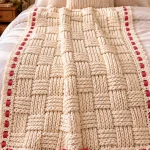
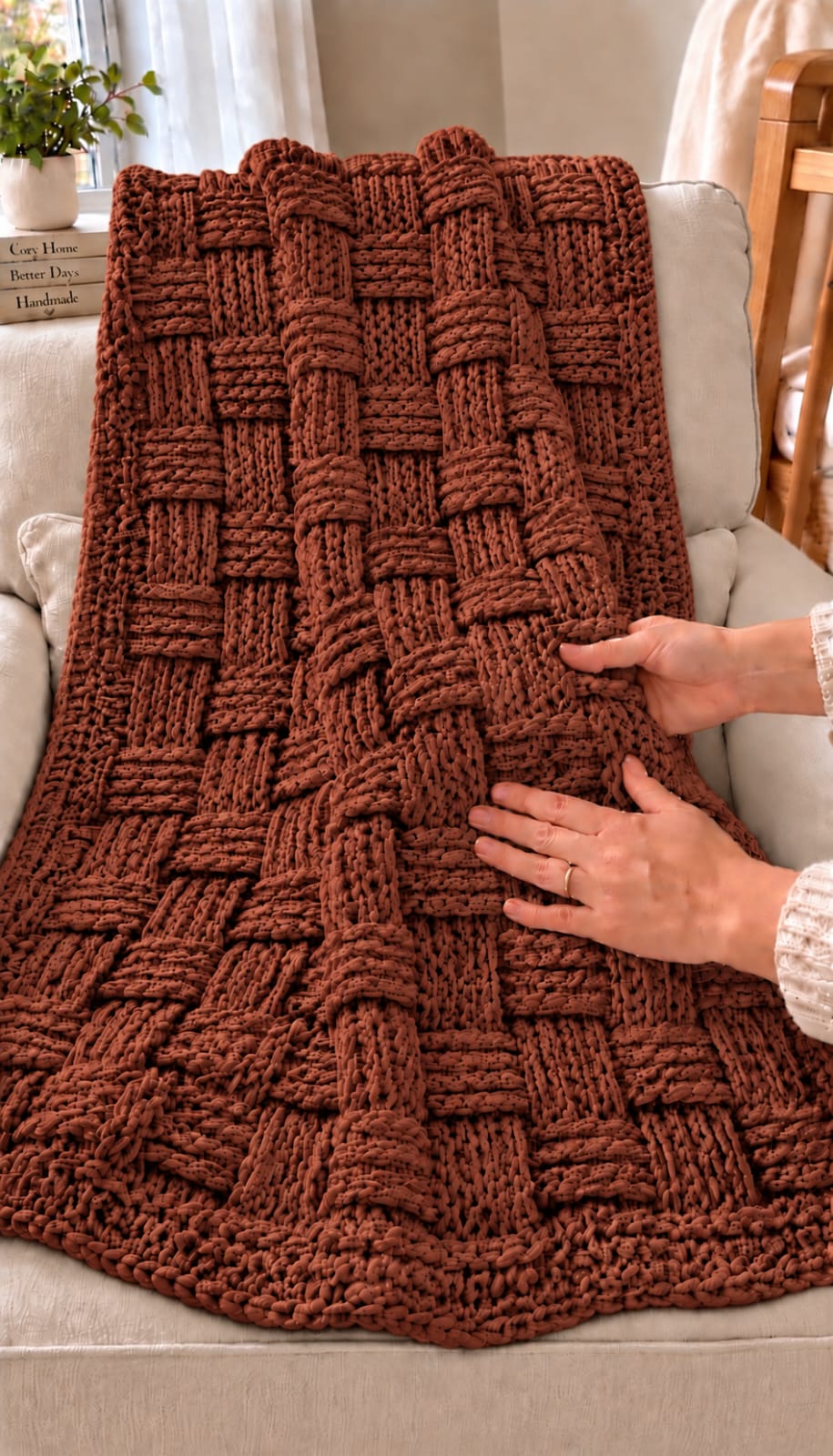
The oversized blocks in this blanket look like thick rust-brown straps physically passing over and under one another. This chunky basketweave crochet blanket pattern uses #6 super-bulky yarn, a 10 mm hook, and grouped front- and back-post double crochet. The intermediate reconstruction targets approximately 125 × 155 cm, producing a substantial sofa throw with a continuous one-piece structure and pronounced raised texture.
The instructions below are an original photo-inspired reconstruction based on visible structure; published patterns cited later are used only for sizing, gauge, and material benchmarks.
The Design: What Makes This Basketweave Blanket Different
The reference enlarges ordinary basketweave until each woven-looking block becomes a major design element. Four post stitches form each vertical band, and four pattern rows establish its height before the raised and recessed positions exchange places. That proportion produces broad blocks rather than a small checkerboard. A plain double-crochet setup row gives every post a stable anchor, while one ordinary stitch at each edge keeps the sides easier to count and finish. The photographed super bulky basketweave blanket also has a restrained edge, so the reconstruction finishes with a narrow textured border instead of fringe or oversized tassels. Post stitches naturally contract and thicken the fabric. A frequent error in a basketweave crochet throw is measuring the starting chain instead of a completed swatch; the apparent width changes after several rows of post stitches.
Project Info at a Glance
| Skill Level | Time | Finished Size | Hook | Best For |
|---|---|---|---|---|
| Intermediate | Reconstruction estimate: 20–28 hours | Reconstruction target: 125 × 155 cm | 10 mm | Sofa throws, reading chairs, foot-of-bed blankets |
Current published benchmarks confirm that super-bulky yarn and large hooks are appropriate for this structure. Sirdar’s Basketweave Blanket 10230 uses super-bulky Hayfield Bonus Super Chunky, an 11.5 mm hook, 1,230 yards, and measures approximately 107 × 150 cm. Michele Webb’s Chunky Basketweave Blanket uses Bernat Blanket with an 8 mm hook and 1,460–1,540 yards for a 45 × 55 inch throw. Yarnspirations’ current Basketweave Blanket uses Bernat Forever Fleece Tweeds, an 11.5 mm hook, and 1,200 yards.
Materials and Tools
Yarn
- Rust brown — #6 super bulky — reconstruction estimate: 1,500–1,750 yd / 1,370–1,600 m
- Estimated yarn weight — approximately 1,900–2,400 g, depending on the selected yarn’s meterage
Bernat Blanket is one practical benchmark: Michele Webb’s published version specifies the #6 polyester yarn at 220 yards per 300 g. Hayfield Bonus Super Chunky offers a more structured acrylic alternative, while Bernat Forever Fleece Tweeds produces a softer surface. Select one yarn family for the complete blanket because different #6 yarns can vary substantially in thickness.
Tools
- 10 mm crochet hook
- 12 mm hook for the foundation chain if needed
- Large tapestry needle
- Locking stitch markers
- Scissors
- Measuring tape
Abbreviations
- ch — chain
- sc — single crochet
- hdc — half double crochet
- dc — double crochet
- FPdc — front-post double crochet
- BPdc — back-post double crochet
- BLO — back loop only
- sl st — slip stitch
- st/sts — stitch/stitches
An invisible decrease joins two stitches through their front loops before completing one single crochet; no decreases are required in this rectangular blanket.
How the Basketweave Structure Works
Basketweave crochet is made by working around the vertical posts of existing stitches. FPdc pulls a post toward the working face. BPdc pushes it away.
Several neighboring post stitches are grouped into blocks. After a fixed number of rows, the raised and recessed positions exchange places. Stitch Authority describes the resulting fabric as thick, structured, reversible, and lower in drape than flatter crochet fabrics.
This reconstruction uses four-stitch blocks. The photographed blocks are relatively large, so four stitches give a closer visual proportion than the three-stitch blocks used by some basketweave variations.
Gauge
Make a basketweave swatch at least 20 × 20 cm before starting the blanket.
Reconstruction target: approximately 7.5–8 post stitches and 5–5.5 rows per 10 cm after the fabric relaxes.
Published gauges demonstrate the normal variation. Sirdar lists 8 stitches × 6 rows per 10 cm with an 11.5 mm hook. Yarnspirations’ Forever Fleece Tweeds blanket lists 6.5 stitches × 4 rows per 10 cm with the same hook size.
Measure across complete basket blocks. Post-stitch fabric draws inward, so a plain double-crochet swatch is not an adequate substitute.
Pattern — Step by Step
Main Foundation
Yarn: rust-brown #6 super bulky. Hook: 10 mm.
Ch 100.
If the foundation chain tends to tighten, make the chain with a 12 mm hook and switch immediately to the 10 mm hook.
Row 1: Dc in fourth ch from hook and in each chain across. Count the skipped ch-3 as the first dc. (98 dc)
The 98-stitch setup divides exactly into:
1 edge stitch + 96 basketweave stitches + 1 edge stitch = 98.
The 96 center stitches contain exactly 12 repeats of 8 stitches.
First Basketweave Section
From this point onward, ch 2 at the beginning of a row. The ch-2 does not count as a stitch.
Row 2: Ch 2, turn. Dc in first st. *FPdc around next 4 posts, BPdc around next 4 posts* ×12. Dc in final st. (98)
Row 3: Ch 2, turn. Dc in first st. Work the post stitches so the blocks that appeared raised on the right side in Row 2 remain raised on that same blanket face. Continue across all 96 center posts. Dc in final st. (98)
Row 4: Repeat Row 3, maintaining the same right-side block orientation. (98)
Row 5: Repeat once more. (98)
Rows 2–5 form the first four-row band.
Second Basketweave Section
The blocks now exchange roles.
Row 6: Ch 2, turn. Dc in first st. Reverse the visual orientation of all 12 repeats so each previously raised four-stitch block becomes recessed and each recessed block becomes raised. Dc in final st. (98)
Row 7: Maintain the new right-side orientation. (98)
Row 8: Maintain the same orientation. (98)
Row 9: Maintain the same orientation. (98)
Rows 2–9 form one complete eight-row basketweave cycle.
Why the Written Post Stitch Changes After Turning
Do not mechanically work FPdc over every stitch that looked like FPdc in the previous row.
Turning changes which side of the fabric faces you. A stitch projecting toward you on a wrong-side row projects toward the opposite face of the completed blanket.
The controlling rule is visual: keep one set of four posts raised on the chosen right side for four rows, then reverse it for four rows.
Place a locking marker on the right side of the blanket until this becomes automatic.
Main Blanket Body
Rows 10–81: Repeat Rows 2–9 nine more times. (98 each row)
You will have completed ten full eight-row basketweave cycles after Row 81.
Lay the blanket flat without stretching it.
Measure from the foundation edge to the working edge.
If the body is shorter than approximately 145–148 cm, continue in complete eight-row cycles until that measurement is reached.
Yarn choice controls the exact number of repeats more reliably than an arbitrary row total.
Final Body Row
After completing a full eight-row cycle:
Final Row: Ch 1, turn. Sc in each of the 98 stitches. (98)
Do not fasten off if the working yarn is positioned conveniently for the border.
Checking the Blanket Width
Measure across three locations: approximately 20 cm below the top, through the center, and 20 cm above the foundation.
Target approximately 119–121 cm before the border.
A difference greater than 3 cm between those measurements usually indicates a dropped edge stitch or changing post-stitch tension.
Correct significant tapering before adding the border because edging will not conceal it.
First Border Round
The final target is approximately 125 cm wide, so the border contributes roughly 2–3 cm per side.
Work across the top first:
Side 1: Sc in each of the 98 top stitches. Work 3 sc in the corner.
Continue down the first long edge.
Place approximately 3 sc across every two dc-height row ends. Work at a consistent measured rate rather than forcing a stitch into every visible strand.
At the lower corner work 3 sc.
Work one sc in each established foundation position across the bottom.
Work 3 sc in the next corner.
Repeat the identical pickup rate along the second long side.
Finish with 3 sc at the final corner and join.
Border Balance Check
Before continuing, count both long sides.
They must match exactly.
Count the top and bottom separately. These two counts must also match.
If one long side differs, remove that side and correct the pickup rate. Do not hide a discrepancy by increasing in the next round.
Border Round 2
R2: Ch 1. Sc in every stitch around.
Work 3 sc in the center stitch of each 3-sc corner.
Join with a slip stitch.
Lay the blanket flat.
If the edge waves, too many stitches were picked up on R1. If it cups, too few were picked up.
Border Round 3
R3: Ch 2. Hdc BLO in each stitch around.
At every corner work (hdc, ch 1, hdc) into the center corner stitch.
Join.
This back-loop round produces a narrow ridge around the blanket without introducing another competing pattern.
Final Border Round
R4: Ch 1. Sc BLO around.
Work (sc, ch 1, sc) in every corner ch-1 space.
Join and fasten off.
Target border depth: approximately 2.5–3.5 cm.
Yarn Changes
A large post-stitch blanket requires multiple skeins.
When possible, change yarn at an outer edge.
If a skein ends within the row, introduce the replacement yarn during the final yarn-over of a post stitch.
Leave both tails at least 15 cm.
Weave them vertically through dense post-stitch fabric, reverse direction, and weave through a neighboring post for at least another 5 cm.
Correcting a Tight Foundation
Basketweave naturally contracts horizontally.
If the foundation forms a visible crescent after Rows 2–9, it is too tight.
Restart the 100-chain foundation with a hook approximately 2 mm larger than the working hook.
Switch back to 10 mm for Row 1.
Do not compensate by making the body stitches unusually loose; that weakens the definition of the woven blocks.
Correcting Tall, Loose Post Stitches
Insert the hook completely around the intended post.
Yarn over and draw the loop up only to ordinary double-crochet height.
Complete the stitch without pulling additional slack through the post.
Loose loops between neighboring four-stitch groups reduce the solid strap-like appearance visible in the photograph.
Changing the Width
The body consists of 96 patterned stitches plus two edge stitches.
Each complete basketweave repeat uses 8 stitches.
To widen the blanket, add stitches in multiples of eight while retaining one edge stitch at each side.
For example, 112 pattern stitches create 14 repeats instead of 12.
To reduce the width, 80 pattern stitches create 10 repeats.
Always make a new foundation calculation that produces the required number of Row 1 double crochets.
Changing the Length
Add or remove complete eight-row cycles.
This preserves the square appearance of the alternating woven blocks.
Measure one finished eight-row cycle in your selected yarn. Multiply that measurement by the number of additional cycles required.
Do not assume another maker’s row gauge will match yours; current published super-bulky basketweave gauges range from four to six rows per 10 cm.
Assembly and Finishing
- Make a basketweave swatch at least 20 × 20 cm with the selected #6 yarn and 10 mm hook, then measure it only after the post stitches have relaxed.
- Chain 100 loosely, switching to a 12 mm hook for the chain only if necessary, and work the exact 98-double-crochet foundation row.
- Establish 12 eight-stitch repeats between the two edge stitches and mark the right side so every four-stitch block can be tracked visually.
- Work four rows in the first raised/recessed orientation, reverse all four-stitch blocks, and work four rows in the second orientation to complete one cycle.
- Repeat complete eight-row cycles until the body measures approximately 145–148 cm long while keeping every body row at exactly 98 stitches.
- Add the final 98-stitch single-crochet row and measure the top, middle, and bottom widths before starting the edging.
- Work the first border round at an identical pickup rate along both long sides, then verify matching side counts before continuing.
- Add the plain single-crochet round, the BLO half-double-crochet ridge, and the final BLO single-crochet edging with increases confined to the four corners.
- Weave every yarn tail at least 5 cm in one direction and 5 cm back through neighboring dense stitches, then trim only after checking the join from both faces.
- Lay the blanket flat without stretching, square the corners by hand, and set the final reconstruction dimensions at approximately 125 × 155 cm.
The finished blanket is one continuous post-stitch fabric with 12 basketweave repeats across, complete eight-row woven cycles, and a narrow stabilizing border.
7 Technical Tips
- The bottom edge pulls inward: make the foundation chain with a hook approximately 2 mm larger than the body hook. Basketweave contraction can make an already-tight chain several centimeters narrower than the finished center.
- The blocks change direction every row: mark the intended right side before Row 2 and judge each four-stitch group from that face. Maintain one visual orientation for exactly four post-stitch rows before reversing it.
- The blanket becomes narrower near the top: count exactly 98 stitches after every fourth row. Losing one plain edge stitch repeatedly produces a diagonal side that becomes obvious after several cycles.
- The woven bands develop long loops: pull each post-stitch loop only to standard double-crochet height. An extra 5–8 mm of loop height produces gaps between blocks and weakens the dense woven effect.
- The fabric feels rigid: fold the 20 cm gauge swatch in half before beginning the full blanket. If it resists folding under its own weight, increase the working hook by approximately 1 mm and test again.
- The border ripples: compare the first long-side stitch count with the second before starting Border Round 2. A difference of even four or five stitches can produce visible waves over a 150 cm edge.
- Yarn ends work loose: leave at least 15 cm at every skein change and weave through dense posts in two directions. Smooth super-bulky polyester has less grip than wool, so a short tail can migrate toward the surface.
Why Basketweave Post Stitches Match the Photograph
The photograph gives the impression that separate thick straps have been interlaced. Crochet basketweave creates that geometry without requiring separate bands.
Front-post double crochet raises a group toward one face. Back-post double crochet recesses the neighboring group. When their positions exchange after several rows, the eye reads one block as passing beneath the next.
Stitch Authority describes basketweave as blocks of raised and recessed post stitches that alternate to imitate a woven basket. It also notes that the fabric is thick, warm, reversible, structured, and relatively low in drape. Those characteristics correspond closely to the substantial photographed throw.
Published Super-Bulky Basketweave Benchmarks
Sirdar’s Basketweave Blanket 10230 uses Hayfield Bonus Super Chunky, a #6 super-bulky acrylic yarn. The pattern specifies an 11.5 mm hook, approximately 1,230 yards / 1,125 m, and a basketweave gauge of 8 stitches × 6 rows per 10 cm. Its published finished measurement is approximately 107 × 150 cm.
Michele Webb’s Chunky Basketweave Blanket uses Bernat Blanket and an 8 mm hook. The published throw measures 45 × 55 inches and lists approximately 1,460–1,540 yards or 75 ounces of super-bulky yarn.
Current Yarnspirations Benchmark
Yarnspirations Design Studio’s 2023 Basketweave Blanket, updated on Ravelry in January 2026, uses Bernat Forever Fleece Tweeds. The yarn is 100% polyester and contains approximately 158 yards per 250 g.
The pattern specifies an 11.5 mm hook, eight balls, approximately 1,200 yards / 1,102 m, and a gauge of 6.5 stitches × 4 rows per 10 cm. It combines front-post double crochet, back-post double crochet, and half double crochet.
Another Yarnspirations Basket-Weave Benchmark
The Yarnspirations Design Studio Basket Weave Crochet Blanket uses Bernat Blanket Tweeds with a 9 mm hook. Its published gauge is 8 stitches × 5 rows per 10 cm, and the listed yarn requirement is approximately 1,720–1,760 yards / 1,573–1,609 m.
That yardage is particularly relevant to the reconstruction because it demonstrates how much yarn dense post-stitch fabric can consume. Basketweave should not be budgeted using the meterage of a plain double-crochet blanket with identical dimensions.
Alternative Basketweave Block Sizes
There is no single mandatory basketweave block width. CyCrochet publishes a stitch-dictionary version worked over a multiple of six, using blocks of front- and back-post double crochet. Crochet and Stitches publishes an alternative based on a multiple of eight plus edge stitches.
The reference photograph shows large rectangular woven units, so this reconstruction uses four FPdc followed by four BPdc. A three-by-three version would produce more, smaller checks and change the visual scale substantially.
Why the Swatch Matters More Than Hook Size
Published super-bulky basketweave patterns currently use hooks from approximately 8 mm through 11.5 mm. That range exists because yarns sold in the same broad weight category do not necessarily have the same diameter or density.
Begin with 10 mm for the reconstruction. If the 20 cm swatch is stiff, move upward. If the gaps between post groups become conspicuous, test a smaller hook.
The goal is a thick fabric that can still fold naturally when lifted, as the reference blanket does over the chair.
Estimating Yarn from a Swatch
Published yardage provides a purchasing benchmark, but weighing your own swatch gives a more accurate estimate.
Make a 20 × 20 cm swatch in the exact yarn and hook combination planned for the blanket. Weigh it after the fabric has relaxed.
The 125 × 155 cm target contains approximately 48.4 times the area of that swatch before accounting for the border.
Multiply the swatch weight by 48.4 and add approximately 10–12% for edging, swatching, tails, and tension variation.
A 40 g swatch, for example, predicts approximately 1,936 g for the central fabric. Adding 12% gives approximately 2,168 g as a purchasing estimate.
Making a Smaller Sofa Throw
Use ten eight-stitch basketweave repeats instead of twelve.
That gives 80 patterned stitches plus two edge stitches.
Work complete eight-row cycles until the desired length is reached, then add the same narrow border.
Reducing the number of repeats rather than shrinking each block preserves the oversized woven appearance.
Making a Larger Bed Throw
Add horizontal repeats in multiples of eight stitches.
For length, add complete eight-row cycles.
Calculate yarn from a measured swatch before beginning because post stitches consume more yarn than flat stitches. Stitch Authority specifically notes the heavier yarn consumption of basketweave fabric.
Large super-bulky blankets also become physically heavy, so work with the fabric supported on a table or lap rather than allowing the full weight to hang from the working row.
Care and Storage
Follow the washing instructions printed for the selected yarn. Super-bulky polyester blankets become considerably heavier when wet, so lift the fabric with both hands rather than by one corner.
Dry flat when space permits. Arrange the block edges while damp but do not stretch the raised post stitches.
For storage, fold along complete basketweave block boundaries. Avoid prolonged compression beneath heavy objects because plush yarn can retain flattened areas along the raised bands.
Sources
Ravelry — Sirdar Basketweave Blanket 10230 — super-bulky yarn, 11.5 mm hook, 1,230 yards, 8-stitch × 6-row gauge, and approximately 107 × 150 cm finished size.
Ravelry — Chunky Basketweave Blanket by Michele Webb — Bernat Blanket, 8 mm hook, 1,460–1,540 yards, 75 ounces, and 45 × 55 inch dimensions.
Ravelry — Basketweave Blanket by Yarnspirations Design Studio — Bernat Forever Fleece Tweeds, 11.5 mm hook, 1,200 yards, and 6.5 stitches × 4 rows per 10 cm.
Ravelry — Basket Weave Crochet Blanket by Yarnspirations Design Studio — Bernat Blanket Tweeds, 9 mm hook, 1,720–1,760 yards, and 8 stitches × 5 rows per 10 cm.
Stitch Authority — Basketweave Stitch — technical reference for alternating FPdc and BPdc blocks, fabric characteristics, tension, and yarn consumption.
CyCrochet — Basketweave Stitch — free stitch reference with row-by-row instructions and diagrams for grouped front- and back-post double crochet.
Crochet and Stitches — Basketweave Stitch — alternative multiple-of-eight basketweave construction and post-stitch technique.
Make & Do Crew — How to Crochet the Basket Weave Stitch — post-stitch tutorial covering FPdc, BPdc, turning, and edge-stitch placement.
Conclusion
The 98-stitch body and complete eight-row cycles control this reconstruction, so test them in a 20 cm swatch before committing to the full yarn quantity. Check that four-post blocks remain distinct, the fabric folds without stiffness, and the starting edge does not contract beneath the first basketweave section. Next, chain 100 and verify exactly 98 double crochets before beginning the post stitches. Save this chunky basketweave crochet blanket pattern to Pinterest or share the completed throw on Instagram with #RustBasketweaveBlanket. For this specific oversized weave, would you keep the photographed rust brown or switch the entire blanket to warm cream?