Introduction
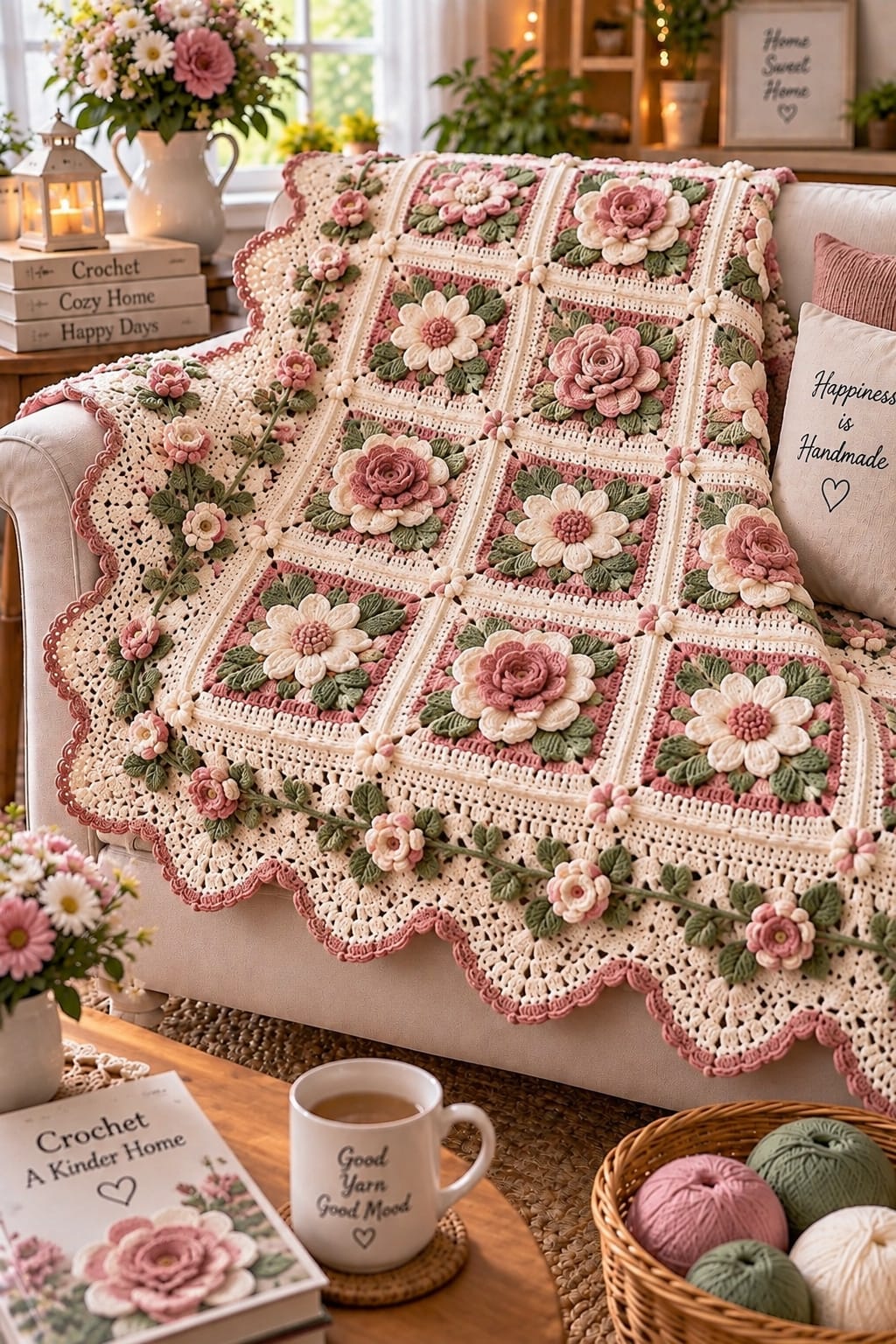
Raised dusty-pink roses alternate with ivory daisies while a separate rose vine runs around the lace perimeter. This 3D rose granny square crochet blanket pattern uses worsted cotton-blend yarn, 4.5 and 5 mm hooks, modular squares, separate leaves, and dimensional flowers. The intermediate reconstruction targets approximately 150 × 190 cm, creating a decorative sofa or bed throw whose individual floral blocks can be repaired separately.
The instructions below are an original photo-inspired reconstruction based on visible structure; published patterns cited later are used only for sizing, gauge, and material benchmarks.
The Design: What Makes This Floral Blanket Different
The photographed blanket combines geometric construction with botanical relief. Large square blocks provide the load-bearing fabric, but their centers alternate between layered dusty-rose blooms and flatter ivory daisies so the surface does not become uniformly bulky. Sage leaves create a transition from each flower to a dusty-pink inner frame, while raised cream joining strips divide the blocks. A broad ivory lace border then changes the scale again, carrying a narrow green vine with miniature roses and leaves. For this 3D flower granny square blanket, the structural squares are made first and the botanical pieces are attached afterward. That keeps joining seams accessible. A common maker error is sewing thick roses onto individual squares before blocking; the raised flowers obstruct measurement and can hide a square that is 1–2 cm undersized.
Project Info at a Glance
| Skill Level | Time | Finished Size | Hook | Best For |
|---|---|---|---|---|
| Intermediate | Reconstruction estimate: 45–60 hours | Reconstruction target: 150 × 190 cm | 5 mm squares; 4.5 mm flowers/leaves | Sofa throws, decorative bed covers, floral heirloom-style blankets |
Published benchmarks support this yarn and hook range. Christa Lynn’s 3D Rose Granny Square uses Aran yarn and a 5 mm hook, while Kimberly Arenas’ 2026 3D Rose Granny Square also specifies Aran Red Heart Super Saver and a 5 mm hook. Chiaki Hayashi’s Crochet Flower Blanket uses worsted yarn with a 4.5 mm hook and lists an individual flower motif at approximately 3¾ inches square. A current flower blanket benchmark using #4 yarn and a 4 mm hook finishes at approximately 114 × 160 cm.
Materials and Tools
Yarn
- Warm ivory — worsted/Aran #4 — reconstruction estimate: 1,500–1,800 g
- Dusty rose — worsted/Aran #4 — reconstruction estimate: 650–800 g
- Sage green — worsted/Aran #4 — reconstruction estimate: 550–700 g
- Soft blush pink — worsted/Aran #4 — reconstruction estimate: 250–350 g
The photographed surface has strong stitch definition, so a smooth cotton blend, premium acrylic, or washable wool blend is more suitable than fluffy chenille. Published 3D rose squares commonly use worsted or Aran yarn; Kimberly Arenas’ benchmark uses Red Heart Super Saver, while a published leaf appliqué from Uma M Natarajan uses worsted yarn with a 3.5 mm hook.
Tools
- 5 mm crochet hook for squares and main border
- 4.5 mm crochet hook for flowers and leaves
- Tapestry needle
- Locking stitch markers
- Blocking mats
- Rust-resistant pins
- Measuring tape
- Scissors
Abbreviations
- MR — magic ring
- ch — chain
- sl st — slip stitch
- sc — single crochet
- hdc — half double crochet
- dc — double crochet
- tr — treble crochet
- BLO — back loop only
- FLO — front loop only
- sp — space
- st/sts — stitch/stitches
An invisible decrease is worked through the front loops of two neighboring stitches before completing one single crochet; this blanket relies mainly on flat motifs, so decreases occur only in optional shaping details.
Blanket Layout
Use a 6 × 8 grid of 48 structural squares. Block every square to approximately 22 cm before joining.
The 48-square center measures about 132 × 176 cm. An outer lace border approximately 9 cm deep brings the reconstruction close to 150 × 194 cm; blocking can then set the final target near 150 × 190 cm.
Alternate the two principal flower types like a checkerboard:
- 24 rose squares
- 24 daisy squares
- 48 large flower appliqués
- 192 square leaves — four per block
- 35 small intersection flowers at interior square junctions
- Miniature roses and leaves for the outer vine
Pattern — Step by Step
Structural Granny Square — Make 48
Yarn: dusty rose for the center rounds, ivory for the frame. Hook: 5 mm.
The square is deliberately kept flat. Dimensional flowers and leaves are attached after blocking.
R1: With dusty rose, ch 4 and join to form a ring. Ch 3, 2 dc in ring, ch 2; *3 dc in ring, ch 2* ×3. Join. Four 3-dc groups.
R2: Sl st to corner. Ch 3, 2 dc, ch 2, 3 dc in same corner; ch 1. In each remaining corner work (3 dc, ch 2, 3 dc), ch 1. Join.
R3: Sl st to corner. Work (3 dc, ch 2, 3 dc) in corner, ch 1, 3 dc in next ch-1 sp, ch 1. Repeat around. Join.
R4: Repeat the established granny-square sequence, adding one additional 3-dc side group on each side. Each side now contains three non-corner groups.
Change to ivory.
R5: Continue the granny-square sequence in ivory. Each side contains four non-corner groups.
R6: Continue in ivory. Each side contains five non-corner groups.
R7: Continue in ivory. Each side contains six non-corner groups.
R8: Ch 1. Sc in every dc and ch-1 sp around; work (sc, ch 2, sc) in each corner.
Fasten off.
Block to exactly 22 × 22 cm. If the square reaches 22 cm after R7, omit R8 and add the stabilizing sc round after joining instead.
Large Ivory Daisy — Make 24
Hook: 4.5 mm. Yarn: dusty rose center and ivory petals.
Daisy Center
R1: With dusty rose, 6 sc in MR. (6)
R2: Inc ×6. (12)
R3: (Sc, inc) ×6. (18)
R4: (2 sc, inc) ×6. (24)
Fasten off.
Daisy Petals
Join ivory to any center stitch.
Each petal consumes two center stitches.
*Sl st in next st, ch 8. Starting in second chain from hook work sc, hdc, dc, tr, dc, hdc, sc. Sl st in next center st.*
Repeat the sequence 12 times.
Fasten off with a 40 cm tail.
The flower has exactly 12 pointed oval petals around the 24-stitch center.
Large Layered Rose — Make 24
The reference roses have a tight dusty-pink center and broader outer petals. A separately rolled multi-strip construction makes the attachment points deterministic and avoids ambiguous rear-loop placement.
Rose Inner Strip
With dusty rose, ch 25.
Starting in second chain, sc across. (24)
Turn. Work *sl st in next st, 4 hdc in next st* ×12. The repeat consumes all 24 foundation stitches.
Fasten off with a 50 cm tail.
Rose Middle Strip
Ch 33.
Sc in second chain and across. (32)
Turn. Work *sl st in next st, 5 dc in next st* ×16.
Fasten off with a 60 cm tail.
Rose Outer Strip
Ch 41.
Sc in second chain and across. (40)
Turn. Work *sl st in next st, (2 dc, 3 tr, 2 dc) in next st* ×20.
Fasten off with a 70 cm tail.
Rose Assembly
Roll the 24-stitch strip tightly from one end and stitch through its foundation edge after every two petals.
Wrap the 32-stitch strip around the first coil, allowing the petals to overlap by approximately one third.
Add the 40-stitch outer strip last.
Sew through the foundation edges rather than the petal tops.
Target approximately 10–12 cm diameter. A published layered worsted rose from JT Easy Crochet measures approximately 7.5 cm with a 4–5 mm hook, so the additional outer strip deliberately increases the reconstruction scale.
Sage Leaf — Make 192
Hook: 4.5 mm. Yarn: sage green.
Ch 14.
Starting in the second chain, work into the next 12 chains, leaving the final chain for the point:
Sl st in 1, sc in 2, hdc in 2, dc in 3, tr in 2, dc in 1, hdc in 1. (12)
Work 5 sc into the final chain.
Work down the opposite side:
Hdc in 1, dc in 1, tr in 2, dc in 3, hdc in 2, sc in 2, sl st in 1. (12)
Fasten off with a 25 cm tail.
Each leaf contains 29 stitches: 12 + 5 + 12.
For comparison, Dani West’s published worsted leaf appliqué uses a 5 mm hook and measures 3 × 8 cm, while Uma M Natarajan’s worsted leaf uses a 3.5 mm hook and 5–7 yards.
Leaf Vein
With a darker sage strand, join at the leaf base.
Surface slip stitch along the foundation-chain ridge.
Stop approximately 1 cm before the point.
Fasten off without pulling the ridge shorter than the leaf.
Decorating a Daisy Square — Make 24
Place one ivory daisy in the center of a blocked structural square.
Position four sage leaves diagonally at approximately 1:30, 4:30, 7:30, and 10:30.
The leaf tips should point toward the four corners.
Sew each leaf through its lower 2–3 cm only.
Center the daisy over the leaf bases and sew around its 24-stitch center.
Add one concealed stitch beneath every third petal if the flower lifts excessively.
Decorating a Rose Square — Make 24
Arrange four sage leaves in the same diagonal formation.
Place one layered dusty rose over their bases.
Sew the rose through all three foundation strips at eight evenly distributed points.
Do not sew the outer petal edges to the square.
Target a raised flower depth of approximately 3–4 cm.
Joining the 48 Squares
Arrange the squares in a 6 × 8 checkerboard, alternating rose and daisy motifs.
For the raised cream grid visible in the photograph, use an external single-crochet join.
Hold two neighboring squares wrong sides together.
Join ivory through corresponding edge stitches.
Sc through both squares from corner to corner.
Repeat until six squares form one row.
Make eight horizontal rows, then join the rows vertically.
Keep every seam on the front of the blanket so it becomes part of the decorative framework.
Small Intersection Flower — Make 35
A 6 × 8 square grid has 5 × 7 = 35 interior four-square intersections.
R1: With blush pink, 10 sc in MR. (10)
R2: *Sl st in next st, (ch 3, 3 dc, ch 3, sl st) in next st* ×5.
Fasten off with a 25 cm tail.
Each flower has exactly five petals.
Sew one over every interior four-square junction, passing the needle through the raised cream joining seams rather than through a large flower appliqué.
Inner Blanket Border
Join ivory at any corner after all 48 squares have been assembled.
R1: Sc evenly around the perimeter, placing one sc in every established square-edge stitch and (sc, ch 2, sc) in each blanket corner.
Because every blocked square has the same edge structure, use the same number of stitches across each 22 cm square segment.
R2: Ch 3, dc in every st around; work (2 dc, ch 2, 2 dc) in each corner.
R3: Ch 1, sc around with (sc, ch 2, sc) at corners.
Openwork Lace Border
R4: Ch 4, skip next st, dc in next st; *ch 1, skip next st, dc in next st* around. At each corner work (dc, ch 3, dc).
R5: Sl st into first ch-1 sp. Work (sc, ch 3) in every ch-1 sp around. In each corner ch-3 sp work (sc, ch 5, sc).
R6: Sl st into first ch-3 sp. Work (2 dc, ch 2, 2 dc) in every ch-3 sp. In each corner work (3 dc, ch 3, 3 dc).
R7: Ch 1. Sc in each dc and work 2 sc in each ch-2 sp. In each corner ch-3 sp work (2 sc, ch 2, 2 sc).
The border should measure approximately 7–8 cm deep at this stage.
Dusty-Rose Scalloped Edge
Before starting the final round, count each side independently.
The shell repeat consumes six foundation stitches.
Adjust each side during a preliminary ivory sc round until the number of stitches between corners is divisible by six.
Change to dusty rose.
Final Round: *Sl st in next st, skip 2 sts, 7 dc in next st, skip 2 sts* across each side.
At each corner work a larger 9-dc shell centered in the corner space.
Fasten off.
Miniature Border Rose — Make 28
The photograph carries a narrow floral vine around the outer lace. Twenty-eight flowers create a manageable reconstruction rather than covering every scallop.
With dusty rose, ch 17.
Sc in second chain and across. (16)
Turn.
Work *sl st in next st, 4 hdc in next st* ×8.
Fasten off with a 30 cm tail.
Roll the strip tightly and sew through its foundation edge.
Target approximately 4–5 cm across.
Small Border Leaf — Make 56
Each miniature rose receives two leaves.
Ch 11.
Starting in the second chain, work into the next nine chains, retaining the final chain for the point:
Sl st in 1, sc in 2, hdc in 2, dc in 2, hdc in 1, sc in 1. (9)
Work 3 sc in the final chain.
Mirror the nine-stitch sequence down the opposite side.
Fasten off.
Each small leaf contains 21 stitches: 9 + 3 + 9.
Green Border Vine
Lay the blanket flat before adding the vine.
With sage yarn and the 4.5 mm hook, make a chain long enough to follow the inside of the lace border without stretching.
For a 150 × 190 cm blanket, the required finished vine is approximately 660–680 cm after allowing for rounded corners and placement inside the outer edge.
Instead of attempting one unwieldy chain, make four separate vine sections, one for each blanket side.
Surface slip stitch back along each chain to create a firmer cord.
Sew one vine section approximately 5 cm inside the outer scalloped edge.
Adding Flowers to the Border Vine
Space the 28 miniature roses approximately 22–24 cm apart.
Place seven along each side, adjusting the corner flowers slightly so they do not fold when the blanket hangs.
Add two small leaves beneath each rose.
Alternate leaf direction as the vine progresses.
Sew every rose through its rolled foundation and every leaf through its lower third.
Optional Side Rosebuds
The photographed border includes smaller buds between some full flowers.
For a bud, ch 9.
Sc in second chain and across. (8)
Turn and work *sl st in next st, 3 hdc in next st* ×4.
Roll tightly and secure through the foundation edge.
Make 8–12 buds if additional density is wanted, spacing them between selected miniature roses rather than adding one to every interval.
Assembly
- Crochet 48 structural squares, block every piece to exactly 22 × 22 cm, and separate them into 24 rose blocks and 24 daisy blocks before adding appliqués.
- Make 24 large ivory daisies, 24 three-strip dusty roses, and 192 sage leaves, then block the leaves and daisy petals while leaving the roses dimensional.
- Attach four diagonal leaves to every square and sew one large flower over their bases, alternating rose and daisy blocks throughout the planned 6 × 8 layout.
- Arrange all 48 completed blocks in a checkerboard and join them with raised ivory single-crochet seams, first forming eight rows of six squares and then joining those rows.
- Crochet 35 five-petal intersection flowers and sew one over every interior four-square junction, covering the crossing point of the raised ivory seams.
- Work the ivory stabilizing and openwork border around the complete blanket, measuring after each round so the fabric remains rectangular and all four corners lie flat.
- Adjust the final ivory border count so each side is divisible by six, then add the dusty-rose 7-dc scalloped edging and one larger 9-dc shell at every corner.
- Make 28 miniature dusty-rose flowers, 56 small sage leaves, and four separate green vine cords sized to follow the four outer edges without tension.
- Sew each vine approximately 5 cm inside the scalloped edge, space seven miniature roses along every side, and place two alternating leaves beneath each rose.
- Weave all tails through at least 5 cm of matching fabric, lightly block the lace and joining seams, and reshape every raised rose and daisy after the blanket has dried.
The completed reconstruction contains 48 floral squares, 35 intersection flowers, 28 miniature border roses, 248 leaves, a raised cream grid, and a wide scalloped lace perimeter.
7 Technical Tips
- The 48 squares refuse to align: block every structural block to exactly 22 cm before sewing on its flower. A 5 mm discrepancy repeated across six squares changes the blanket width by 3 cm.
- The large roses sag toward one side: sew through all three strip foundations at eight attachment points. Securing only the innermost coil allows the 10–12 cm flower to rotate under its own weight.
- The leaf tips curl upward: stop the surface-crochet vein approximately 1 cm before the tip. Pulling the center ridge even 5 mm shorter than the leaf body produces visible cupping.
- The joining grid puckers: match corresponding edge stitches one-for-one and place markers at both corners and the midpoint before seaming. Stretching a 22 cm square to match a longer neighbor transfers the distortion into the next row.
- The lace border ripples: lay the blanket flat after every border round and inspect all four sides. More than approximately 2 cm of excess wave over a 50 cm section indicates too many stitches or chain spaces.
- The miniature vine pulls the border inward: make each green cord approximately 2% longer than its pinned route before sewing. A tight surface cord can shorten a 150 cm blanket edge by several centimeters.
- The blanket becomes difficult to wash: secure every raised flower with multiple independent yarn passes rather than one continuous attachment strand. If one 5 cm section breaks, independent anchoring prevents the entire appliqué from detaching.
Why Modular Squares Fit the Reference
The photograph clearly divides the main fabric into framed rectangular blocks. Each block carries its own leaves and dimensional flower, while cream seams remain visible between neighboring motifs.
A modular foundation therefore reproduces the visible architecture and provides a practical construction advantage. Forty-eight 22 cm squares can be blocked individually, sorted by flower type, and replaced if one is damaged.
Published flower blankets use the same broad modular logic at different scales. Jo Edwards’ Flower Granny Square Blanket is built from joined flower squares, while Chiaki Hayashi’s worsted flower blanket uses motifs measuring approximately 3¾ inches square. The reconstruction increases square scale substantially to match the large floral panels visible in the supplied photograph.
Published 3D Rose Square Benchmarks
Christa Lynn’s 3D Rose Granny Square is rated intermediate and uses Aran yarn with a 5 mm hook. Its listed materials separate petal, leaf, and square-base colors, which provides a relevant benchmark for the layered color construction used here.
Kimberly Arenas’ 2026 3D Rose Granny Square also uses Aran-weight yarn and a 5 mm hook. The specified Red Heart Super Saver contains 364 yards per 198 g. Both published patterns support the use of medium-weight yarn for a dimensional rose square without requiring bulky yarn.
Published Flower Blanket Benchmarks
Chiaki Hayashi’s Crochet Flower Blanket specifies worsted yarn and a 4.5 mm hook. Its published flower motif measures approximately 3¾ × 3¾ inches; the full version measures about 23.5 × 38.5 inches.
A current graded flower-blanket benchmark using worsted #4 yarn and a 4 mm hook finishes at approximately 45 × 63 inches / 114 × 160 cm. Its listed materials use multiple 100 g skeins across cream, blush, mint, sage, and yellow, demonstrating how quickly multicolor modular blankets accumulate yarn even before large appliqués are added.
Published Leaf Benchmarks
Uma M Natarajan’s Crochet Leaf Applique uses worsted yarn, a 3.5 mm hook, and approximately 5–7 yards. Its published gauge is four stitches and four rows per inch.
Dani West’s 2025 Leaf Applique uses Aran-weight Bernat Premium and a 5 mm hook, with approximately 4–6 yards per leaf and a finished measurement of 3 × 8 cm. CyCrochet publishes a DK cotton leaf measuring approximately 8 × 4 cm with a 3.25 mm hook. These references show how yarn and hook selection can shift leaf scale substantially.
Changing the Blanket Size
The 22 cm modular grid makes resizing predictable.
For a smaller throw, use a 5 × 6 layout of 30 squares. The unbordered center will measure approximately 110 × 132 cm.
For a larger bed cover, use a 7 × 9 layout of 63 squares. Its unbordered center will measure approximately 154 × 198 cm before the lace edging.
Recalculate the number of interior intersection flowers with the formula (columns − 1) × (rows − 1). A 7 × 9 blanket therefore requires 6 × 8 = 48 intersection flowers.
Making a Flatter Blanket
Replace the three-strip roses with the ivory daisy construction worked in dusty rose.
Alternatively, omit the 40-stitch outer rose strip and retain only the 24- and 32-stitch layers.
Sew each remaining rose through the center and lower petal bases.
This reduces bulk through the main seating area while preserving a dimensional floral appearance.
Changing the Flower Ratio
The checkerboard arrangement uses 24 roses and 24 daisies.
For fewer dimensional flowers, place roses only in every second row. Fill the remaining squares with daisies or flatter six-petal flowers.
Keep the underlying 48-square structure unchanged. Altering only the appliqués means the joining and border calculations remain valid.
Yarn Planning
Make one complete structural square, one rose, one daisy, four leaves, and a 22 cm test length of raised join before purchasing additional yarn.
Weigh each component on a gram scale.
Multiply the structural-square weight by 48, each large flower weight by 24, and the leaf weight by 192. Add the measured joining and border requirements separately.
Include approximately 15% additional yarn for swatching, tails, border adjustment, replacement motifs, and individual tension differences. A component-based estimate is more dependable than transferring meterage from a blanket with much smaller flower squares.
Blocking and Care
Block the structural squares before attaching flowers. After assembly, block only the joining grid and lace perimeter unless the selected yarn requires full wet finishing.
Support the blanket from underneath when wet because raised flowers retain additional water and increase the load on the joining seams.
Dry flat. Reshape the roses after the surrounding fabric has reached its final dimensions.
For storage, fold along the cream joining strips rather than directly through the large flowers. Place tissue or a soft cotton cloth between layers if the blanket will remain folded for an extended period.
Sources
Ravelry — 3D Rose Granny Square by Christa Lynn — intermediate floral square using Aran yarn and a 5 mm hook.
Ravelry — 3D Rose Granny Square by Kimberly Arenas/The Caffeinated Snail — 2026 Aran-weight rose square using a 5 mm hook.
Ravelry — Flower Granny Square Blanket by Jo Edwards — 2024 modular flower-square blanket with written, photo, and video instructions.
Ravelry — Crochet Flower Blanket by Chiaki Hayashi — worsted yarn, 4.5 mm hook, approximately 3¾-inch motifs, and published blanket dimensions.
Ravelry — Crochet Leaf Applique by Uma M Natarajan — worsted yarn, 3.5 mm hook, 5–7 yards, and published gauge.
Ravelry — Leaf Applique by Dani West — Aran yarn, 5 mm hook, 4–6 yards, and 3 × 8 cm finished dimensions.
JT Easy Crochet — Layered Rose Flower — two-layer worsted/Aran rose measuring approximately 7.5 cm with a 4–5 mm hook.
Raffamusa Designs — Crochet Leaf Applique — comparative leaf measurements for worsted acrylic, worsted cotton, and DK cotton with different hook sizes.
Conclusion
The 22 cm square controls every later measurement, so complete one structural block, block it, and confirm its size before producing the remaining 47. Make one rose and one daisy next to verify that the flowers occupy the center without covering the cream frame. Once those proportions work, batch the leaves and assemble the blanket in a 6 × 8 checkerboard before adding the lace and floral vine. Save this 3D rose granny square crochet blanket pattern to Pinterest or share the finished blanket on Instagram with #RoseGardenGrannyBlanket. For this specific design, would you keep the alternating ivory daisies or replace every center with a layered dusty-pink rose?