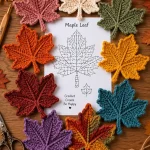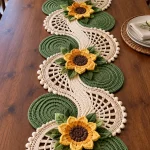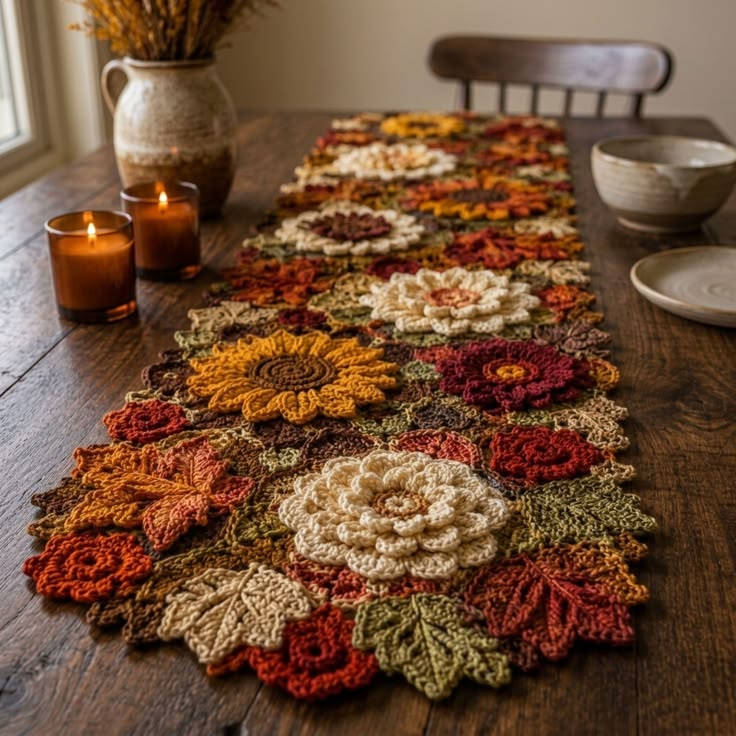
A sunflower needs a broad center and narrow radiating petals, while the neighboring dahlias need almost the opposite construction. This autumn floral crochet table runner pattern combines layered cream flowers, mustard sunflowers, burgundy blooms, rust accent flowers, and individually crocheted leaves. DK cotton and a 3.5–4 mm hook provide a practical starting point. The modular construction also allows the finished runner to be shortened or lengthened before assembly.
The Design: What Makes This Autumn Table Runner Different
There is almost no conventional rectangular background in this design. Flowers and leaves form the surface themselves, with smaller motifs filling the openings between the dominant blooms. This construction keeps the wooden tabletop visible and creates the irregular botanical perimeter shown in the reference.
Flower scale is deliberately varied. Large cream and mustard blooms establish the main line of the crochet flower table runner, while burgundy, rust, brown, and orange motifs close the gaps. Pointed leaves then control the outer silhouette.
Another structural decision is layering. Several flowers use two petal levels rather than one flat round, creating visible depth. A common mistake with this type of autumn crochet table runner is attaching every motif before testing the complete arrangement. Small gaps then become difficult to correct. Block first, arrange second, sew last.
Project Info at a Glance
| Skill Level | Time | Finished Size | Hook | Best For |
|---|---|---|---|---|
| Intermediate | 14–20 hours | Approx. 35 × 145 cm | 3.5–4 mm | Dining tables, consoles and fall displays |
The finished dimensions are a design target for this photo-inspired runner. Actual measurements depend on yarn, tension, motif placement and blocking.
Materials and Tools
Yarn
Use smooth DK cotton or a cotton-rich blend. Cotton gives the raised petals and leaf veins enough definition while allowing the assembled runner to block flat.
- Cream / ivory: DK cotton — approximately 120 g
- Mustard gold: DK cotton — approximately 70 g
- Burgundy: DK cotton — approximately 60 g
- Rust / burnt orange: DK cotton — approximately 80 g
- Terracotta: DK cotton — approximately 50 g
- Olive green: DK cotton — approximately 80 g
- Brown: DK cotton — approximately 60 g
- Beige / taupe: DK cotton — approximately 50 g
These quantities are working estimates for the photo-inspired version rather than measurements taken from the photograph. Keep leftover yarn from every color until assembly is complete because small filler motifs can be added where necessary.
Tools
- 3.5 mm crochet hook
- 4 mm crochet hook if needed to match motif size
- Tapestry needle
- Sharp scissors
- Locking stitch markers
- Blocking mats
- Rust-resistant pins
- Measuring tape
Abbreviations
- MR — magic ring
- ch — chain
- sc — single crochet
- hdc — half double crochet
- dc — double crochet
- tr — treble crochet
- sl st — slip stitch
- inc — increase
- sp — space
- sts — stitches
- dc2tog — double crochet two together
- FLO — front loop only
- BLO — back loop only
An invisible decrease is unnecessary because the flowers and leaves are flat or lightly dimensional motifs rather than closed stuffed pieces.
Autumn Floral Crochet Table Runner Pattern
This is an original photo-inspired construction rather than a transcription of a commercial pattern. Crochet all motifs separately, block them to shape, arrange the complete runner, and join them during final assembly.
Large Mustard Sunflower — Make 2
Yarn: dark brown and mustard.
Brown Center
R1: With brown, 6 sc in MR. Join with sl st. (6)
R2: Inc ×6. Join. (12)
R3: (1 sc, inc) ×6. Join. (18)
R4: (2 sc, inc) ×6. Join. (24)
R5: (3 sc, inc) ×6. Join. (30)
Fasten off brown.
Mustard Petals
Join mustard yarn in any stitch.
R6: *Sl st in next st, ch 8. Starting in second ch from hook work sc, hdc, dc, 2 tr, dc, hdc. Sl st into next center stitch.* Repeat around to form 15 elongated petals.
Fasten off.
For additional dimension, gently overlap neighboring petals during blocking instead of stretching them into a perfectly flat circle.
Large Layered Cream Flower — Make 3
Yarn: beige center and cream petals.
R1: With beige, 6 sc in MR. (6)
R2: Inc ×6. (12)
R3: (1 sc, inc) ×6. (18)
Change to cream.
R4: *Sl st in next st, (ch 3, 3 dc, ch 3, sl st) in next st.* Repeat around. (9 inner petals)
Turn the flower over.
R5: Working behind the first petal layer, *sl st around the base between petals, ch 5*. Repeat around. Join. (9 ch-5 spaces)
R6: In each ch-5 space work (sc, hdc, 4 dc, hdc, sc). (9 middle petals)
R7: Working behind R6, create 9 ch-7 spaces anchored between the petals.
R8: In each ch-7 space work (sc, hdc, dc, 3 tr, dc, hdc, sc). (9 large outer petals)
Fasten off with a 20 cm tail.
The three petal levels should remain individually visible. Do not press the flower completely flat during blocking.
Large Burgundy Dahlia — Make 2
Yarn: mustard center and burgundy petals.
R1: With mustard, 6 sc in MR. (6)
R2: Inc ×6. (12)
Change to burgundy.
R3: FLO: *sl st, ch 5, starting in second ch work sc, hdc, dc, hdc, sl st into next st*. Repeat around. (12 inner petals)
R4: Working into the unused back loops from R3, *sl st, ch 7, starting in second ch work sc, hdc, dc, tr, dc, hdc, sl st into next back loop*. Repeat around. (12 outer petals)
Fasten off.
Keep the burgundy petals slightly cupped. That small amount of height distinguishes these flowers from the flatter sunflower motifs.
Medium Rust Flower — Make 5
Yarn: rust or burnt orange.
R1: 6 sc in MR. (6)
R2: Inc ×6. (12)
R3: (1 sc, inc) ×6. (18)
R4: *Sl st in next st, ch 5, 2 dc in same st, ch 5, sl st in next st.* Repeat around. (9 petals)
Fasten off.
Small Accent Flower — Make 8
Use rust, mustard, burgundy, brown and terracotta in mixed quantities.
R1: 6 sc in MR. (6)
R2: Inc ×6. (12)
R3: *Sl st in next st, (ch 3, 2 dc, ch 3, sl st) in next st.* Repeat around. (6 petals)
Fasten off with a 15 cm sewing tail.
Vary the colors instead of making all eight motifs identical. The reference uses small flowers to interrupt larger blocks of cream, mustard and burgundy.
Large Pointed Autumn Leaf — Make 12
Use olive, rust, terracotta, mustard, beige and brown.
Ch 17.
Starting in the second ch from hook:
Side 1: Sl st, sc, hdc, dc, dc, tr, tr, tr, tr, dc, dc, hdc, hdc, sc, sc, sl st.
Ch 2 at the tip.
Working along the opposite side of the foundation chain:
Side 2: Sl st, sc, sc, hdc, hdc, dc, dc, tr, tr, tr, tr, dc, dc, hdc, sc, sl st.
Join at the base.
Leaf Edge
Ch 1 and sc evenly around the complete leaf.
At the tip work (sc, ch 2, sc).
Approximately every fourth stitch along each side, work ch 2 and sl st into the following stitch to introduce a lightly serrated edge.
Fasten off with a 25 cm tail.
Raised Leaf Vein
Join a matching or darker shade at the base.
Work surface slip stitches directly over the original foundation chain from the base toward the point.
Add three short diagonal surface-slip-stitch branches on each side of the center vein.
Fasten off on the wrong side.
Small Leaf — Make 16
Use mixed olive, sage, beige, rust and brown.
Ch 11.
Starting in second ch from hook work:
Sl st, sc, hdc, dc, tr, tr, dc, hdc, sc, sl st.
Ch 2.
Work along the opposite side:
Sl st, sc, hdc, dc, tr, tr, dc, hdc, sc, sl st.
Join.
Ch 1 and sc around the complete leaf, working (sc, ch 2, sc) at the point.
Fasten off with a 20 cm sewing tail.
Three-Lobed Maple-Style Leaf — Make 6
Use burnt orange, rust, burgundy and mustard.
R1: 6 sc in MR. (6)
R2: Inc ×6. (12)
First lobe: Ch 8. Starting in second ch work sl st, sc, hdc, dc, tr, dc, hdc. Sl st into next 2 sts of center.
Second lobe: Ch 11. Starting in second ch work sl st, sc, hdc, dc, 3 tr, dc, hdc, sc. Sl st into next 2 center sts.
Third lobe: Ch 8. Starting in second ch work sl st, sc, hdc, dc, tr, dc, hdc. Sl st into the center.
Work sc around the complete outer edge.
At the point of each lobe work (sc, ch 2, sc).
Fasten off.
Add a surface-slip-stitch vein from the base toward each of the three points.
Small Brown Filler Circles — Make 8
Yarn: brown, taupe or olive.
R1: 6 sc in MR. (6)
R2: Inc ×6. (12)
R3: (1 sc, inc) ×6. (18)
R4: (2 sc, inc) ×6. (24)
Fasten off with a long sewing tail.
These pieces fill openings that are too small for leaves but too large to leave unsupported.
Planning the Runner Layout
Do not begin joining immediately after finishing the first motifs. The irregular construction depends on seeing the complete composition before permanent assembly.
Lay a measuring tape along the center of a large table or clean floor. Mark a target rectangle approximately 35 cm wide and 145 cm long.
Position the largest flowers first.
Place one cream flower near the lower third, another around the center, and the remaining cream bloom toward the opposite end. Distribute the mustard sunflowers between them rather than positioning both together.
Add the two burgundy flowers next. Their darker color should interrupt areas containing several pale motifs.
Place the medium rust flowers around the large motifs, followed by the large leaves. Rotate neighboring leaves in different directions.
Finish with small flowers, small leaves and filler circles.
Leave irregular outer edges. A perfectly straight border would remove the botanical character visible in the reference.
Joining the Crochet Motifs
The runner needs enough connection points to be lifted from the table without individual flowers folding away from the main structure.
Start at the center and work outward.
Thread a tapestry needle with yarn matching the motif being attached. Overlap neighboring pieces by approximately 1–2 cm where possible.
Sew through the back loops or underside of the stitches so the joining yarn remains hidden from the front.
Attach every large flower at a minimum of three points.
Large leaves should have their bases firmly attached while their outer points remain relatively free. This preserves the raised appearance shown in the photograph.
Small flowers can bridge openings between two larger motifs. Sew them to both neighboring pieces rather than attaching them at only one point.
Optional Crochet Connecting Vines
Where two motifs need support but should not overlap, use a narrow crochet connector.
Ch 8–15 depending on the distance.
Starting in the second chain from the hook, sl st across the complete chain.
Fasten off with long tails at both ends.
Sew one end beneath the first motif and the opposite end beneath the second.
Use olive, brown or taupe so these structural connectors blend with the foliage.
Adjusting the Finished Length
Modular construction makes this runner easier to resize than a traditional rectangular pattern.
For a short coffee table, target approximately 80–90 cm and reduce the number of large flowers to four or five.
A dining-table version can measure approximately 130–150 cm.
For a long farmhouse table, extend the central arrangement beyond 170 cm by adding alternating large flowers and groups of leaves.
Do not simply add small motifs at one end. Length extensions look more balanced when they contain at least one large focal flower surrounded by medium and small pieces.
Assembly
- Complete all large cream, mustard and burgundy flowers and weave in the tails that are not needed for sewing.
- Crochet the medium flowers, small flowers and filler circles in mixed autumn colors.
- Make all large and small leaves, then add the raised surface-crochet veins before assembly.
- Lightly block every motif individually and allow all pieces to dry before arranging them.
- Place the largest flowers along the center line and measure the total target length.
- Arrange the large leaves around the flowers, alternating their direction instead of forming symmetrical pairs.
- Add medium flowers and maple-style leaves to close the largest openings.
- Fill remaining spaces with small flowers, leaves and brown circles, then photograph the complete arrangement before moving anything.
- Sew from the center toward both ends, checking the runner against the reference photograph or layout photo as you work.
- Add any required vine connectors, weave in all remaining tails, and give the assembled runner a final controlled blocking.
The completed runner should form one stable botanical strip while retaining an irregular perimeter of flower petals and pointed leaves.
How to Keep Layered Crochet Flowers Dimensional
The cream flowers depend on separation between the petal levels. Blocking every layer flat against the mat removes much of that effect.
Pin only the outermost petals to establish the overall diameter. Arrange the middle layer between those outer petals and allow the smallest petals to sit naturally around the center.
The burgundy flowers can remain even more dimensional. Their narrow inner petals should sit slightly above the second layer.
Sunflower petals require a different treatment. Pull each mustard petal outward enough to reveal its full length, but maintain small variations in direction rather than creating a rigid wheel.
How to Block the Autumn Table Runner
Individual blocking should happen before assembly. Final blocking should correct the overall dimensions without flattening the raised flower centers.
Dampen the completed runner according to the yarn manufacturer’s care instructions.
Lay it on blocking mats and establish the central axis first.
Target approximately 35 cm across the widest sections. Do not force every section to that measurement because the outer silhouette is intentionally irregular.
Pin large leaf tips and the outermost petals. Keep pins away from the raised central petals of the cream and burgundy flowers.
Measure the overall length. For the six-to-seven focal-flower arrangement described here, approximately 140–150 cm provides a useful dining-table target.
Allow the runner to dry completely before removing the pins.
7 Technical Tips for an Autumn Floral Table Runner
- Block before assembly. Joining an unblocked 14 cm flower beside a blocked 16 cm flower produces uneven tension. Bring motifs to their intended measurements before sewing them together.
- Use at least three attachment points on every large flower. A flower connected at only one edge can rotate when the runner is lifted. Place the connections around different sections of the outer petal round.
- Keep leaf points free. Sewing the complete perimeter of a leaf removes its dimensional structure. Attach roughly the inner one-third and allow the remaining two-thirds to rest above neighboring motifs.
- Check openings before adding filler pieces. Gaps wider than approximately 4–5 cm can weaken the assembled runner. Insert a small flower, leaf or hidden connecting vine where necessary.
- Do not pull sewing yarn tightly. A rigid join can make two otherwise flat motifs buckle upward. Stop tightening as soon as the neighboring edges meet securely.
- Photograph the arrangement before sewing. Moving only three or four loose motifs can destroy the planned color distribution. Take one overhead reference image after the final dry layout.
- Weave tails through dense stitches. Open petal chains do not provide enough friction for a short yarn tail. Weave each assembly tail through approximately 3 cm of solid stitches, reverse direction once, then trim.
Color Placement for the Autumn Palette
The reference uses color distribution rather than repeating stripes. Mustard, cream and burgundy act as the strongest focal colors, while rust, brown, olive and beige connect those larger areas.
Avoid placing all cream flowers consecutively. Spread them along the runner so pale sections recur from one end to the other.
The same principle applies to burgundy. Two dark burgundy flowers positioned together create one visually heavy section. Separate them with mustard, cream or orange motifs.
Olive works best as a structural neutral. Use it for several leaves and small filler pieces so the green appears throughout the complete arrangement.
For a different palette, replace burgundy with plum, mustard with muted gold, and rust with copper. Keep at least one cream or beige shade to prevent the darker autumn colors from merging into a single field.
Making the Raised Leaf Veins
The visible leaf veins add structure as well as decoration. They can also correct a leaf that curls slightly after the first blocking.
Begin at the leaf base and surface-crochet toward the tip directly over the foundation chain. Keep each slip stitch loose enough that the leaf remains flat.
Side veins should angle toward the outer edge rather than run perpendicular to the center. Three branches on each side are sufficient for a medium or large motif.
If the leaf begins folding along its center, the surface stitches are too tight. Remove them and repeat with a larger hook or looser tension.
Finishing the Runner
Place the assembled runner on a table before completing the final blocking. Inspect the edges from both ends rather than only from directly above.
Look for isolated motifs connected by a single narrow point. Reinforce those areas with hidden stitches or a short crochet vine.
Check the large flowers next. Their centers should follow an irregular but continuous path along the length rather than forming two separate clusters.
Finally, turn the runner over. Trim no yarn tail until every join has been inspected from the wrong side. Secure loose tails inside dense flower centers or leaf bases where they will remain hidden.
Conclusion
This construction combines large layered flowers, sunflower motifs, pointed autumn leaves, maple-style foliage and small filler pieces into one continuous botanical runner. Crochet and block the largest motifs first, then arrange the complete project at its intended 35 × 145 cm target before making permanent joins. That single step controls both color balance and final dimensions. Save this autumn floral crochet table runner pattern to Pinterest or share your completed version on Instagram with #AutumnFloralTableRunner. For this specific design, which focal flower would you repeat most often in a longer runner: the cream layered bloom, mustard sunflower or burgundy dahlia? “`1