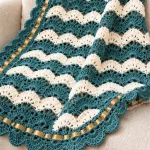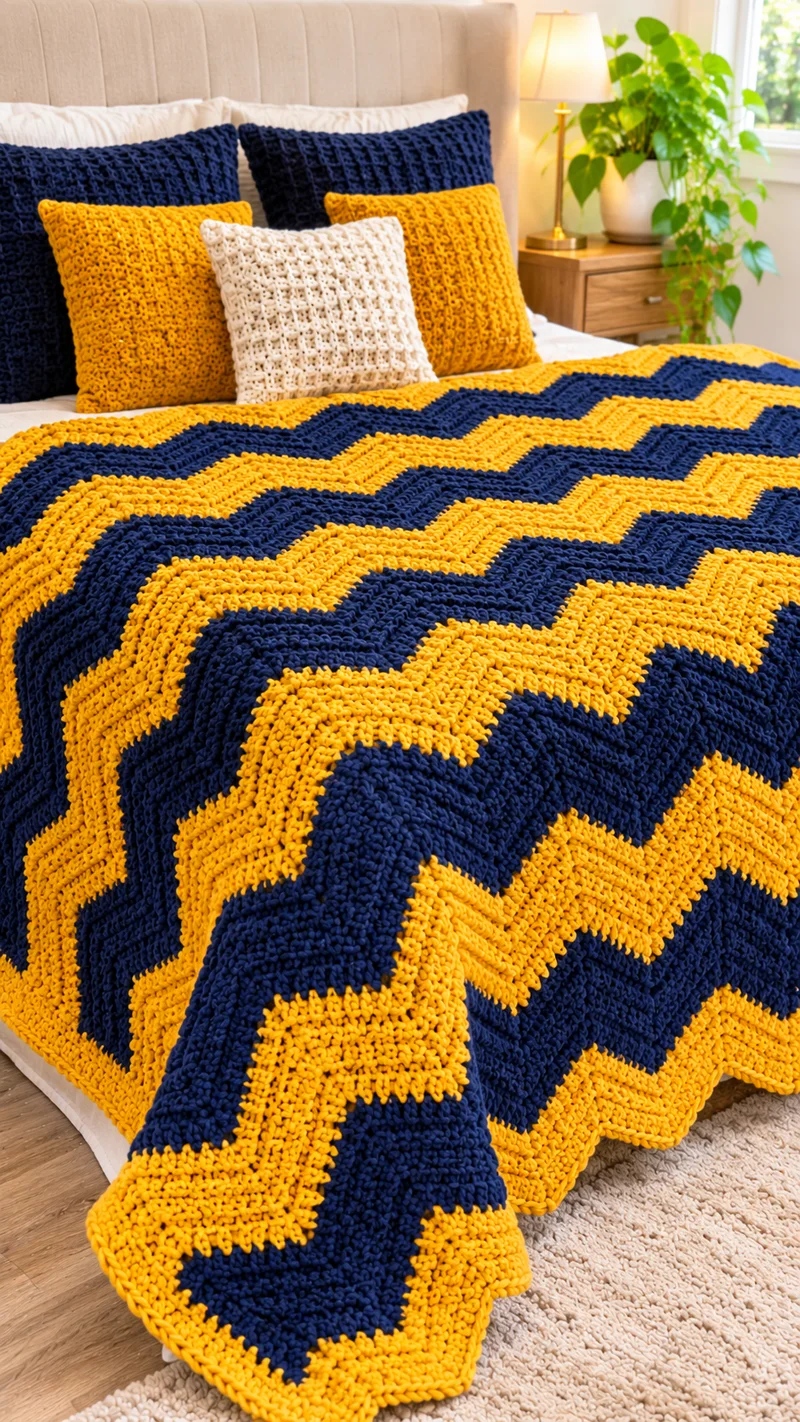
Every mustard peak is framed by a deep navy valley, so the zigzag is visible from across the room. This crochet chevron blanket pattern was designed for warm, high-contrast colorwork: bright mustard chevrons, deep navy bands and narrow cream stripes. The blanket is worked flat in rows, using a classic chevron stitch that is repeated across the throw.
How To Read The Chevron Pattern
A chevron is formed by combining increases at the peaks and decreases at the valleys. The increase creates a sharp upward point, while the decrease pulls the fabric down into a V shape.
Each chevron is 24 stitches wide. That width is large enough to show the mustard color clearly, but not so wide that the zigzag feels flat.
Chevron strips are worked in blocks of color. A navy strip is followed by a cream stripe, then a mustard peak, then another cream stripe. The color order repeats from the bottom of the blanket to the top.
- Dark navy yarn creates the valleys and the lower sections of each chevron.
- Mustard yarn forms the bright peaks.
- White yarn creates a thin stripe that separates the two main colors and gives the zigzag a crisp edge.
Project Information
| Skill Level | Time Required | Finished Size | Hook | Project Type |
|---|---|---|---|---|
| Intermediate | 5-7 hours | 40 x 50 inches | 5.0 mm (H) | Sampler-style throw |
To achieve the finished size, check your gauge before starting the blanket. Work a swatch of 15 stitches using the chevron pattern, then measure the result before committing to the full foundation chain.
Materials and Tools
Yarn
- Mustard Yellow — 550 g
- Navy Blue — 450 g
- White or Cream — 150 g
Using a smooth worsted weight yarn makes it easier to see where each chevron peak and valley begins. A soft acrylic or acrylic blend is a good choice for a blanket that will be used often.
Tools and Supplies
- Crochet hook: 5.0 mm (H)
- Stitch markers
- Tapestry needle
- Scissors
The finished blanket is a flat throw, not an amigurumi project. It is worked in rows, with no stuffing or shaping in the round.
Abbreviations and Terms
- ch — chain
- sc — single crochet
- dc — double crochet
- st/sts — stitch/stitches
- sk — skip
- sp — space
- inc — increase
- dec — decrease
- rep — repeat
- RS — right side
Pattern Instructions
Part 1: Make the body of the throw by repeating colored chevron blocks in navy, cream, mustard, and cream. The blanket is worked from the bottom edge to the top edge.
Foundation Chain and Setup Rows
- Foundation: Chain 193.
- Row 1: Work 1 sc in the 2nd ch from the hook. Work 1 sc in each ch across. Turn.
- Row 2: Work 1 sc in each st across. Turn.
- Row 3: Work 1 sc in each st across. Turn.
- Row 4: Work 1 sc in each st across. Turn.
Keep the strip even at this stage. A wavy lower edge will make the first chevron row harder to read.
Navy Blue Strip
- Row 1: Work 1 sc in each st across. Turn.
- Row 2: Work 1 sc in each st across. Turn.
- Row 3: Work 1 sc in each st across.
- Row 4: Work 1 sc in each st across.
Every blue section is worked in the same way. The color change itself creates the visual contrast, so no new stitch is introduced in these rows.
White or Cream Transition Stripe
- Row 1: Change to white or cream. Work 1 sc in each st across. Turn.
- Row 2: Work 1 sc in each st across. Turn.
- Row 3: Work 1 sc in each st across.
- Row 4: Work 1 sc in each st across.
The crisp white stripe is the most important visual element. If the edge between the navy and the mustard is uneven, the chevron line will look blurred instead of sharp.
Opposite Chevrons
- Row 1: Work 1 row of sc across.
- Row 2: Work the chevron increase and decrease pattern across the row.
- Rows 2-4: Repeat Row 2.
- Change to navy blue: Work 2 rows of sc in the navy color.
Alternating the direction of the chevron rows creates the rhythm that makes the blanket feel like a classic zigzag throw rather than a single repeated motif.
First Mustard Chevron Section
- Row 1: Work 1 row of sc in mustard.
- Row 2: Work the chevron increase and decrease pattern across the row.
- Rows 3-5: Repeat Row 2.
- Row 6: Work the chevron increase pattern one last time.
- Row 7: Work 1 row of sc in mustard.
Think of each mustard wedge as a mountain. The higher the peak, the clearer the chevron shape. Work the mustard point carefully, because a missed increase at the tip will make the row look slanted.
Full Blanket Structure
- Repeat: Work the navy strip, then the cream stripe, then the mustard chevron section.
- Second repeat: Work the navy strip, then the cream stripe, then the mustard chevron section.
- Third repeat: Work the navy strip, then the cream stripe, then the mustard chevron section.
- Fourth repeat: Work the navy strip, then the cream stripe, then the mustard chevron section.
- Turn: Turn the work and continue until the blanket reaches the desired length.
- Row count: Continue until you have reached 48 rows in total.
- Last section: End with a navy strip.
- Last row: Work 1 row of sc in navy across the last section.
Work each chevron cleanly. The repeat count is the only variable that changes the size of the throw.
Border
- Round 1: Work 1 sc in each st across the top and bottom edges. Work 1 sc in the side of each row along the side edges. Place 3 sc in each corner.
- Round 2: Work 1 dc in each st across all four sides. Place 3 dc in each corner.
- Round 3: Work 1 sc in each st across all four sides. Fasten off.
The border uses only single crochet and double crochet. It frames the chevron pattern without adding a new visual motif to the throw.
Sizing
| Size | Finished Size | Chain Start | Rows | Yarn Increase |
|---|---|---|---|---|
| Baby | 30 x 35 inches | 149 | 34 | +30% |
| Throw | 40 x 50 inches | 193 | 48 | — |
| Full | 50 x 60 inches | 241 | 58 | +60% |
Change the blanket size by adding or subtracting 24 stitches from the foundation chain. Each 24-stitch group adds one full chevron repeat.
Assembly and Finishing
- Fasten off the remaining yarn and cut the yarn tail.
- Weave in all yarn tails at the back of the work.
- Block the blanket lightly if needed.
- Check all chevron peaks and valleys for symmetry.
- Fold and store the blanket flat or displayed on the bed.
Care and Washing
- Machine wash on a gentle cycle.
- Use cold water only.
- Air dry flat or tumble dry on low heat.
- Do not bleach.
- Store flat to avoid stretching the chevron points.
Why This Pattern Works
The mustard and navy combination is the reason this crochet chevron blanket pattern feels warm without being busy. The navy gives the design weight and depth, while the mustard adds warmth and contrast. The dark, light, and bright sections balance each other instead of competing.
This structure also makes the throw easy to read from a distance. Each chevron block is visible on its own, and the overall pattern stays clear at the size of a full bed throw.
White yarn is used only in small amounts, but it has the biggest visual impact. The thin cream stripes stop the mustard and navy from blending together and make the edge of every chevron visible.
Tips For Clean Chevron Lines
- Count stitches at the end of every chevron repeat.
- Place a stitch marker at the first peak to keep the row aligned.
- Keep your tension even when switching colors at the end of a row.
- Carry the unused yarn along the edge instead of cutting it after every color change.
- Check the width of the blanket after the first chevron repeat.
- Avoid working too tightly at the decrease points.
- Block the finished blanket to open up the chevron points.
- Choose yarns in the same weight and fiber content for the cleanest color change.
Conclusion
The mustard and navy chevron blanket works because the color blocks stay clear and the stitch pattern stays simple. The classic zigzag creates a modern look without using complex stitches or fussy shaping.
Stop after the current chevron repeat to make a shorter lap blanket, or add extra repeats to make a full-sized throw. The finished blanket will keep its shape well, making it a practical piece for a styled bedroom or living room.
Which starting color gives you the clearest zigzag: mustard or navy?