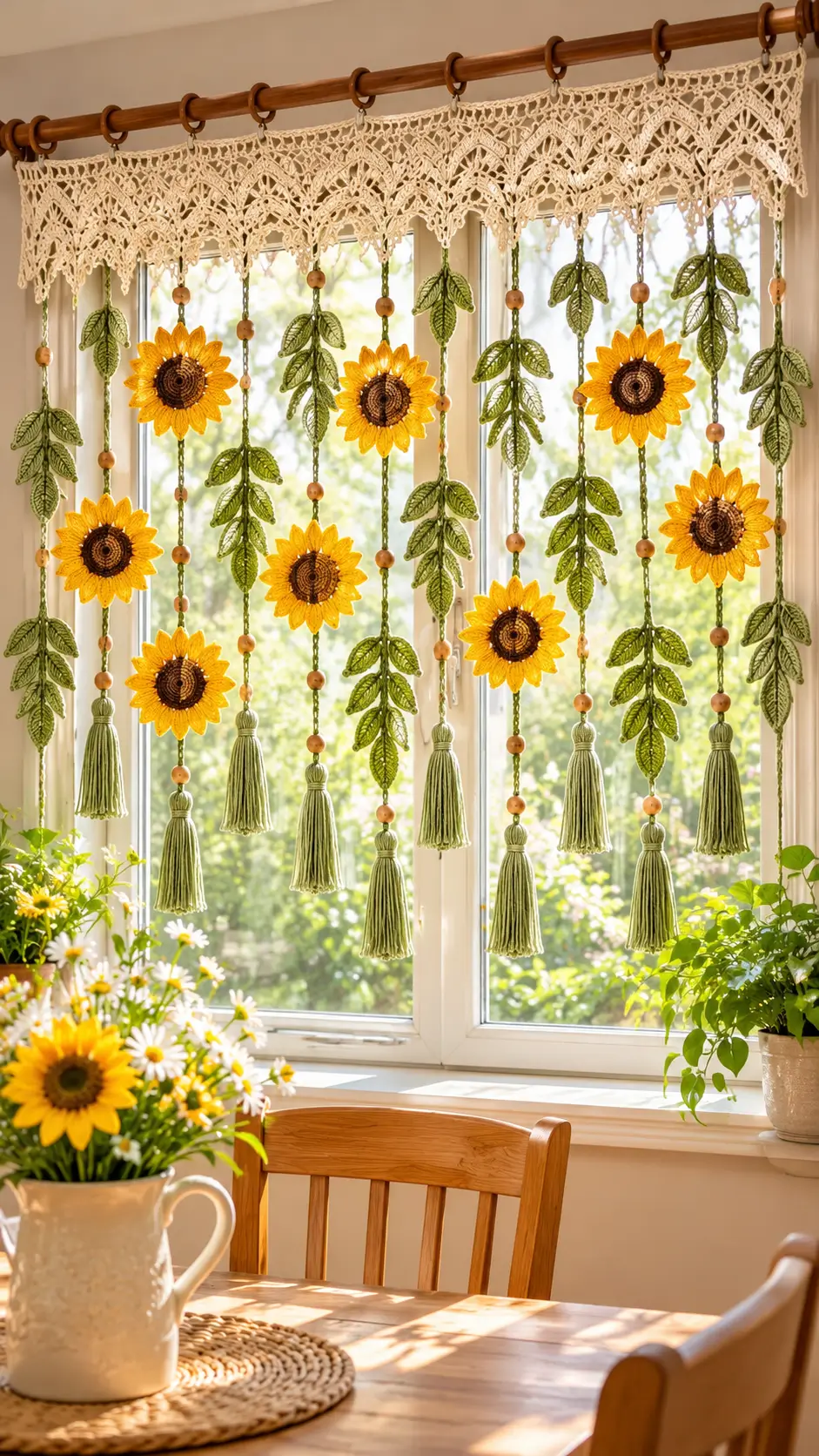
Sunflowers suspended between long olive leaf strands turn this crochet window valance into a vertical botanical design rather than a conventional flat curtain. The upper section uses an ivory lace panel with pointed arches, while separate sunflower motifs, crochet foliage, wooden beads, and tassels hang below it. Worked with cotton or cotton-blend yarn, the construction can be adjusted to fit almost any window width without changing the individual decorative motifs.
The Design: What Makes This Sunflower Curtain Different
The design is divided into two structural zones. A shallow ivory lace valance carries the weight across the curtain rod, while independent hanging cords create the lower decoration. This matters because large sunflowers and leaf clusters would distort a lightweight lace panel if they were crocheted directly into it.
The hanging strands alternate between golden sunflower motifs and olive leaf branches. Wooden beads interrupt the vertical lines and add small weighted points, while long tassels stabilize the lowest strands. The upper lace uses repeating pointed arches that echo the shape of the sunflower petals without competing with them. A common construction error is making every hanging strand identical. Staggered lengths are more effective here because they distribute the motifs across the window instead of forming one heavy horizontal line.
Project Information at a Glance
| Skill Level | Construction | Suggested Hook | Yarn | Suggested Size |
|---|---|---|---|---|
| Intermediate | Lace valance with separate hanging motifs | 3.5–4.0 mm | DK #3 cotton or cotton blend | Custom window width × approximately 75–100 cm drop |
Materials and Tools
Yarn
- Natural Ivory — DK #3 cotton — approximately 250–400 g for the upper lace valance.
- Golden Yellow — DK #3 cotton — approximately 120–180 g for sunflower petals.
- Dark Chocolate Brown — DK #3 cotton — approximately 50–80 g for sunflower centers.
- Olive Green — DK #3 cotton — approximately 180–250 g for stems, leaves, hanging cords, and tassels.
These quantities are project estimates for a medium-width window. Measure the window and make one complete hanging strand before purchasing yarn for a precisely sized installation.
Additional Materials
- 3.5–4.0 mm crochet hook
- Wooden beads with holes large enough for the crochet cord
- Curtain rings or wooden rings
- Yarn needle
- Scissors
- Stitch markers
- Measuring tape
- Blocking mats and pins
- Cardboard approximately 15–18 cm long for making tassels
Abbreviations
- MR — magic ring
- ch — chain
- sc — single crochet
- hdc — half double crochet
- dc — double crochet
- tr — treble crochet
- sl st — slip stitch
- st/sts — stitch/stitches
- sp — space
- RS — right side
Measure the Window First
Measure the curtain rod between the two outer points where the valance will hang. The finished crochet panel should be close to this measurement rather than substantially wider because the lace is intended to hang relatively flat.
For example, if the usable rod width is 140 cm, target approximately 135–140 cm after blocking.
Next determine the decorative drop. Measure from the curtain rod to the lowest point you want the tassels to reach. A drop of approximately 80–95 cm works well for a decorative kitchen or dining-room window, but the pattern can be shortened substantially.
Upper Ivory Lace Valance
The top section is worked as a rectangular lace strip before the pointed lower arches are added.
Foundation
With ivory yarn, make a foundation chain that reaches the required window width when gently relaxed.
Use a repeat based on approximately 12 stitches plus the edge stitches. Make a 30 cm sample first if exact sizing is important.
Row 1
Work 1 dc into the fourth chain from the hook and 1 dc into each remaining chain.
Turn.
Row 2 — Mesh Foundation
Ch 4.
*Skip 2 sts, dc in next st, ch 2.*
Repeat across, ending with a dc in the final stitch.
Row 3 — Open Lace
Ch 1, sc in first dc.
*Ch 5, sc around the next ch-2 space.*
Repeat across.
Row 4
Sl st into the first ch-5 space.
*Ch 5, sc in next ch-5 space.*
Repeat across.
Rows 5–8
Continue alternating chain meshes with occasional dc groups. Keep the upper portion relatively shallow, approximately 8–12 cm deep.
Lay the work flat after every two rows. The upper edge should remain straight because it will carry all of the hanging motifs.
Pointed Lace Arches
The lower section of the ivory valance is divided into repeating triangular arches.
Mark the lower edge into equal sections approximately 10–14 cm wide.
Work each arch separately.
Arch Row 1
Join ivory at the first marker.
Work chain loops across the marked section:
*Ch 5, sc into the next available space.*
Arch Row 2
Work back across while leaving the first and last loop unworked. Continue ch-5 loops between the remaining spaces.
Following Rows
Repeat the reduction at both sides until only one or two central loops remain.
At the tip, work:
sc, ch 3, sc
Fasten off.
Repeat for every marked section across the valance.
Decorative Arch Edging
Join ivory at one side of the first triangular arch.
Work sc evenly along the edge.
At selected spaces work:
(sc, hdc, 3 dc, hdc, sc)
Continue around each point and along the neighboring arch.
This produces the small scalloped outline visible along the pointed lower edge.
Top Attachment Edge
Work one firm row of sc across the upper edge.
Add a second row of hdc if the valance feels too flexible.
Do not make this section excessively tight. The upper edge must remain the same width as the blocked lace below it.
Curtain Ring Loops
Mark ring positions evenly across the top edge. A spacing of approximately 12–18 cm works for many windows.
At each marker, attach the crochet panel directly to a curtain ring or make a reinforced yarn loop.
For a crochet loop:
Ch 12–16, depending on the diameter of the rod or ring. Sl st back into the starting point.
Turn and work sc around the entire chain loop.
Fasten securely.
Test one loop on the actual hardware before making the remaining loops.
Large Crochet Sunflower Motif
The sunflower motifs form the main focal points below the lace panel. Make approximately 6–8 for a medium-width window.
Sunflower Center
With dark chocolate brown, make an MR.
Round 1: 12 dc in MR. Join. (12)
Round 2: 2 dc in each stitch around. (24)
Round 3: *1 dc, 2 dc in next st* around. (36)
Round 4: *2 dc, 2 dc in next st* around. (48)
Round 5: 1 hdc in each stitch around. (48)
Fasten off.
Golden Petals
Join golden-yellow yarn to the outer round.
For each petal, ch 8.
Beginning in the second chain from the hook work:
sc, hdc, dc, 2 tr, dc, hdc
Anchor the petal to the next designated base position with a sl st.
Continue around, spacing approximately 16 petals evenly around the center.
Second Petal Layer
Join golden yarn behind the first petal layer.
Ch 9 for each outer petal.
Work:
sc, hdc, dc, 3 tr, dc, hdc
Anchor behind the neighboring petals.
Position the second layer so its petals appear between the petals of the first layer.
Block the finished sunflower to approximately 14–18 cm across.
Olive Crochet Leaves
Make a large quantity of leaves in two sizes. Approximately 35–50 leaves may be needed for a full window arrangement.
Large Leaf
With olive yarn, ch 11.
Beginning in the second chain from the hook work:
sc, hdc, dc, 2 tr, dc, hdc, sc, sl st
Work around the opposite side of the foundation chain using the corresponding stitch sequence.
At the tip work:
(sc, ch 2, sc)
Continue to the base and sl st.
Fasten off.
Small Leaf
Ch 8.
Beginning in the second chain work:
sc, hdc, dc, tr, dc, hdc, sc
Repeat along the opposite side.
Fasten off.
Leaf Veins
Use a darker olive strand to surface crochet from the base toward the leaf tip.
Keep the slip stitches relaxed. A tight vein pulls the leaf into a cup.
For additional definition, embroider two short diagonal veins on each side of the central line.
Hanging Olive Cords
Make the vertical cords separately before attaching them to the lace.
Ch to the required length using olive yarn. Work one sl st into each chain on the return pass.
This produces a narrow cord that is stronger than an untreated chain but remains flexible.
Make several lengths rather than one standard size.
| Strand Type | Suggested Length | Decoration |
|---|---|---|
| Short | 40–50 cm | Sunflower or leaf cluster |
| Medium | 55–70 cm | Leaves + beads + tassel |
| Long | 75–90 cm | Sunflower + beads + tassel |
Staggering these lengths creates the layered vertical arrangement visible in the design.
Leaf Branch Strands
For a foliage-only strand, begin with one olive cord.
Position pairs of leaves approximately 5–8 cm apart.
Sew one leaf toward the left and the next toward the right. Add occasional groups of three leaves near the lower half of the strand.
Do not attach leaves through their entire perimeter. Secure the base and a short section of the center vein so the outer edges remain free.
Sunflower Hanging Strands
Attach a sunflower approximately halfway down an olive cord.
Pass the cord behind the center of the flower rather than through the petals.
Secure the sunflower at two points approximately 2–3 cm apart. Two attachment points prevent the flower from rotating sideways.
Add a wooden bead above and below the sunflower if desired.
Adding Wooden Beads
Use unfinished or lightly stained wooden beads approximately 12–18 mm in diameter.
Thread the bead onto the cord before completing the lower section.
If the bead hole is too narrow for the finished crochet cord, thread it onto the yarn before crocheting that section and slide it into position when needed.
Place beads irregularly rather than at exactly the same height on every strand.
Making the Tassels
Cut a piece of cardboard approximately 15–18 cm long.
Wrap olive yarn around the cardboard 25–35 times.
Pass a separate strand under the upper loops and tie firmly.
Cut through the loops at the opposite end.
Wrap another piece of yarn around the tassel approximately 2 cm below the top.
Tie securely and hide the ends inside the tassel.
Trim the bottom edge so all strands are the same length.
Attaching Tassels
Attach tassels to selected medium and long hanging cords.
Not every cord needs one. Alternating tassels with leaf clusters and sunflower endings prevents the lower edge from becoming too heavy.
The finished tassel should hang vertically without pulling the lace point above it downward.
Suggested Hanging Sequence
For a medium-width window, a balanced sequence can be:
- Medium leaf strand with tassel.
- Long sunflower strand.
- Short leaf strand.
- Medium sunflower strand with tassel.
- Long foliage strand.
- Short sunflower strand.
- Medium foliage strand with tassel.
- Long sunflower strand.
- Short foliage strand.
- Medium sunflower strand with tassel.
- Long foliage strand.
Adjust the number of strands to the actual width of the window.
Spacing the Hanging Strands
Lay the blocked valance flat and mark the attachment positions before sewing anything.
For most installations, place hanging strands approximately 10–15 cm apart.
Keep sunflower motifs from touching neighboring leaf clusters. Approximately 3–5 cm of open space between large motifs helps preserve the vertical appearance.
Custom Width Calculation
Suppose the finished valance is 150 cm wide and you want approximately 12 cm between hanging strands.
150 ÷ 12 = 12.5
Use approximately 12 or 13 attachment positions.
Do not force the spacing to exactly 12 cm. Divide the actual blocked width evenly so the first and final strands sit at equal distances from the side edges.
Shorter Kitchen Window Version
For a shorter curtain, keep the same ivory upper panel but reduce the hanging cords to approximately 30–55 cm.
Use four or five sunflowers rather than six to eight.
Replace long tassels with smaller 8–10 cm tassels. The leaf motifs can remain unchanged.
Full-Length Decorative Version
For a taller window, extend selected cords to approximately 100–120 cm.
Long strands need additional attachment points because the extra weight increases movement. Sew the upper end through at least two stitches of the lace foundation rather than one chain space.
Add extra leaves to the middle section instead of concentrating all decorations at the bottom.
Alternative Color Palettes
The same construction can be changed without altering the motif structure.
- Autumn: mustard petals, espresso centers, rust leaves, cream lace.
- Farmhouse: ivory petals, brown centers, sage leaves, natural lace.
- Summer: bright yellow petals, dark brown centers, fresh green foliage, white lace.
- Neutral: beige petals, mocha centers, taupe foliage, warm ivory lace.
Assembly
- Crochet the ivory upper valance to the measured window width and block it flat.
- Add the pointed lower arches and complete the decorative scalloped edging.
- Prepare and test the top loops or curtain-ring attachments on the actual rod.
- Make all sunflower motifs and block them to matching diameters.
- Crochet the large and small olive leaves and add their central veins.
- Make hanging cords in short, medium, and long lengths and position any wooden beads.
- Attach sunflowers and leaf clusters to the individual cords before mounting them on the valance.
- Make the olive tassels and attach them to selected medium and long strands.
- Pin all finished strands to the valance, check the staggered layout, then sew each attachment securely.
- Hang the completed curtain, check that the upper edge remains level, and trim any tassels that differ in length.
The finished curtain should have a level ivory top panel with individually suspended botanical strands that hang freely without pulling the pointed lace arches out of shape.
7 Technical Tips
- Upper valance sagging: add a firm sc or hdc reinforcement row along the top edge. A drop greater than approximately 1–2 cm between neighboring curtain rings indicates that the upper edge needs more support.
- Sunflowers rotating sideways: sew each flower to its hanging cord at two points separated by approximately 2–3 cm. A single central attachment acts like a pivot.
- Leaf strands twisting: alternate leaves on opposite sides of the cord. Placing several large leaves on one side adds uneven weight and rotates the strand.
- Pointed lace arches stretching: attach heavy cords to structural stitches above the arch rather than directly to the lowest chain loop. The pointed section should remain decorative, not load-bearing.
- Tassels becoming uneven: cut them 1–2 cm longer than the target length and trim only after hanging. Gravity changes the final position of individual strands.
- Wooden beads sliding: place a firm knot or compact crochet stitch immediately below each bead. Leave no more than approximately 2 mm of slack if the bead is intended to remain fixed.
- Uneven overall drop: hang all strands temporarily before final sewing. Measure from the curtain rod to the lowest tassel and correct differences greater than approximately 2 cm.
Blocking and Final Shaping
Block the ivory valance before attaching the hanging decorations. Pin the top edge perfectly straight, then shape each triangular lace point individually.
Block sunflower and leaf motifs separately. This prevents moisture from wooden beads or heavy hanging cords from interfering with the shaping process.
After assembly, hang the curtain for several hours and inspect the drop. Cotton can settle slightly under the combined weight of flowers, beads, and tassels.
Make final length corrections only after this hanging test.
Care
Remove detachable wooden beads or hardware before washing when possible. Hand washing is preferable for a heavily decorated curtain because the dimensional flowers and long tassels can tangle during machine washing.
Press excess water out without twisting. Lay the lace panel flat and reshape the flowers and leaves while damp.
Comb the tassels with your fingers and trim loose fibers after the piece is fully dry.
Conclusion
This crochet sunflower window valance combines a structural ivory lace header with independently hanging sunflowers, olive leaves, wooden beads, and tassels. Begin by measuring the actual rod and making the upper panel to its blocked width; the decorative strands can then be added or removed without changing the basic curtain construction. Keep heavy flowers attached to reinforced points, vary the hanging lengths, and test the complete arrangement on the rod before final sewing. The same pattern can also be shortened for a kitchen window or extended for a tall decorative panel. Share the finished curtain on Pinterest or Instagram with #SunflowerCrochetValance. Would you keep the olive foliage or replace it with sage green for a lighter version?