Introduction
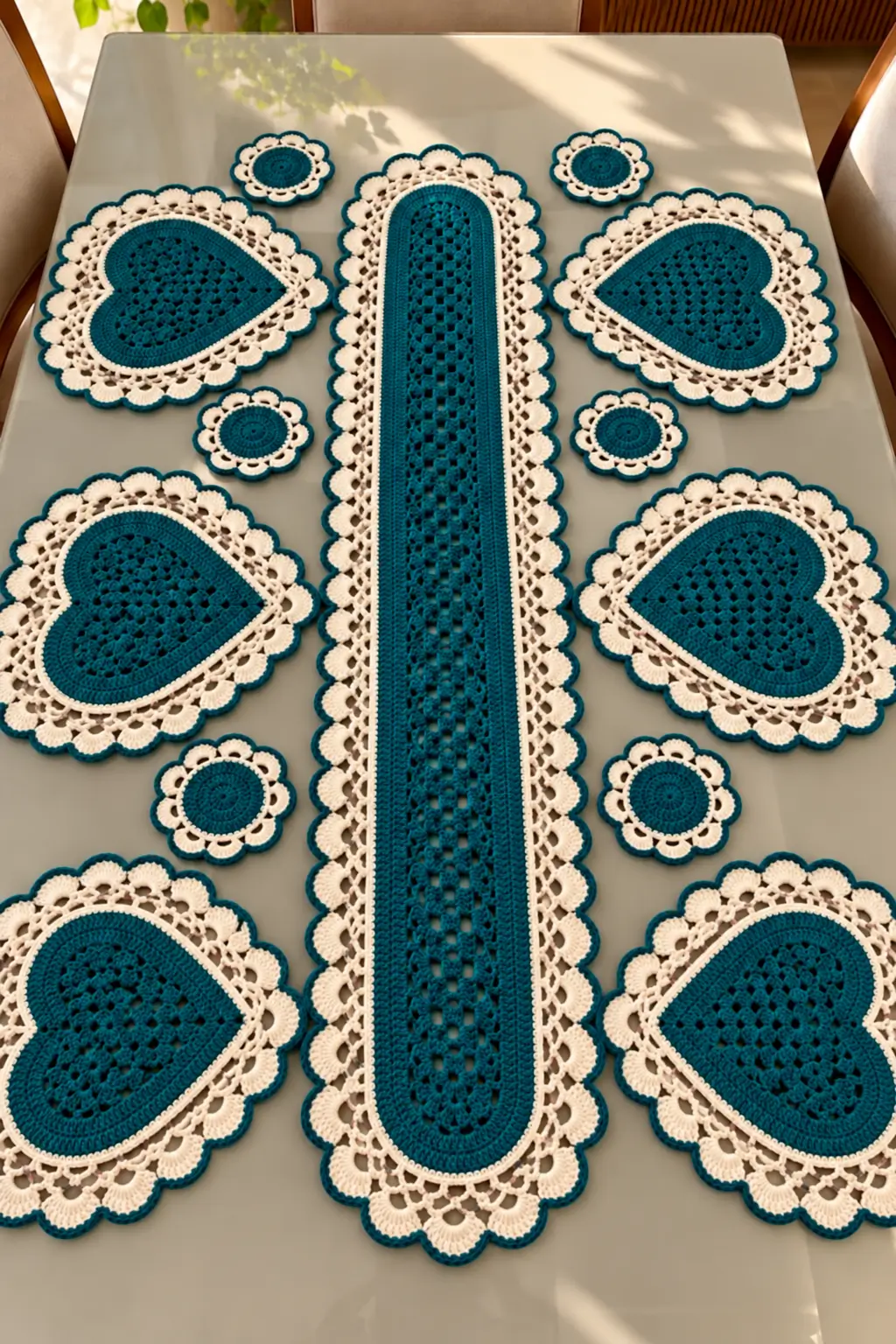
The pointed base of each heart has to stay sharp while two rounded upper lobes carry a wide lace border. This crochet heart placemat table set combines teal heart placemats, a long oval runner, round coasters and matching cream scallops. DK cotton and a 3.5–4.0 mm hook suit the photographed proportions and give the openwork borders enough definition for an intermediate coordinated table set.
The Design: What Makes This Table Set Different
Three shapes share one border language. The heart placemats use a teal openwork center, narrow cream separator, cream chain-lace band and rounded shells edged in teal. The central runner repeats the same structure around an elongated oval, while the small coasters simplify it to a solid teal disc with cream petals.
Comparable heart placemats show substantial sizing differences: one DK design measures about 17 × 12 inches with a 4.0 mm hook, while another heart mat measures approximately 33 × 30 cm. 0 DK cotton coasters commonly use 3.5–4.0 mm hooks and finish around 11–15 cm. 1 For this photo-inspired set, target approximately 32–36 cm for each heart and 11–13 cm for the coasters.
Project Info at a Glance
| Skill Level | Construction | Target Size | Hook | Best For |
|---|---|---|---|---|
| Intermediate | Separate coordinated table pieces | Runner 95–120 cm; hearts 32–36 cm | 3.5–4.0 mm | Dining-table sets and decorative place settings |
The dimensions above are targets for this original photo-inspired construction. Published crochet placemats commonly fall around 13–17 inches across depending on technique and yarn, supporting this general scale. 2
Materials and Tools
Yarn
- Deep teal — DK #3 cotton — approximately 350–450 g for the complete photographed-style set
- Warm cream — DK #3 cotton — approximately 250–350 g for lace borders and scallops
Use smooth cotton rather than fuzzy yarn. DK cotton is documented for both heart placemats and round coasters, and 3.5–4.0 mm hooks are common at this scale. 3
Tools
- 3.5–4.0 mm crochet hook
- DK #3 cotton yarn
- Yarn needle
- Scissors
- Stitch markers
- Tape measure
- Blocking mats and rust-resistant pins
Abbreviations
- MR — magic ring
- ch — chain
- sl st — slip stitch
- sc — single crochet
- hdc — half double crochet
- dc — double crochet
- tr — treble crochet
- sp — space
- st/sts — stitch/stitches
- inc — increase
- FO — fasten off
Pattern — Teal Heart Placemat
This is an original construction based on the proportions and stitch character visible in the reference. It is not a transcription of an existing commercial heart pattern.
Make approximately 6 heart placemats for a table arrangement similar to the image.
Heart Center
With teal, make a MR.
Round 1: Ch 3, work 11 dc in MR. Join. (12 dc)
Round 2: Ch 3, 2 dc in each stitch around. Join. (24)
Round 3: Ch 3, (dc in next st, 2 dc in next st) ×12. Join. (36)
Round 4: Ch 3, (dc in next 2 sts, 2 dc in next st) ×12. Join. (48)
Openwork Heart Center
Round 5: Ch 4, skip 1 st, dc in next st.
Repeat ch 1, skip 1, dc in next st around.
Join.
Round 6: Sl st into first ch-1 space. Ch 4, dc in next ch-1 space.
Continue ch 2, dc in next space around.
This gives the teal center the open filet character visible in the reference.
Shaping the Heart
Place markers at the top, bottom, left and right quarters of the circle.
The bottom marker becomes the heart point. The top section will be divided into two rounded lobes.
Begin at the bottom marker.
Work sc for approximately one quarter of the circumference.
Change gradually through hdc to dc as you approach the upper-left section.
Across the upper-left quarter, work regular increases approximately every third stitch to build the first rounded lobe.
Work 2–3 sl sts at the top-center indentation.
Mirror the shaping across the upper-right quarter.
Change from dc to hdc and then sc as you approach the lower point.
Defining the Bottom Point
At the bottom marker work:
(hdc, dc, tr, ch 2, sl st into second ch from hook, tr, dc, hdc)
in the same central area.
This produces the pointed lower tip.
Join and check the symmetry before continuing.
Teal Stabilizing Round
Work one round of sc around the complete heart.
At the upper indentation, use one sl st or skip one stitch if the center is too rounded.
At the bottom point work:
(sc, ch 2, sc)
in the point space.
The heart should lie flat before the cream border is added.
Cream Separator Round
Change to cream.
Work one round of sc around the heart.
Keep the stitches loose around both upper lobes.
At the bottom point work:
(sc, ch 2, sc)
FO only if changing the starting position for the lace round.
Cream Lace Foundation
Join cream near one side.
Work:
ch 4, skip 2 sts, sc in next st.
Repeat around.
Near the upper curves, use ch 4 with slightly closer anchors if necessary.
At the bottom point, place one chain loop directly over the point.
Second Lace Round
Sl st into the first ch-4 space.
Work:
ch 5, sc in next ch-4 space.
Repeat around.
This creates the open cream lattice visible between the teal heart and scalloped edge.
Cream Scallop Border
Into each selected ch-5 space work:
(sc, hdc, 5 dc, hdc, sc)
Move directly into the next chain space.
Repeat around the heart.
If the shells begin to overlap on the inner upper curves, alternate a full shell with a smaller 3-dc shell.
Teal Picot Outline
Join teal at the edge of the first cream scallop.
Work sc around each scallop.
At the center of each shell work:
ch 2, sl st into second ch from hook.
Continue sc around the shell.
This narrow teal outline visually connects the border with the heart center.
Blocking the Heart Placemat
Pin the bottom point first.
Measure upward through the center indentation.
Pin both upper lobes symmetrically.
Then shape the cream scallops.
Target approximately 32–36 cm wide and 28–32 cm high, depending on yarn and tension.
For comparison, published DK heart placemats include examples around 17 × 12 inches, while another heart design measures approximately 33 × 30 cm. 4
Pattern — Long Teal Table Runner
The central runner repeats the same colors and lace border but uses an elongated oval structure.
Foundation
With teal, ch 121.
This count is intended as a starting point for a medium-length runner. Add or subtract chains if a different finished length is required.
Round 1
Beginning in the second chain from hook, sc in each chain until the final chain.
Work 5 sc in the final chain.
Rotate the work.
Working down the unused side of the foundation chain, sc in each chain.
Work 4 additional sc in the starting chain.
Join.
The work now forms a long narrow oval.
Runner Round 2
Ch 2.
Hdc along the first long side.
Across the curved end, increase evenly by working 2 hdc in selected stitches.
Hdc along the second long side.
Repeat matching increases around the opposite curve.
Join.
Runner Round 3
Work another hdc round.
Place increases only around the two semicircular ends.
Do not increase along the long straight sides.
Lay the piece flat after each curve. If an end cups, add an increase; if it waves, remove one.
Central Filet Panel
On the next round establish the openwork pattern along the long center section:
dc, ch 2, skip 2 sts, dc.
Repeat across the straight sections.
At each rounded end, shorten the gaps to ch 1 where necessary so the curve remains stable.
Second Openwork Round
Work dc into each dc.
Over each ch-2 space work:
ch 2, dc in next dc.
Continue the mesh through the straight sections.
Maintain smaller spaces around the ends.
Building the Teal Body
Work 3–5 additional rounds around the complete oval.
Alternate one solid hdc round with one openwork round.
Keep the increases concentrated around the curved ends.
Stop when the teal body measures approximately 17–20 cm wide.
Solid Teal Outer Band
Work two rounds of hdc around the entire runner.
Continue increasing only around the curved ends.
The purpose of these solid rounds is to support the lace border.
Cream Runner Separator
Change to cream.
Work one round of sc.
On the following round work:
ch 4, skip 2 sts, sc in next st.
Repeat around.
Runner Lace Band
Sl st into the first chain space.
Work:
ch 5, sc in next space.
Repeat around.
At the two rounded ends, check the work every few repeats. The chain spaces should spread evenly without folding over one another.
Runner Cream Shell Border
Into each ch-5 space work:
(sc, hdc, 5 dc, hdc, sc)
Repeat around.
The shells should form a continuous cream scalloped frame.
Runner Teal Outline
Join teal.
Sc around every cream shell.
At the crown of each scallop work a small picot:
ch 2, sl st into second ch from hook.
Continue around.
FO and weave in the tail.
Runner Finished Size
Block the runner to approximately 95–120 cm long and 24–30 cm wide.
A current intermediate lace-runner example uses worsted yarn with a 4.0 mm hook and combines solid rows, chain spaces and a shell border, supporting this general border construction. 5
For a longer dining table, extend the initial foundation chain rather than adding disproportionately wide outer rounds.
Pattern — Round Teal and Cream Coaster
Make approximately 6 coasters.
DK cotton coasters commonly finish around 11–15 cm with 3.5–4.0 mm hooks. 6 Target approximately 11–13 cm for this set so the coasters remain visually smaller than the heart placemats.
Teal Center
With teal, make a MR.
Round 1: 12 dc in MR. Join. (12)
Round 2: 2 dc in each stitch. (24)
Round 3: (Dc, inc) ×12. (36)
Round 4: (Dc in next 2 sts, inc) ×12. (48)
FO teal.
Coaster Cream Petals
Join cream.
Work a foundation round of:
sc, ch 3, skip 2 sts
around, adjusting the final repeat so the spaces remain evenly distributed.
Into each ch-3 space work:
(sc, hdc, 3 dc, hdc, sc)
Repeat around.
Coaster Teal Edge
Join teal.
Work sc around each cream petal.
At the center of every petal work:
ch 2, sl st into second ch from hook.
FO.
Block flat.
A recent DK cotton lace coaster pattern uses a 3.5 mm hook, about 10 g of main-color yarn and finishes around 15 cm; another DK cotton coaster with a 4.0 mm hook finishes around 4.5 inches. 7 This set deliberately targets the smaller end of that range.
Suggested Set Configuration
| Piece | Quantity | Target Measurement |
|---|---|---|
| Long central runner | 1 | 95–120 × 24–30 cm |
| Heart placemats | 6 | 32–36 cm wide |
| Round coasters | 6 | 11–13 cm diameter |
Color Placement
Keep teal dominant inside every piece. Cream should function as the open decorative frame rather than occupying most of the surface.
Repeat teal as the final outline around every cream scallop. This thin line is important because it visually connects the runner, hearts and coasters even though their shapes differ.
Use the same cream dye lot across the complete set. Slight cream-tone changes become noticeable when multiple pieces sit together on a light tabletop.
Making a Four-Place Set
For a smaller dining table, make:
- 1 runner
- 4 heart placemats
- 4 coasters
Keep the runner unchanged and remove one place setting from each long side.
Making an Eight-Place Set
Make eight hearts and eight coasters.
Increase the runner foundation by approximately 30–50 chains, depending on gauge and table length.
Work the same oval shaping at both ends.
Measure the runner after the teal body is complete and before adding the cream lace because the border can add several centimeters to both length and width.
Yarn Estimation
Make one heart and one coaster before buying the full quantity.
Weigh each color separately if possible.
For example, suppose one heart requires:
- 45 g teal
- 28 g cream
Six hearts would therefore require:
45 × 6 = 270 g teal
28 × 6 = 168 g cream
Add the measured runner and coaster requirements, then add approximately 10% for swatching and tension variation.
Published DK cotton coaster examples range from roughly 10 g per coaster to about 27.5 m of yarn, illustrating why weighing a project-specific sample is more accurate than relying on a universal gram figure. 8
Keeping the Hearts Symmetrical
Fold a finished unblocked heart vertically through its center.
The upper lobes should overlap closely.
If one side extends more than approximately 5 mm beyond the other, correct the shaping before adding the cream border.
Do not try to hide a strongly asymmetrical teal center by stretching the lace during blocking.
Controlling the Heart Indentation
The upper center must remain visibly lower than the two lobes.
Use short stitches at the indentation and taller stitches as the lobe curves rise.
If the indentation disappears, remove several stitches around the center and replace them with slip stitches or sc.
If it folds inward excessively, the center stitches are too tight.
Controlling the Heart Point
Place only one major increase group at the bottom.
Too many stitches create a rounded lower edge.
During blocking, pin the tip first and pull gently in line with the upper indentation.
The point should extend naturally from the stitch structure rather than depending entirely on aggressive blocking.
Keeping the Runner Ends Flat
The straight sides of an oval need no increases.
The curved ends do.
Check each end after every round by placing the work on a table.
If the curve lifts upward, add one or two evenly spaced increases on the next round.
If the edge waves, reduce the number of increases.
Matching the Scallops Across All Pieces
Use the same shell recipe for hearts and runner:
sc, hdc, 5 dc, hdc, sc.
For the small coaster, reduce the center of the shell to 3 dc.
This keeps the proportions appropriate while retaining the same visual identity.
Assembly
- Crochet one teal heart center, shape the two lobes and bottom point, then check vertical symmetry before adding any cream rounds.
- Add the cream separator, open chain-lace band and scalloped border, then finish the shells with the narrow teal outline.
- Block the master heart to approximately 32–36 cm wide and record its height, width and upper-lobe measurements.
- Make the remaining heart placemats while comparing every second piece with the blocked master.
- Crochet the elongated teal runner, adding increases only around its curved ends and checking flatness after each structural round.
- Add the same cream lattice, scallops and teal outline to the runner so its border matches the placemats.
- Make the round teal coasters, finish them with smaller cream shells and repeat the teal edge treatment.
- Weave every tail through at least 4–5 cm of dense crochet rather than through the open chain spaces.
- Block all pieces individually, using the master heart and coaster as measurement references for the repeated pieces.
- Arrange the runner along the table center, position matching heart placemats symmetrically on both sides and place one coaster above each setting.
The completed set should show one consistent teal center color, cream openwork framing and a narrow teal outline across all three motif shapes.
7 Technical Tips
- Compare the two heart lobes before every color change. A difference greater than 5 mm becomes more obvious after the contrasting cream border is added.
- Keep the bottom heart point to one concentrated shaping area. Spreading increases across several centimeters produces a rounded teardrop instead of a defined heart.
- Check the runner’s curved ends after every round. Cupping means too few increases; rippling means too many increases around the semicircle.
- Keep each cream shell the same height. Changing from five dc to six or seven dc unintentionally creates a visibly uneven scalloped perimeter.
- Target 11–13 cm for the coasters. A much larger coaster competes visually with the heart placemat and occupies too much of an individual place setting.
- Use blocking pins at every second or third scallop. Pinning only the heart point and corners allows the lace loops between them to dry at inconsistent sizes.
- Weave tails through at least 4–5 cm of solid stitches. Chain-lace spaces provide insufficient friction and can expose short yarn ends after repeated washing.
Care and Final Blocking
Wash according to the selected cotton yarn’s care instructions.
Do not hang the runner while wet. Lay it flat and establish its center line first.
Shape both rounded ends to matching dimensions, then position the cream scallops.
For the hearts, pin the lower point, upper indentation and two lobe peaks before working around the lace perimeter.
Measure all repeated pieces after drying. Store the set flat or loosely rolled so the scallops are not permanently folded.
Conclusion
The repeated cream scallop is what turns three different shapes into one crochet heart placemat table set. Begin with a single 32–36 cm heart and an 11–13 cm coaster, block both and use those pieces as the measurement standards for every repeat. Work the central runner only after checking your table length, keeping all oval increases at the curved ends. The next practical step is to crochet one teal heart through its cream border and test it beneath an actual dinner plate before producing the complete set. Save the finished arrangement to Pinterest or share it on Instagram with #TealHeartCrochetTableSet. Would you keep the entire set teal and cream, or replace the teal with burgundy, sage green or navy?