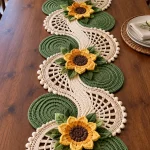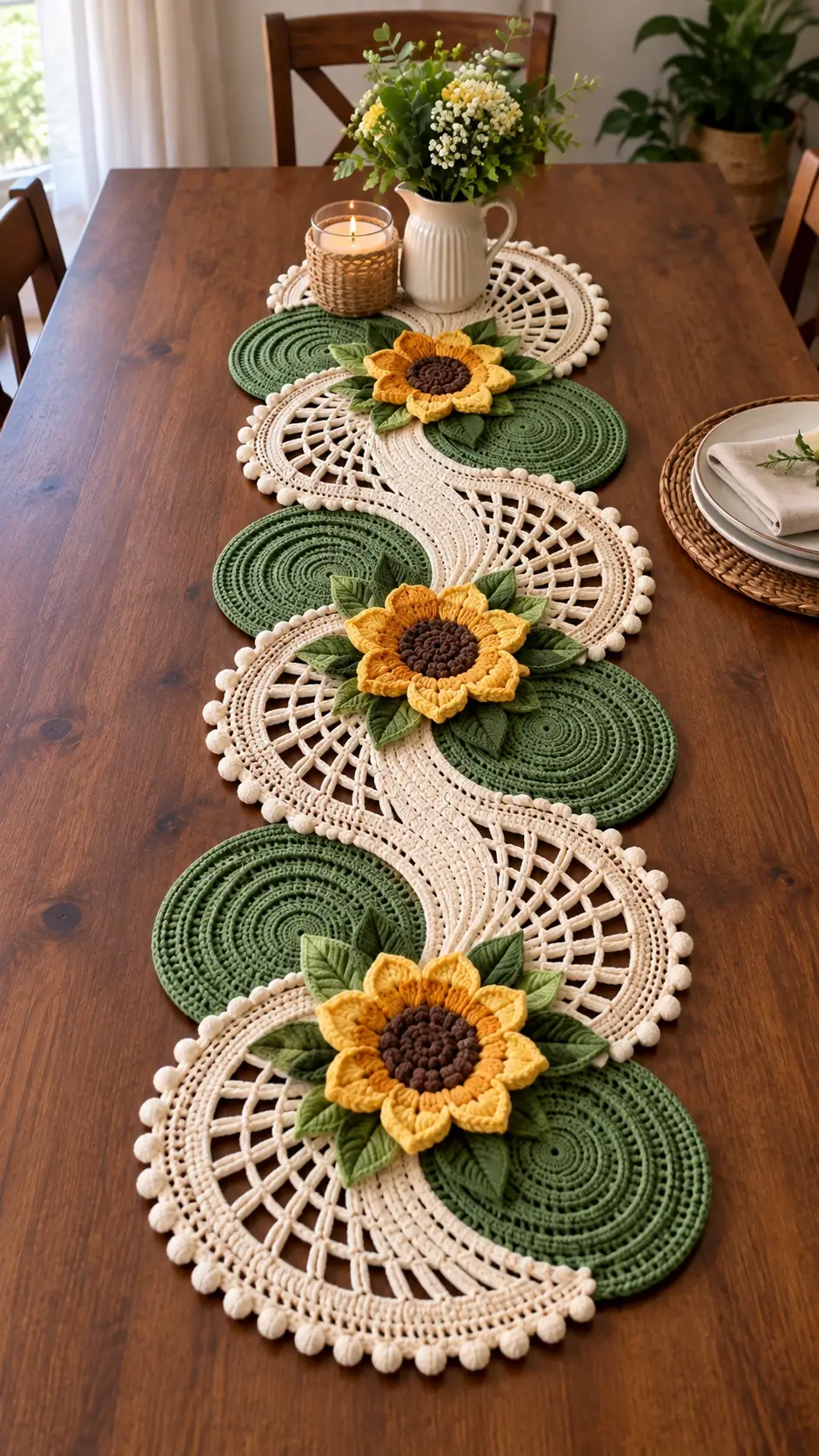
Three raised sunflowers have to sit over this runner without closing the cream lacework that gives the design its distinctive S-shaped movement. This sunflower crochet table runner pattern combines cream openwork medallions, overlapping sage-green circles, dimensional yellow flowers, pointed leaves and a bobble-edged border. The photo-inspired runner targets approximately 38–42 cm wide and 145–160 cm long. Smooth DK cotton and a 3.5–4 mm hook suit the detailed construction.
The Design: What Makes This Sunflower Runner Different
The runner is assembled from overlapping circular components rather than worked as one conventional rectangle. Cream lace circles form the primary path, while solid green discs alternate from side to side and create the sweeping outline.
Three-dimensional sunflowers cover selected intersections. Each flower uses a dark brown textured center, two layers of yellow petals and a ring of pointed green leaves. Those raised components create substantial depth without requiring the entire runner to be thick.
The cream circles need large open spaces to preserve the lace effect. Working too many stitches into those mesh rounds makes the circles heavy and reduces the contrast between solid and open sections. For this crochet sunflower table runner, blocking every circular component before assembly is critical because mismatched diameters will distort the repeating curves.
Project Info at a Glance
| Skill Level | Time | Finished Size | Hook | Yarn |
|---|---|---|---|---|
| Intermediate | 15–20 hours | Approx. 38–42 × 145–160 cm | 3.5–4 mm | DK cotton |
The dimensions are targets for this photo-inspired reconstruction rather than direct measurements from the photograph. The final length can be changed by adding or removing complete cream-and-green motif units.
Materials and Tools
Yarn
- Natural cream — DK cotton — approximately 220–260 g
- Sage or moss green — DK cotton — approximately 180–220 g
- Sunflower yellow — DK cotton — approximately 80–100 g
- Dark brown — DK cotton — approximately 40–50 g
- Optional lighter yellow — DK cotton — approximately 20–30 g for petal highlights
Allow approximately 550–650 g total for a runner near 150 cm long. Yarn consumption changes with motif diameter, cotton thickness, bobble size and the final number of leaves.
Tools
- 3.5 mm crochet hook — main motifs
- 4 mm crochet hook — optional for looser cream mesh
- Tapestry needle
- Sharp scissors
- Locking stitch markers
- Blocking mats
- Rust-resistant pins
- Tape measure
Abbreviations
- MR — magic ring
- ch — chain
- sc — single crochet
- hdc — half double crochet
- dc — double crochet
- tr — treble crochet
- inc — 2 sc in one stitch
- sl st — slip stitch
- sp — space
- st/sts — stitch/stitches
- BLO — back loop only
- FLO — front loop only
An invisible decrease is not required for the main runner because its circles, flowers and leaves are constructed primarily as flat or layered components.
Gauge and Finished Measurements
For the solid green circles, target approximately 18–20 stitches per 10 cm after blocking. More important than exact gauge is producing identical circles from the same instructions.
Each large green circle should finish approximately 21–23 cm across. The cream lace motifs should finish approximately 25–27 cm at their widest point including the decorative edge.
The dimensional sunflowers should measure approximately 15–17 cm across before the surrounding leaves are attached.
Sunflower Crochet Table Runner Pattern
Make and block the individual components before joining. The runner is assembled by alternating cream lace circles with green solid circles, then covering selected intersections with dimensional sunflowers and leaves.
Solid Green Circle — Make 6
Yarn: sage or moss green.
R1: 6 sc in MR. (6)
R2: inc ×6. (12)
R3: (sc, inc) ×6. (18)
R4: (2 sc, inc) ×6. (24)
R5: (3 sc, inc) ×6. (30)
R6: (4 sc, inc) ×6. (36)
R7: (5 sc, inc) ×6. (42)
R8: (6 sc, inc) ×6. (48)
R9: (7 sc, inc) ×6. (54)
R10: (8 sc, inc) ×6. (60)
R11: Ch 3, dc in each stitch around. (60)
R12: Ch 1, sc in each stitch around. (60)
R13: *Sc in next 4 sts, ch 1, skip 1 st.* Repeat around.
R14: Sc in every sc and ch-1 space around, distributing stitches evenly to keep the circle flat.
R15: Sc around.
Fasten off. Leave a 30 cm tail on circles that will be sewn directly to a cream motif.
Block each green circle to approximately 21–23 cm diameter.
Cream Lace Circle — Make 5
Yarn: natural cream.
R1: 6 sc in MR. (6)
R2: inc ×6. (12)
R3: (sc, inc) ×6. (18)
R4: (2 sc, inc) ×6. (24)
R5: (3 sc, inc) ×6. (30)
R6: (4 sc, inc) ×6. (36)
R7: Ch 4, skip 1 stitch, dc in next stitch. *Ch 1, skip 1 stitch, dc in next stitch.* Repeat around.
R8: Sl st into first ch-1 space. Ch 4, sc in next ch-1 space. Repeat around.
R9: Sl st into first ch-4 space. Ch 5, sc in next ch-4 space. Repeat around.
R10: Sl st into first ch-5 space. Ch 6, sc in next ch-5 space. Repeat around.
The expanding chains form the open radial mesh visible in the cream sections.
Outer Solid Band
R11: Work 6 sc into every ch-6 space.
R12: Sc evenly around, adjusting by a few stitches if required so the circle lies flat.
R13: Dc in every stitch around.
R14: Sc in every stitch around.
Do not fasten off if adding the bobble edge immediately.
Cream Bobble Edge
The photograph shows small rounded cream details around the outer edge of each lace circle.
R15: *Sc in next 3 stitches, make bobble in next stitch, sc in next 3 stitches.* Repeat around as evenly as possible.
For each bobble:
Yarn over, insert hook into the designated stitch, yarn over and pull up a loop, yarn over and pull through two loops. Repeat this partial dc four more times in the same stitch.
Yarn over and pull through all remaining loops on the hook.
Push the bobble toward the right side with your finger.
Fasten off.
Block each cream motif to approximately 25–27 cm across without stretching the bobbles flat.
Dark Brown Sunflower Center — Make 3
Yarn: dark brown.
R1: 6 sc in MR. (6)
R2: inc ×6. (12)
R3: (sc, inc) ×6. (18)
R4: (2 sc, inc) ×6. (24)
R5: (3 sc, inc) ×6. (30)
R6: Work one small bobble in every second stitch, with sc between bobbles.
R7: Sc evenly around. Increase only where required to keep the disc flat.
The bobbles should remain on the right side, creating the textured seed center visible in the photograph.
Fasten off. Leave a 30 cm tail.
Inner Sunflower Petals — Make 12 Per Flower
Yarn: sunflower yellow.
Join yellow yarn to the outer edge of the brown center.
Petal 1: Ch 8.
Starting in the second chain from the hook work:
Sl st, sc, hdc, dc in next 2 chains, hdc, sc.
Sl st into the next available stitch on the brown center.
Repeat around until approximately 12 inner petals have been formed.
Adjust the anchoring positions slightly if necessary so the petals are distributed evenly around the entire center.
Outer Sunflower Petals — Make 12 Per Flower
Attach yellow yarn behind the first petal layer.
For each outer petal:
Ch 10.
Starting in the second chain from the hook work:
Sl st, sc, hdc, dc, tr in next 3 chains, dc, hdc, sc.
Anchor behind the next inner petal with sl st.
Repeat around.
The outer petals should extend beyond the inner layer by approximately 2–3 cm.
Fasten off and weave the working tail through the reverse side of the flower.
Optional Petal Edging
For a more defined sunflower, join a slightly lighter yellow yarn at the base of an outer petal.
Sl st loosely along one side, work (sl st, ch 1, sl st) at the tip, then continue down the opposite side.
Repeat for each outer petal.
Keep the slip stitches loose enough that the petals remain flat.
Large Green Sunflower Leaves — Make 18
Yarn: sage or moss green.
Row 1: Ch 13.
Starting in the second chain from the hook work:
Sl st, sc, hdc, dc, tr in next 4 chains, dc, hdc, sc, then 3 sc in the final chain.
Rotate the work and crochet along the unused loops on the opposite side of the foundation chain.
Work sc, hdc, dc, tr in next 4 loops, dc, hdc, sc, sl st.
Row 2: Ch 1. Sc around the entire leaf. At the tip work (sc, ch 2, sc).
Row 3: Sl st along the exposed center loops from base to tip to create a raised central vein.
Fasten off. Leave a 25 cm sewing tail.
Block the leaf to approximately 9–11 cm long.
Smaller Green Leaves — Make 9
Yarn: green.
Row 1: Ch 9.
Starting in the second chain from the hook:
Sl st, sc, hdc, dc in next 2 chains, hdc, sc, then 3 sc in the final chain.
Work along the opposite side:
Sc, hdc, dc in next 2 loops, hdc, sc, sl st.
Row 2: Sc around, working (sc, ch 2, sc) at the tip.
Fasten off. Leave a 20 cm tail.
Assembling Each Sunflower Cluster
Each of the three major floral clusters consists of one sunflower plus approximately six large leaves and three smaller leaves.
- Place the completed sunflower face down on a flat surface.
- Position six large leaves around the back of the flower.
- Stagger the leaf angles rather than spacing every tip identically.
- Add three smaller leaves between selected large leaves.
- Pin every leaf before sewing.
- Sew the leaf bases to the reverse side of the brown flower center.
- Do not sew through the yellow petals.
- Turn the cluster over and check that green remains visible between the petals.
- Add a second attachment stitch to any leaf that rotates excessively.
- Leave several long green tails for attaching the completed cluster to the runner.
The finished flower cluster should measure approximately 23–27 cm across from leaf tip to leaf tip.
Arranging the Cream and Green Motifs
Lay all blocked components on a table or floor before sewing.
Place the cream lace circles along the central axis. Offset each successive circle slightly to the opposite side to begin forming the S-shaped path.
Position a green circle beside each cream motif so approximately one-third of the green circle passes beneath the cream edge.
Alternate the green circles from left to right down the runner.
The layout should remain visually balanced even though the outline is asymmetrical.
Joining the Main Runner
Use matching cream or green yarn depending on which component is uppermost at each overlap.
Overlap neighboring circles by approximately 5–7 cm.
Sew through the back loops or rear strands only. Keep the stitches away from the large cream mesh openings.
Secure each overlap across approximately 7–10 cm rather than sewing around the complete circle. Partial joining preserves more flexibility and prevents the runner from becoming excessively rigid.
After every two joins, lay the runner flat and check the center line.
Positioning the Three Sunflowers
Place the first flower cluster near the lower third of the runner.
Position the second cluster near the center and the third near the upper third.
Each sunflower should cover an intersection between cream and green components rather than sitting entirely on one circle.
Rotate the leaf arrangements slightly between flowers. Repeating the exact same orientation makes the runner appear mechanically duplicated.
Pin all three flowers before permanently attaching any of them.
Attaching the Sunflowers
Use the long green tails left on the leaves to anchor each cluster.
Sew through several cream and green solid stitches beneath the flower. Avoid attaching directly through large lace openings.
Add approximately six to eight hidden attachment points around each cluster.
The yellow petals should remain largely free. Sewing the tips down removes the raised dimensional effect.
Test each flower by gently lifting its center. It should not rise more than approximately 10–15 mm from the runner.
Optional Extra Bobbles Between Motifs
If a joined cream section loses some of its decorative edge beneath a green circle, add individual cream bobbles along the exposed section.
Join cream yarn to an edge stitch.
Work one bobble, sl st into the next two or three stitches, then repeat.
Keep the spacing consistent with the existing cream border.
7 Technical Tips for a Sunflower Crochet Table Runner
- Wavy green circles: Stop increasing if the solid disc begins to ripple. Adding six stitches mechanically on every decorative round can create excess fabric once the circle becomes large.
- Cupped cream motifs: Check every mesh round on a flat surface. If the outer edge lifts more than approximately 1 cm, add slightly more chain length or distribute additional stitches in the following solid round.
- Uneven sunflower petals: Mark the brown center into 12 approximate sections before adding petals. Crowding several petals into one quarter of the circle makes the flower visibly asymmetric.
- Flat flower centers: Push each brown bobble toward the right side immediately after completing it. Leaving alternating bobbles on the reverse reduces the seed-like texture.
- Rotating leaves: Attach each large leaf at two points approximately 1–2 cm apart. A single attachment point allows the leaf to turn underneath the flower.
- Runner twisting: Lay the project flat after every two motif joins. Correct an incorrect overlap immediately rather than attempting to block a pronounced twist out of the finished runner.
- Collapsed bobble border: Pin between the cream bobbles during blocking rather than through them. Stretching a wet bobble directly under a pin can permanently flatten its rounded shape.
How to Make the Table Runner Longer
Lengthen the runner by adding one complete cream-and-green motif unit. Make one additional cream lace circle and one additional green solid circle.
Continue the existing left-right alternation rather than placing the new green circle on whichever side has more empty space.
One extra unit will add less than the full diameter of a motif because adjacent circles overlap by approximately 5–7 cm.
If extending the runner substantially, add another sunflower cluster after approximately every two additional motif units. Leaving a long extension without flowers changes the visual rhythm of the design.
How to Make a Shorter Sunflower Centerpiece
For a coffee table or smaller dining table, use three cream circles, four green circles and two sunflower clusters.
Arrange the circles using the same alternating overlap. Keep one sunflower near each transition rather than placing both flowers close to the center.
A shorter version can target approximately 85–100 cm in length while retaining the same 38–42 cm maximum width.
Creating the Cream Lace Effect
The open cream sections depend on increasing chain lengths as the motif expands. The mesh should remain large enough for the wooden tabletop to remain visible through the runner.
Keep the chain stitches relaxed and consistent. Tight chains pull the radial bars inward and make the outer solid rounds ruffle.
If your crochet tension is naturally tight, use the 4 mm hook for the open mesh rounds and return to 3.5 mm for the solid edging.
Do not steam the finished mesh aggressively. Excess heat can flatten cotton texture or damage synthetic fibers if a cotton-blend yarn is used.
Making the Sunflower Centers More Dimensional
The dark center can be made more pronounced by adding another round of small bobbles before beginning the yellow petals.
Keep additional bobbles compact. An overly thick center can become heavy enough to pull the surrounding petals downward.
For a flatter table runner, substitute ordinary single crochet for the final brown bobble round. This reduces thickness while preserving the dark center.
Adjusting the Sunflower Petals
For longer petals, add two chains to the outer-petal foundation and place additional treble crochet stitches through the center of each petal.
For a compact sunflower, reduce the outer petals from ch 10 to ch 8.
Make one complete petal and compare it against the brown center before repeating the remaining eleven. The finished petal should extend far enough to overlap the green leaves without completely covering them.
Blocking the Table Runner
Block the green and cream components individually before joining. This establishes accurate diameters and prevents one circle from forcing its neighbor out of shape.
After assembly, perform a second light blocking of the complete runner.
Pin the central cream path first. Next, pin the outer edges of the green circles. Adjust the cream bobbles and sunflower leaves last.
Do not flatten the sunflower centers or petals under heavy objects. The raised flower structure is intended to remain dimensional.
Choosing Yarn Colors
The photographed palette uses muted botanical green, natural cream, golden yellow and dark brown. The subdued green allows the sunflowers to remain the dominant color accents.
For a brighter version, substitute grass green for sage and use a stronger lemon yellow. For an autumn version, combine olive green, oatmeal cream, mustard petals and chocolate brown centers.
Keep the cream sections significantly lighter than the green circles. Low contrast between those two colors makes the overlapping S-shaped construction less visible.
Finishing the Runner
Turn the completed runner over and inspect every overlap. Weave all joining tails through at least 4 cm of dense crochet and reverse direction once before trimming.
Check the exposed cream mesh for accidental pulls. A stretched chain can usually be redistributed by gently moving the excess loop into neighboring stitches.
Reshape each sunflower by separating the inner and outer petals. Position the green leaves between petal gaps rather than directly underneath the yellow points.
Lay the runner on the intended table and check its final alignment. The central path should curve gradually rather than producing abrupt left-right turns.
Conclusion
Block one cream lace circle and one green disc before producing the remaining motifs. Their finished diameters determine the overlap, total runner width and how strongly the alternating circles create the S-shaped path. Next, make one complete sunflower with its leaves and place it temporarily over the first cream-and-green intersection to check scale. Save this sunflower crochet table runner pattern to Pinterest or share the finished runner on Instagram with #SunflowerLaceTableRunner. For this specific design, would you keep all three sunflowers golden yellow or make the center flower a deeper burnt-orange shade?