Introduction
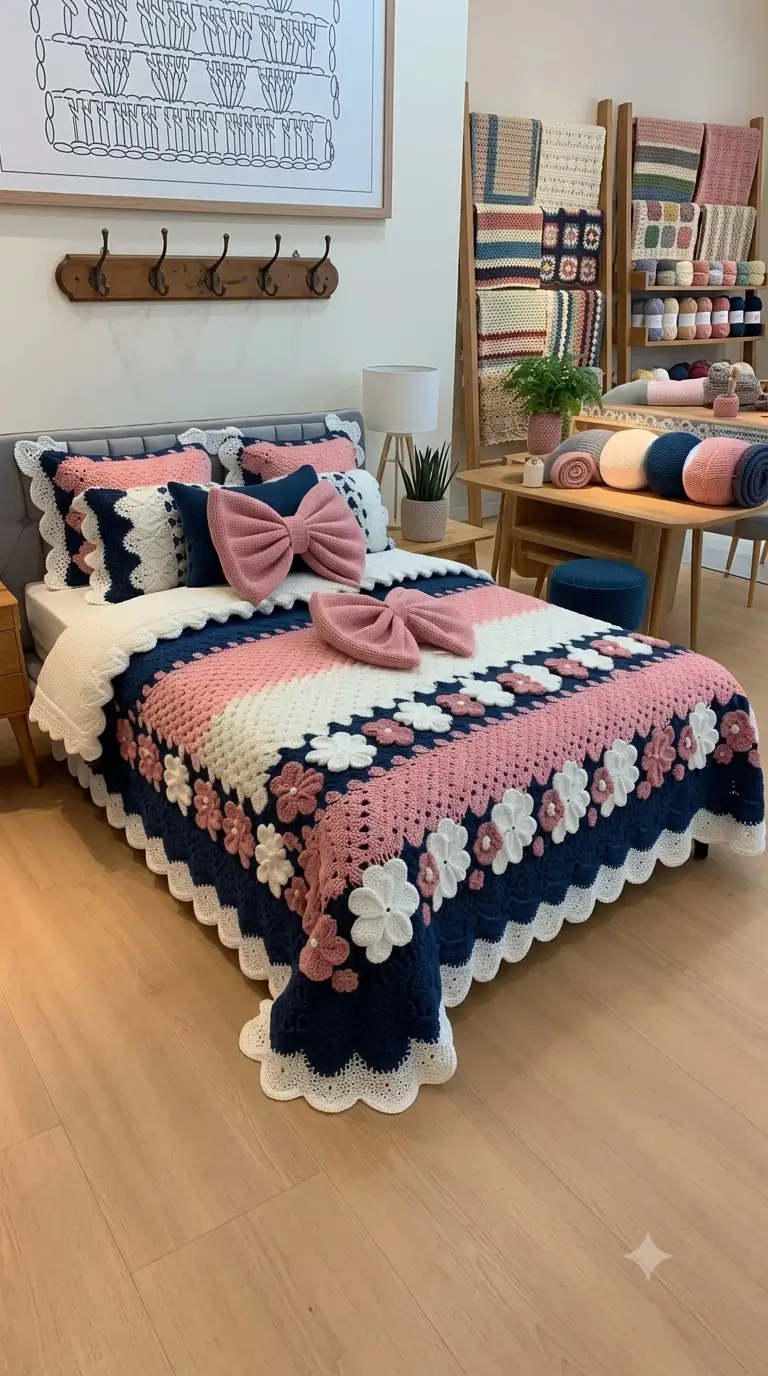
The flower rows on this bedspread must remain visually level even while the fabric drops over three sides of the mattress. This crochet flower bedspread pattern guide uses DK yarn, a 4 mm reference hook and mattress-based sizing rather than an unreliable measurement taken from the photograph. It suits intermediate crochet skills and provides a practical route for recreating the pink, navy and white structure as a washable modular bed cover.
The Design: What Makes This Flower Bedspread Different
Three structural choices define this design. First, wide pink, cream and navy sections establish the geometry before any flowers are attached. That keeps the bedspread readable as a complete composition rather than allowing the appliqués to dominate every surface.
Second, the flowers sit mainly against navy bands. The dark ground produces clear separation around white and dusty-pink petals, an effective construction choice for a 3D crochet flower blanket.
Third, the white perimeter is deeper and more decorative than a basic finishing round. Its repeated curves create a deliberate scalloped crochet blanket border beneath the dark lower band.
A common error is attaching every flower before blocking the blanket. The base fabric can change dimensions after blocking, leaving an originally straight flower row visibly uneven.
Project Info at a Glance
| Skill Level | Time | Finished Size | Hook | Best For |
|---|---|---|---|---|
| Intermediate | Large multi-session project | Mattress-sized; swatch before calculating | 4 mm reference | Double or queen bed cover |
The 4 mm hook is a practical starting point for DK-weight floral blanket construction. Exact bedspread dimensions should be calculated from the intended mattress because a photograph does not provide a dependable scale reference.
Materials and Tools
Yarn
A DK cotton or cotton-blend yarn gives the raised flowers enough definition while keeping the main fabric manageable.
- Dusty pink — DK weight — quantity determined from swatch — main upper and lower panels
- Navy blue — DK weight — quantity determined from swatch — contrast bands and lower field
- Cream/white — DK weight — quantity determined from swatch — center panel, flowers and edging
- Dusty pink scraps — DK weight — flower centers and secondary flowers
Do not calculate yarn requirements from a small baby-blanket pattern. A full bedspread can require several times that amount. Make and weigh a representative swatch before purchasing the complete quantity.
Tools
- 4 mm crochet hook
- Tapestry needle
- Scissors
- Locking stitch markers
- Flexible measuring tape
- Blocking mats
- Rust-resistant blocking pins
- Digital kitchen scale for yarn calculations
A row counter is useful because the large color fields must remain symmetrical. For flower placement, removable markers are more accurate than estimating spacing by eye.
Abbreviations
- MR — Magic ring
- sc — Single crochet
- hdc — Half double crochet
- dc — Double crochet
- tr — Treble crochet
- inc — Increase
- sl st — Slip stitch
- ch — Chain
- st/sts — Stitch/stitches
- RS — Right side
- WS — Wrong side
An invisible decrease is unnecessary in the flat blanket but can be used in stuffed accessories where two stitches need to be reduced without creating a prominent bar.
Construction — Step by Step
The photograph does not provide readable stitch-level information, so exact row counts should not be presented as an original pattern. Instead, construct the bedspread from a gauge swatch and the visible proportions.
Main Bedspread Panel
Yarn: dusty pink, cream/white and navy DK.
Make a minimum 15 × 15 cm swatch in the stitch selected for the main bedspread. Wash and block it exactly as the finished project will be treated.
Measure the number of stitches across 10 cm. Calculate the starting stitch count with this formula:
Required stitch count = target width in cm × stitches per cm
Round the result when necessary to accommodate the stitch repeat.
The bedspread needs to cover the mattress and provide substantial drops along both sides and the foot. Measure the actual bed rather than relying only on labels such as double, full or queen.
Work the foundation across the required width. Crochet the first large dusty-pink field, then change to cream/white, followed by navy and the subsequent pink and navy sections according to the desired layout.
Treat the photograph as a color-placement reference rather than an exact row chart.
White Flower Appliqués
Yarn: cream/white DK.
R1: 6 sc in MR (6)
R2: inc ×6 (12)
R3: Work evenly distributed petals around the circle using sl st, chains and dc stitches.
One practical petal sequence is:
(sl st in next st, ch 3, 3 dc in next st, ch 3, sl st in next st)
Repeat the sequence around while maintaining even spacing. Fasten off and leave approximately a 20 cm sewing tail.
For larger and more pronounced petals, substitute treble crochet stitches for the central double crochet stitches.
Pink Flower Appliqués
Yarn: dusty pink DK with a cream or pale-pink center.
R1: 6 sc in MR (6)
R2: inc ×6 (12)
Change color if a contrasting center is required. Build evenly spaced petals around the circle using the same basic structure as the white flowers.
Keep every motif at approximately the same finished diameter. Blocking the flowers against a reusable paper or cardboard template makes the floral band considerably more consistent.
Alternate white and dusty-pink flowers across the navy background. Smaller pink details can be positioned between the larger white flowers to reproduce the layered floral effect.
Raised Flower Centers
Yarn: dusty pink or cream DK.
R1: 6 sc in MR (6)
R2: inc ×6 (12)
Fasten off.
For a smaller flower center, stop after R1 and close the magic ring tightly. Position the center over the petal junction.
Sew primarily through the center rather than attaching every outer petal stitch tightly to the blanket. Leaving portions of the petals free produces the raised appearance visible in this style of floral bedspread.
Navy Floral Band
The navy stripe acts as a mounting field for the white and pink flowers. Work this section directly into the blanket body rather than sewing a separate long strip over the finished fabric.
After blocking, mark the horizontal center of the navy band using removable stitch markers.
Divide the usable width by the number of flowers required.
For example, a 180 cm usable band carrying 12 motifs needs flower centers approximately 15 cm apart.
180 ÷ 12 = 15 cm
Adjust the first and final positions so both end flowers sit an equal distance from the side edges.
Scalloped White Border
Yarn: cream/white DK.
Begin with one stabilizing round of single crochet around the entire completed blanket. Work approximately three stitches into each corner so the border can turn without pulling.
For the decorative shell round, use:
Skip 1 st, 5 dc in next st, skip 1 st, sl st in next st.
Repeat around the perimeter.
Test the repeat before completing all four sides. If a shell lands badly at a corner, adjust the spacing gradually over the preceding section instead of forcing several stitches into the corner.
The border should lie flat when the bedspread is spread across the mattress. Visible ruffling indicates excess border stitches. An edge that pulls inward indicates too few stitches.
Large Crochet Bow
Yarn: dusty pink.
The oversized pink bows are one of the strongest visual features of this bed set.
For a flat decorative bow, crochet two matching rectangular panels. Join three sides, insert a thin layer of filling if additional dimension is required, then close the remaining edge.
Make a narrow rectangular center band separately.
Wrap the band firmly around the midpoint of the large rectangle. Compressing the center produces two distinct bow loops.
Sew the center band securely at the back where the join will remain hidden.
If the bow will lie directly on the bed rather than function as a cushion, omit the filling and use a relatively dense crochet fabric.
Matching Pillow Covers
The pillow covers repeat the bedspread’s dusty pink, navy, cream, flower and scallop elements.
Measure each cushion insert before beginning. For a firm-fitting cover, make the crochet panels approximately 1–2 cm smaller than the relaxed dimensions of the insert, subject to the stretch of the chosen stitch.
Make two panels for each cushion.
Block the pieces before joining them. Add the main navy, pink and cream sections before assembly.
Join three sides, insert the cushion and close the remaining side using a removable closure or permanent seam.
Add the flower appliqués after the cover has been assembled. This makes it easier to position each motif in the center of the visible cushion face.
Pillow Scalloped Edging
The white edging on the cushions can repeat the same shell construction used around the bedspread.
Start with a stabilizing round of sc. Test a smaller shell repeat before working around the complete pillow.
A cushion border should generally project less than the bedspread border. Oversized shells can distort the corners and visually reduce the size of the central pillow panel.
Optional Bow Pillow
A fully dimensional bow can also be made as a separate pillow.
Crochet two broad rectangular pieces in dusty pink. Seam the pieces around the perimeter while leaving an opening for filling.
Add stuffing gradually, keeping the pillow flatter through its central section. Close the opening securely.
Make a separate narrow crochet band and wrap it around the center. Pull the band tight enough to create the characteristic bow shape, then sew it together at the back.
Assembly
- Block the complete bedspread base to its target measurements before attaching surface decoration.
- Mark the horizontal center of every navy floral band with removable stitch markers.
- Lay out all white flowers first and measure the distance between their centers.
- Position the dusty-pink flowers between the larger white motifs.
- Pin every flower before permanently sewing the first motif.
- Sew the flower centers firmly while allowing the outer petal edges to remain slightly raised.
- Add the white perimeter border after confirming that the bedspread hangs evenly on the intended mattress.
- Block the border separately if any scallops curl, overlap or pull inward.
- Assemble the matching cushion covers and attach their floral decorations after seaming.
- Form and attach the large pink bows last so their centers can be aligned with the finished bed and pillow arrangement.
The completed set should have aligned floral bands, symmetrical color sections and a scalloped lower edge that hangs without pulling the main fabric.
7 Technical Tips for a Cleaner Bedspread
- Mark every color change. A one-row error across a bed-width panel becomes conspicuous when the blanket drops over the mattress. Place a marker at both ends of the first row of every new color.
- Control flower diameter to within 5 mm. Unequal appliqués make an otherwise straight flower band appear irregular. Block every flower against the same reusable circular template.
- Do not overstuff the bow accessories. Excess filling rounds the loops and removes the compressed center. Fill only until each bow holds its shape without becoming cylindrical.
- Pin the complete flower row before sewing. A spacing error of 1 cm repeated across 12 motifs can move the final position by more than 10 cm. Measure from center to center rather than from the edges of the petals.
- Test the scallop repeat over at least 30 cm. Too many shell stitches create ruffling, while too few pull the blanket inward. The test section should lie flat without stretching.
- Keep color-change tension consistent. Tight first stitches at the start of the navy section can narrow the blanket locally. Measure its width after approximately three rows and correct the tension before continuing.
- Weave yarn tails horizontally for several centimeters. Short vertical tails can migrate toward the surface as a heavy bedspread repeatedly flexes over the mattress. Reverse direction once inside the same-color section.
How to Size the Crochet Bedspread
Do not calculate bed dimensions from a photograph. Perspective makes the foot of a bed appear wider and can substantially distort the apparent length.
Measure three values before calculating the foundation: mattress width, mattress length and required side drop.
Use this formula:
Finished width = mattress width + (2 × side drop)
For example, suppose the mattress measures 152 cm across and the required drop is 40 cm on each side.
152 + 40 + 40 = 232 cm finished width
Calculate the length independently. Add the desired foot drop and any additional fabric required at the head of the mattress.
After deciding the final dimensions, use the blocked gauge swatch to convert centimeters into stitches and rows.
How Much Yarn Will You Need?
Yarn requirements depend on bed dimensions, stitch density, yarn fiber, appliqué count and border depth. Calculating from a representative swatch gives a much more useful estimate than copying the quantity from a smaller blanket.
Make a 20 × 20 cm swatch using the main stitch and chosen yarn.
Wash and dry it, then weigh the finished swatch on a digital scale.
Suppose the 20 × 20 cm swatch weighs 14 g.
Its area is:
20 × 20 = 400 cm²
Now suppose the planned bedspread measures 220 × 240 cm.
220 × 240 = 52,800 cm²
Divide the total area by the swatch area:
52,800 ÷ 400 = 132
Multiply that figure by the swatch weight:
132 × 14 g = 1,848 g
This produces an estimated 1,848 g for fabric with the same construction as the swatch.
The flowers, decorative edging and bows require additional yarn. Add an allowance for swatching, joins, finishing and differences between dye lots rather than buying exactly the calculated amount.
Why the Crochet Flowers Should Be Added Last
The raised flower appliqués form a strong horizontal line across the bedspread. Their alignment therefore needs to be based on the final dimensions of the blanket rather than its dimensions immediately after crocheting.
Crochet fabric can change after washing and blocking. A large blanket may gain or lose several centimeters depending on yarn fiber, stitch construction and working tension.
Attaching the flowers before blocking locks their spacing to the unfinished dimensions.
Complete the main field first. Weave in the structural ends, wash or block the fabric according to the yarn manufacturer’s care instructions, dry it completely and measure again.
Next, divide the finished navy band into equal flower positions. Mark every center point before sewing.
This construction also makes maintenance easier. A damaged appliqué can be removed and replaced without opening the main bedspread fabric.
Conclusion
The defining structure of this crochet flower bedspread pattern comes from the relationship between dusty-pink panels, navy floral bands, raised white motifs and the deep cream scalloped edging. Measure the intended mattress first, then make, wash and block a representative gauge swatch before calculating the foundation width or purchasing the complete yarn quantity. Attach the flowers only after the main fabric reaches its final blocked dimensions. Save the finished bedspread to Pinterest and share your version on Instagram with #PinkNavyFlowerBedspread. For the floral band, decide before assembly whether to alternate complete white and pink flowers or use white petals with dusty-pink centers throughout.