Introduction
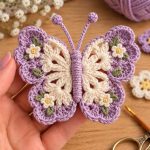
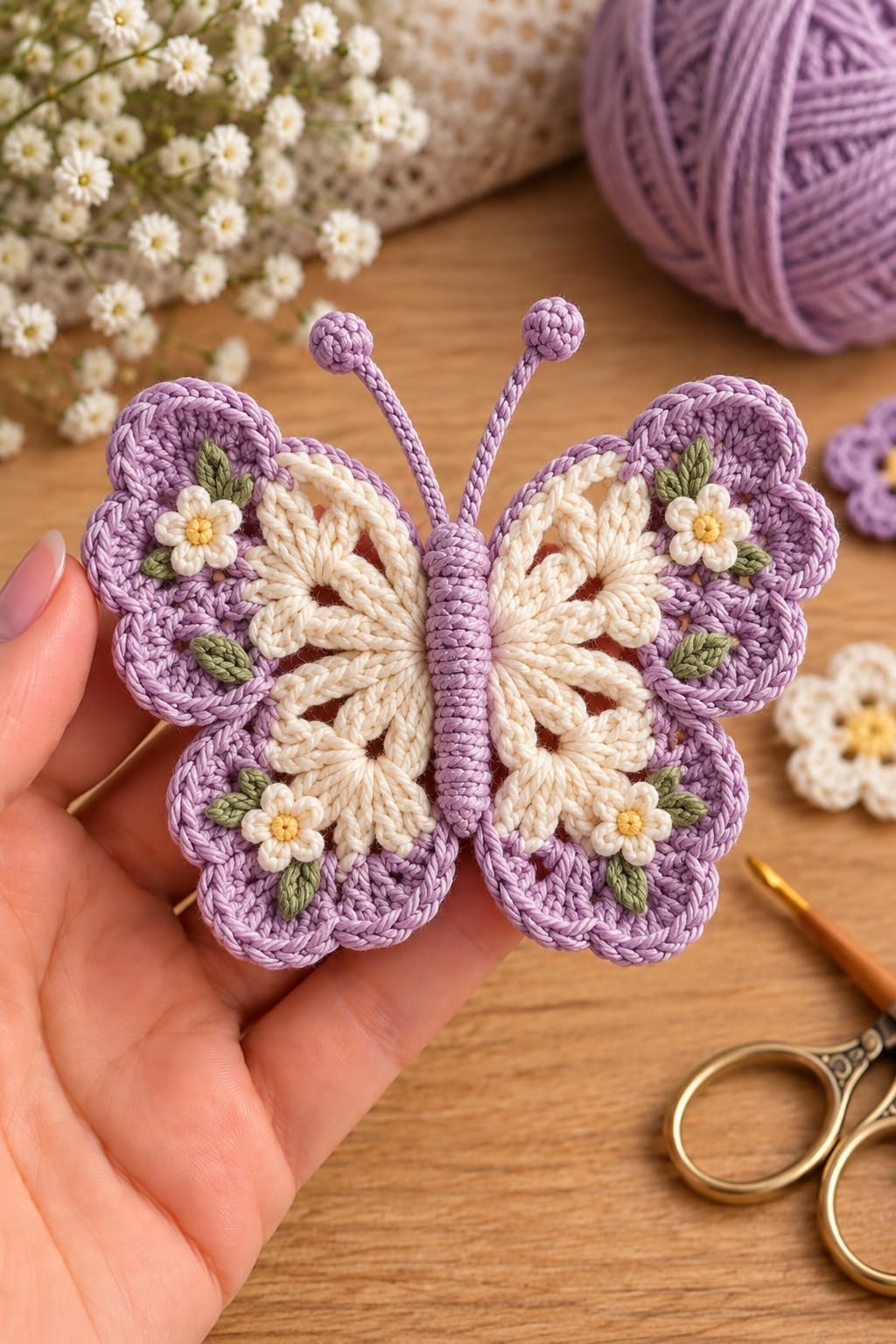
A butterfly this small needs four clearly separated wing lobes or the silhouette quickly turns into a flower. This crochet butterfly pattern uses lavender outer wings, open cream inner wings, a narrow lavender body, floral appliqués, embroidered green leaves and two raised antenna tips. Worked in DK cotton with a 3–3.5 mm hook, the finished butterfly is designed as a decorative appliqué measuring approximately 10–12 cm across.
The Design: What Makes This Crochet Butterfly Different
The upper wings are larger than the lower pair, preserving a recognizable butterfly proportion while leaving enough surface for the miniature flowers. Cream openwork fills the inner wings and contrasts with the denser lavender perimeter. The central body is deliberately narrow so it separates the left and right wings instead of covering their inner edges.
The floral details are applied after the wing structure is complete. Small cream flowers sit mainly on the lavender sections, while olive leaves provide a second level of surface detail. Two chain-based antennae finish with compact crocheted balls.
Butterfly appliqué patterns vary considerably in scale: documented examples range from about 7.5 cm to 17 cm depending on yarn and hook. A DK-weight version around 10–12 cm provides enough room for the layered details used here.
Project Info at a Glance
| Skill Level | Construction | Finished Size | Hook | Best For |
|---|---|---|---|---|
| Intermediate | Flat appliqué with applied details | Approx. 10–12 cm wingspan | 3–3.5 mm | Garlands, bags, blankets, wall décor |
Crochet butterfly appliqués made with DK yarn and a 3–3.5 mm hook commonly fall around the 8–11 cm range, although yarn choice and blocking can change the measurement substantially.
Materials and Tools
Yarn
- Lavender DK cotton yarn — approximately 12–18 g for wings, body and antennae.
- Ivory or cream DK cotton yarn — approximately 5–8 g for inner wing motifs and flowers.
- Olive green fingering or DK yarn — approximately 2–4 g for miniature leaves.
- Golden yellow yarn or embroidery thread — small quantity for flower centers.
Tools
- 3.5 mm crochet hook for the main butterfly
- 2.5–3 mm crochet hook for flowers and leaves
- Yarn needle
- Embroidery needle
- Scissors
- Blocking mat
- Rust-resistant pins
Abbreviations
- MR — magic ring
- ch — chain
- sl st — slip stitch
- sc — single crochet
- hdc — half double crochet
- dc — double crochet
- tr — treble crochet
- inc — increase
- dec — decrease
- st / sts — stitch / stitches
- sp — space
Keep chain spaces relaxed because tight chains pull the open cream wing sections inward during blocking.
Crochet Butterfly Pattern
The butterfly is assembled from four shaped lavender wings, four cream inner motifs, one narrow body and two antennae. Make the left and right pieces as mirror-image pairs.
Upper Lavender Wing — Make 2
Yarn: lavender DK.
Round 1: 6 sc in MR. Join. (6)
Round 2: Inc ×6. Join. (12)
Round 3: Ch 3, 2 dc in same st, 2 dc in each of next 3 sts, 2 tr in each of next 3 sts, 2 dc in each of next 3 sts, 3 dc in final 2 sts. Join.
The different stitch heights begin forming an oval rather than a circle.
Round 4: Ch 1. Sc in first 3 sts, hdc in next 3, 2 dc in each of next 4 sts, hdc in next 4, sc across remaining stitches. Join.
Do not fasten off.
Upper Wing Scallops
Work approximately five prominent scallops around the outside edge.
Scallop: Skip 1 st, work 5 dc in next st, skip 1 st, sl st in next.
Repeat around the broad outer section.
Use smaller 3-dc scallops as the edge approaches the butterfly body.
Fasten off with a 25 cm tail.
Lower Lavender Wing — Make 2
The lower wings should be visibly smaller than the upper pair.
Round 1: 6 sc in MR. Join. (6)
Round 2: Inc ×6. Join. (12)
Round 3: Sc in first 2 sts, hdc in next 2, 2 dc in each of next 4 sts, hdc in next 2, sc in final 2 sts. Join.
Round 4: Work sc around the inner half of the wing. Across the outer half alternate hdc, 2 dc, hdc to broaden the edge.
Lower Wing Scallops
Work four scallops around the outer edge.
Scallop: Skip 1 st, 5 dc in next st, skip 1 st, sl st in next.
Near the body, finish with one smaller 3-dc scallop.
Fasten off with a 25 cm sewing tail.
Cream Upper Inner Wing — Make 2
Yarn: ivory or cream.
The cream sections use open chain spaces rather than solid fabric.
Round 1: 6 sc in MR. Join. (6)
Round 2: *Ch 5, sl st in next st.* Repeat around to create six loops.
Round 3: Sl st into first loop. Work sc, hdc, 3 dc, hdc, sc in the loop. In the next two loops work sc, hdc, 4 dc, hdc, sc. Continue shaping the remaining loops with progressively shorter stitch groups.
Fasten off with a 20 cm tail.
Stretch the motif into a long teardrop during blocking.
Cream Lower Inner Wing — Make 2
Round 1: 6 sc in MR. Join. (6)
Round 2: *Ch 4, sl st in next st.* Repeat around.
Round 3: In each loop work sc, hdc, 2 dc, hdc, sc.
Fasten off.
Pin the piece into a smaller teardrop with its narrow point facing the butterfly body.
Creating the Open Wing Veins
The photographed butterfly has cream structures that resemble branching wing veins rather than solid circular motifs.
After positioning each cream inner wing, add several chain loops between its center and outer edge.
Join cream yarn near the inner edge.
Vein 1: Ch 8–10 and sl st into the cream outer motif.
Vein 2: Join one or two stitches lower, ch 7–9 and sl st into a different point.
Vein 3: Repeat with a shorter chain.
Work two or three connecting slip stitches back along selected chains if a thicker raised vein is required.
Repeat on the opposite wing as a mirror image.
Lavender Butterfly Body
The body is a narrow oval tube worked in continuous rounds.
Round 1: 6 sc in MR. (6)
Round 2: Inc ×6. (12)
Rounds 3–5: Sc around. (12)
Round 6: (2 sc, dec) ×3. (9)
Rounds 7–15: Sc around. (9)
Round 16: (1 sc, dec) ×3. (6)
Rounds 17–20: Sc around. (6)
Fasten off with a 30 cm tail.
For a flatter appliqué, leave the body unstuffed. Insert only a narrow strand of yarn or a very small amount of fiberfill if a more raised center is wanted.
Butterfly Antennae — Make 2
Yarn: lavender.
Foundation: Ch 18.
Starting in second chain from hook, sl st in each chain back toward the beginning. (17 sl sts)
Fasten off with a long tail.
The finished antenna should remain thin enough to curve without folding.
Round Antenna Tip — Make 2
Round 1: 6 sc in MR. (6)
Round 2: Inc ×6. (12)
Round 3: Sc around. (12)
Round 4: Dec ×6. (6)
Fasten off.
No stuffing is required at this scale. Insert the end of one antenna into the opening and sew securely.
Miniature Cream Flower — Make 4
The reference butterfly places one small flower near the outer portion of each wing.
Round 1: 5 sc in MR. Join. (5)
Petals: In each stitch work sl st, ch 2, 2 hdc, ch 2, sl st.
Repeat in all five stitches.
Fasten off with a 15 cm sewing tail.
Yellow Flower Center
Using yellow embroidery thread, make several compact French knots or short surface stitches in the flower center.
Keep the yellow area small so the five cream petals remain distinct.
Miniature Green Leaf — Make 8–12
Yarn: olive green.
Foundation: Ch 6.
Starting in second ch work:
Sl st, sc, hdc, sc, sl st.
Ch 2 and sl st in second ch from hook to form the tip.
Rotate the work.
Along the opposite side of the foundation chain work:
Sl st, sc, hdc, sc, sl st.
Fasten off with a 12 cm tail.
Pinch the base slightly when sewing so the leaf forms a narrow pointed shape.
Optional Embroidered Leaf Veins
The small green leaves can be given additional definition with one central stitch.
Thread a darker olive strand onto an embroidery needle.
Bring the needle up at the leaf base.
Insert it near the tip.
Do not pull tightly enough to curl the leaf.
Secure the yarn on the back.
Blocking the Four Wings
Block the wings before assembly because the scalloped outlines need to remain symmetrical.
Place the two upper wings side by side.
Measure from the inner attachment edge to the outermost scallop.
The difference between the pair should be less than approximately 3 mm.
Repeat with the lower wings.
Pin each scallop separately and allow the pieces to dry completely.
Attaching the Cream Wing Sections
Place one cream motif over each lavender wing.
Leave approximately 5–8 mm of lavender visible around the outside.
Sew the cream pieces at their inner edge and at several points around their perimeter.
Do not stitch every loop flat.
A few free chain sections create the raised openwork appearance visible in the reference butterfly.
Repeat for all four wings.
Adding the Wing Flowers
Position one cream flower on each lavender wing.
The flowers should sit near the outside half of the wings rather than against the central body.
Sew through each flower center several times.
Leave the petal edges free.
Add two or three green leaves around each flower.
Angle the leaves toward the nearest wing edge.
Optional Additional Leaf Details
Small isolated leaves can fill empty lavender areas without adding another flower.
Place one miniature leaf approximately midway along the outer edge of each lower wing.
Add another near the top of each upper wing if space permits.
Avoid covering the cream openwork because the contrast between the lavender perimeter and ivory center is the primary feature of the wing design.
Assembly
- Block the two upper and two lower lavender wings so each mirrored pair matches in height and width.
- Sew the cream openwork motifs onto the lavender wings, keeping approximately 5–8 mm of lavender visible around the outer perimeter.
- Add the cream chain veins and check that the left and right wing patterns mirror one another.
- Arrange the upper wings behind the body with their widest sections angled slightly upward.
- Position the smaller lower wings beneath them and sew all four wings securely to the center body.
- Attach one miniature cream flower to each wing and sew two or three olive leaves around every flower.
- Add isolated green leaves to empty lavender areas without covering the cream wing structure.
- Sew both antennae to the top of the body and angle them outward approximately 25–35 degrees.
- Attach one round lavender tip to each antenna and curve the antennae gently into matching arcs.
- Weave all tails into the back, reshape the scallops and lightly block the completed butterfly without flattening the flowers.
The finished motif should remain substantially flat except for the narrow body, miniature flowers and rounded antenna tips.
Keeping the Butterfly Symmetrical
Symmetry is more important in a butterfly motif than in many floral appliqués because the central body creates an obvious visual dividing line.
Make both upper wings before beginning the lower pair.
After each round, place the corresponding wings together and compare their dimensions.
Count the scallops rather than judging their placement only by eye.
During assembly, mark the horizontal midpoint of the body. Attach corresponding left and right wings at the same body rounds.
Check the butterfly from directly above before securing the final stitches.
Changing the Butterfly Size
Yarn and hook changes provide the simplest method of resizing the motif.
Published butterfly appliqué patterns demonstrate substantial variation: one cotton design measures about 7.5 cm with a 2.75 mm hook, while another reaches approximately 10 cm when worked with a 3.5 mm hook. Larger versions can exceed 15 cm with heavier yarn.
For a smaller butterfly, use fingering cotton and a 2–2.5 mm hook.
For a larger appliqué, use worsted cotton with a 4–4.5 mm hook.
Scale the miniature flowers with the wings so they do not cover the lavender scallops.
Using the Butterfly as an Appliqué
When sewing the butterfly onto a blanket, bag or cushion, attach it through the body and inner portions of the wings.
Leave the outer scallops free if a raised effect is wanted.
For clothing or children’s accessories, attach the outer wings as well because projecting pieces can catch during wear.
Secure the antennae along their lower sections when the finished project will be washed frequently.
The motif can also be mounted onto felt before being converted into a brooch or decorative hanging piece.
7 Technical Tips for a Floral Crochet Butterfly
- Measure mirrored wings before assembly. Keep the corresponding upper wings within approximately 3 mm of each other or the difference becomes obvious beside the straight center body.
- Keep the upper wings larger. Making all four lobes identical creates a four-petal silhouette rather than the butterfly proportions shown in the reference image.
- Leave 5–8 mm of lavender exposed. A cream insert positioned too close to the outer edge hides the scalloped lavender frame.
- Do not pull the cream chain veins tightly. Excess tension cups the wings and prevents the finished appliqué from lying flat.
- Sew flowers through their centers only. Stitching every petal to the wing removes the raised floral texture.
- Attach antennae at matching angles. Position the two stems approximately 25–35 degrees apart before securing their bases.
- Block the wings before adding flowers. Trying to pin a completed butterfly flat can crush the miniature petals and distort the rounded antenna tips.
Color Variations
Lavender, ivory and olive reproduce the photographed palette, but the structure works with other three-color combinations.
Use dusty pink outer wings with cream centers and sage leaves for a softer floral version. Pale blue and ivory can create a cooler palette, while burgundy wings with blush inner sections produce stronger contrast.
For the clearest wing structure, keep the outer and inner colors visibly different.
The flower color can match the inner wings, as shown here, while the leaf color should remain darker enough to stay visible against both surrounding shades.
Care and Finishing
Weave every tail through several dense stitches on the back of the butterfly.
Trim only after checking that the appliqué retains its shape when gently flexed.
For cotton yarn, light wet blocking can sharpen the scalloped wing edges. Pin each major curve separately rather than stretching the entire wing from one point.
If the butterfly is attached to another crocheted item, follow the washing requirements of the least washable fiber used in either piece.
Reshape the antennae and flowers while damp and allow the project to dry flat.
Conclusion
Build the four-wing structure before adding the floral surface details. Match the upper wings carefully, keep the lower pair smaller, and leave a consistent lavender margin around each cream insert. Attach the narrow body only after the wing pairs have been blocked, then add the flowers, olive leaves and chain-based antennae. The result is a dimensional motif that can remain freestanding or be sewn onto a larger crochet project. Save this crochet butterfly pattern to Pinterest and share the finished version on Instagram with #LavenderFloralButterfly. Would you keep the four flowers ivory or make their petals match the lavender wings?