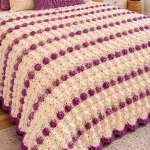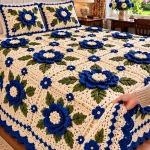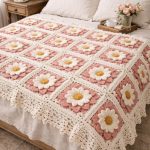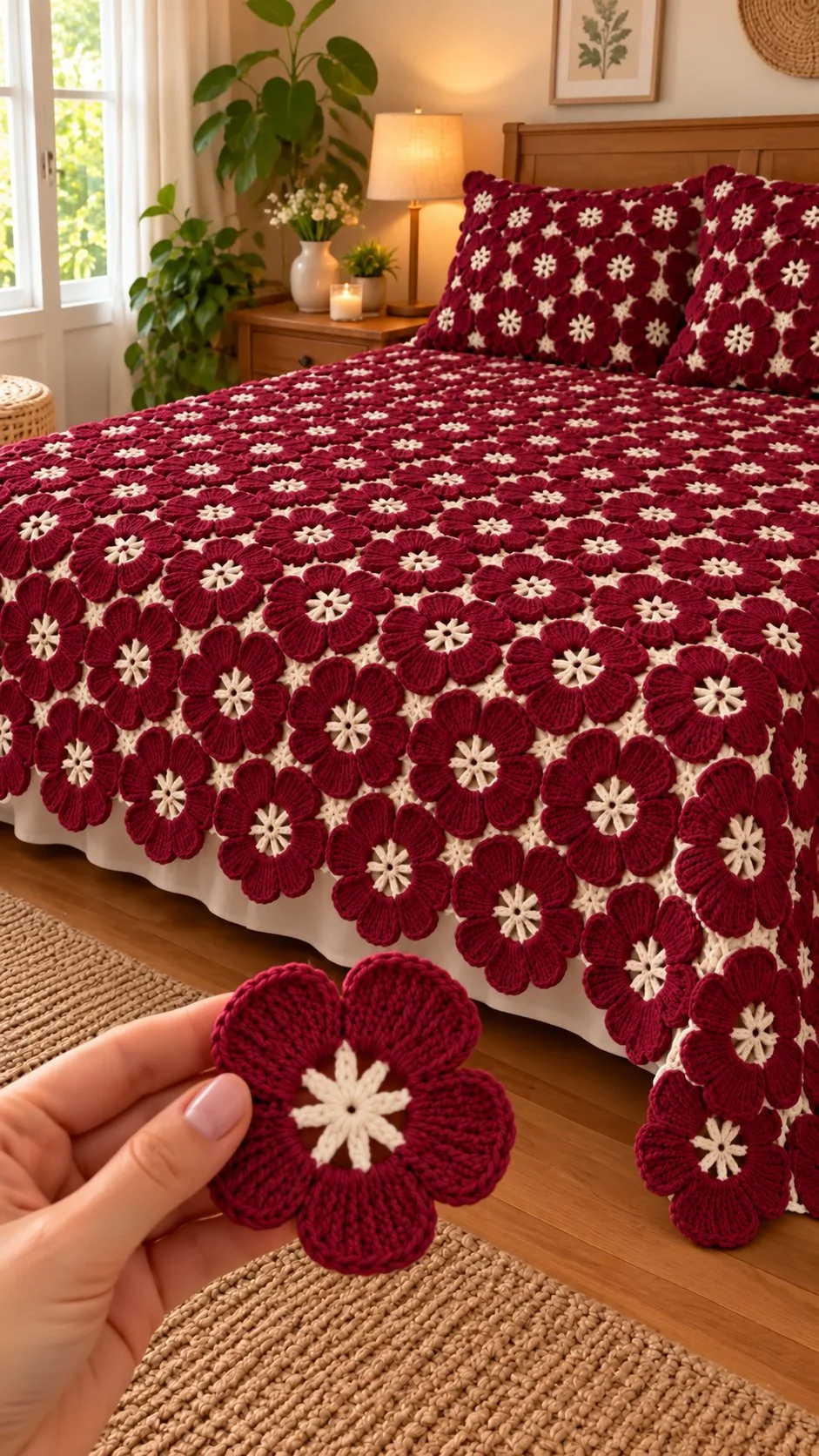
This project creates a coordinated bedspread and two cushion covers from burgundy five-petal flowers with open ivory centers and ivory joins. The floral motifs give the fabric a decorative, dimensional look, while the contrasting join lines define the arrangement. The bedspread is built from individual motifs rather than worked as one large panel, so you can plan its size and layout around your bed.
This is a photo-inspired project guide, not a tested stitch-by-stitch pattern. The reference does not establish exact stitch counts, motif dimensions, yarn amounts, or a particular joining stitch. To make the set, select a tested five-petal flower motif pattern that matches the intended look, then use a finished, blocked sample to plan the layout and estimate materials. The same sample-first approach helps the two cushion panels coordinate with the bedspread.
Pattern at a Glance
- Skill level: Best suited to crocheters comfortable following a separate flower-motif pattern, making consistent motifs, and joining pieces. The exact difficulty depends on the chosen motif and joining method.
- Terminology: US crochet terminology is recommended when selecting the motif and joining instructions.
- Construction: Individual flowers are made first, joined in ivory into a bedspread, and arranged into two matching cushion panels.
- Finished size: Determined by the bed measurements, desired side drop, cushion inserts, motif size, and joining layout.
- Yarn: Smooth cotton or cotton-blend yarn, with one consistent weight throughout.
- Colors: Burgundy for petals; ivory for flower centers and joins.
- Hook: Choose a hook matched to the yarn label, then adjust as needed for the desired drape.
- Motif: A five-petal flower with an open ivory center and rounded colored petals. Exact stitch counts are not specified.
- Gauge: No gauge is supplied. Use a blocked sample motif to plan the layout.
- Joining: Use a tested ivory joining method. Make a small joining sample first and check that the fabric lies flat.
- Border: No separate border is specified. Preserve the flower-shaped outer edge.
Materials
Gather the following supplies:
- Burgundy yarn for the flower petals
- Ivory yarn for the centers and joins
- Smooth cotton or cotton-blend yarn of one consistent weight
- Crochet hook matched to the yarn label and the fabric drape you want
- Yarn needle for weaving in ends
- Scissors
- Stitch markers for tracking planned layout points or marking motif positions
- Measuring tape
- Blocking mat and pins
- Two cushion inserts
- Optional fabric backing for the cushion covers
Yarn quantity cannot be specified from the available pattern information. Estimate it after completing a motif sample and deciding on the bed and cushion dimensions. Weigh the sample by color, then use those figures to estimate the burgundy and ivory needed for the planned pieces. Allow extra for joins, weaving in ends, and other finishing.
Yarn and Color Notes
A smooth yarn makes the flower shape and the join easier to see, and it is less likely to catch while motifs are being connected. Cotton and cotton-blend yarns are suitable options for a household bedspread and cushion set. Choose one yarn weight for both colors; changing yarn weight between burgundy and ivory can make petals, centers, and joins sit at different heights.
The hook should suit the yarn label as a starting point, but the sample is the practical test. If the flower feels stiff or the joins pull the fabric inward, try a larger hook. If the fabric looks loose or the motifs lose their shape, try a smaller hook. Keep the same hook and tension for the remaining motifs once the sample gives a satisfactory result.
Burgundy petals against ivory centers create a strong contrast. If you prefer a softer look, you can choose a different two-color palette while keeping the same color roles: one shade for petals and another for centers and joins. A busy variegated yarn may obscure the flower shape, so a solid or gently shaded yarn is often easier to assess in the sample.
Finished Measurements and Sizing
There are no fixed finished dimensions for this project. Measure the bed top and decide how far you want the spread to drop over the sides. Measure the cushion inserts as well, allowing for the way you want the finished covers to fit.
For the bedspread, make a blocked sample motif before calculating the layout. Its finished width—not its unblocked width—is the useful measurement for planning. Arrange sample motifs on a flat surface to test how their edges meet and how much the ivory joins add to the overall dimensions. The final size depends on motif size, spacing, joining, and the placement of the flower-shaped outer edge.
For each cushion, plan a flower panel that fits the insert without stretching the motifs out of shape. Since the pattern does not specify a cushion closure or backing construction, choose a suitable removable opening and backing arrangement for your inserts.
Gauge
No stitch gauge or motif gauge is provided. Instead, establish a project-specific measurement from a finished and blocked sample flower.
Measure the motif consistently across its widest points. If its outline is irregular, record both the widest horizontal and vertical measurements. Also weigh the burgundy and ivory yarn used. These measurements and weights become your planning reference for the larger pieces.
For a bedspread, exact stitch gauge is less important than consistent motif size and a flat join. If your flowers are larger than the sample, the same layout will produce a larger spread and use more yarn. Smaller flowers will require more motifs to cover the same area. If you change hook size or yarn, make and block a new sample before estimating the layout or yardage.
Abbreviations
The project guide does not specify stitches or provide a stitch-by-stitch motif pattern, so no stitch abbreviations can be listed reliably here. Use the abbreviations and terminology supplied with the tested five-petal flower pattern you select, and make sure that pattern uses US or UK terminology as intended.
Important Pattern Notes
- This is a photo-inspired project guide, not a complete stitch-by-stitch pattern.
- Exact stitch counts for the flower cannot be confirmed. Select a tested five-petal flower motif pattern with an open ivory center and rounded colored petals.
- Treat the motif pattern and the bedspread layout as separate decisions: the motif pattern defines how to crochet each flower; your measurements and sample define how many flowers to make and how to arrange them.
- Make and block one complete sample before producing the full set.
- Keep yarn weight, hook choice, and tension consistent so the flowers are similar in size.
- Use an ivory joining method that has been tested with the chosen motif. A joining sample should lie flat without drawing the petals together or leaving the fabric wavy.
- The finished bedspread should retain a flower-shaped outer edge. Do not add a straight border unless you choose to adapt the design.
- Follow the selected motif pattern for its specific color changes and stitch instructions. Those details are not determined by this guide.
Special Techniques and Skills
The main project skills are making consistent motifs, planning a layout, joining crocheted pieces, and blocking a larger fabric. Because the source does not identify a specific stitch pattern or join, use the instructions from your chosen tested motif and joining method rather than substituting guessed stitch counts.
Before committing to a joining method, make a small sample with two or more motifs. Check that the connection is secure and that the flower outlines remain recognizable. If the join causes the pieces to buckle, adjust tension or try a different tested joining method; do not proceed to the full bedspread until the sample lies flat.
Understanding the Construction
Each flower is crocheted separately. After the sample is blocked and measured, the motifs are arranged to establish the bedspread layout. Matching flowers are then made, their ends woven in, and the pieces connected with ivory yarn. The outer edge remains shaped by the flower outlines rather than being squared off with a specified border.
The cushion covers use the same floral idea on a smaller scale. Make two matching flower panels sized for the inserts, then attach them to suitable backings with removable openings. The bedspread and cushions are therefore coordinated through repeated motifs and colors, but their final dimensions are planned separately.
Full Project Instructions
1. Measure the Bed and Cushion Inserts
Measure the bed top and decide how far the bedspread should extend down the sides. Record the dimensions you want the finished bedspread to cover. Measure both cushion inserts so you can plan panels that fit them.
Keep these measurements together with your notes on the motif size and layout. The project has no preset finished dimensions, so your measurements guide the number and arrangement of motifs.
Checkpoint: You should have a target bedspread area and the dimensions of both cushion inserts before committing to a motif quantity.
2. Choose a Tested Flower Motif
Select a tested five-petal flower pattern with an open ivory center and rounded colored petals resembling the intended design. The available photo-inspired information does not confirm the exact stitch counts or the precise construction of the flower, so follow the stitch instructions included with the tested motif you choose.
Use burgundy for the petals and ivory for the center, unless you are deliberately choosing another palette. Check that the motif pattern is appropriate for your yarn weight and that it can be joined in a way that produces a flat fabric.
Checkpoint: Before making a full set, confirm that your selected flower has five petals and the open-center, rounded-petal appearance you want.
3. Crochet, Finish, and Measure a Sample
Make one flower using your selected motif pattern and the project colors. Finish it as you intend to finish the full set, including weaving in the ends. Block the sample and allow it to dry or settle fully before measuring.
Record:
- The blocked motif’s width and height
- The yarn weight used
- The hook used
- The amount of burgundy yarn used
- The amount of ivory yarn used
Weighing the yarn before and after the sample is made is one way to estimate how much each color it uses. Use the same approach for the other yarn color, taking care to account for any yarn used in the center.
Checkpoint: The sample should be fully finished and blocked. Use its final measurements—not its working measurements—to plan the layout.
4. Plan the Bedspread Layout and Yarn Estimate
Arrange sample motifs on a flat surface to determine their spacing and the shape of the planned bedspread. Include the effect of the chosen ivory join: the joined fabric may cover a different area than the motifs placed edge to edge.
Compare the layout with the bed measurements and desired side drop. Adjust the arrangement until it provides the coverage you want while retaining a flower-shaped outer edge. Count the motifs in the planned layout.
Estimate yarn by applying the sample’s per-color use to the number of planned motifs. Include additional yarn for joining and finishing, especially for ivory, which is used for both centers and joins. This is an estimate, not a guaranteed yardage figure: the joining method, motif size, and tension can all affect the final amount.
Checkpoint: Before making all the flowers, you should have a workable motif count, a layout plan, and separate burgundy and ivory yarn estimates with extra allowed for joins and finishing.
5. Make the Remaining Flowers
Crochet matching flowers using the same yarn weight, hook choice, motif pattern, color placement, and tension as the sample. Work carefully to keep the motifs similar in size. Weave in ends as you go or after completing each flower, using the same finishing approach throughout.
If a new flower seems noticeably larger or smaller than the blocked sample, pause and compare your tension and finished measurements. It is easier to correct a few motifs than to discover a size difference after the layout is joined.
Checkpoint: Lay the flowers beside one another periodically. Their petals and overall dimensions should be consistent enough to join without stretching or gathering.
6. Lay Out and Join the Flowers
Arrange the motifs according to your plan, checking the color distribution and the intended outline. Connect them using a tested ivory joining method. Make a joining sample first if you have not already confirmed that the method works with your flower.
Follow the chosen joining method for its exact placement and handling. Keep the tension even: pulling joins too tightly can draw the motifs inward, while very loose joins may leave gaps or a floppy fabric. Check the work as you proceed and flatten it on a surface to see whether it lies smoothly.
Checkpoint: The joined fabric should lie flat, with the motifs aligned as planned and no obvious puckering or stretching around the connections.
7. Preserve the Flower-Shaped Outer Edge
Keep the outer edge shaped by the flower outlines. Secure all joins and check the perimeter for loose yarn or unsecured connections. The project guide does not specify a separate border, so do not assume that a straight edging is required.
Handle the edge gently while moving the bedspread. If you decide to add an edging as a personal adaptation, test it on a small section first to ensure it does not distort the flower-shaped outline.
8. Make the Two Cushion Panels
Use the same flower motif and color arrangement to make two matching panels sized for the cushion inserts. Plan each panel around the actual insert measurements rather than relying on an unspecified standard cushion size.
Join the flowers with the same ivory method used for the bedspread if it produces a suitable fabric. Match the two panels in overall size and motif arrangement so the finished covers look coordinated. Attach the panels to suitable backings with removable openings, leaving the opening positioned so the insert can be removed without damaging the crochet.
The backing and closure construction is not specified. Choose materials and an opening arrangement suited to your inserts, and check that the cover can be removed for cleaning or care.
Checkpoint: Before attaching each backing, compare the two crochet panels and test the fit around the relevant insert. Both should be similar in size and should not need to be stretched forcefully to fit.
9. Block and Care for the Set
Block the bedspread and cushion panels to their planned dimensions, using a method suitable for the yarn. Shape the motifs and outer edge gently; do not stretch the joins or petals beyond their intended form. Pinning can help hold the planned outline while the pieces dry.
Follow the yarn label for washing and care. Since the set combines crochet with cushion backings, make sure the care instructions for the backing and closure are compatible with those for the yarn. If the materials require different care, use the gentler method that is safe for the complete item.
Joining and Assembly Checks
Before completing the whole bedspread, review these points:
- Motif orientation: Confirm that petals face the intended way and that the color arrangement is consistent.
- Join tension: The ivory joins should connect securely without pulling the motifs inward.
- Flatness: Lay the joined area on a flat surface. Correct waviness or puckering before continuing.
- Edge shape: Keep the flower-shaped outer perimeter visible and intentional.
- Cushion panels: Make two panels that match in dimensions and layout.
- Openings: Ensure the removable cushion openings are usable before closing or finishing the backing.
How to Resize the Project
Resize by changing the layout, not by altering an unspecified stitch repeat. First make a blocked motif sample, then arrange it to cover the bed area and desired side drop. Adding motifs changes the overall coverage; removing motifs reduces it. The exact change in dimensions depends on motif width, motif shape, and the joining method, so test the layout before calculating a final quantity.
For a larger or smaller cushion, use the insert measurements to plan the flower panel. A panel made from more motifs will cover a larger area, while fewer motifs will cover less, but the join and motif outlines affect the finished fit. Use the sample and a test layout rather than guessing an exact motif count from the insert size alone.
If you change the yarn weight or hook, make and block another sample before resizing. A change in motif size affects both the number of flowers needed and the total yarn estimate.
Useful Variations
- Change the palette: Keep the burgundy-and-ivory color roles or substitute another petal and center combination while retaining the five-petal motif construction.
- Use one color: A single shade can create a subtler surface, though the flower centers and petals will be less distinct.
- Make a smaller coordinated project: Use the same flowers and ivory joins for a cushion panel or a smaller covering. Plan dimensions from the blocked motif sample.
- Vary the motif arrangement: Reposition flowers to change the bedspread outline, while keeping the edge shaped by the outer petals and checking the new layout against the bed measurements.
Troubleshooting
Why Are My Motifs Different Sizes?
Changes in tension, hook choice, yarn, or blocking can alter the finished dimensions. Compare each flower with the blocked sample rather than comparing it while still on the hook. Keep the same yarn weight, hook, and motif instructions, and avoid changing tension from one flower to the next.
If you have already made several noticeably different motifs, sort them by size and decide whether they can be arranged without forcing them into alignment. Do not stretch smaller flowers or gather larger ones to make them match; that can distort the petals and fabric.
Why Does the Joined Fabric Pucker?
A join that is too tight can pull neighboring motifs toward one another. The motif itself may also be changing size, making the pieces difficult to align. Test the join on sample flowers and check the joined area flat before making more connections. Use the selected tested joining method consistently and maintain an even, relaxed tension.
Why Is the Joined Fabric Wavy?
Waviness can come from loose joining tension, inconsistent motif sizes, or a layout that places the flowers unevenly. Compare the joined section with the unjoined motifs and check that the connections are distributed consistently. Confirm the sample join lies flat before continuing with the full piece.
Why Is the Bedspread Not the Size I Planned?
The layout may have been estimated from unblocked motifs, or the joins may add more or less space than expected. Measure the fully blocked sample and make a trial arrangement with the intended joining method. Compare that layout with the bed and desired side drop before crocheting the full quantity.
If the spread is already underway, reassess the remaining layout using the measured dimensions of the joined portion. Do not rely on a motif count alone: the final size depends on both the flowers and their connections.
Why Does the Outer Edge Look Uneven?
Individual flower petals naturally create an irregular outline. The edge may look inconsistent if motifs differ in size, are oriented differently, or have been joined under uneven tension. Lay the edge flat and check the placement and alignment of the flowers. Preserve the flower-shaped outline rather than forcing it into a straight line.
Why Is My Yarn Estimate Too Low?
The initial estimate may not have included enough ivory for both centers and joins, or the sample may not represent the tension used for the full set. Weigh the sample by color and recalculate using the actual motif count and joining plan. Include extra yarn for joins and finishing, as required by the project instructions.
Why Do the Cushion Covers Fit Differently?
The two panels may differ in motif size, layout, or joining tension. Measure both finished panels and compare them with the inserts before attaching the backings. Check that the removable openings are positioned and sized so the inserts can be removed without stretching the crochet.
Why Are the Flowers Losing Their Shape After Blocking?
Blocking should shape the fabric to the planned dimensions, not force it into a shape it cannot hold. Use a method appropriate for the yarn, handle the petals gently, and avoid stretching the joins. Follow the yarn label’s care guidance, and test your blocking method on the sample before using it on the full set.
Frequently Asked Questions
Is this a complete stitch-by-stitch pattern?
No. This is a photo-inspired project guide, not a tested stitch-by-stitch pattern. It does not provide exact flower stitch counts, a specific joining stitch, or fixed dimensions. Choose a tested five-petal flower motif pattern that matches the described appearance, then use a blocked sample to plan the layout.
How much yarn will I need?
The quantity depends on your bed measurements, desired side drop, cushion sizes, motif size, and joining method. Crochet and block one sample, weigh the yarn used in each color, and estimate the total from your planned motif count. Allow extra for joins and finishing.
Can I use a different yarn weight?
You can, but the motif dimensions and yarn requirements will change. Use one consistent weight for both colors, make a new sample with the matching hook, and re-plan the layout from the blocked measurements.
Is cotton suitable?
Yes. Smooth cotton or cotton-blend yarn is recommended in the materials guidance. Follow the yarn label for hook, washing, and care instructions, and test the sample before committing to the full project.
Can I use a different hook?
Choose a hook matched to the yarn label and desired drape. If the sample is too firm, too loose, or does not lie flat after joining, test another hook size and remeasure the finished sample. Keep your final hook choice consistent throughout the set.
Can I make the bedspread larger or smaller?
Yes. Adjust the number and arrangement of motifs to suit the measured bed area and desired side drop. Since motif dimensions and join width are not specified, use a blocked sample and a trial layout to determine the needed quantity.
Do the cushion covers need fabric backing?
The project calls for suitable backings with removable openings; fabric backing is optional. If you use backing, choose a construction that allows the inserts to be removed and that can be cared for appropriately with the crochet panels.
Does the bedspread have a border?
No separate border is specified. Retain the flower-shaped outer edge and secure all joins. Any additional edging would be an adaptation, so test it before applying it to the whole perimeter.
How should I care for the finished set?
Follow the yarn label and consider the care needs of the cushion backing as well. Test the washing and blocking approach on the sample first. Use a method safe for the complete item, especially where crochet, backing, and closures are joined.
Final Thoughts
Plan this set in stages: measure the bed and inserts, make and block one flower, then use the sample to establish motif size, yarn use, and layout. Make matching flowers, connect them with a tested ivory join, preserve the floral outer edge, and finish with two coordinating cushion panels. Consistent motifs and a flat joining sample are the most useful checks for a polished result.