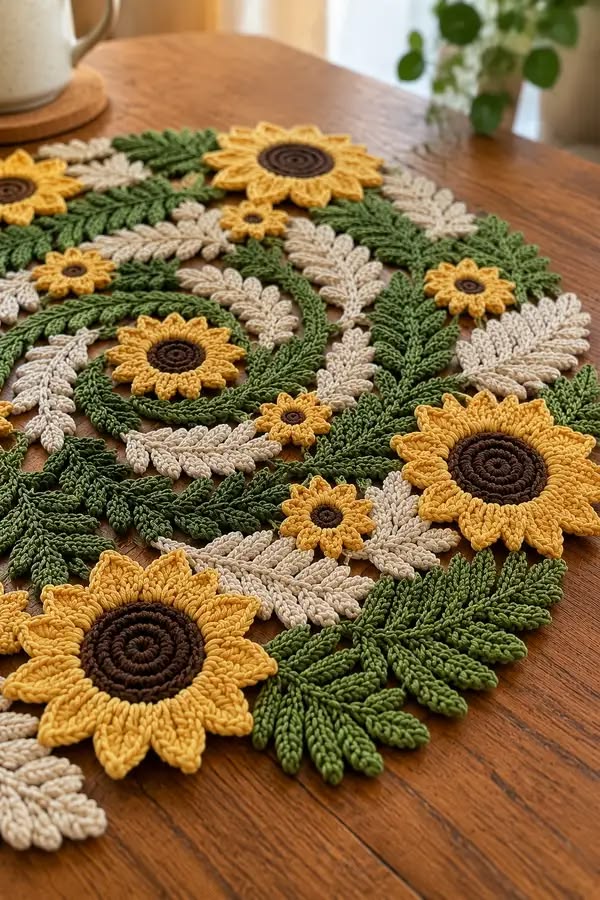
A sunflower needs a dark seed disc surrounded by a clear ring of pointed petals; here that geometry becomes the anchor for an entire botanical runner. This crochet sunflower table runner pattern combines large and small golden flowers, green fern-style foliage, cream leaves, and curling stems. Worked as separate motifs and assembled afterward, the design is best suited to intermediate crochet skills.
The Design: What Makes This Sunflower Runner Different
The photographed runner is not constructed as one rectangular crochet panel. Instead, individual botanical motifs overlap and connect across an open background, allowing the wooden table to remain visible between leaves and flowers.
Three structural decisions define the design. Large sunflowers create focal points, smaller flowers fill gaps, and elongated foliage establishes the direction of the runner. Curved green stems connect otherwise separate motifs and prevent the composition from looking like disconnected appliqués.
The cream foliage is equally important. Without it, the yellow flowers and dark green leaves have insufficient visual separation. A common mistake with a crochet sunflower runner is attaching every motif before testing the complete layout. Pinning the components first makes it possible to correct gaps, crowded sections, and uneven outer edges.
Project Info at a Glance
| Skill Level | Construction | Hook | Yarn | Best For |
|---|---|---|---|---|
| Intermediate | Joined appliqué motifs | 3.5–4.5 mm | DK or worsted cotton | Dining tables, sideboards, seasonal displays |
The photographed piece does not provide a scale, so an exact finished measurement cannot be verified from the image alone. Published sunflower appliqués range from approximately 5.5 cm with DK yarn to roughly 10–14 cm with heavier yarn and larger hooks. Build the runner to the dimensions of your table rather than relying on the photograph for scale.
Materials and Tools
Yarn
- Golden yellow — DK or worsted cotton — approximately 80–120 g for sunflower petals.
- Dark brown — DK or worsted cotton — approximately 30–50 g for sunflower centers.
- Dark olive green — DK or worsted cotton — approximately 120–180 g for fern leaves, stems, and connecting foliage.
- Cream — DK or worsted cotton — approximately 80–120 g for contrasting leaves.
These quantities are project allowances rather than exact consumption figures because the finished runner dimensions are adjustable. Cotton is particularly practical for table décor because it produces defined stitches and responds well to blocking.
Tools
- 3.5–4.5 mm crochet hook
- Tapestry needle
- Scissors
- Stitch markers
- Blocking mat
- Blocking pins
- Measuring tape
- Optional washable fabric stiffener
Abbreviations
- MR — magic ring
- ch — chain
- sl st — slip stitch
- sc — single crochet
- hdc — half double crochet
- dc — double crochet
- tr — treble crochet
- st/sts — stitch/stitches
- sp — space
- inc — increase
- FO — fasten off
Invisible decreases are unnecessary because the flowers, leaves, and stems are worked as flat or lightly dimensional botanical motifs rather than stuffed pieces.
Crochet Sunflower Table Runner Pattern — Step by Step
Make all flowers and foliage separately before assembling the runner. The exact number of motifs depends on the required table length, but the reference uses a mixture of large sunflowers, smaller filler flowers, dark-green foliage, cream foliage, and curved connecting stems.
Large Sunflower — Make 3 to 5
Yarn: dark brown and golden yellow.
Round 1: With brown, make an MR. Work 10 sc into MR. Join with sl st. (10)
Round 2: Ch 1, 2 sc in each st around. Join. (20)
Round 3: Ch 1, (sc in next st, 2 sc in next st) ×10. Join. (30)
Round 4: Ch 1, (sc in next 2 sts, 2 sc in next st) ×10. Join. (40)
The four brown rounds produce the broad seed disc visible on the largest flowers.
For a raised spiral effect, work a line of surface slip stitches from the center outward. Keep the surface stitches relaxed so the disc remains flat.
Change to golden yellow.
Large Sunflower Petals
Work each petal across approximately two stitches of the brown center.
Petal: Sl st in next st, ch 7. Starting in second ch from hook work sc, hdc, dc, tr, dc, hdc. Sl st into the next available center stitch.
Repeat around the flower.
Depending on the exact placement, aim for approximately 16–20 petals around the large disc.
Each petal should point outward rather than overlap heavily with its neighbors. If the petals become crowded, use an occasional extra center stitch between attachment points.
Fasten off. Weave the yellow tail into the back of the flower.
Optional Second Petal Layer
The largest flowers in the reference have substantial depth around the brown center. A second staggered layer creates a similar effect.
Attach yellow yarn behind the first petal round.
Work each new petal between two existing petals.
Use the same sequence:
Ch 7, sc, hdc, dc, tr, dc, hdc.
Anchor the petal behind the first layer with a sl st.
Continue around, keeping the second layer slightly behind the first.
Fasten off.
Small Sunflower — Make 5 to 8
Yarn: dark brown and golden yellow.
Round 1: With brown, make an MR. Work 8 sc into MR. Join. (8)
Round 2: Work 2 sc in each st around. Join. (16)
Change to yellow.
Petal Round: *Sl st in next st, ch 5, starting in second ch from hook work sc, hdc, dc, hdc; sl st into next center st.* Repeat around.
Fasten off.
The smaller flowers should remain visibly different in scale from the primary sunflowers. They function as fillers between larger foliage groups.
Long Green Fern Leaf — Make 8 to 12
Yarn: dark olive green.
Ch 28.
Starting in the second chain from the hook, sl st in the first 4 chains. This forms the narrow tip.
Continue down the foundation chain while forming paired leaflets.
Leaflet 1: Ch 5. Starting in second ch from hook work sl st, sc, hdc, dc. Sl st into the central stem.
Move to the next stem stitch.
Leaflet 2: Ch 6. Starting in second ch from hook work sl st, sc, hdc, dc, dc. Sl st into the stem.
Continue making leaflets, gradually increasing their length toward the middle of the frond.
For the widest middle leaflets:
Ch 8, then work sl st, sc, hdc, dc, tr, dc, hdc back toward the stem.
After the midpoint, gradually shorten the leaflets again.
Work toward the base until approximately 2–3 cm of bare stem remains.
Fasten off with a 20 cm sewing tail.
Full Green Botanical Leaf — Make 6 to 10
Yarn: dark olive green.
Ch 18.
Starting in the second chain from the hook:
Sl st in next st, sc in next st, hdc in next 2 sts, dc in next 7 sts, hdc in next 3 sts, sc in next 2 sts.
Work 3 sc into the final chain to turn.
Continue along the unused side of the foundation chain:
Sc in next 2 sts, hdc in next 3 sts, dc in next 7 sts, hdc in next 2 sts, sc, sl st.
Do not fasten off.
Leaf Serrations
Work around the leaf edge to create the segmented foliage seen in the photograph.
*Sl st in next edge stitch, ch 4, starting in second ch from hook work sc, hdc, sc, then sl st into the next edge stitch.*
Repeat along the outer edge.
Make the center side projections slightly longer by using ch 5 or ch 6 instead of ch 4.
Repeat symmetrically down the second side.
Fasten off with a long sewing tail.
Cream Fern Leaf — Make 8 to 12
Yarn: cream.
Ch 24.
Starting near the tip, work short paired leaflets along the central chain.
Upper leaflets: Ch 4, sc in second ch, hdc in next ch, sc in final ch. Sl st to central stem.
Middle leaflets: Ch 6, sc in second ch, hdc in next ch, dc in next 2 ch, hdc in final ch. Sl st to stem.
Lower leaflets: Ch 5, sc, hdc, dc, hdc back toward the stem.
Alternate the leaflets from one side of the central stem to the other.
Shorten the final leaflets near the base.
Fasten off with a 20 cm tail.
Small Cream Leaf Spray — Make 4 to 8
Yarn: cream.
Ch 16 for the central stem.
Work sl sts along the chain while adding short branches at regular intervals.
For each branch, ch 4–6 and work back toward the stem using sc and hdc.
Alternate branches between the left and right sides.
Keep the tip narrow and allow the central branches to become progressively wider.
Fasten off.
Curved Green Vine — Make 3 to 5
Yarn: dark olive green.
Ch 45–70 depending on the required curve.
Starting in the second chain from the hook, work one sl st in each chain.
Turn.
Ch 1 and work sc in each stitch along the vine.
To create a natural curve, place 2 sc in selected stitches along the outside of the intended bend.
Do not increase in every stitch. Three or four strategically positioned increases are usually sufficient for a gentle arc.
Fasten off with a long tail.
Branching Green Stem
Yarn: dark olive green.
Ch 35.
Sl st back along the first 8 chains.
At the next position, ch 8 to form a branch.
Sl st back along the branch chain, then continue down the main stem.
Repeat at irregular intervals to create two or three branches.
Small flowers or leaves can be sewn to these branches during final assembly.
Planning the Runner Layout
Do not sew any motifs together immediately after crocheting them. Block every flower, leaf, and stem first.
Measure the usable length of the table. Decide how much uncovered space should remain at each end, then mark the intended runner dimensions on a blocking mat or large sheet of paper.
Place the largest sunflowers first. The reference distributes them rather than arranging them in a straight central row.
Add long green fern leaves around the large flowers. Angle their tips toward the outer perimeter and allow some foliage to extend beyond the main visual edge.
Next, position the cream leaves. Use them between dark-green areas to prevent the foliage from merging into one continuous mass.
Add small sunflowers only after the large structural motifs are positioned.
Finally, place the curved vines through open areas. Their purpose is to connect groups without completely filling the negative space.
Assembly
- Block all large sunflowers so the brown centers remain flat and the yellow petals radiate evenly.
- Position the largest flowers across the planned runner outline, leaving irregular rather than identical gaps between them.
- Arrange the dark-green fern motifs around the flowers with their tips pointing in different directions.
- Add the cream foliage between major green sections to establish contrast.
- Place curved green stems through the central open areas and pin every curve before sewing.
- Add small sunflowers to gaps that remain visually empty after the primary foliage is positioned.
- Sew overlapping motifs together from the wrong side using matching yarn and small whip stitches.
- Attach leaves to stems at two or three points rather than sewing their entire edges flat.
- Weave all tails through at least 4–5 cm of matching stitches and trim only after checking every connection.
- Block the complete runner to its final dimensions and allow it to dry completely on a flat surface.
The finished runner should remain flexible while holding the flowers and foliage in a stable interconnected network.
7 Technical Tips for a Sunflower Table Runner
- Sunflower center cupping: Check the brown disc after every increase round. If its edge rises more than a few millimeters from the table, the center needs additional increases before the petals are attached.
How to Crochet the Sunflower Centers Flat
The dark center controls the proportions of each flower. Increase too slowly and the disc cups upward; increase too quickly and its perimeter begins to ripple.
A flat circle generally requires increases distributed evenly around each round. For the large sunflower above, the sequence progresses from 10 stitches to 20, then 30 and 40. Keep the increases separated rather than stacking every increase directly above the previous one if a polygonal outline begins to appear.
The photographed flowers also show pronounced concentric texture. Surface slip stitches can reproduce that detail after the brown disc is complete.
Start near the center and work outward in a spiral. Keep the yarn behind the motif and pull each loop through to the front. The loops should sit above the fabric without tightening the underlying circle.
How to Make Pointed Sunflower Petals
Petal shape depends on stitch height. Single crochet forms the narrow base, half double and double crochet widen the middle, and a treble crochet creates the longest section.
The sequence should then decrease in reverse order. That produces a petal with two balanced sides.
If a sharper point is required, add a small picot at the petal tip. For a broader petal, replace the central treble crochet with two treble stitches.
Keep all large-flower petals approximately the same chain length. Differences of one chain can be useful for natural variation, but larger differences make the flower appear distorted after blocking.
How to Arrange the Crochet Leaves
The reference uses foliage in several directions rather than pointing every leaf toward the ends of the runner. Copy that principle during assembly.
Place some fern tips toward the outer edge, some diagonally toward neighboring flowers, and a smaller number toward the center. Avoid placing two identical leaves parallel unless they are part of the same intentional spray.
Cream motifs should interrupt large concentrations of dark green. They can also sit partially beneath sunflower petals, which creates visible layering without adding a separate background fabric.
Allow a few outer leaves to define an irregular perimeter. The runner does not need a conventional straight border.
Adjusting the Runner Length
This construction makes the crochet sunflower table runner pattern easy to adapt because length is determined primarily during assembly rather than by a fixed starting chain.
For a shorter centerpiece, begin with three large sunflowers and build foliage around them. For a longer dining-table runner, add another large sunflower group and connect it with curved vines and overlapping leaves.
Do not simply add small flowers to increase length. Large flowers and long foliage establish the scale of the composition; too many small motifs can make an extended section noticeably denser than the rest.
Lay every new component on the table before attaching it. Measure total length after each major flower group is added.
Choosing Yarn for Crochet Table Décor
Cotton or a cotton-rich blend is practical for this design because it gives the leaves and petals clear stitch definition. It also allows individual motifs to be blocked accurately before assembly.
DK yarn produces smaller, more delicate foliage. Worsted yarn creates larger flowers and a heavier runner with stronger surface texture.
Published sunflower appliqué patterns demonstrate how dramatically yarn and hook selection changes finished size. DK cotton with a 3.5 mm hook can produce a sunflower around 5.5 cm across, while worsted-weight versions using approximately 4–5 mm hooks can reach roughly 10 cm or more.
Use one yarn weight across all motifs if consistent scale is required. Mixing yarn weights can work, but it should be intentional rather than the result of substituting whatever yarn is available.
Blocking the Finished Runner
Block individual motifs before assembly, then block the complete runner a second time. This two-stage process gives better control over both motif shape and final dimensions.
Pin the large sunflower centers first. Arrange each yellow petal individually and maintain an approximately circular flower outline.
For fern motifs, pin the central stem before positioning the side leaflets. Cream foliage should be treated the same way.
During final blocking, straighten only the overall length. Do not force the outside foliage into a rectangular outline because the irregular botanical perimeter is part of the design.
Allow the runner to dry completely before lifting it from the blocking surface. If cotton is used, reshape it after future washing while the fabric is still damp.
Making a Matching Sunflower Placemat
The same motifs can be adapted to a smaller table piece without changing their construction. Start with one large sunflower positioned away from the exact center.
Add two or three dark-green foliage motifs and one or two cream sprays. Connect them with a short curved stem.
Keep the outer dimensions suitable for the intended place setting and avoid placing thick flower centers directly beneath glasses or plates.
A matching coaster can be reduced to a single flat sunflower with fewer petal layers. For functional table pieces, keep the center as flat as possible and reserve strongly raised flowers for decorative sections.
Conclusion
Assemble this runner from the largest elements outward: sunflower centers first, major green foliage second, cream leaves third, then small flowers and connecting vines. That sequence makes the final dimensions easier to control and preserves the open spaces visible between motifs. Block every component before sewing, then perform a final blocking after all connections are secure. Record the number of flowers, leaves, and finished measurements if a matching runner or placemat will be made later. Save this crochet sunflower table runner pattern to Pinterest and share the finished layout on Instagram with #SunflowerCrochetRunner. Will your largest sunflower sit near the end like the reference, or become the central focal point? “`0