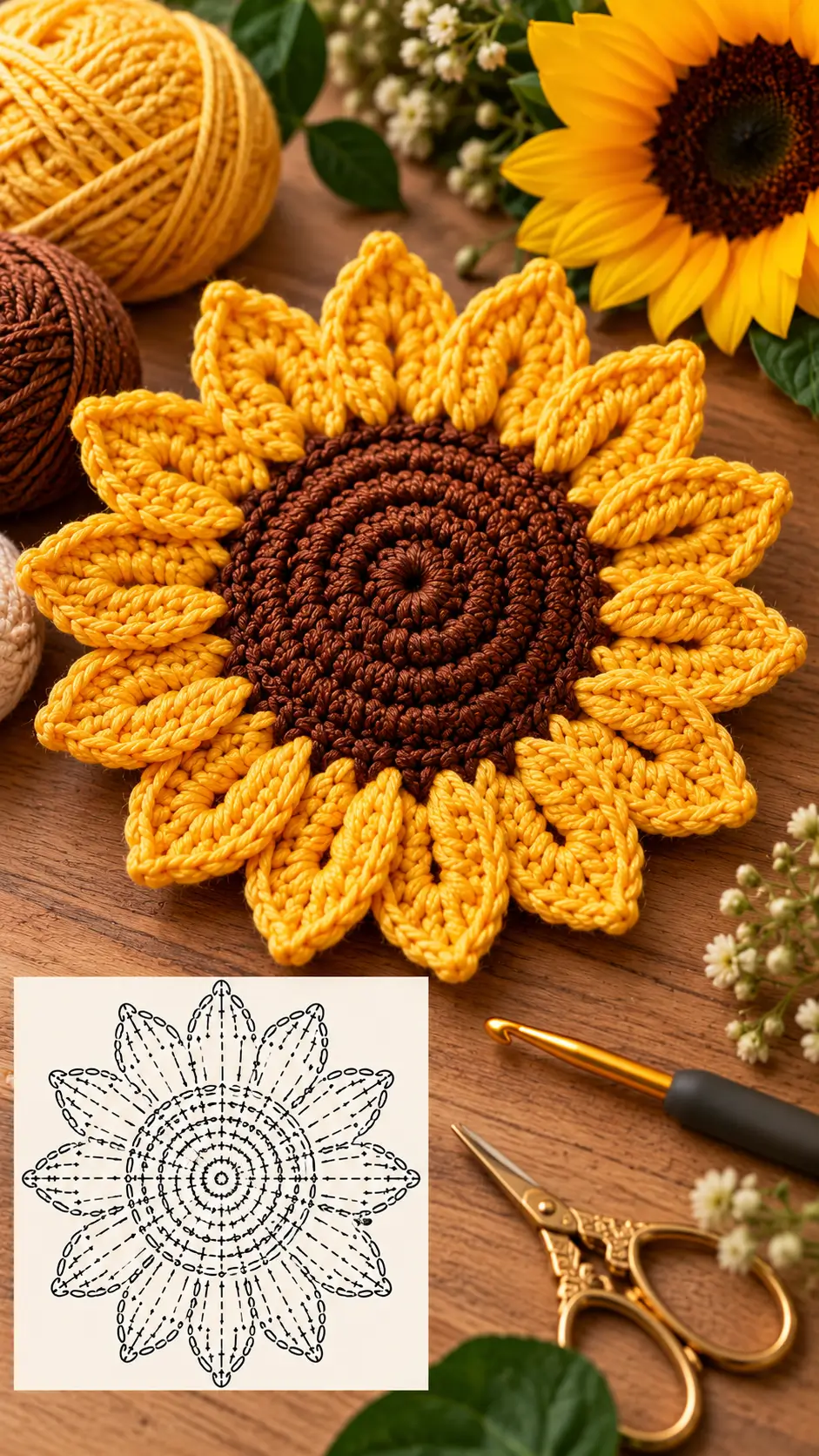
Sixteen pointed yellow petals change the geometry of this sunflower: the brown center has to provide enough attachment space for every petal without forcing the flower into a bowl. This crochet sunflower coaster pattern builds a dense circular center first, then adds individually shaped golden petals around the edge. Made with cotton yarn and a 4.5 mm hook, the finished sunflower measures approximately 15–17 cm across.
The Design: What Makes This Crochet Sunflower Different
The photographed sunflower has three defining features: a broad dark-brown center, approximately 16 long pointed petals and a strong raised texture. The center occupies nearly half of the total diameter, which keeps the finished piece useful as a coaster or small table mat instead of turning it into a loose flower appliqué.
The petals are deliberately narrow at their attachment points and widest near the middle. This produces the elongated sunflower shape visible in the reference image. Each petal is worked individually from the outer edge of the brown center.
A common failure with a crochet sunflower coaster is adding too many stitches to the center before beginning the petals. Excess increases cause the brown disk to ripple. Too few increases create the opposite problem: the center cups upward instead of lying flat.
Project Info at a Glance
| Skill Level | Time | Finished Size | Hook | Best For |
|---|---|---|---|---|
| Easy / Intermediate | 45–75 minutes | Approx. 15–17 cm | 4.5 mm | Coasters, table decor, appliqués |
The exact finished measurement depends on yarn, hook size and tension. Published sunflower coaster patterns commonly finish around 12–14 cm, while larger examples reach approximately 5.5–7 inches. This version deliberately uses longer petals to reproduce the proportions visible in the reference image.
Materials and Tools
Yarn
- Dark brown: Aran or worsted-weight cotton yarn — approximately 12–15 g.
- Golden yellow: Aran or worsted-weight cotton yarn — approximately 18–25 g.
Choose cotton when the finished sunflower will be used under cups or glasses. Cotton produces a firmer center, holds the petal points well and absorbs small amounts of condensation more effectively than many smooth acrylic yarns.
The yellow and brown yarns should have similar thickness. Mixing a thin brown center with substantially heavier yellow yarn can make the petals pull the edge of the center out of shape.
Tools
- 4.5 mm crochet hook
- Stitch marker
- Tapestry needle
- Scissors
- Blocking pins
- Blocking mat or folded towel
Abbreviations
- MR — magic ring
- ch — chain
- sc — single crochet
- hdc — half double crochet
- dc — double crochet
- tr — treble crochet
- inc — increase
- sl st — slip stitch
- st/sts — stitch/stitches
Keep increases evenly distributed around the brown center; stacking increases directly above one another can create visible corners instead of a circular disk.
Crochet Sunflower Coaster Pattern — Step by Step
The sunflower is constructed from the center outward. The brown disk is completed first. Yellow yarn is then joined to its outer edge and the petals are worked individually around the circumference.
Brown Sunflower Center
Yarn: dark brown.
Rnd 1: Make a MR. Work 8 sc into the ring. Join with sl st. (8)
Rnd 2: Ch 1. Work 2 sc in each stitch around. Join. (16)
Rnd 3: Ch 1. [Sc 1, inc] ×8. Join. (24)
Rnd 4: Ch 1. [Sc 2, inc] ×8. Join. (32)
Rnd 5: Ch 1. [Sc 3, inc] ×8. Join. (40)
Rnd 6: Ch 1. [Sc 4, inc] ×8. Join. (48)
Rnd 7: Ch 1. [Sc 5, inc] ×8. Join. (56)
Rnd 8: Ch 1. [Sc 6, inc] ×8. Join. (64)
Fasten off the brown yarn.
The completed center should lie flat before the petals are added. Place it on a table without stretching it. If the outer edge forms waves, the tension is too loose for the number of increases. If the center forms a shallow bowl, the stitches are too tight.
Optional Textured Center Round
Yarn: dark brown.
The reference image shows pronounced concentric texture across the brown disk. Add this optional surface round if a more dimensional center is wanted.
Join brown yarn around a post or exposed loop approximately one round inward from the outer edge.
Texture Round: Work surface slip stitches around the existing round, keeping every stitch loose enough that the center remains flat.
Fasten off and weave the yarn tail into the back.
A second surface-slip-stitch ring may be added farther toward the center. Do not pull the surface stitches tightly; doing so contracts the finished disk.
Petal Foundation
Change to golden yellow yarn.
Join the yellow yarn to any stitch on Round 8.
The 64-stitch outer edge is divided into 16 petal sections of 4 stitches each. Place a marker every four stitches if consistent spacing is difficult to maintain.
Each petal is worked from one four-stitch section before moving directly to the next section.
Sunflower Petal 1
Yarn: golden yellow.
Working across the next four stitches:
Petal: Sl st in first stitch, ch 1, sc in same stitch, hdc in next stitch, dc in next stitch, tr in next stitch.
Ch 3.
Working back down the opposite side of the petal foundation, work tr, dc, hdc and sc into the corresponding spaces toward the base.
Sl st at the base to secure the petal.
The ch-3 section forms the pointed tip. Keep these chains firm; loose chains make the point round rather than tapered.
Petals 2–16
Repeat the same petal sequence around the remaining outer edge:
Petal Repeat: Sl st, sc, hdc, dc, tr, ch 3, then work back down with tr, dc, hdc and sc. Secure with a sl st at the base.
Continue until 16 petals have been completed.
Before fastening off, count the petals. The spacing should remain consistent around the entire brown disk.
Fasten off the yellow yarn and leave approximately a 12 cm tail for weaving.
Alternative Fuller Petals
The photographed petals have substantial thickness and a clearly defined outer edge. For a fuller version, add one edging pass around each completed petal.
Join yellow yarn at the base of the first petal.
Petal Edging: Work sl st along the first side, 2 sc near the middle, sc into the tip, then mirror the same sequence down the opposite side.
Continue directly onto the next petal.
Keep the edging stitches loose. A tight border shortens the petal and can cause its tip to curl upward.
Optional Raised Petal Ridge
The petals in the reference image show a visible central ridge. A simple surface-crochet line can reproduce this effect without changing the basic petal construction.
Insert the hook at the base of a petal and pull up a loop of yellow yarn from the back.
Surface sl st in a straight line toward the tip.
Stop one stitch before the point.
Fasten off on the back.
Repeat for all 16 petals if a strongly dimensional sunflower is wanted. For a flatter coaster, omit this step.
Shaping the Sunflower
The petals may look irregular immediately after crocheting. Cotton responds particularly well to controlled blocking.
- Lay the sunflower face up on a blocking mat.
- Flatten the brown center without stretching its circumference.
- Count all 16 petals before pinning.
- Position the petals at approximately equal angles around the center.
- Pin each petal through its pointed tip.
- Measure from the center of the flower to several opposite petal tips. Correct any visibly shorter sections before dampening the piece.
- Lightly dampen the sunflower according to the yarn manufacturer’s care instructions.
- Allow the piece to dry completely while pinned.
- Remove the pins and inspect the petal spacing.
- Weave all remaining yarn tails through stitches of the same color on the back.
The finished sunflower should have a flat brown center surrounded by 16 evenly spaced pointed yellow petals.
How to Keep the Brown Center Flat
The center determines whether the finished sunflower crochet coaster functions properly. A coaster that cups will allow a mug to rock, while a severely rippled center creates an unstable surface.
After every increase round, place the piece flat without pressing it down. Minor waviness can disappear after another round, but pronounced rippling usually indicates that the stitches are too loose. Moving down by 0.5 mm in hook size can correct the problem.
If the disk curls upward instead, loosen the tension or move up by 0.5 mm. Cotton yarn varies considerably between brands, so hook size should be treated as a working specification rather than an absolute rule.
How to Make the Petals Pointed
A sunflower petal needs a clear transition from a narrow base to a broad middle and then back to a narrow tip. Using only double crochet stitches produces a rounded oval rather than the pointed profile visible in the reference.
The progression from sc to hdc, dc and tr creates increasing height toward the tip. Reversing those stitch heights on the opposite side brings the petal back toward the center.
Do not make the tip chain excessively loose. The final three chains should be similar in tension to the rest of the petal. During blocking, pull only enough to define the point.
Using the Sunflower as a Coaster
For drink coasters, 100% cotton is the most practical fiber choice. The center should remain dense enough to support the base of a cup without large openings.
The brown center in this pattern is approximately the functional resting area. The yellow petals extend beyond the cup and provide the sunflower silhouette.
If the finished piece is intended for a large mug, measure the mug base before starting. Increase the center only when necessary. Adding another full increase round will also change the number and spacing of the petals, so the petal foundation must be recalculated rather than simply attaching 16 petals to a much larger circumference.
Using the Sunflower as an Appliqué
The same pattern can be used as a large floral appliqué on a tote, cushion cover or wall hanging.
For appliqué use, omit the petal edging when a flatter flower is required. Leave a long brown yarn tail at the center and use it to sew the flower to the background fabric.
Stitch around the outer portion of the brown center rather than sewing every petal down. Leaving the yellow petals unattached preserves their three-dimensional appearance.
7 Technical Tips for Better Sunflower Coasters
- Check for center cupping after every round. Place the brown disk on a hard surface after Rounds 5–8. If the outer 1 cm lifts noticeably, change hook size or tension before adding the petals.
- Mark every four stitches. The 64-stitch final center divides exactly into 16 groups of four. Losing one attachment stitch will shift every remaining petal.
- Control the petal tip. Keep the ch-3 tip approximately the same tension as the hdc stitches. An oversized chain produces a loop instead of the sharp sunflower point.
- Do not overtighten surface crochet. Raised brown-center rings should sit on the fabric without contracting it. If the disk becomes concave after adding texture, remove that surface round and remake it more loosely.
- Block all 16 points individually. Pinning only four opposing petals leaves the intermediate petals free to twist. One pin through every petal tip gives much more consistent spacing.
- Keep yarn weights matched. A difference greater than roughly one standard yarn category between the center and petals can distort the attachment edge. Use comparable brown and yellow yarn thicknesses.
- Weave tails by color. Run the brown tail through at least 4–5 cm of brown stitches and the yellow tail through yellow stitches. Crossing a dark tail behind loosely worked yellow petals can make the brown strand visible from the front.
Adjusting the Sunflower Size
A smaller sunflower can be produced with DK cotton and a 3.5–4 mm hook. Keep the same basic proportions but make a gauge sample before relying on the finished diameter.
For a standard coaster, aim for approximately 12–14 cm from opposite petal tips. For the larger appearance shown in the reference image, approximately 15–17 cm provides more room for elongated petals.
A larger hook alone is not always the best way to increase size. Loose stitches reduce the structural definition of both the brown center and the pointed petals. Moving to a heavier cotton yarn while maintaining firm tension produces a cleaner large sunflower.
Color Variations
The reference uses a saturated golden yellow around a dark chocolate-brown center. That high contrast clearly separates the petals from the seed disk.
For a botanical variation, combine a very dark brown inner center with a slightly lighter brown outer round before beginning the yellow petals. Rust, mustard and amber can also be alternated through the petal round.
Keep the center darker than the petals when the goal is a recognizable sunflower silhouette. Similar values across both sections reduce the visual distinction between the seed disk and petals.
Finishing the Crochet Sunflower Coaster
After weaving the final yarn tails, place the finished flower on a flat surface and check every petal from directly above. Correct twisted points with light blocking rather than adding more stitches to individual petals.
Make one complete sample before producing a matching set. Record the yarn brand, hook size, brown-center diameter and finished tip-to-tip measurement. Those four measurements make it much easier to reproduce identical flowers.
This crochet sunflower coaster pattern can then be repeated for table sets, larger floral arrangements or appliqués. Share the finished version on Pinterest or Instagram with #PointedSunflowerCoaster. For your next sunflower, would you keep all 16 petals golden yellow or alternate mustard and bright yellow petals?