Introduction
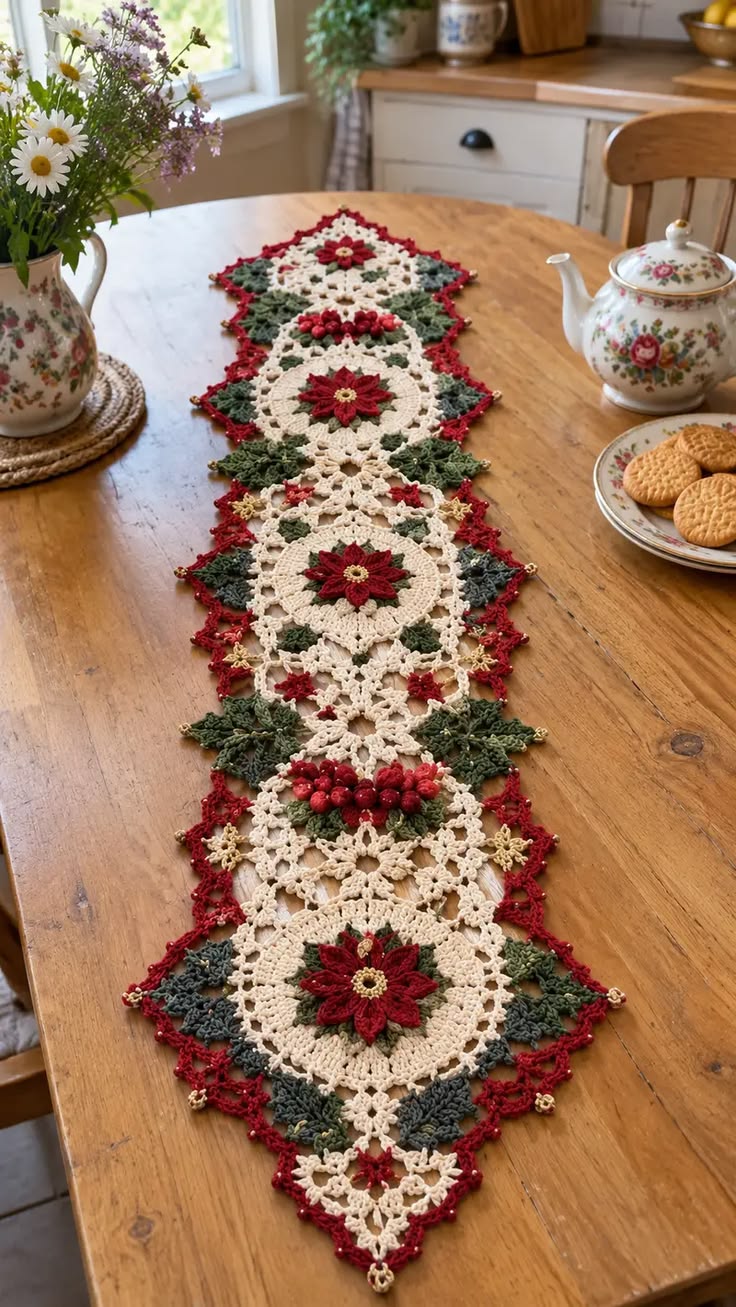
Five red poinsettias have to remain centered while holly leaves and berry clusters push this runner well beyond the edges of its cream medallions. This Christmas poinsettia crochet table runner pattern combines DK cotton, circular lace motifs, dimensional flowers, dark-green foliage, berries, connector lace, and a pointed red border. The intermediate project targets approximately 32 × 135 cm and can be shortened one medallion at a time.
The Design: What Makes This Christmas Table Runner Different
The runner is modular rather than worked as one long rectangle. Five cream medallions establish its centerline, allowing the length to change without recalculating a large foundation chain. Red poinsettias sit above selected medallions, while dark-green holly leaves extend into the open spaces between them.
Berry clusters introduce smaller raised forms between the large flowers. They also repeat the red color without requiring another full poinsettia at every connection point. Finally, a narrow red openwork border outlines the irregular silhouette instead of forcing the runner into a conventional rectangle.
A frequent problem in a crochet Christmas table runner with separate motifs is inconsistent blocking. Even a 5 mm difference between medallions can bend the finished centerline. Every poinsettia crochet runner section should therefore be measured before joining.
Project Info at a Glance
| Skill Level | Time | Finished Size | Hook | Best For |
|---|---|---|---|---|
| Intermediate | 18–24 hours | Approx. 32 × 135 cm | 4.0 mm | Dining table, buffet, sideboard, Christmas centerpiece |
Published poinsettia runners vary substantially in scale. Documented examples include approximately 22 × 10.5 inches, 15 × 57 inches, and modular versions offered at 60, 120, and 180 cm long. The 32 × 135 cm measurement used here is a photo-inspired target rather than a direct measurement of the pictured runner.
Materials and Tools
Yarn
- Warm cream — DK/light worsted cotton — approximately 250–300 g.
- Deep Christmas red — DK/light worsted cotton — approximately 90–120 g.
- Dark holly green — DK/light worsted cotton — approximately 100–130 g.
- Gold or mustard — DK/light worsted cotton — approximately 10–15 g.
A published DK Christmas runner uses 200 g of its main neutral plus less than 25 g each of red and green. This design needs larger accent allowances because the photograph contains dimensional poinsettias, substantial foliage, berry clusters, and a red perimeter.
Tools
- 4.0 mm crochet hook
- 3.5 mm crochet hook for smaller berries and center details
- Tapestry needle
- Scissors
- Locking stitch markers
- Measuring tape
- Blocking mats
- Rust-resistant pins
Abbreviations
- MR — magic ring
- ch — chain
- sc — single crochet
- hdc — half double crochet
- dc — double crochet
- tr — treble crochet
- sl st — slip stitch
- sp — space
- st/sts — stitch/stitches
- RS — right side
- FO — fasten off
An invisible decrease is not required because the project is built from flat lace motifs and separately attached botanical components.
Pattern — Step by Step
This is an original photo-inspired construction, not a transcription of a commercial or published pattern. Make one complete medallion, poinsettia, and holly leaf first. Block those samples before producing the remaining components.
Large Cream Lace Medallion — Make 5
Yarn: warm cream. Use a 4.0 mm hook.
R1: Ch 6 and join with sl st to form a ring.
R2: Ch 3, work 15 dc into ring. Join to top of beginning ch 3. (16 dc)
R3: Ch 4, dc in same st. *Ch 1, dc in next st.* Repeat around. Join. (16 dc, 16 ch-1 spaces)
R4: Sl st into first ch-1 sp. Ch 3, 2 dc in same sp. Work 3 dc in every ch-1 sp around. Join. (48 dc)
R5: Ch 4. *Skip 2 sts, dc in next st, ch 1.* Repeat around. Adjust the final spacing by one stitch if required to close cleanly.
R6: Sl st into first ch-1 sp. Ch 3, dc in same sp, ch 2. *2 dc in next ch-1 sp, ch 2.* Repeat around. Join.
R7: Sl st into first ch-2 sp. Work (sc, ch 4, sc) in each ch-2 sp around.
R8: Sl st into first ch-4 loop. Work (sc, hdc, 3 dc, hdc, sc) into each loop.
Join and fasten off.
Block each medallion to approximately 23–25 cm across. All five must finish at the same measurement.
Large Red Poinsettia — Make 5
Yarn: deep red and gold/mustard. Use a 4.0 mm hook.
Poinsettia Center
With gold or mustard:
R1: 6 sc in MR. Join. (6)
R2: Inc ×6. Join. (12)
Change to red.
Inner Poinsettia Petals — Make 6
R3: *Sl st in next st, ch 6. Beginning in second ch from hook work sc, hdc, dc, dc, hdc. Sl st into next base st.* Repeat six times.
Six pointed petals are formed.
Outer Poinsettia Petals — Make 6
Join red behind the inner petal layer.
*Ch 9 and sl st into the space behind the next inner petal.* Repeat six times.
Into each ch-9 loop work:
Sc, hdc, dc, 3 tr, dc, hdc, sc.
Repeat around.
Fasten off with a 30 cm attachment tail.
Shape the six outer petals so their points sit between the six smaller petals.
Optional Raised Gold Center
With gold or mustard yarn, make 6 small French-knot-style embroidered stitches over the central disc.
Alternatively, crochet tiny bobbles directly into the center.
Avoid loose beads if the runner will be used in a household where detachable decorative pieces would present a hazard.
Large Holly Leaf — Make 20
Yarn: dark holly green. Use a 4.0 mm hook.
Ch 15.
Beginning in second ch from hook work:
Sl st, sc, hdc, dc, dc, tr, tr, dc, dc, hdc, sc, sl st, sl st, sl st.
At the end work (sc, ch 2, sc).
Continue down the opposite side using the corresponding stitch sequence.
Join at the base.
Holly Points
Ch 1.
Work sc along the leaf edge, adding (sc, ch 3, sl st in second ch, sc) at three evenly spaced positions on each side.
At the tip work (sc, ch 3, sl st in second ch, sc).
Continue around.
Fasten off with a 25 cm tail.
Leaf Vein
Join green yarn at the base.
Surface sl st along the foundation chain toward the pointed tip.
Fasten off on the wrong side.
Small Holly Leaf — Make 12
Ch 9.
Beginning in second ch work:
Sl st, sc, hdc, dc, dc, hdc, sc, sl st.
Work (sc, ch 2, sc) at the tip.
Return down the opposite side.
Add two small ch-2 points along each side while working the final sc edging.
Fasten off.
Red Berry — Make 24 to 30
Yarn: deep red. Use a 3.5 mm hook.
R1: 6 sc in MR. (6)
R2: Inc ×6. (12)
R3: Sc around. (12)
R4: Dec ×6. (6)
Insert a tiny amount of stuffing if a round berry is wanted.
Fasten off and close.
Berry Cluster — Make 6
Arrange four or five berries together.
Sew their lower sections together using red yarn.
Position two small holly leaves behind the berries before attaching the cluster to the runner.
Small Red Star Flower — Make 8 to 12
Yarn: red.
R1: 5 sc in MR. Join. (5)
R2: *Ch 4, beginning in second ch work sl st, sc, hdc. Sl st into next base st.* Repeat five times.
Fasten off.
These small flowers fill narrow spaces between the large medallions and echo the poinsettia color without adding another large raised element.
Small Cream Snowflake Connector — Make 8
Yarn: cream.
R1: Ch 6 and join to form a ring.
R2: *Sc in ring, ch 5.* Repeat six times. Join.
R3: Into each ch-5 loop work (sc, ch 3, sc, ch 3, sc).
Fasten off.
Block to approximately 6–7 cm across.
Large Open Lace Connector — Make 4
Ch 8 and join into a ring.
R1: *Sc in ring, ch 7.* Repeat eight times.
R2: Sl st into first loop. Work (sc, ch 5, sc) into each loop.
R3: In alternate loops work (sc, ch 7, sc). In the remaining loops work (sc, ch 4, sc).
Fasten off.
The longer loops become attachment points between adjacent large medallions.
Arranging the Five Main Medallions
Place the five blocked cream medallions in one straight line.
Leave approximately 2–4 cm between adjacent medallions for the connector lace.
Position one poinsettia at the center of each medallion.
Rotate the flowers so the petal tips do not all point in exactly the same direction.
Before sewing, measure from the center of the first medallion to the center of the fifth. Adjust spacing until the runner remains within the planned length.
Attaching the Poinsettias
Center one red flower over each cream medallion.
Sew through the gold center and inner red petal bases.
Add a concealed stitch beneath each outer petal base.
Do not sew through the outer tips.
The petals should remain raised above the cream lace rather than becoming flat appliqués.
Joining the Main Medallions
Position one large lace connector between each pair of medallions.
Pin the four attachment points before sewing.
Sew the connector to the cream outer loops of the first medallion.
Repeat on the opposite side with the next medallion.
Keep the centerline straight while joining all five sections.
Lay the runner flat after every new connection rather than joining all four gaps before checking alignment.
Adding Holly Between Medallions
Arrange two to four large holly leaves around each connector area.
Point the leaves diagonally outward rather than directly along the runner centerline.
Attach the lower 2–3 cm of each leaf.
Leave the pointed outer portion free.
Add berry clusters to alternating connector sections. The photograph uses berries as concentrated focal accents rather than scattering single berries uniformly across the runner.
Side Lace Framework
Join cream yarn to an outer loop of the first medallion.
Side R1: *Ch 7, sc into the next suitable outer loop.* Repeat along the medallion and connector edges.
Continue down the complete side of the runner.
Repeat on the opposite side.
The chain arches do not need identical stitch attachment points on every component, but their finished lengths should remain consistent.
Pointed Red Outer Border
Yarn: deep Christmas red.
Join red in the first cream chain arch.
Border R1: Into each ch-7 arch work (sc, ch 5, sc).
Border R2: Sl st into first ch-5 loop. Work (sc, ch 3, dc, ch 3, sc) into each loop.
For every third repeat, replace the middle ch 3 with ch 5 to create a longer point.
At both ends of the runner, use longer ch-5 or ch-6 points to emphasize the tapered silhouette.
Fasten off.
Gold Accent Picots
Yarn: gold or mustard.
Small gold details are visible at selected outer points in the reference.
Join gold at a red border point.
Ch 3 and sl st into the first chain.
Fasten off immediately.
Repeat at approximately every third or fourth major border point rather than adding gold to the complete perimeter.
End Medallion Points
The runner ends should be narrower than the center sections.
Join cream at the lowest loop of an end medallion.
Ch 7, sc into the next outer loop, then ch 9 and attach to the center point.
Mirror the sequence on the opposite side.
Work the red pointed border over these arches.
Add one small cream snowflake connector or red star flower near the tip.
Assembly
- Make one complete cream medallion, block it to approximately 23–25 cm, and use that measurement for the remaining four motifs.
- Crochet five dimensional red poinsettias and attach one to the center of each blocked cream medallion.
- Lay the five decorated medallions in a straight line and set their spacing before joining any sections permanently.
- Connect adjacent medallions with the four large cream openwork connectors, checking the centerline after every join.
- Arrange large and small holly leaves around the connector areas and sew only their lower sections to the lace.
- Add six berry clusters, concentrating them around selected joins rather than spacing every berry independently.
- Attach the small cream snowflakes and red star flowers in open gaps that remain between medallions and foliage.
- Work the cream side framework around the irregular runner silhouette, maintaining chain arches of consistent length.
- Add the pointed red outer border and selected gold picots, then inspect both ends for matching taper and width.
- Weave all tails into matching-color stitches, block the runner to approximately 32 × 135 cm, and shape every poinsettia and holly point before drying.
The completed runner should show five clearly separated cream medallions, raised red poinsettias, dark-green holly foliage, concentrated berry clusters, and an uninterrupted pointed red perimeter.
7 Technical Tips
- Crooked centerline: A 5 mm diameter difference between adjacent medallions can make the five-section runner curve. Block every large cream motif to the same 23–25 cm measurement before joining.
- Flattened poinsettias: Sewing through every red petal removes the layered flower profile. Attach each flower through its center and petal bases while leaving the outer 2–3 cm of each large petal free.
- Twisted holly leaves: A tight surface-crochet vein shortens the center of the leaf. Work the vein with relaxed loops and stop immediately if the two leaf edges begin curling toward each other.
- Uneven berries: Different stuffing amounts make one cluster noticeably larger than another. Use approximately the same pea-sized quantity of fiberfill in every 12-stitch berry.
- Sagging connectors: Chain arches that are too long allow neighboring medallions to separate under their own weight. Pin the pieces 2–4 cm apart and test the connection before fastening the joining yarn.
- Ruffled red edging: Too many border groups force the perimeter outward. Use one decorative group per established cream arch and adjust only at the pointed ends.
- Distorted blocking: Pulling only the end points can stretch the runner length without correcting its width. Pin the five medallion centers first, then side points, connectors, and outer red tips in that order.
Choosing Yarn for a Christmas Lace Runner
Published Christmas table runners demonstrate that several yarn scales work. Size-10 cotton thread with a 1.75 mm hook creates fine filet lace, DK cotton with a 4 mm hook produces a more substantial household textile, and Aran yarn with a 5 mm hook creates heavier motifs.
DK cotton is a practical match for the photographed construction because the runner contains both open lace and dimensional botanical pieces. The poinsettias need enough structure to retain their points, while the cream medallions should still drape flat against the table.
Use the same yarn family for cream, red, and green where possible. Matching fiber composition reduces changes in size when the completed runner is washed or blocked.
Controlling the Christmas Color Palette
Cream should occupy the largest area. It establishes the five medallions and connector lace, preventing the dark red and green details from forming one continuous dense strip.
Deep red belongs on the poinsettias, berries, small star flowers, and outer border. Repeating the same red at the center and perimeter visually links otherwise separate motifs.
Dark holly green works best around the transitions between medallions. Avoid covering the cream lace completely; exposed negative space is part of the design.
Gold or mustard requires the smallest quantity. Restrict it to flower centers and selected border picots.
Changing the Runner Length
The modular architecture makes length adjustment relatively simple.
For a compact runner, make three medallions rather than five. Join them with two connector sections and retain the same tapered end treatment.
For a longer dining table, add a sixth or seventh medallion. Each added section requires another poinsettia, connector, foliage group, and additional side border.
Published modular Christmas runner patterns use the same general sizing principle, with documented versions offered at approximately 60, 120, and 180 cm.
Measure the table before selecting the motif count. Decorative runners generally look more controlled when their end points remain on the tabletop rather than interfering with seated diners.
Making a Flatter Version
Raised berries and double-layer poinsettias add height. If serving dishes will sit directly on the runner, reduce those elements.
Work only the six outer poinsettia petals and omit the inner layer. Replace stuffed berries with small flat red circles consisting of 6 sc in an MR followed by 12 sc.
Holly leaves can also be attached at both the base and midpoint.
These changes preserve the red-green botanical composition while creating more stable areas for tableware.
Alternative Holiday Palettes
A traditional variation can use bright white, scarlet, and forest green. For a muted farmhouse palette, substitute oatmeal, burgundy, and olive.
A winter version can replace red with dusty blue and use eucalyptus green foliage. Gold centers can remain unchanged.
Another option is an ivory runner with white poinsettias, sage leaves, and champagne-colored centers. In that palette, increase contrast by working the outer border in sage rather than ivory.
Maintain one dominant neutral, one flower color, and one foliage color. Too many equal-strength accent colors can obscure the modular lace structure.
Blocking the Completed Runner
Block the assembled runner only after every botanical component and border section has been attached.
Pin the centers of all five medallions along one straight guideline. Next pin the widest left and right points of each section.
Shape the cream connector lace without stretching it beyond the planned 2–4 cm gap.
Pin the red border points last.
Do not flatten the poinsettia petals or stuffed berries beneath blocking pins. Shape them manually after the cream foundation has been secured.
Allow the runner to dry completely before removing any pins.
Care and Storage
Follow the washing instructions printed on the selected yarn label. Cotton lace can become substantially heavier when wet, so support the complete runner during lifting.
Reshape the medallions while damp. Align the centerline first, then correct the side lace and pointed border.
For seasonal storage, place the runner flat or roll it around an acid-free tube. Folding directly through a raised poinsettia can compress the petals.
If folding is unavoidable, place clean tissue between the dimensional flowers and neighboring layers.
Finishing the Christmas Poinsettia Table Runner
Inspect the runner from the end of the table before trimming the final yarn tails. The five cream medallions should form one straight centerline, each red flower should remain distinct, and the holly leaves should broaden the silhouette without covering the open lace. Compare both pointed ends and correct any border section that pulls sideways.
The finished Christmas poinsettia crochet table runner pattern depends on repeated proportions: matching medallions, centered flowers, controlled connector gaps, and consistent border arches. Make and block one complete medallion before producing the other four, then use its finished diameter as the project’s reference measurement.
Share the completed runner on Pinterest or Instagram with #ChristmasPoinsettiaRunner. For this design, would you keep the dark holly green or replace it with a softer sage green?