Introduction
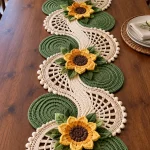
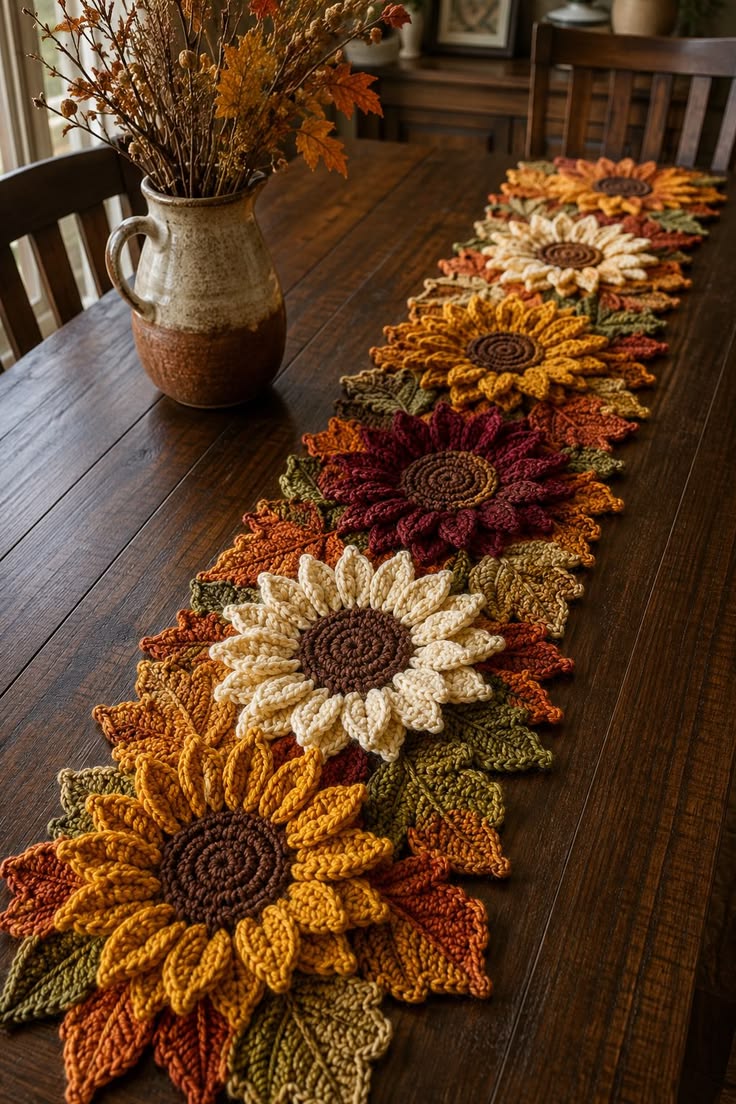
A sunflower runner fails visually when its pointed petals disappear into the surrounding maple-shaped leaves. This sunflower crochet table runner pattern separates large brown-centered flowers with layered mustard, cream, burgundy, olive, and rust motifs. DK cotton and a 3.5 mm hook produce a runner approximately 25–28 cm wide, with length adjusted by repeating flower units. Modular construction also allows individual leaves or flowers to be replaced before assembly.
The Design: What Makes This Sunflower Table Runner Different
The reference is not a conventional rectangular runner worked in rows. Its outside edge is created by overlapping flowers and pointed autumn leaves, so the silhouette remains irregular from end to end. Large flowers establish the center line, while smaller leaves bridge the spaces between neighboring blooms. Brown spiral centers provide a common visual anchor even when petal colors change from mustard to cream or burgundy.
Current sunflower-runner patterns use the same modular principle, combining statement flowers with autumn leaves and joining the motifs into a narrow table-length arrangement. DK cotton with a 3–3.5 mm hook is also used in comparable floral runners. The main construction mistake is attaching every leaf flat beneath a flower. That produces a dense oval mat instead of the open, pointed outline visible in this autumn crochet table runner. Leaf tips need to extend beyond the petals and remain partly free.
Project Info at a Glance
| Skill Level | Estimated Time | Finished Size | Hook | Best For |
|---|---|---|---|---|
| Intermediate | 12–18 hours | Approx. 90–100 × 25–28 cm | 3.5 mm | Dining tables, consoles, fall centerpieces |
A comparable modular sunflower runner is listed at approximately 90–96 cm long and 24–28 cm wide using DK/light #3 cotton and a 3–3.5 mm hook. The photographed runner appears longer, so additional flower modules can be added without changing the individual motif construction.
Materials and Tools
Yarn
- Chocolate brown — DK/light #3 cotton — approximately 70–90 g
- Mustard gold — DK/light #3 cotton — approximately 90–120 g
- Warm cream — DK/light #3 cotton — approximately 70–100 g
- Deep burgundy — DK/light #3 cotton — approximately 50–70 g
- Olive green — DK/light #3 cotton — approximately 70–90 g
- Rust orange — DK/light #3 cotton — approximately 60–80 g
- Muted ochre — DK/light #3 cotton — approximately 40–60 g
Keep approximately 20 g of olive or brown yarn unused until assembly. Extra joining yarn is useful because the motifs are connected from the reverse rather than surrounded by a conventional rectangular border.
Tools
- 3.5 mm crochet hook
- 3 mm hook — optional for firmer leaf motifs
- Tapestry needle
- Scissors
- Blocking mat
- Rust-resistant pins
- Stitch markers
- Tape measure
Abbreviations
- MR — magic ring
- ch — chain
- sc — single crochet
- hdc — half double crochet
- dc — double crochet
- tr — treble crochet
- inc — increase
- sl st — slip stitch
- BLO — back loop only
- FLO — front loop only
- st/sts — stitch/stitches
An invisible decrease is not required in the primary flower construction because the centers expand as flat circles rather than closing into stuffed forms.
Runner Layout
For a runner approximately 95 cm long, make the following primary pieces:
| Component | Quantity | Suggested Colors |
|---|---|---|
| Large Sunflowers | 5 | Mustard ×2, Cream ×2, Burgundy ×1 |
| Large Autumn Leaves | 20–24 | Olive, rust, ochre |
| Small Filler Leaves | 10–14 | Olive, rust, mustard |
For a longer dining-table runner, add one flower and approximately four to six leaves for every additional 16–20 cm.
Pattern — Step by Step
Large Brown Flower Center — Make 5
Yarn: chocolate brown.
R1: 6 sc in MR (6)
R2: inc ×6 (12)
R3: (1 sc, inc) ×6 (18)
R4: (2 sc, inc) ×6 (24)
R5: (3 sc, inc) ×6 (30)
R6: (4 sc, inc) ×6 (36)
R7: sc around (36)
Join with sl st and fasten off.
The center should measure approximately 7–8 cm before petals are added.
Spiral Texture on the Flower Center
Join brown yarn close to the MR.
Work surface slip stitches in a continuous spiral, following the visible round structure toward R7.
Keep the surface stitches relaxed enough that the circle remains flat.
Fasten off on the reverse.
The spiral is important for matching the photographed flowers, where the brown centers show a distinct concentric texture rather than a plain flat disc.
Large Mustard Sunflower — Make 2
Yarn: mustard gold for petals.
Join mustard yarn to any stitch of R7.
Petal 1
Ch 9.
Starting in second chain from hook: sl st, sc, hdc, dc, dc, hdc, sc, sl st.
Sl st into the next two stitches of the brown center.
Petals 2–18
Repeat the Petal 1 sequence around the center until 18 petals have been formed.
Adjust the final attachment by one stitch if necessary to distribute the petals evenly.
Fasten off.
The completed flower should measure approximately 16–18 cm across after blocking.
Second Petal Layer
The photographed flowers have substantial overlapping petals. Add a second layer behind the first for greater depth.
Join mustard yarn behind the first petal round.
Position the new petals between the existing petals.
Petal: Ch 8; starting in second chain work sl st, sc, hdc, dc, hdc, sc, sl st.
Attach behind the next gap with sl st.
Repeat around.
Keep the rear petals slightly shorter than the front layer.
Cream Sunflower — Make 2
Use the same 36-stitch chocolate-brown center.
Join warm cream yarn.
Work the same 18-petal front layer.
Add the shorter rear petal layer.
Fasten off and block to approximately 16–18 cm.
The cream flowers should retain the same brown center as the mustard flowers so the color change affects only the petals.
Burgundy Sunflower — Make 1
Make the brown center through R7.
Join deep burgundy.
Work 18 pointed petals using the same nine-chain petal construction.
Add the rear petal layer.
Fasten off.
The burgundy flower provides the darkest floral value in the runner and should be positioned close to the central third of the arrangement rather than at one extreme end.
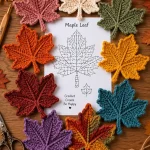
Large Pointed Autumn Leaf — Make 20–24
Use olive, rust, ochre, or muted brown-green.
Ch 14.
Beginning in second chain from hook:
sl st, sc, hdc, dc, dc, tr, tr, dc, dc, hdc, sc, sc, 3 sc in final chain.
Continue along the opposite side of the foundation chain:
sc, sc, hdc, dc, dc, tr, tr, dc, dc, hdc, sc, sl st.
Join.
Leaf Point
At the upper tip, work:
sc, ch 3, sl st in first ch, sc into the tip space.
This creates a small picot point.
Leaf Stem
At the base, ch 6.
Sl st back through all five chains.
Sl st into the leaf base.
Fasten off, leaving approximately 25 cm for assembly.
Raised Leaf Vein
Join matching or contrasting yarn at the stem base.
Surface slip stitch along the central foundation chain toward the point.
Fasten off.
The raised central vein adds the linear structure visible in the surrounding fall foliage.
Lobed Fall Leaf — Make 8–10 of the Large Leaf Total
For greater variation, replace several simple pointed leaves with lobed leaves.
R1: 6 sc in MR (6)
R2: inc ×6 (12)
R3: (1 sc, inc) ×6 (18)
Do not fasten off.
Center Lobe
Ch 10.
Starting in second chain: sl st, sc, hdc, dc, tr, tr, dc, hdc, sc.
Sl st into the next two stitches of R3.
Side Lobe 1
Ch 8.
Starting in second chain: sl st, sc, hdc, dc, dc, hdc, sc.
Sl st into the next two stitches.
Side Lobe 2
Ch 6.
Starting in second chain: sl st, sc, hdc, dc, sc.
Sl st into the next two stitches.
Repeat the same three-lobe sequence in reverse order around the opposite side.
Add a ch-7 stem at the base and sl st back through the chain.
Fasten off.
Small Filler Leaf — Make 10–14
Use olive, rust, mustard, or brown-green.
Ch 9.
Starting in second chain:
sl st, sc, hdc, dc, hdc, sc, sc, 3 sc in final chain.
Continue along opposite side:
sc, sc, hdc, dc, hdc, sc, sl st.
Fasten off with a 20 cm tail.
Small leaves fill gaps between larger motifs without increasing the runner width excessively.
Optional Rust Leaf Edging
Several leaves in the reference show contrasting autumn edges.
Join rust yarn at the leaf base.
Sl st loosely around the complete perimeter.
At the point, work ch 2 before continuing down the second side.
Fasten off.
Do not add contrasting edging to every leaf. Use it selectively so individual leaf shapes remain distinguishable.
Blocking the Flowers
Pin the brown center first.
Arrange all 18 front petals at even intervals.
Pull each petal gently toward its point.
Position the rear petals between the front layer.
Block the flower to approximately 16–18 cm across.
Allow it to dry fully before removing the pins.
Do not flatten the surface-crocheted center spiral.
Blocking the Leaves
Pin the leaf base and central point.
For lobed leaves, pin each lobe independently.
Target approximately 9–12 cm for the larger leaves and 6–8 cm for filler leaves.
Keep the central vein straight while blocking.
The leaf does not need to be perfectly flat. A small amount of edge movement helps preserve the layered botanical appearance after assembly.
Planning the Runner Before Joining
Use a table or blocking mat at least as long as the intended runner.
Place the five flowers in one loose central line.
Leave approximately 10–14 cm between neighboring flower centers so some petals overlap visually.
Rotate each flower slightly.
A rigid row with every petal aligned produces a mechanical appearance that differs from the reference.
Position large leaves between and behind the flowers.
Allow leaf points to extend beyond both long sides of the floral line.
Fill the remaining gaps with smaller leaves.
Suggested Flower Order
For a five-flower runner, use:
Mustard → Cream → Burgundy → Cream → Mustard
This arrangement places the darkest flower near the center and repeats the lighter colors symmetrically without making both halves identical.
For a longer runner, continue with another cream or mustard flower rather than adding a second burgundy flower immediately beside the first.
Joining the Flowers
Turn two neighboring flowers wrong side up.
Overlap the outer edges of two or three petals by approximately 1–2 cm.
Using matching yarn, sew through the rear loops of the overlapping petals.
Make four to six secure stitches.
Do not sew across the entire petal.
The front half should remain free enough to retain its dimensional edge.
Repeat between all neighboring flowers.
Attaching the Large Leaves
Slide each large leaf partly beneath a flower.
The leaf base should disappear under the petal layer while approximately two-thirds of the leaf remains visible.
Sew the lower 2–3 cm of the leaf to the flower or neighboring leaves.
Add one hidden stitch near the central vein if the leaf rotates too freely.
Leave the outer point unattached.
This produces the irregular foliage edge seen along both sides of the runner.
Attaching Filler Leaves
Place smaller leaves between two large motifs wherever the tabletop remains visible through a wide gap.
Sew only at the base and midpoint.
Do not fill every opening.
Small negative spaces help separate the individual leaves and prevent the runner from becoming a continuous heavy mat.
Optional Joining Vine
If additional stability is required, crochet a narrow olive vine along the reverse.
Ch 140–170, depending on the finished runner length.
Sl st back through every chain.
Lay this cord along the center back of the assembled motifs.
Sew it to the back of every flower center and several large leaves.
The vine functions as a hidden spine and is particularly useful on runners longer than one meter.
Assembly
- Crochet five 36-stitch brown flower centers and add the surface-slip-stitch spiral to each center before making petals.
- Add two layers of pointed petals to every flower, using mustard for two flowers, cream for two, and burgundy for one.
- Make 20–24 large autumn leaves in olive, rust, ochre, and brown-green, mixing simple pointed and lobed forms.
- Crochet 10–14 smaller filler leaves and block all leaf points before any pieces are joined.
- Arrange the five flowers in a loose central line with the burgundy flower near the middle and rotate neighboring flowers slightly.
- Join adjacent flowers through only the rear portions of overlapping petals so the outer petal tips remain dimensional.
- Position large leaves beneath and between the flowers, allowing their points to extend beyond both long edges of the runner.
- Add small filler leaves only where structural gaps remain, keeping some open space between neighboring motifs.
- Add the optional reverse-side crochet vine if the runner exceeds approximately one meter or flexes excessively when lifted.
- Lay the completed runner flat, correct twisted leaves, weave all remaining tails through matching stitches, and complete a final light blocking.
The finished runner should form one stable floral strip with distinct brown-centered flowers, visible leaf points, and an intentionally irregular autumn foliage perimeter.
7 Technical Tips
- The flower center cups upward: Check the 6-12-18-24-30-36 increase sequence before adding petals. A missing increase in the brown disc becomes harder to correct once 18 petals have been attached.
- The sunflower petals overlap too heavily: Block the 18 front petals so their bases remain close but their outer halves separate by several millimeters. Crowded petals reduce the finished flower diameter and hide the rear layer.
- The runner curls along one side: Compare leaf density on both long edges before final sewing. Three or four additional tightly attached leaves on one side can shorten that edge enough to curve the complete runner.
- The leaf points lose definition: Block every large leaf to approximately 9–12 cm before assembly. Sewing an unblocked leaf beneath a flower makes the outer point difficult to reshape later.
- The flower joins are visible from above: Sew only through rear petal loops within the first 1–2 cm of each overlap. Stitching near the pointed end creates a flat bridge between neighboring flowers.
- A long runner stretches when lifted: Add a slip-stitched vine along the reverse and anchor it behind every flower center. A runner longer than one meter places significantly more force on the petal-to-petal joins.
- The center spiral puckers: Work surface slip stitches with a hook movement slightly looser than the underlying single crochet. Tight surface stitches reduce the circumference and turn a flat 36-stitch disc into a shallow bowl.
Why Cotton Yarn Works for a Table Runner
Cotton is useful for this project because the individual petals and leaf points need to retain their shape on a flat surface.
Highly elastic yarn can allow long petals to retract after blocking.
DK cotton also keeps the motifs relatively thin despite the layered construction.
A comparable sunflower runner specifies DK/light #3 cotton with a 3–3.5 mm hook, which is an appropriate starting combination for this scale.
Mercerized cotton produces sharper stitch definition. Matte cotton gives the flowers a softer visual finish.
Either can work, but use one yarn family throughout the runner so motif thickness remains consistent.
Choosing the Autumn Color Palette
The reference depends on muted fall shades rather than bright primary yellow and green.
Choose mustard instead of lemon yellow.
Use olive or moss instead of emerald green.
Rust should lean toward burnt orange, while burgundy should remain dark enough to contrast with the chocolate center.
Cream provides the lightest flower and prevents the full arrangement from becoming uniformly dark.
Chocolate brown ties the different flower colors together because every major bloom uses the same center.
How Many Petals Should a Crochet Sunflower Have?
Petal count depends on the center circumference and desired density.
Comparable crochet sunflower designs use counts ranging from 12 to 16 or more petals. One current floral design uses 14 petals, while a modular sunflower runner specifies 16 front and 16 back petals.
This version uses 18 pointed front petals because the photographed flowers have a dense radial edge around a relatively large brown center.
If using thicker yarn, reduce the count to 16 rather than forcing 18 bulky petal bases around the disc.
Making the Brown Center Larger
For a more dominant center, add one increase round before R7.
Additional round: (5 sc, inc) ×6 (42)
Next round: sc around (42)
The larger center needs approximately 20 petals if using DK yarn.
Do not enlarge the center without increasing petal count or petal width. Too few petals around a 42-stitch disc leave visible gaps between their bases.
Making Narrower Petals
For the slim pointed petals visible on the mustard flowers, reduce the central double-crochet section.
Ch 9.
Work sl st, sc, hdc, dc, hdc, sc, sc, sl st.
The reduced height difference produces a narrower blade.
Alternate slightly wider and narrower petals if a less uniform botanical edge is preferred.
Keep all petals approximately the same length so the flower remains circular after blocking.
Making the Runner Longer
The modular construction allows length to change without recalculating a foundation chain.
Add one complete flower.
Make four to six additional large leaves.
Add two or three filler leaves.
Position the new flower at one end and overlap its nearest petals with the existing end flower.
Expect each additional bloom to increase the runner by approximately 16–20 cm, depending on overlap.
For a 150 cm dining table, a runner around 110–120 cm usually leaves visible tabletop at both ends.
Making a Short Centerpiece Version
Use three flowers instead of five.
A useful sequence is:
Mustard → Cream → Burgundy
Make approximately 12 large leaves and six filler leaves.
Arrange the three flowers in a slight diagonal rather than a perfectly straight line.
The completed centerpiece should measure approximately 55–65 cm, depending on flower diameter and overlap.
Making a Matching Sunflower Placemat
One large flower can become the center of a round botanical placemat.
Make one 36-stitch brown center and both petal layers.
Arrange eight to ten large leaves around the flower.
Overlap the leaf bases behind the petals.
Sew neighboring leaves together at their lower edges.
Target approximately 32–36 cm across.
For practical table use, keep the center relatively flat and omit excessive rear petal layering beneath areas intended for plates.
Keeping the Runner Flat
Flatness depends on balanced attachment tension rather than a border.
After joining every second flower, return the runner to a flat table.
Do not hold it in the air while deciding where the next leaf belongs.
Check that the central flower line remains approximately straight.
If one side begins to contract, loosen or remove the most recent leaf attachments.
Only the base of each leaf needs firm sewing. Leaving the outer half free reduces distortion and preserves the layered appearance.
Joining Without Glue
All components can be assembled with yarn and a tapestry needle.
Use the existing long tails whenever their color matches the attachment area.
For a mustard petal overlapping a rust leaf, sew from the reverse with whichever color is least visible from the front.
Make several small stitches rather than one long stitch.
Long floats on the reverse can catch during storage or washing.
After securing the join, weave the tail back through the motif for at least 5–7 cm.
Care and Blocking
Follow the yarn manufacturer’s washing instructions.
For cotton motifs, hand washing helps preserve carefully blocked points.
Support the complete runner when wet rather than lifting it from one flower.
Lay it flat on towels or blocking mats.
Arrange the center line first.
Next, separate all flower petals.
Finally, position the leaf tips and lobes.
Allow the runner to dry completely before moving it.
For storage, roll it loosely around a clean cardboard tube covered with fabric or acid-free paper rather than folding directly across the flower centers.
Conclusion
The runner’s structure comes from overlapping motifs, so flower spacing and leaf placement matter more than producing a conventional rectangular edge. Begin with one 36-stitch brown center, test an 18-petal flower, and block it before making the remaining blooms. Keep the mustard, cream, and burgundy flowers similar in diameter, then use olive and rust leaves to connect them without covering the petal points. Add a reverse-side vine when extra length needs more support. Your next step is a single mustard test flower. Save this sunflower crochet table runner pattern to Pinterest or share the finished runner on Instagram with #AutumnSunflowerRunner. Would you place the burgundy sunflower at the center or use cream as the central bloom?