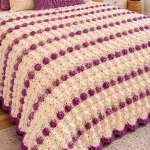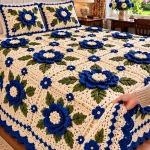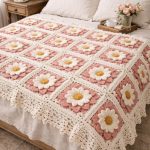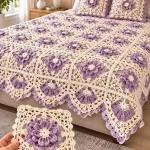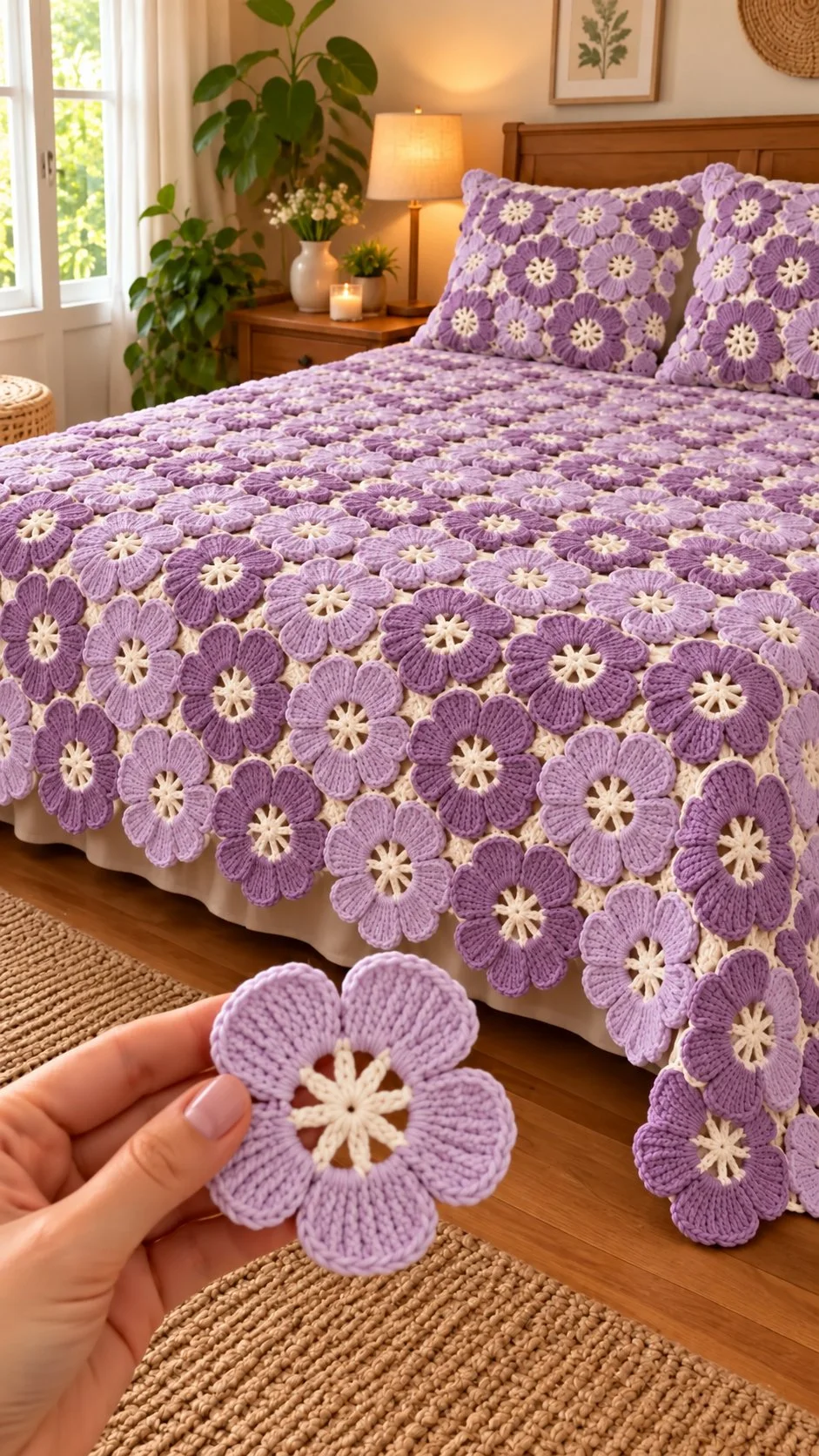
The lavender-and-lilac flowers bring a soft, dimensional look to a bedspread, while ivory centers and joins help each motif stand out. The coordinated cushion covers extend the floral design beyond the bed and make the set feel intentional without requiring a single large piece of fabric to be crocheted all at once.
This is a photo-inspired project guide, not a tested stitch-by-stitch pattern. It uses individual five-petal flower motifs selected from a tested motif pattern, then joins them into a bedspread and two cushion fronts. Exact stitch counts, motif dimensions, and yarn quantities are not specified, so the flower pattern and materials must be tested and measured before making the full set.
Pattern at a Glance
- Skill level: Depends on the selected flower motif and joining method. You should be comfortable following the motif pattern you choose and joining crochet pieces evenly.
- Terminology: US crochet terminology.
- Construction: Make and block a sample flower, plan a motif layout, crochet matching flowers, and join them with ivory yarn. Make two flower panels for the cushions.
- Finished size: Determined by the bed measurements, desired side drop, motif size, spacing, and cushion inserts.
- Yarn: Smooth cotton or cotton-blend yarn, all in one consistent weight. Light lavender and lilac are suggested for petals; ivory is suggested for centers and joins.
- Hook: Choose a hook that suits the yarn label and gives the drape you want. No hook size is specified.
- Motifs: Five-petal flowers with open ivory centers and rounded colored petals, made using a tested motif pattern.
- Joining: Use a tested ivory joining method. Make a join sample first to check that the fabric lies flat.
- Border: No additional border is specified. Preserve the flower-shaped outer edge of the joined bedspread.
- Gauge: No gauge is provided. Use the blocked sample motif as the practical measurement reference.
Materials
- Light lavender and lilac yarn for the petals
- Ivory yarn for the centers and joins
- Smooth cotton or cotton-blend yarn in one consistent weight
- Crochet hook matched to the yarn label and your desired drape
- Yarn needle for weaving in ends
- Scissors
- Stitch markers for tracking layout or marking sections during assembly
- Measuring tape
- Blocking mat and pins
- Two cushion inserts
- Optional fabric backing for the cushion covers
No fixed yarn quantity is given. Calculate the amount from your own sample motif and measured project dimensions. Since the bedspread requires many motifs and joining yarn, allow extra for joins, finishing, and any differences in your tension from the sample.
Yarn and Color Notes
Choose a smooth yarn that makes the flower shape easy to see and handle. Cotton and cotton blends are suggested because they provide a clear stitch definition and are suitable for household projects. Use the same yarn weight throughout so the flowers and joins behave consistently. Even yarns of the same stated weight can vary in thickness, so a single yarn line or a careful test swatch can help keep the motifs uniform.
The suggested palette uses light lavender and lilac for the petals, with ivory for the flower centers and joining. You can decide whether each flower uses one petal color or both. If you alternate shades, make a simple color plan before crocheting the full set; an orderly sequence can keep the bedspread balanced.
The ivory joining yarn becomes part of the overall design. Before committing to the full project, join two sample flowers and check the contrast, seam width, and drape. A join that is too tight can draw the motifs together, while a bulky join may obscure the flower edges.
Finished Measurements and Planning
There are no fixed finished dimensions. Measure the bed and decide how far you want the bedspread to extend beyond the top. Measure the cushion inserts separately so their panels can be planned to fit.
Record:
- The width and length of the area you want the bedspread to cover
- The desired side drop, if the bedspread should hang over the sides
- The dimensions of each cushion insert
- The blocked width of one sample flower
- Any extra width or length added by the chosen joining method
For an even, practical fit, plan the bedspread layout using the actual blocked motif and join sample—not the unblocked flower. Motifs may change size when wet-blocked, and joining adds fabric between them. A paper sketch or a simple grid can help you compare possible layouts with your measurements before you make a large quantity of flowers.
Gauge
No gauge is supplied for this project. Because the bedspread is made from motifs, the most useful planning measurement is the width of a finished, blocked sample flower, along with the spacing created by the joining method.
Crochet and finish one motif using the yarn and hook you intend to use. Block it as you plan to block the finished bedspread, let it dry, and then measure it. If the motif is larger than desired, adjust the hook or choose a different suitable yarn before making the rest. If it is smaller, a larger hook or a different yarn may produce a more suitable result—but make and block another sample before calculating quantities.
For this project, consistency matters more than matching an unpublished gauge. If later flowers are noticeably larger or smaller than the sample, the layout may distort and the edges may not align cleanly.
Abbreviations
No stitch abbreviations are specified because the flower pattern is selected separately. Follow the abbreviations and stitch instructions provided with the tested five-petal motif pattern you choose.
Important Pattern Notes
- This is a project guide, not a complete stitch-by-stitch flower pattern. The exact flower counts and rounds cannot be confirmed from the photo.
- Choose a tested five-petal motif with an open ivory center and rounded colored petals.
- Use the same yarn weight and maintain consistent tension for every flower.
- Finish and block a sample before deciding how many motifs to make.
- Measure yarn use by color from the sample so you can estimate lavender, lilac, and ivory needs separately.
- Test the ivory joining method on sample flowers before joining the full set.
- Keep the flower-shaped outer edge rather than adding an unspecified straight border.
- Plan cushion panels around the actual inserts and any backing or removable opening you intend to use.
- Follow the yarn label for care of the finished set.
Special Techniques and Skills
The project involves making motifs, joining them, weaving in ends, measuring, and blocking. The chosen flower pattern may require additional stitches or techniques; refer to that pattern for its specific instructions rather than assuming stitch counts or construction details.
For the joining, select a tested method that works with the edges of your chosen flower motif. The source does not specify a particular seam or joining stitch. Whatever method you use, test it first: the join should secure the flowers without pulling them out of shape or making the fabric stiff.
Understanding the Construction
The bedspread is assembled from separate flowers rather than worked as one continuous rectangle. Each flower is crocheted individually and finished before the full layout is committed to. The blocked sample tells you how much area one motif covers and how much yarn it uses.
Once you have enough matching flowers, arrange them in the planned layout and connect them with ivory yarn. The outside of the bedspread remains shaped by the flower edges. The two cushion fronts use the same motif and color approach, but their dimensions are planned around the cushion inserts. Suitable backings with removable openings can be attached to make the cushions usable and easy to remove for care.
Full Project Instructions
1. Measure the Bed and Cushions
Measure the bed top, then decide how much side drop you want. Measure each cushion insert and note whether you plan to cover only the front with a flower panel or make a matching panel for each side.
Write down the measurements before calculating the layout. The bedspread and cushion covers are separate parts of the project, so keep their requirements distinct.
Checkpoint: You should have a clear target for the bedspread coverage, the desired drop, and the size of both cushion panels.
2. Select a Five-Petal Flower Motif
Choose a tested crochet flower pattern with five rounded petals and an open ivory center, matching the general look you want. Exact stitch counts cannot be confirmed from the reference, so use the complete instructions that accompany your selected motif pattern. Do not assume a particular stitch count, round structure, or finished size from the photo.
If the pattern allows color choices, use lavender and lilac for the petals and ivory for the center. Follow the motif pattern’s own instructions for color changes and finishing.
Checkpoint: Before making a sample, confirm that the chosen pattern creates five petals and that its finished shape will work with your planned joining method.
3. Crochet, Finish, and Measure a Sample
Make one flower using the yarn, hook, and colors you plan to use. Finish it as you would finish every motif, including weaving in its ends if that is part of your normal process. Block it, let it dry completely, and measure its width.
Weigh the yarn used by color if you have a suitable scale. Record how much lavender, lilac, and ivory the sample requires. Include any motif finishing yarn that is part of the sample, and keep the measurements and yarn-use notes together for later reference.
Checkpoint: Your sample should be fully finished and blocked before you use it to plan the total project. Measuring an unblocked flower can give an unreliable layout estimate.
4. Plan the Layout and Estimate Yarn
Arrange sample flowers on a flat surface to explore the bedspread layout. Account for the join between motifs as well as the motif width. A simple sketch can help you see how the flower edges will meet and how the perimeter will fall.
Estimate the number of flowers from the chosen layout and the measured coverage. Then use the sample’s yarn use by color to estimate the yarn required for the motifs. Allow extra for joins and finishing. If you are uncertain, make additional flowers only after checking the layout and keeping a record of how much yarn the first batch uses.
Checkpoint: The planned layout should be large enough for the intended bed coverage, with the desired side drop taken into account. Confirm the perimeter before making the entire set.
5. Make the Matching Flowers
Crochet the flowers using the selected motif pattern. Keep the yarn weight, hook, and tension consistent. If you are alternating lavender and lilac, follow your written color plan so the finished arrangement looks balanced.
Weave in ends as you go or after a manageable batch of motifs. Leaving many loose ends until the end can make the project harder to handle and may make it difficult to keep track of unfinished flowers.
Checkpoint: Compare new motifs with the blocked sample periodically. If their size is changing, pause and identify whether the cause is a change in tension, yarn, hook, or blocking before making more.
6. Lay Out and Join the Bedspread Flowers
Place the flowers in the planned arrangement with their right sides oriented consistently. Use the tested ivory joining method and follow its instructions. Start by joining a small section, then place it flat to check that the fabric remains smooth.
Keep the join tension even. Avoid pulling the ivory yarn so tightly that the petals bunch or the layout narrows. Also avoid slack loops that leave gaps or create an uneven seam. Continue joining in the planned order, checking alignment as you work.
Checkpoint: After joining a section, lay it flat. The motifs should sit without pronounced puckering, pulling, or rippling.
7. Preserve and Secure the Flower-Shaped Edge
Keep the outer edge in the flower shape created by the motifs. No additional border stitch is specified, so do not treat a straight-edged border as part of the project instructions. Secure all joins and weave in remaining ends, checking the perimeter for loose yarn.
Checkpoint: Lay the joined bedspread flat and inspect the outside edge and every join. The flower edges should remain visible and the joins should be secure.
8. Make Two Matching Cushion Panels
Use the same flower motif and color palette to make two matching panels sized for the cushion inserts. Plan the arrangement for each cushion separately, since the insert dimensions may not suit the bedspread’s motif layout exactly.
Attach the panels to suitable backings if desired. Include removable openings so the inserts can be taken out. The source does not specify a backing material, opening style, or fastening, so choose a suitable construction for the inserts and the care needs of the yarn.
Checkpoint: Compare the panels with one another and with the inserts before attaching the backing. Check that each panel sits as intended and that the removable opening is usable.
9. Block and Care for the Set
Block the finished bedspread and cushion panels to the planned dimensions, using a method appropriate for the yarn. Shape the motifs and outer flower edges carefully without stretching them beyond the intended size. Let the pieces dry fully before use.
Care for the bedspread and cushions according to the yarn label. If the backing has separate care requirements, follow those as well.
Estimating Yarn from a Sample
The sample-based method is more dependable than guessing from the appearance of the photo:
- Crochet and block one complete flower.
- Measure its width and weigh the yarn used by color.
- Determine how many motifs your chosen layout requires.
- Multiply the sample’s color-by-color yarn use by the planned motif count.
- Add extra for joining and finishing, especially for ivory yarn.
- Use the first joined section to check whether the joining method consumes more yarn than expected.
This gives an estimate based on your own yarn, hook, motif pattern, and tension. It is still an estimate: motif size and joining style can affect the final amount.
Resizing the Bedspread and Cushions
Resize by changing the layout, not by altering the chosen flower pattern. First make and block the sample motif, then decide how many flowers fit the measured area. Adding motifs increases the coverage; removing them reduces it. The join must be included in the calculation because it contributes to the overall dimensions.
To adjust the bedspread, revise the layout before making the full set. Check both the total width and length, and consider how the flower-shaped perimeter will fall at the sides. If the desired side drop cannot be achieved with a balanced arrangement, reconsider the motif layout or the target coverage rather than stretching the finished fabric.
For the cushions, plan each panel around its actual insert. A panel that is too small may strain the backing or flatten the flowers; one that is too large may sit loosely. Test the panel against the insert before attaching the backing.
Variations
- Single petal color: Use either lavender or lilac consistently for a quieter, more uniform arrangement.
- Alternating petal colors: Alternate the two suggested shades according to a written layout plan.
- Ivory-forward palette: Use ivory centers and joins as specified, while choosing a paler or deeper lavender range for contrast.
- Matching cushion accents: Keep the cushions in the same color order as the bedspread, or use a coordinated arrangement while retaining the same flower motif.
- Smaller project: Use the same motifs and joining approach for a smaller blanket, lap cover, or decorative panel. Recalculate the layout and yarn from the finished sample.
These variations change color or project scale without changing the underlying construction.
Troubleshooting
Why Don’t My Motifs Match in Size?
Check that you are using the same yarn weight, hook, motif instructions, and tension throughout. Compare motifs only after blocking, since unblocked flowers may not reflect their final dimensions. If later flowers are consistently larger or smaller, pause and correct the cause before making more.
Why Is the Joined Fabric Puckering?
The joining yarn may be pulled too tightly, or the motifs may not be aligned evenly. Undo the affected section and rejoin with a more relaxed, consistent tension. Test a short section on sample flowers before continuing across the bedspread.
Why Does the Bedspread Ripple?
Rippling can come from uneven motif sizes, loose joins, or a layout that does not suit the blocked flower measurements. Check the flowers and the join sample separately. Do not try to correct a distorted layout by forcing the fabric flat with aggressive blocking.
Why Does the Edge Look Uneven?
The outer edge follows the flower shapes, so irregular motif sizes or inconsistent positioning can make it look unbalanced. Arrange the flowers before joining and check that neighboring petals and centers are oriented consistently. Confirm the perimeter again as you join sections.
Why Is My Yarn Estimate Too Low?
The sample estimate may not include the yarn used for joins and finishing, or your motifs may be larger than the sample. Weigh the completed sample by color, then record yarn use from the first joined section. Use those figures to revise the estimate before making the remaining joins.
Why Do the Cushion Panels Fit Poorly?
Check the blocked panel against the insert before adding the backing. Make sure you have accounted for the panel’s finished size and the way the backing and removable opening affect the fit. If the panels are already complete, do not stretch them to force a fit; reassess the panel layout or backing dimensions.
Why Do Some Flowers Look Less Defined?
A fuzzy or loosely spun yarn can soften the outline of the petals and open center. A smooth yarn is suggested because it makes the motif shape easier to see. Consistent tension and careful blocking also help the petals remain distinct.
Frequently Asked Questions
Is this a complete stitch-by-stitch flower pattern?
No. This is a photo-inspired project guide, not a tested stitch-by-stitch pattern. Choose a tested five-petal flower motif pattern with an open ivory center and rounded colored petals; follow that pattern for its exact stitch instructions.
How much yarn do I need?
No fixed quantity is provided. Crochet, block, measure, and weigh a sample motif, then estimate from the number of flowers in your planned layout. Allow extra for joins and finishing.
Can I use a different yarn weight?
The materials guidance calls for one consistent yarn weight. A different weight can be used only if you make a new blocked sample and recalculate the layout and yarn estimate. Do not mix weights within the same bedspread unless you have tested how they behave together.
Do I need a special hook?
No special hook size is specified. Choose a hook matched to the yarn label and the drape you want, then verify the result with a blocked sample.
Can I make the project in one color?
Yes. A single color can be used for the petals, while retaining the ivory centers and joins if you want to preserve the suggested contrast. Make a sample first to confirm the overall effect.
Is cotton required?
Cotton or a cotton blend is suggested, but no specific fiber is mandatory in the project guide. Choose a smooth yarn in one consistent weight and follow its care instructions. Any substitution should be sampled and blocked before estimating the full project.
How do I make the bedspread larger or smaller?
Change the number and arrangement of motifs to suit your measurements. Use the blocked sample and a test join to calculate coverage; the guide does not provide fixed motif dimensions or a stitch multiple.
How should I care for the finished set?
Follow the yarn label for the bedspread and cushion covers. If you add fabric backing, check its care needs too, and make sure the cushion inserts can be removed before washing when appropriate.
Final Thoughts
The project is built in stages: measure the bed and cushions, test and measure one flower, then make a planned set of matching motifs. Join the bedspread flowers with ivory yarn while preserving their shaped outer edge, and make two coordinating cushion panels sized to the inserts. A blocked sample and a tested join are the key checkpoints for getting the dimensions, drape, and yarn estimate right.