Introduction
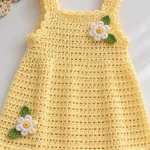
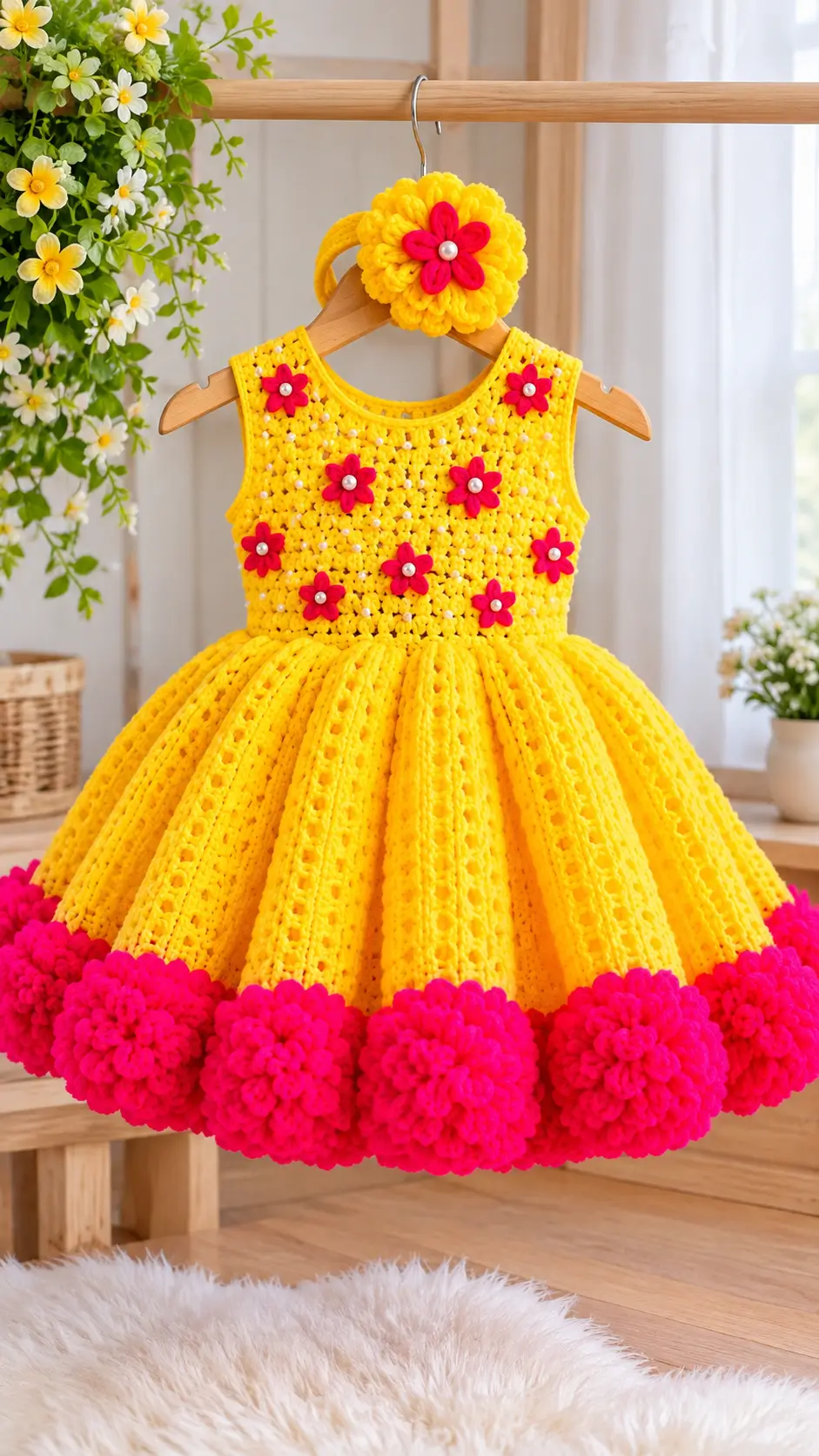
Nine small flowers across the bodice are not the difficult part of this yellow dress; the heavy floral hem is. This yellow crochet flower girl dress pattern uses DK yarn, a 3.5 mm hook and an intermediate garment construction, with finished length set from the child’s measurements. The fitted upper section and expandable skirt make the draft practical when chest and dress length need separate adjustment.
The Design: What Makes This Flower Dress Different
The photograph depends on three structural decisions. First, the bodice remains comparatively dense so the neckline and armholes resist stretching under the skirt’s weight. Second, substantial increases begin at the waist rather than the chest, producing the pronounced bell silhouette without making the upper garment oversized. Third, the flower border is treated as a separate decorative layer instead of forcing bulky bobbles into the final skirt rounds.
For this crochet flower dress pattern, flower placement matters as much as stitch choice. The small five-petal motifs are distributed asymmetrically enough to avoid obvious horizontal rows, while the large hem flowers form an almost continuous border. A common mistake in a floral crochet dress is adding heavy flowers before checking the hanging length. Their weight can pull the skirt lower, so complete and measure the yellow base first.
Project Info at a Glance
| Skill Level | Time | Finished Size | Hook | Best For |
|---|---|---|---|---|
| Intermediate | 15–25 hours | Made to child measurements; photo target roughly 55–65 cm | 3.5 mm | Party / flower-girl garment |
Published child-dress patterns commonly support 3.5 mm hooks with DK or similarly light yarn. Because sizing cannot be established accurately from a photograph alone, measure the intended wearer before beginning the foundation.
Materials and Tools
Yarn
- Sunflower yellow — DK/light #3 — approximately 350–450 g for a toddler-size photo-matched version.
- Hot pink/red — DK/light #3 — approximately 100–150 g working allowance for appliqués and the dimensional floral hem.
- White — DK/light #3 — approximately 5–10 g for embroidered flower centers.
The yellow quantity is a working estimate rather than an exact requirement. Final consumption depends heavily on chest size, skirt length, gauge and the amount of flare added to the lower section.
Tools
- 3.5 mm crochet hook
- Locking stitch markers
- Tapestry needle
- Scissors
- Measuring tape
- Blocking pins
- Sewing thread and needle, if required for appliqués
The photographed dress appears to use pearl-like centers on its flowers. For clothing intended for a young child, embroidered or securely crocheted centers remove the need for small detachable beads.
Abbreviations
- ch — chain
- sc — single crochet
- hdc — half double crochet
- dc — double crochet
- tr — treble crochet
- sl st — slip stitch
- inc — two stitches in one stitch
- dc2tog — double crochet decrease
- sp — space
- st/sts — stitch/stitches
- rep — repeat
- BLO — back loop only
An invisible decrease works through the front loops of the next two stitches before completing one sc and is mainly relevant when shaping three-dimensional accessories rather than this skirt.
Gauge and Sizing
Make a 10 × 10 cm swatch before calculating the neckline. A useful starting gauge for this type of child garment is approximately 22 dc × 11 rows per 10 cm with a 3.5 mm hook, but your blocked swatch controls the final calculations.
Measure chest circumference, shoulder-to-waist length and shoulder-to-desired-hem length. Add approximately 4–6 cm of positive ease to the chest for a pullover dress, or use a back opening if a closer fit is required.
The following stitch numbers illustrate a roughly 56 cm finished chest. Recalculate the foundation from your own blocked gauge before making a wearable garment.
Pattern — Step by Step
Neckline and Yoke
Yarn: sunflower yellow.
Ch 92 loosely. Join with sl st only if the resulting opening passes comfortably over the child’s head. Otherwise, work the first yoke rows flat and add a back button opening.
R1: Ch 2, dc around. Join. (92)
R2: Distribute 12 increases evenly. (104)
R3: Dc around. (104)
R4: Distribute 12 increases evenly. (116)
R5: Dc around. (116)
R6: Distribute 12 increases evenly. (128)
R7: Dc around. (128)
R8: Distribute 16 increases evenly. (144)
Check the yoke depth against the child rather than adding rounds automatically.
Bodice and Armholes
Yarn: sunflower yellow.
Place four markers to divide the yoke into front, back and two armhole sections. A practical starting division is 42 stitches for the front, 42 for the back and 30 for each armhole section.
R9: Dc across front 42, ch 6, skip 30 armhole sts, dc across back 42, ch 6, skip remaining 30. Join. (96 working sts)
R10: Dc in each dc and chain around. (96)
R11: Dc around. (96)
R12: Dc around. (96)
R13: Dc around. (96)
R14: Dc around. (96)
Continue even until the bodice reaches the measured waist. Add or remove plain rounds here rather than altering the skirt proportions.
Armhole Edging
Yarn: sunflower yellow.
Join yarn at the underarm.
R1: Sc evenly around the armhole, working approximately one sc per stitch and distributing stitches smoothly across the underarm chain.
R2: Sl st loosely around.
Repeat for the second armhole.
Waist Transition
Yarn: sunflower yellow.
R1: Dc around. (96)
R2: (Dc in next 3 sts, 2 dc in next st) around. (120)
R3: Dc around. (120)
This expansion starts the skirt while keeping excess bulk away from the fitted bodice.
Full Skirt
Yarn: sunflower yellow.
R4: (Dc 4, 2 dc in next st) around. (144)
R5: Dc around. (144)
R6: (Dc 5, 2 dc in next st) around. (168)
R7: Dc around. (168)
R8: (Dc 6, 2 dc in next st) around. (192)
For the vertical openwork effect visible in the dress:
R9: Ch 3, (dc in next 3 sts, ch 1, skip 1) around.
R10: Work dc into dc and ch-1 spaces around, maintaining 192 working positions.
R11: Repeat R9.
R12: Repeat R10.
Continue alternating these two rounds until the skirt is approximately 8–10 cm shorter than the target finished length.
For additional flare, distribute 24 increases across one solid dc round, then resume the openwork repeat. Stop increasing once the skirt hangs with the required fullness.
Small Five-Petal Flowers
Make approximately 9 for the bodice, plus 1 for the matching hair accessory. Yarn: hot pink/red.
R1: 5 sc in MR. Join with sl st. (5)
For each petal, work the following sequence into one stitch:
Petal: (sl st, ch 2, 2 dc, ch 2, sl st) in the same stitch.
Repeat in each of the remaining four stitches to create five petals.
Fasten off. Leave approximately a 20 cm tail for sewing.
Embroider a compact white center when making the garment for a young child instead of attaching a loose bead.
Large Dimensional Hem Flowers
Make enough to circle the finished hem. Yarn: hot pink/red.
The photographed design uses densely textured flowers that are substantially larger than the bodice appliqués.
R1: 6 sc in MR. (6)
R2: Inc ×6. (12)
R3: (Sc, inc) ×6. (18)
R4: (Sc 2, inc) ×6. (24)
Build six large petals around the center.
Petal round: (Sl st, ch 6, 5 tr in same base area, ch 6, sl st), spacing six petals evenly around the 24-stitch center.
For additional volume, add a second layer behind the first by working into available back loops.
Back layer: (Sl st, ch 8, 7 tr, ch 8, sl st) repeated six times.
Fasten off with a 30 cm sewing tail.
Make one flower before calculating the total quantity. Measure its finished width and divide the blocked skirt circumference by that measurement. For example, a 7 cm motif around a 112 cm hem requires approximately 16 flowers.
Bodice Flower Placement
Pin the nine small motifs before sewing. Place two near the upper shoulder area, three through the upper-middle bodice and four across the lower section, adjusting the spacing for the actual garment width.
Keep the petals away from the armhole edge so repeated movement does not trap them underneath the arm. Sew through each flower center securely, then tack the individual petal tips to control curling.
Floral Hem
Block the yellow skirt before attaching the dimensional flowers. Arrange the large motifs edge-to-edge around the lower circumference.
The upper portion of each flower should overlap the yellow hem slightly while most of the motif remains visible below the skirt edge.
Sew each center through several garment stitches rather than attaching it at one point. Tack neighboring petals together at one or two positions where additional support is required. This distributes some of the border weight horizontally.
Matching Floral Hair Accessory
Yarn: sunflower yellow and hot pink/red.
For a crocheted band, ch to the required head circumference minus approximately 2 cm.
R1: Hdc in second ch from hook and across.
R2: Ch 1, turn, hdc across.
R3: Repeat R2.
Fasten off and seam the short ends.
Make one large yellow dimensional flower using the hem-flower construction. Add one small hot-pink five-petal flower at its center and sew the layered motif securely to the band.
For a young child’s accessory, use an embroidered center instead of a detachable pearl-style embellishment.
Assembly
- Block the completed yellow bodice and skirt to the intended chest and length measurements.
- Check both armholes against each other and correct uneven edging before adding decoration.
- Pin all nine small hot-pink flowers across the bodice while the dress lies flat.
- Sew each flower through its center and tack the petal tips so they cannot curl excessively.
- Embroider the white flower centers after the appliqués have been attached.
- Lay the large hem flowers around the blocked skirt and adjust spacing before sewing the first motif.
- Attach every hem flower through multiple stitches rather than one center point.
- Tack adjacent hem petals together where the border needs extra support.
- Assemble the matching hair accessory and attach its layered yellow-and-pink flower.
- Weave yarn tails through several stitches on the wrong side, reverse direction once, trim and complete the final blocking.
The completed garment should hang evenly from the waist with the dimensional flower border positioned clearly below the skirt openwork.
7 Technical Tips
- Marker drift: Put a locking marker at the first stitch of every skirt round. Losing the join by one stitch repeatedly can rotate the openwork columns noticeably before reaching the hem.
- Skirt weight: Measure the dress while it hangs vertically after blocking. A heavily decorated floral border can increase the hanging length compared with a flat-table measurement.
- Armhole distortion: Do not pack extra sc into the underarm edge. Too many edging stitches produce a ruffle, while too few stitches pull the armhole inward.
- Flower placement: Keep small appliqués at least 1.5 cm from the armhole edge. A petal positioned directly beneath the arm can fold repeatedly during wear.
- Pinning failure: Pin every large hem flower before sewing any of them permanently. A spacing error of only 3–4 mm per motif becomes obvious across a border containing 15 or more flowers.
- Center security: Do not depend on a single pass of yarn through the flower center. Sew across the center in at least three directions and tack two or more petals to the underlying fabric.
- Tail weaving: Weave each structural tail at least 5 cm, change direction and pass through another section of stitches. Straight tails can migrate outward when the garment stretches during dressing and washing.
Conclusion
Finish the yellow skirt before committing yarn to the floral border because its blocked circumference determines the number of large motifs required. Next, crochet one hem flower, measure its usable width and divide the skirt circumference by that figure; this prevents gaps or compressed petals. Use the same test-first method for the smaller bodice appliqués and matching hair piece. Save this yellow crochet flower girl dress pattern to Pinterest with a clear front-view project photo, and share the completed version on Instagram with #YellowFlowerGirlDress. Record the final chest, shoulder-to-waist and shoulder-to-hem measurements for future sizing. Which would you change first: the nine bodice flowers or the oversized hot-pink floral hem?