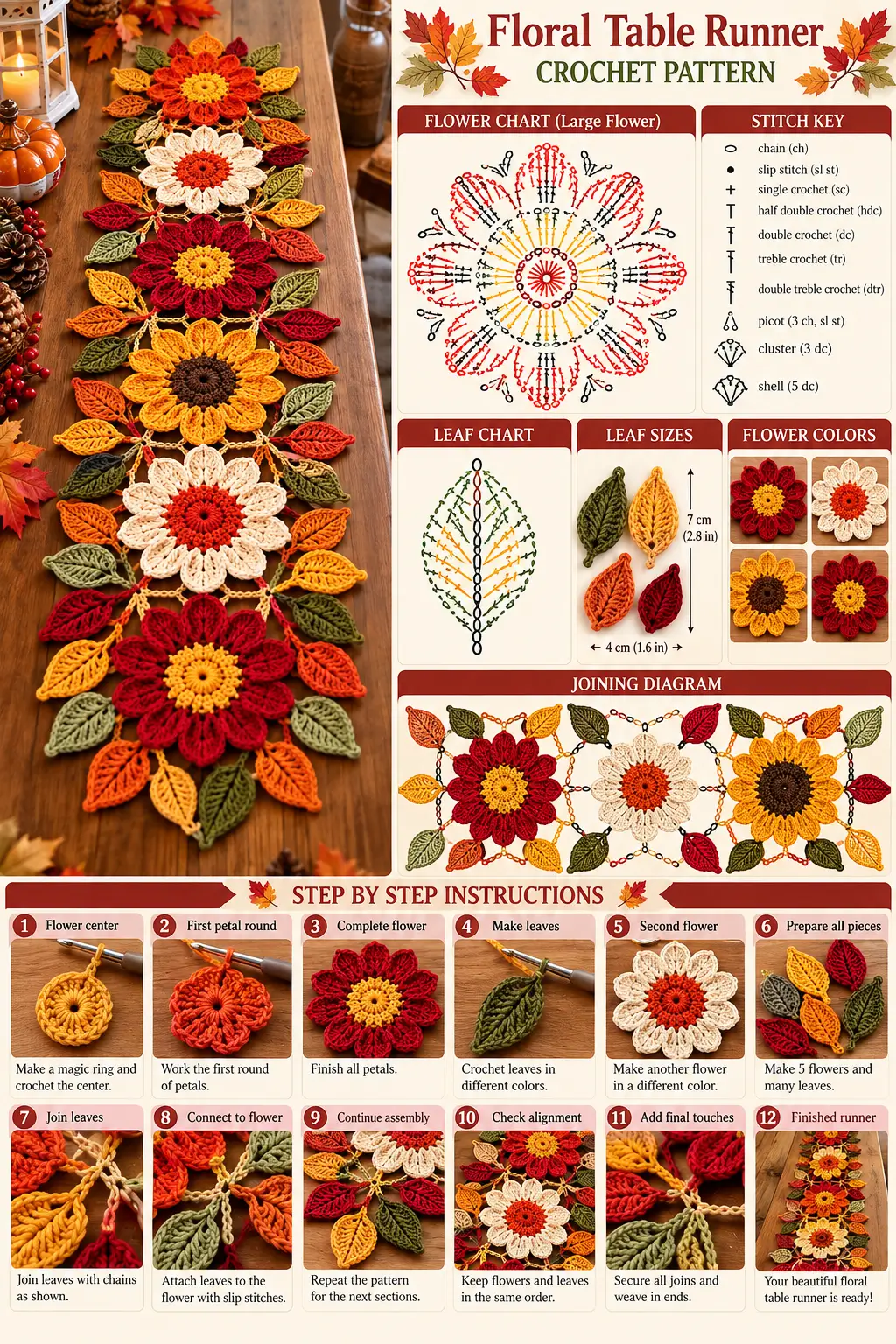
A fall runner built from flowers has no rectangular background to hide uneven joins; every chain connection becomes part of the finished outline. This crochet floral table runner pattern recreates the pictured design with five large flowers, pointed autumn leaves, and open chain connectors. Burgundy, pumpkin orange, mustard, cream, olive, and brown create the seasonal palette, while modular construction lets you alter the finished length.
The Design: What Makes This Floral Runner Different
The runner is assembled from individual motifs rather than worked continuously in rows. Five large flowers establish the center line. Each bloom uses a dense circular center surrounded by elongated petals, while alternating colors prevent the repeated flower shape from becoming visually uniform.
Pointed leaves form the outer edge. Their approximately 7 × 4 cm proportions, shown in the reference chart, are long enough to extend beyond the flowers without overwhelming them. Short chain bridges then connect flowers and foliage while leaving the table visible beneath the runner.
The primary construction risk is excessive tension at those joins. If the chains are too short, the completed autumn crochet table runner contracts and the flowers overlap. If they are too loose, gaps become irregular. Block every motif before calculating the final joining length.
Project Info at a Glance
| Skill Level | Construction | Flower Count | Hook | Best For |
|---|---|---|---|---|
| Intermediate | Joined motifs | 5 large flowers | 3.5–4 mm | Dining table, sideboard, autumn centerpiece |
The image specifies leaves approximately 7 cm long × 4 cm wide. It does not provide an overall runner measurement. Comparable modular sunflower runners are commonly adjusted by adding or removing complete flower units, and published examples use DK or light-worsted cotton with hooks around 3.5–4 mm.
Materials and Tools
Yarn
- Burgundy — DK cotton — approximately 50–70 g.
- Pumpkin orange — DK cotton — approximately 50–70 g.
- Mustard yellow — DK cotton — approximately 50–70 g.
- Warm cream — DK cotton — approximately 40–60 g.
- Olive green — DK cotton — approximately 40–60 g.
- Dark brown — DK cotton — approximately 15–25 g.
These quantities are practical allowances rather than measured consumption from the pictured runner. Smooth cotton is useful for this construction because pointed leaves and elongated petals require clear stitch definition.
Tools
- 3.5 mm crochet hook
- Tapestry needle
- Scissors
- Stitch markers
- Measuring tape
- Blocking mat
- Rust-resistant pins
Abbreviations
- MR — magic ring
- ch — chain
- sl st — slip stitch
- sc — single crochet
- hdc — half double crochet
- dc — double crochet
- tr — treble crochet
- dtr — double treble crochet
- sp — space
- st/sts — stitch/stitches
- inc — increase
- FO — fasten off
Invisible decreases are not required because the flowers and leaves are flat motifs rather than stuffed components.
Pattern — Step by Step
Make and block all five flowers before beginning the leaves. The runner can then be assembled on a flat surface so its width and spacing can be checked before permanent joins are made.
Large Flower Center
Use the center color required for the selected flower.
R1: Make an MR and work 10 sc into the ring. Join with sl st. (10)
R2: Ch 1, 2 sc in each st around. Join. (20)
R3: Ch 1, (sc in next st, 2 sc in next st) ×10. Join. (30)
R4: Ch 1, (sc in next 2 sts, 2 sc in next st) ×10. Join. (40)
Fasten off if changing color for the petals.
This 40-stitch center provides enough attachment positions for ten substantial petals without making the flower center excessively small.
Large Flower Petals
Change to the petal color.
Join yarn to any center stitch.
Petal 1: Ch 9.
Starting in the second chain from the hook, work:
sl st, sc, hdc, dc, tr, tr, dc, hdc.
Sl st into the next available center stitch.
Skip the required center stitches to maintain even spacing and begin the next petal.
Repeat until 10 petals surround the center.
Fasten off.
The tallest stitches sit near the middle of each petal, producing the long oval-pointed shape visible in the reference.
Petal Edging
Join the same petal yarn at the base of one petal.
Work sc evenly up the first side.
At the point work:
sc, ch 2, sl st in second ch from hook, sc.
Continue with sc down the opposite side.
Sl st between petals.
Repeat around all ten petals.
Fasten off and weave in the tail.
Flower 1 — Burgundy With Mustard Center
Make one flower using mustard for the four center rounds and burgundy for all ten petals.
This flower can be positioned near one end of the runner.
Flower 2 — Cream With Pumpkin Center
Make one flower using pumpkin orange for the center and warm cream for the petals.
Keep the same hook and stitch counts so its finished diameter matches Flower 1.
Flower 3 — Mustard With Brown Center
Use dark brown for the center and mustard yellow for the ten petals.
Position this flower near the middle of the finished runner.
Flower 4 — Cream With Orange Center
Repeat the cream flower construction.
Use pumpkin orange or rust for the center.
Flower 5 — Burgundy With Mustard Center
Repeat Flower 1.
Five flowers reproduce the basic motif count shown in the reference.
Autumn Crochet Leaf Pattern
The reference specifies leaves approximately 7 cm long × 4 cm wide. Make leaves in olive, mustard, orange, and burgundy.
Pointed Leaf — Make Approximately 24–30
Ch 13.
Starting in the second chain from the hook:
sl st in next ch, sc in next ch, hdc in next 2 ch, dc in next 2 ch, tr in next 2 ch, dc in next 2 ch, hdc in next ch, sc in final ch.
Work 3 sc into the end of the foundation chain.
Rotate and work along the unused loops on the opposite side:
sc, hdc, dc in next 2 sts, tr in next 2 sts, dc in next 2 sts, hdc in next 2 sts, sc, sl st.
Join at the base.
Do not fasten off yet.
Leaf Edge
Ch 1.
Work sc evenly along the first side of the leaf.
At the tip work:
sc, ch 2, sl st in second ch from hook, sc.
Continue with sc down the second side.
Join at the base.
Fasten off, leaving approximately 20 cm of yarn when the leaf will be sewn rather than joined with chains.
Raised Leaf Vein
Place the leaf right side up.
Join matching yarn at its base.
Surface sl st along the visible foundation chain toward the tip.
Keep the surface loops relaxed so the leaf remains flat.
Fasten off on the wrong side.
The completed leaf should measure close to the reference target of 7 × 4 cm when the selected yarn and hook produce comparable gauge.
Leaf Color Distribution
Make approximately:
- 7 olive leaves
- 6 mustard leaves
- 7 pumpkin-orange leaves
- 6 burgundy leaves
The count can change with the final runner length. Avoid arranging identical colors directly opposite each other throughout the entire piece; controlled variation gives the outer edge a more natural autumn rhythm.
Open Chain Connectors
The flowers in the reference are separated by open chains rather than a continuous fabric background.
With mustard, orange, or another connecting color, join yarn to the edge of the first flower.
Ch 8.
Sl st into the neighboring flower or leaf attachment point.
For a more decorative bridge:
Ch 4, picot, ch 4.
To make the picot, ch 3 and sl st into the first of those three chains.
Use shorter chains where motifs almost touch and longer chains where leaves must span an open area.
Do not make all connectors before laying out the runner. Their lengths depend on the exact blocked dimensions of the flowers.
Joining Leaves Into Branches
The photographed runner uses small groups of leaves extending diagonally from the central flowers.
Ch 12 for a short branch.
Sl st back through 3 chains.
Attach one leaf with a sl st.
Continue down the branch for 2–3 stitches.
Attach a second leaf on the opposite side.
Continue toward the flower and attach a third leaf if the space allows.
Fasten the branch to the outer petal or a chain connector.
Branches with two leaves work well in narrow spaces. Three-leaf branches provide more width around the ends and between widely spaced flowers.
Preparing the Runner Layout
Block every component before assembly. The final chain lengths cannot be judged accurately from curled petals or unblocked leaves.
Place the five flowers in a straight central line. Leave approximately 3–6 cm between neighboring petals before adding connectors.
Rotate each flower slightly rather than aligning every petal vertically.
Arrange leaf clusters along both sides. Point some leaves diagonally toward the runner ends and others outward toward the table edges.
Check the total width at several locations.
The irregular leaf tips should define the outer perimeter, but the runner should not become dramatically wider at one flower than another.
Joining the Five Flowers
Begin with the two central flowers.
Connect them with two or three chain bridges rather than one central chain. Multiple joins prevent the flowers from rotating when the runner is moved.
Add the next flower and repeat.
Continue until all five blooms form one stable central line.
Lay the runner flat after every flower is added. If the center begins curving, one or more chain bridges are too short.
Correct the connector before adding leaves.
Adding the Autumn Leaves
Start at the center flower and work toward the ends.
Attach the first olive or orange leaf near a petal valley rather than directly to a petal point.
Add a second leaf at an angle of approximately 30–45 degrees from the first.
Fill the opposite side with another color.
Continue outward, alternating olive, mustard, burgundy, and orange.
Allow individual leaf tips to extend beyond the flowers. That irregular perimeter is an important feature of the reference.
Assembly
- Block all five flowers so their centers lie flat and the ten petals are distributed evenly.
- Block every leaf to approximately 7 × 4 cm, shaping the terminal point while damp.
- Arrange the five flowers in one central line and test the spacing before making permanent connections.
- Connect neighboring flowers with at least two chain bridges so the motifs cannot rotate independently.
- Position the largest leaf clusters between neighboring flowers before filling the outer edges.
- Attach leaves at their bases and, where necessary, at one additional point along the lower edge.
- Add smaller two-leaf branches to gaps where the table surface appears excessively open.
- Check the runner from both ends and correct any section that pulls the center line sideways.
- Weave every tail through at least 4–5 cm of matching stitches and trim after testing each join.
- Block the complete runner a second time, pinning flowers first and leaf points last.
The finished runner should remain flat while retaining visible open space between the flowers, leaves, and chain connections.
7 Technical Tips for the Floral Table Runner
- Flower centers cupping: Lay the center flat after each increase round. If the outer edge rises more than a few millimeters, correct the increase distribution before adding petals.
How to Keep Crochet Flowers Flat
A flat flower depends on the relationship between center diameter and petal count. If the center is too small for ten broad petals, their bases become crowded and the flower begins to cup.
Complete all four center rounds before attaching petals. The 40-stitch perimeter provides room to distribute the ten petals without forcing every attachment into adjacent stitches.
Block the flower after the petals are finished. Pin the center first, then position petals in opposite pairs. Working clockwise around the flower can unintentionally stretch one side more than the other.
Do not pull each petal to its maximum length. The objective is consistent shape, not maximum diameter.
How to Crochet Pointed Autumn Leaves
The leaf shape depends on increasing stitch height toward the middle and reducing it toward both ends. Slip stitches and single crochet create the narrow base, while double and treble crochet establish the broad central section.
A small chain picot at the terminal point produces the sharp tip visible in the reference.
Published flower-and-leaf appliqué patterns show considerable size variation based on materials. Medium-weight flower and leaf appliqués commonly fall within roughly 2.5–7.5 cm, while DK flower designs made with hooks around 3–4 mm often produce motifs in the same general scale as the leaves used here.
For this runner, the image itself gives the most useful leaf target: approximately 7 cm long and 4 cm wide.
Choosing Yarn for the Runner
Smooth DK cotton is a practical material for a modular runner because it holds leaf points while keeping the flowers thin enough for table use.
Comparable current sunflower-runner designs use DK or light-worsted cotton with a 4 mm hook, while other autumn floral constructions use DK cotton with a 3.5 mm hook. These published specifications provide a useful range for the photo-inspired design.
Worsted yarn can also be used, but every flower and leaf will become larger. Published flower appliqués made with worsted yarn and a 5 mm hook can measure approximately 3.8–9 cm depending on construction.
Use one yarn line across all six colors if possible. Differences in yarn thickness are particularly noticeable when two leaves with identical stitch counts are placed beside each other.
Changing the Runner Length
The modular construction makes length adjustment easier than resizing a conventional rectangular runner.
For a shorter centerpiece, use three large flowers. Arrange one central flower with one additional flower at each end, then add leaf branches around all three.
For a longer dining-table version, make seven flowers rather than five. Add the new motifs before crocheting the final leaves so the foliage distribution can be recalculated across the entire length.
Comparable commercial and free sunflower runner patterns also use modular flower construction specifically so length can be changed without rebuilding the complete pattern.
Measure the intended table before beginning. Leave enough exposed surface at both ends for place settings or decorative objects.
Planning the Autumn Color Sequence
The reference avoids a strict repeating order. Burgundy flowers appear beside cream and mustard motifs, while leaves alternate among olive, orange, yellow, and deep red.
Keep dark colors separated by lighter components. A burgundy flower surrounded entirely by burgundy leaves loses its petal outline.
Cream petals provide the strongest contrast, so distribute those flowers rather than placing both together. Mustard works as a transition between pumpkin orange and burgundy.
Olive leaves should appear throughout the runner. Their cooler color interrupts the otherwise warm palette and helps individual orange and red leaves remain distinguishable.
Blocking the Finished Runner
Block the complete runner only after every structural connection has been tested.
Place the central flower first and pin its center. Move outward to the neighboring flowers, keeping the central axis as straight as possible.
Pin each flower center before touching the leaves. Next, shape the petals. Finish by positioning individual leaf points around the perimeter.
Do not pull chain bridges taut during blocking. They should retain a slight relaxed curve rather than forming rigid straight lines.
Measure the runner at several points along its width. Adjust individual leaves instead of stretching an entire side.
Allow cotton motifs to dry fully before removing the pins.
Using the Runner on a Dining Table
The open motif construction works best as decorative table covering rather than as a heat-protection mat. Hot cookware should be placed on a suitable trivet rather than directly on raised crochet flowers.
Position serving dishes over the flatter central flower areas only if the motifs remain stable. Large bowls placed across leaf tips can fold or distort them.
For frequent use, avoid beads, buttons, or hard centers. The photographed design relies entirely on crochet texture, which keeps the runner flatter and easier to wash.
Store the piece flat or loosely rolled. Tight folding across the flower centers can create creases that require reblocking.
Conclusion
Complete all five flowers and block them before calculating any chain connectors; their finished diameters determine the spacing of the entire runner. Add leaves only after the central flower line lies flat, using the reference measurement of approximately 7 × 4 cm to keep the foliage consistent. For another length, change the number of complete flower units rather than stretching the spaces between existing motifs. Record the final flower diameter, leaf dimensions, and connector lengths before making a matching piece. Save this crochet floral table runner pattern to Pinterest and share the finished runner on Instagram with #AutumnFloralCrochetRunner. Which flower will occupy the center of your runner: mustard with brown or cream with pumpkin orange? “`0