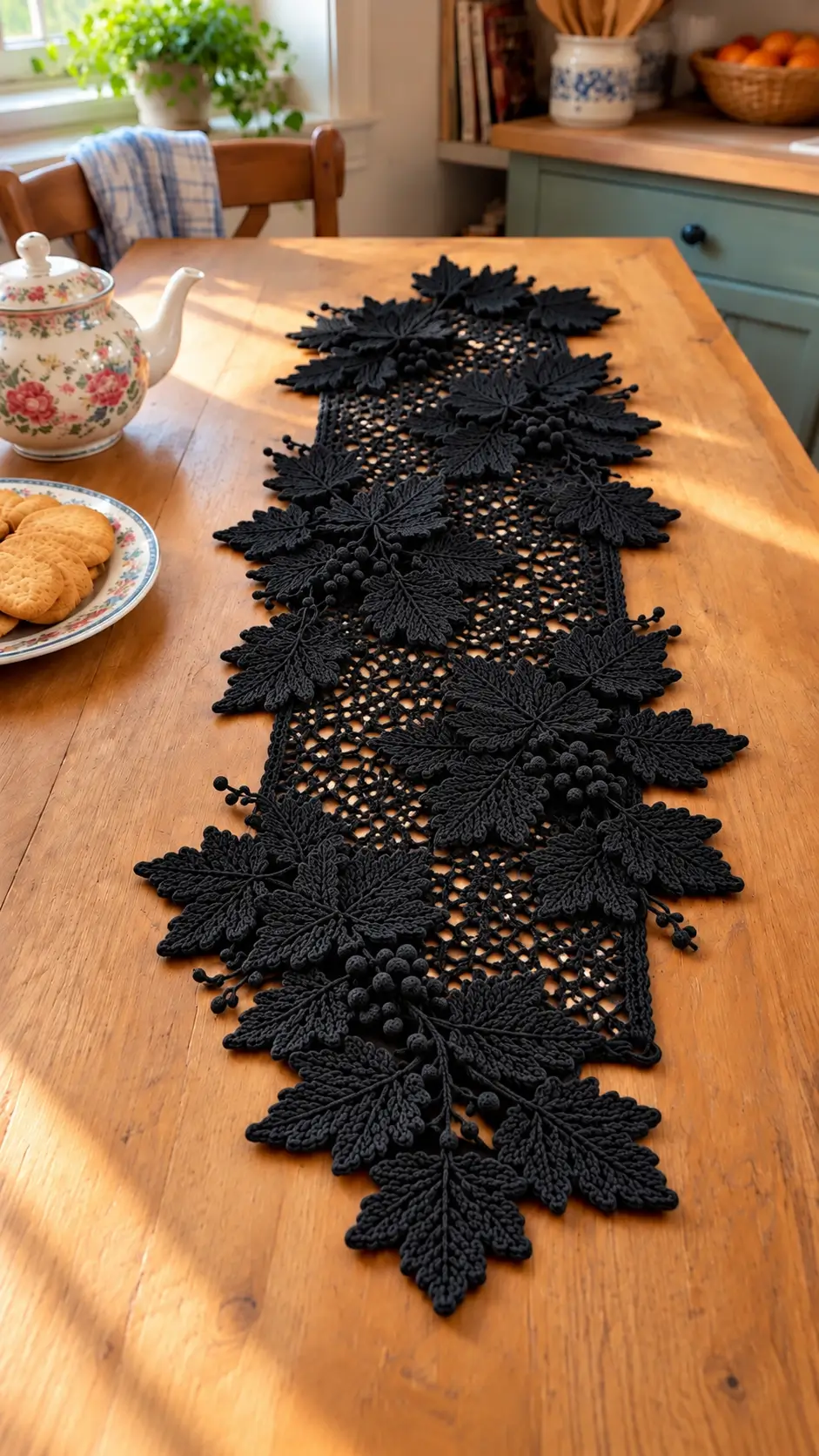
Grape leaves need deep fingered lobes and visible veins; without both, this all-black runner loses its botanical identity. This black crochet grape leaf table runner combines an open mesh center with layered vine leaves, dimensional berry clusters and curling tendrils. The monochrome construction makes texture do the work normally handled by color. Using cotton or a firm cotton blend, the finished runner measures approximately 38 × 120 cm.
The Design: What Makes This Black Botanical Runner Different
The center is deliberately light and open. A rectangular chain mesh creates a stable foundation without competing with the large leaves positioned along both sides. That contrast matters because black yarn reduces visible stitch separation; dense leaves placed over open mesh remain readable even from several feet away.
The second structural decision is the five-lobed grape leaf. Each motif has a dominant central point, two medium side lobes and two smaller lower lobes. Surface crochet creates the veins after the leaf is complete. Several leaves overlap the mesh edge, producing the irregular silhouette visible in the reference.
Finally, dimensional berries and thin tendrils break up the broad black areas. The most common construction error is attaching the leaves before blocking the mesh. That can permanently pull the runner toward the heavier decorated side.
Project Info at a Glance
| Skill Level | Time | Finished Size | Main Hook | Construction |
|---|---|---|---|---|
| Intermediate | 14–20 hours | Approx. 38 × 120 cm | 3.5 mm | Mesh panel with sewn botanical motifs |
The dimensions are a working target for this photo-inspired construction rather than a measurement taken directly from the photograph. Length can be changed by adding or removing mesh repeats before the decorative motifs are attached.
Materials and Tools
Yarn
- Black mercerized cotton or firm cotton-blend yarn, DK to light worsted — approximately 550–700 g total
- Black yarn for center mesh — approximately 180–220 g
- Black yarn for large leaves — approximately 280–350 g
- Black yarn for berries and tendrils — approximately 70–100 g
Using one black yarn throughout produces the closest visual match. If two yarns are combined, match their undertones under daylight; blue-black and brown-black can look noticeably different when placed together.
Tools
- 3.5 mm crochet hook for the mesh and leaves
- 3.0 mm crochet hook for firm berries
- Large-eye yarn needle
- Scissors
- Locking stitch markers
- Flexible measuring tape
- Blocking mats
- Rustproof pins
- Small amount of black or dark polyester stuffing
Abbreviations
- MR — magic ring
- ch — chain
- sc — single crochet
- hdc — half double crochet
- dc — double crochet
- tr — treble crochet
- dtr — double treble crochet
- inc — increase
- dec — decrease
- sl st — slip stitch
- sp — space
- st / sts — stitch / stitches
- picot — ch 3, sl st into first ch
Surface slip stitches are added after the leaves are finished. Keep these stitches loose enough that the leaf remains flat.
Gauge and Finished Measurements
For the mesh, target approximately 10 chain spaces per 15 cm after light blocking. The exact stitch gauge is less important than producing a rectangular panel with square or slightly diamond-shaped openings.
The center mesh should finish at approximately 25–27 cm wide and 100–105 cm long. Leaves extend beyond both long sides, bringing the total runner width to approximately 38 cm and the total length close to 120 cm.
Make one large leaf before completing the full set. A useful target is approximately 16–18 cm across after blocking.
Center Mesh Panel
Use black yarn and a 3.5 mm hook.
Ch 58.
Row 1
Sc in second ch from hook.
*Ch 5, skip 3 ch, sc in next ch.*
Repeat across, adjusting the final space if required so both sides finish evenly.
Row 2
Ch 5, turn.
Sc into the center of the first ch-5 space.
*Ch 5, sc into the next ch-5 space.*
Repeat across.
Rows 3–84
Repeat Row 2.
Lay the mesh flat every 10 rows. The sides should remain approximately parallel rather than narrowing toward the center.
Continue until the panel measures approximately 100–105 cm long without stretching.
Do not fasten off.
Mesh Border
Border Round 1
Ch 1.
Work sc evenly around all four sides.
Place approximately 3 sc into each corner.
Along the long edges, distribute the stitches so the mesh remains flat rather than gathering.
Join with sl st.
Border Round 2
Ch 1.
Sc in each stitch around.
Work 3 sc in the center stitch of every corner.
Join and fasten off.
This compact border provides a stronger sewing area for the botanical motifs.
Large Five-Lobed Grape Leaf – Make 10
Use black yarn and a 3.5 mm hook.
The runner uses several large leaves as its dominant decoration. They are constructed around a central ring with five separate lobes.
Leaf Center
R1: 10 sc in MR. Join with sl st. (10)
Do not close the ring too tightly until the five lobe positions have been identified.
Central Lobe
From the first marked stitch, ch 17.
Starting in second ch from hook:
Sl st, sc, hdc, dc in next 3 ch, tr in next 5 ch, dc in next 3 ch, hdc in next 2 ch, sc.
Work 5 sc into the final chain.
Continue along the opposite side of the foundation chain and mirror the stitch sequence back toward the center.
Sl st into the next stitch of the center ring.
First Side Lobe
Ch 14.
Starting in second ch:
Sl st, sc, hdc, dc in next 3 ch, tr in next 4 ch, dc in next 2 ch, hdc, sc.
Work 3 sc at the outer tip.
Mirror the sequence down the opposite side.
Sl st into the next center stitch.
Second Side Lobe
Repeat the first side lobe on the opposite side of the central lobe.
Lower Lobe 1
Ch 11.
Starting in second ch:
Sl st, sc, hdc, dc in next 2 ch, tr in next 3 ch, dc, hdc, sc.
Work 3 sc at the tip.
Mirror the stitches along the opposite side.
Attach to the center.
Lower Lobe 2
Repeat the previous lower lobe on the opposite side.
Grape Leaf Outer Shaping
Join black yarn at the base of one lower lobe.
Sc around the complete perimeter.
At each major lobe tip work:
(sc, ch 2, sc).
At selected positions along the sides, work a small picot to produce the serrated outline visible in the reference.
Use sl st in the deep spaces between lobes. This pulls the valleys inward and keeps the five points distinct.
Join at the base and fasten off with a 30 cm sewing tail.
Raised Leaf Veins
Join black yarn at the leaf center.
Surface sl st along the center of the largest lobe until approximately 1 cm before its tip.
Fasten off.
Repeat from the center toward each of the four remaining lobes.
For more relief, add one short secondary vein branching from the main vein on each large lobe.
Do not pull these surface stitches tightly. A shortened vein makes the corresponding lobe curl upward.
Medium Grape Leaf – Make 8
Use the same five-lobed construction but shorten each foundation chain.
- Central lobe: ch 14
- Upper side lobes: ch 11
- Lower lobes: ch 9
Work the same progression from shorter to taller stitches and back down again.
Finish with sc around the outer edge, small picots and surface-crocheted veins.
The blocked medium leaf should measure approximately 12–14 cm across.
Small Grape Leaf – Make 6
Small leaves fill narrow spaces near berry clusters and the runner ends.
Begin with 8 sc in MR.
Work five short lobes around the center using foundation chains between 6 and 10 chains long.
Keep the central lobe longest.
Finish the perimeter with sc and one ch-2 point at each lobe tip.
Block to approximately 8–10 cm across.
Black Grape Berry – Make 45 to 55
Use black yarn and a 3.0 mm hook.
R1: 6 sc in MR. (6)
R2: Inc ×6. (12)
R3: Sc around. (12)
R4: Sc around. (12)
Add a very small amount of dark stuffing.
R5: Dec ×6. (6)
Fasten off and close.
Each berry should remain compact, approximately 1.5–2 cm across depending on yarn.
Small Berry – Make 20 to 30
For the tiny berries at the ends of the branching stems:
R1: 6 sc in MR. (6)
R2: Sc around. (6)
Fasten off without stuffing.
Pull the yarn tail through the center to round the berry.
Large Grape Cluster – Make 5
Arrange approximately 8–10 standard berries into a loose triangular bunch.
Place four berries across the widest upper area.
Add three below them, then two, then one at the bottom.
Using black yarn and a tapestry needle, sew through the side of each berry rather than directly through its center.
Pass through the group several times until it behaves as one flexible cluster.
Leave a 35 cm tail for attaching the bunch to the runner.
Small Grape Cluster – Make 5 to 7
Use 4–6 berries per cluster.
Arrange them irregularly rather than creating a perfect triangle.
Small clusters work well near the ends of the runner and beside medium leaves.
Branching Berry Stem – Make 6
Ch 24.
Sl st in second ch from hook and in next 4 ch.
Ch 7.
Sl st back along the branch.
Continue sl st along the main chain for 4 stitches.
Ch 6 and sl st back to form a second branch.
Repeat until 3–4 side branches have been created.
Fasten off with a long sewing tail.
Sew one tiny berry to the end of each branch.
Curly Vine Tendril – Make 10 to 14
Ch 25.
Work 3 sc into second ch from hook.
Work 3 sc into each remaining chain.
The strip will coil naturally.
For a looser curl, alternate 2 sc and 3 sc in each chain.
Fasten off with a 20 cm tail.
Long Vine Stem – Make 4
Ch 45.
Sl st in second ch and each chain across.
At approximately every eighth chain, add a small side branch:
Ch 5, sl st back down the branch, then continue along the main stem.
Attach small leaves or tiny berries to selected branch ends.
Planning the Botanical Arrangement
Block the center mesh and every leaf before beginning assembly.
Place the runner lengthwise on a large table or blocking surface.
Start with the largest leaves. Position them in irregular groups rather than equal pairs.
Allow approximately one-third of selected leaves to extend beyond the mesh border. Other leaves should overlap the mesh itself.
Rotate neighboring leaves so their central veins point in different directions. A repeated parallel arrangement looks more geometric than the botanical composition in the reference.
Position grape clusters close to the bases of large leaves. Keep the largest clusters away from the exact center of the runner if plates or serving dishes will be placed there.
Suggested Motif Layout
At the first end, place two large leaves with one medium leaf beneath them. Add one large berry cluster near their shared base and allow one branching berry stem to extend beyond the edge.
Approximately 20 cm farther along, place one large leaf across the right edge and a medium leaf toward the left.
Near the central area, group two large leaves with one smaller leaf. Keep the center of the mesh partly visible so the openwork remains an important part of the design.
Repeat a related arrangement in the second half without creating an exact mirror image.
Finish the opposite end with a broad three-leaf cluster and one grape bunch extending toward the end point.
Attaching the Leaves
Pin every major leaf before sewing the first one.
Thread a yarn needle with the long attachment tail.
Sew through the leaf center first.
Add attachment stitches along the lower third of each lobe.
Leave the outer 2–4 cm of selected lobe tips unattached. The slight lift produces the dimensional appearance visible in the reference.
Do not sew continuously around the full perimeter. A completely flattened leaf loses much of its vein texture.
Attaching Grape Clusters
Place each cluster near a leaf junction.
Sew the upper row of berries securely to the mesh or to the dense leaf base.
Add one hidden attachment point through the middle of the cluster.
Leave the lower berries slightly mobile.
This prevents the cluster from appearing compressed against the runner.
Decorative Outer Edge
The runner does not require a conventional scalloped border because the leaf points create the outer silhouette.
If additional definition is wanted, join black yarn to the mesh border between two leaf groups.
*Sc in next 3 sts, ch 3, sl st into first ch.*
Repeat until reaching the next leaf.
Fasten off and repeat only in exposed sections.
Avoid working this edging beneath attached leaves because the extra thickness can create raised areas under tableware.
Blocking the Runner
Block the center mesh before assembly and perform a second light blocking after all flat motifs have been attached.
Pin the four corners of the mesh first.
Measure the width at the top, center and bottom. Keep all three measurements within approximately 1 cm.
Pin the long edges next.
Shape each leaf individually, opening the five lobes and defining the valleys between them.
Do not stretch the berry clusters.
Allow the runner to dry completely while lying flat.
Assembly
- Complete the rectangular black mesh panel and add two firm border rounds around all four sides.
- Block the mesh to approximately 25–27 × 100–105 cm and check that both long edges remain parallel.
- Crochet all large, medium and small grape leaves, then add their raised surface veins before blocking each motif.
- Pin the largest leaves along both sides of the mesh, allowing selected lobe tips to extend 5–8 cm beyond the border.
- Add medium and small leaves between the major motifs while keeping portions of the open mesh visible.
- Make the black berries, assemble five large clusters and several smaller bunches, and position them near leaf junctions.
- Attach the leaves through their centers and lower lobes while leaving selected outer tips free for dimensional relief.
- Sew grape clusters through their upper berries and add branching berry stems around the outer silhouette.
- Attach curly tendrils last, distributing them between leaves rather than concentrating them at one end.
- Weave all tails through black stitches, inspect the reverse for loose loops and complete a final light blocking.
The finished runner should combine a narrow openwork center with irregular layers of five-lobed black leaves, grape-like berry clusters and curling vine details.
7 Technical Tips for a Better Black Crochet Table Runner
- Work black yarn under strong lighting. Missed mesh spaces are difficult to identify after several rows. Count the chain arches every 5–10 rows so the panel does not gradually lose width.
- Keep the mesh width within 1 cm. A narrow middle produces an hourglass-shaped runner after blocking. Measure the panel at regular intervals while working the 100 cm length.
- Block every large leaf before assembly. A 16 cm leaf attached while curled can pull several mesh spaces out of alignment. Pin all five lobes separately and allow them to dry completely.
- Do not overfill the berries. A 12-stitch berry needs only a small pinch of stuffing. Excess filling exposes pale fiber through black stitches and makes the cluster rigid.
- Leave 2–4 cm of the leaf tips free. Sewing every lobe completely flat removes the layered effect. Secure the center and lower portions instead.
- Keep surface veins relaxed. A vein shortened by even 5 mm can curl the corresponding lobe. Compare the leaf against a flat surface after completing each vein.
- Distribute dimensional clusters away from serving areas. A berry bunch can rise 2–3 cm above the table. Position the largest groups toward the sides when the runner will sit beneath bowls or serving dishes.
How to Make a Shorter Black Table Runner
For a small dining table or coffee table, stop the center mesh at approximately 65–70 cm.
Use six large leaves, four medium leaves and three berry clusters.
Keep the full 25–27 cm mesh width. Reducing both width and length can make the large five-lobed leaves dominate the entire piece.
How to Make a Longer Runner
Continue the mesh repeat until the center measures the required length.
For every additional 20–25 cm, add approximately two large leaves, two medium leaves and one berry cluster.
Do not repeat the exact same arrangement. Rotate the leaves and alternate which side receives the larger cluster so the botanical layout remains irregular.
Choosing Yarn for an All-Black Design
Stitch definition is the main consideration. A smooth cotton or tightly twisted cotton blend shows the five-lobed leaves, mesh openings and berry shapes more clearly than heavily brushed yarn.
Matte black emphasizes silhouette. Mercerized cotton reflects more light and can make the vein stitches easier to see.
Use the same dye lot when possible. Small black color differences are especially visible in daylight when one yarn has a charcoal, blue or brown undertone.
Making the Leaves More Dramatic
Increase only the central and upper side lobes rather than enlarging the entire motif equally.
Add 2–3 chains to the central lobe and 1–2 chains to each upper side lobe. Keep the lower lobes unchanged.
This creates a longer pointed silhouette without producing an oversized circular leaf.
Additional surface veins can also increase definition. Use one main vein per lobe and no more than two short branches on the largest sections.
Keeping the Runner Functional
The raised botanical motifs make this design best suited to the center of a dining table rather than directly beneath dinner plates.
Keep the central 12–15 cm of mesh relatively free from large berry clusters if serving dishes will be used.
Leaves can overlap this area because they remain comparatively flat. Position the stuffed berries toward the outer third of the runner.
For a completely flat version, replace the dimensional berries with small crocheted circles sewn directly to the leaf bases.
Care Instructions
Follow the washing directions for the selected yarn. A large runner with dimensional leaves and berries is easier to maintain when washed by hand or on a gentle cycle inside a mesh laundry bag.
Press excess water between towels rather than twisting the runner.
Lay it flat and reshape the center mesh first. Open each leaf lobe while damp and separate any tendrils that have become tangled.
Allow the berry clusters to dry completely before storing the runner. Store it flat or loosely rolled around a wide tube rather than folding directly through the large leaf motifs.
Conclusion
The five-lobed leaves provide the structure that makes this black crochet grape leaf table runner recognizable despite its single-color palette. Build the rectangular mesh first, block it to consistent measurements, then crochet and shape every leaf before planning the final botanical arrangement. Berry clusters and tendrils come last because their placement depends on the open spaces left between the larger motifs. Begin with one 16–18 cm grape leaf and a small mesh swatch to test how clearly the stitches show in your chosen black yarn. Save the finished runner to Pinterest or share it on Instagram with #BlackGrapeLeafRunner. Would you keep every motif black or add a single dark burgundy grape cluster?