Introduction
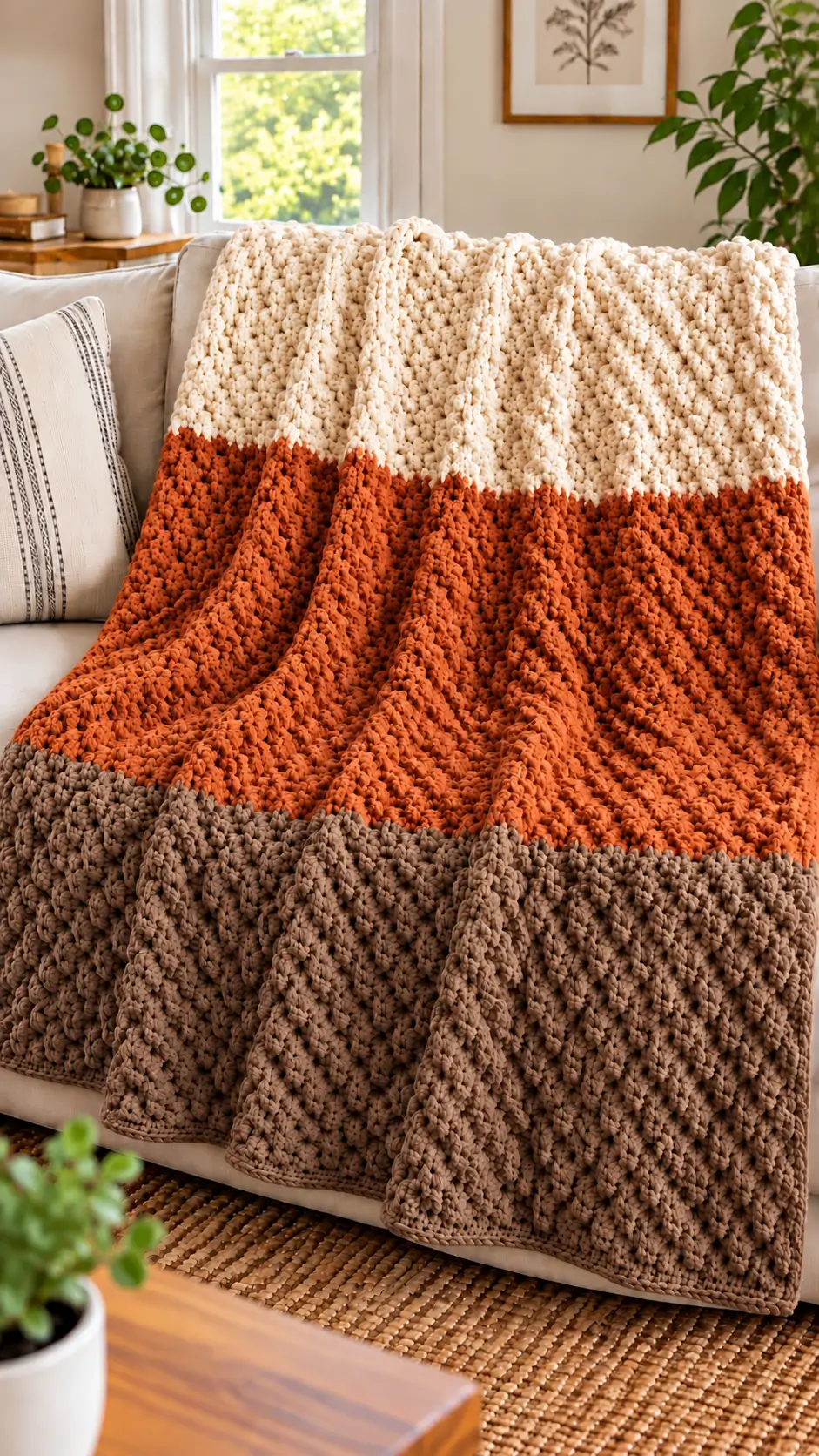
Three unequal bands are what give this rust, cream, and taupe blanket its distinctive proportions. This chunky color block crochet blanket uses #6 super bulky yarn, a 10 mm hook as a starting point, and a simple textured row repeat. The target size is approximately 120 × 140 cm. It suits an advanced beginner and provides a practical sofa throw that can be resized from gauge.
The Design: What Makes This Color Block Blanket Different
The color proportions do most of the visual work. Instead of dividing the blanket into three identical stripes, the rust center occupies the dominant area while cream and taupe frame it. That decision reproduces the strong horizontal structure visible in the reference photograph without claiming to duplicate an unseen original pattern.
A dense stitch is equally important. Very open stitches would change both the drape and appearance of a three color crochet blanket, particularly with thick yarn. The third decision is to work the entire piece flat rather than joining separate panels. Fewer seams mean fewer changes in thickness across the blanket.
One frequent error in a super bulky crochet blanket is assuming that yarn weight alone determines dimensions. It does not. Hook size, fiber, stitch choice, and individual tension can alter width considerably, so the starting chain must be checked against a swatch.
Project Info at a Glance
| Skill Level | Time | Finished Size | Hook | Best For |
|---|---|---|---|---|
| Advanced Beginner | Approx. 10–16 hours | Approx. 120 × 140 cm | 10 mm | Sofa throw / large lap blanket |
The 120 × 140 cm target is based on common throw proportions and published chunky color-block blanket dimensions. Actual measurements depend on yarn choice and individual gauge.
Materials and Tools
Yarn
Use #6 super bulky yarn in three colors. A washable chenille-style blanket yarn will create an appearance closer to the photographed blanket, while a conventional spun acrylic or wool-blend yarn will produce clearer stitch definition.
- Taupe/brown: #6 super bulky — approximately 450–600 g
- Burnt orange/rust: #6 super bulky — approximately 700–850 g
- Cream/ivory: #6 super bulky — approximately 450–600 g
These quantities are planning estimates for this construction rather than quantities identified from the photograph. Yarn consumption changes with fiber, meterage per ball, gauge, hook size, and final blanket dimensions.
Purchase according to meterage as well as grams. Two 100 g super bulky yarns can contain substantially different lengths.
Tools
- 10 mm crochet hook
- #6 super bulky yarn
- Large-eye tapestry needle
- Scissors
- Locking stitch markers
- Tape measure
- Digital kitchen scale — optional for monitoring yarn consumption
The 10 mm hook is a starting size. Increase the hook size if the fabric is excessively rigid or decrease it if the stitches are too loose.
Abbreviations
- ch — chain
- sc — single crochet
- hdc — half double crochet
- BLO — back loop only
- st(s) — stitch(es)
- sl st — slip stitch
- RS — right side
- WS — wrong side
This blanket uses no increases, decreases, or amigurumi-style shaping.
Gauge and Sizing
Make a swatch before beginning the full foundation chain. Super bulky yarns vary considerably in thickness even when they carry the same weight classification.
For this pattern, begin by testing the following approximate gauge:
7 hdc × 6 rows = approximately 10 × 10 cm in the established textured pattern.
Treat this measurement as the pattern target rather than a universal gauge for #6 yarn.
For approximately 120 cm of width:
120 ÷ 10 × 7 = 84 stitches.
The foundation therefore begins with ch 85, producing 84 working stitches when the turning chain does not count as a stitch.
If 84 stitches measure only 110 cm with your yarn and tension, increase the foundation count according to the actual swatch. If they measure substantially more than 120 cm, reduce the count.
Chunky Color Block Crochet Blanket Pattern
Construction: Worked flat in rows.
Target dimensions: Approximately 120 × 140 cm.
Stitch count: 84 stitches throughout.
Foundation
Yarn: taupe/brown.
Foundation: Ch 85 loosely.
Row 1: Hdc in second ch from hook and in every ch across. Turn. (84 sts)
Measure the width at this point. The target is approximately 120 cm.
If the width differs by more than approximately 5 cm, correct the foundation chain before continuing. Making this adjustment now prevents a significant size discrepancy after all three color sections have been completed.
Taupe Lower Section
The lower taupe or brown block occupies approximately one quarter of the finished blanket length.
Row 2: Ch 1, hdc BLO in each st across. Turn. (84)
Row 3: Ch 1, hdc in each st across. Turn. (84)
Row 4: Ch 1, hdc BLO in each st across. Turn. (84)
Row 5: Ch 1, hdc in each st across. Turn. (84)
Repeat Rows 2–5 until the taupe section measures approximately 35 cm, ending after a complete row.
The alternating standard and back-loop rows create controlled horizontal texture without producing extremely deep ribs.
Keep the stitch count at 84 stitches throughout this section.
Changing from Taupe to Rust
On the final taupe stitch, begin the last hdc normally but stop before completing the final yarn-over. Drop the taupe yarn.
Yarn over with rust and pull the new color through the remaining loops.
Cut the taupe yarn, leaving a tail of approximately 15 cm for weaving.
This method places the new color directly into the final stitch and avoids creating a knot on the blanket edge.
Rust Center Section
Yarn: burnt orange/rust.
The center color block is deliberately larger than either outer section.
Next Row: Ch 1, hdc BLO across. Turn. (84)
Next Row: Ch 1, hdc across. Turn. (84)
Continue alternating these two rows until the rust section measures approximately 65 cm.
The cumulative blanket length should now measure close to 100 cm.
Count the stitches every five to ten rows. Each row must contain 84 stitches.
Dropped edge stitches are particularly easy to miss when using chenille yarn because the turning area has less visible definition than conventional plied yarn. Place a locking stitch marker in the first and last stitch of the row if necessary.
Changing from Rust to Cream
Begin the final rust hdc and stop before its last yarn-over.
Complete the final pull-through using the cream yarn.
Cut the rust yarn, leaving approximately 15 cm for weaving.
Before beginning the next row, count the stitches again. The cream section should begin with exactly 84 stitches.
Cream Upper Section
Yarn: cream/ivory.
Next Row: Ch 1, hdc BLO in every stitch. Turn. (84)
Next Row: Ch 1, hdc in every stitch. Turn. (84)
Continue alternating these two rows until the cream section measures approximately 40 cm or the complete blanket reaches approximately 140 cm.
The planned color-block measurements are:
- Taupe: approximately 35 cm
- Rust: approximately 65 cm
- Cream: approximately 40 cm
Total planned length: approximately 140 cm.
The unequal dimensions are intentional. They preserve the dominant rust center section visible in the reference design rather than dividing the blanket into three identical stripes.
Final Row
Work one final standard hdc row across. (84)
Fasten off with a tail approximately 20 cm long.
Do not add fringe if the goal is to retain the clean three-block appearance.
Optional Edge Finish
The reference blanket does not show a strongly contrasting decorative border. For that reason, a simple stabilization round works better than a large ornamental edging.
If the side edges need additional structure, join matching yarn at one corner and work one round of sc around the entire blanket.
Along the top and bottom edges, place one sc into each stitch.
Along both side edges, distribute the stitches evenly. Do not automatically force one sc into every visible strand because excessive stitches can make a super bulky border flare.
At each corner, work 3 sc into the corner stitch or space.
Join with a sl st and fasten off.
How to Resize the Blanket
The most accurate resizing method starts with your own gauge rather than a generic foundation-chain chart.
If your swatch produces 7 stitches per 10 cm, calculate the required number of stitches with this formula:
Desired width in centimeters × 0.7 = approximate stitch count.
For a 100 cm wide lap blanket:
100 × 0.7 = 70 stitches.
For a 150 cm wide blanket:
150 × 0.7 = 105 stitches.
Add one turning chain to obtain the foundation-chain count for this construction.
Blanket length is adjusted by adding or removing rows. Continue until the desired measurement is reached rather than depending exclusively on a predetermined number of rows.
Keep the Three Color Sections in Proportion
Maintain approximately 25% taupe, 46% rust, and 29% cream if you want a resized blanket to retain the same visual proportions.
For a 140 cm blanket, this pattern uses approximately:
- 35 cm taupe
- 65 cm rust
- 40 cm cream
For a 160 cm version, proportional sections would be approximately:
- 40 cm taupe
- 74 cm rust
- 46 cm cream
Measure the sections in centimeters rather than relying entirely on row counts. Changes in hand tension can alter row height over a large project.
Assembly and Finishing
- Lay the completed blanket flat without stretching the fabric.
- Measure the width at the top, center, and bottom.
- Check each color-change row for accidentally dropped edge stitches.
- Thread each 15–20 cm yarn tail onto a large tapestry needle.
- Weave every tail through stitches of the same color.
- Reverse direction at least once to reduce the chance of the tail moving during washing.
- Trim the tails only after they are securely woven into the fabric.
- Add the optional single-crochet edging if the side edges require additional stabilization.
- Wash and dry the blanket according to the yarn manufacturer’s care instructions.
- Measure the finished blanket again after the fabric has returned to its normal relaxed state.
The completed blanket should have three uninterrupted horizontal color blocks, with the rust center occupying the largest portion.
7 Technical Tips for a Chunky Crochet Blanket
- Mark both edge stitches. The main failure mode is accidentally skipping the final hdc, reducing an 84-stitch row to 83 stitches and gradually producing a diagonal side.
- Measure the width every 10 rows. If a nominal 120 cm blanket contracts by more than approximately 5 cm, tension has changed enough to affect the final dimensions.
- Leave color-change tails at least 15 cm long. Very short tails can pull free during washing, particularly when the yarn has a smooth chenille construction.
- Change colors during the final pull-through. Tying the replacement yarn between rows can produce a hard knot or visible bump directly on the blanket edge.
- Measure the rust block at approximately 65 cm. A small row-gauge change multiplied across the largest section can shift the cream boundary several centimeters.
- Test chenille yarn before repeatedly frogging rows. Pulling out the same section several times can damage the yarn surface or separate the outer pile from its core.
- Weigh the remaining cream yarn before the final section. Measuring the amount consumed by a 10 cm sample gives a more useful estimate than judging the remaining yarn by the apparent size of the skein.
Why Gauge Matters More With Chunky Yarn
Large yarn does not remove the need for gauge. Small differences become more noticeable because every stitch occupies considerably more space.
Two yarns carrying the same super bulky classification may behave differently with the same crochet hook. Fiber construction, elasticity, chenille pile, twist, and meterage can all affect the resulting fabric.
The same problem applies to crocheters. One person may obtain the required dimensions with a 10 mm hook while another needs a larger or smaller hook.
For this reason, use 10 mm as the starting hook for this chunky crochet blanket pattern and change the hook size only after evaluating the swatch.
Color Placement
The burnt orange or rust section should remain the dominant block if the goal is to reproduce the proportions visible in the reference photograph.
Dividing the blanket into exact thirds creates a different design. Equal blocks would each measure approximately 46.7 cm on a 140 cm blanket, considerably reducing the visual dominance of the center color.
The 35 cm taupe, 65 cm rust, and 40 cm cream arrangement produces a stronger central field while leaving enough depth in both outer colors to frame it.
You can substitute other colors without changing the construction. Keep the same measurements if you want to preserve the original three-block balance.
Conclusion
A successful chunky color block crochet blanket depends on controlled proportions and consistent gauge rather than complicated stitch work. Make a 10 × 10 cm swatch with the selected #6 yarn first, calculate the foundation from the measured gauge, and keep the center color section larger than the two framing blocks. The next step is to test the 10 mm hook and record both stitch and row gauge before purchasing the full yarn quantity. Save the finished blanket to Pinterest or share your three-color version on Instagram with #ChunkyColorBlockBlanket. Which section would you change first: the 35 cm taupe block, 65 cm rust center, or 40 cm cream block?