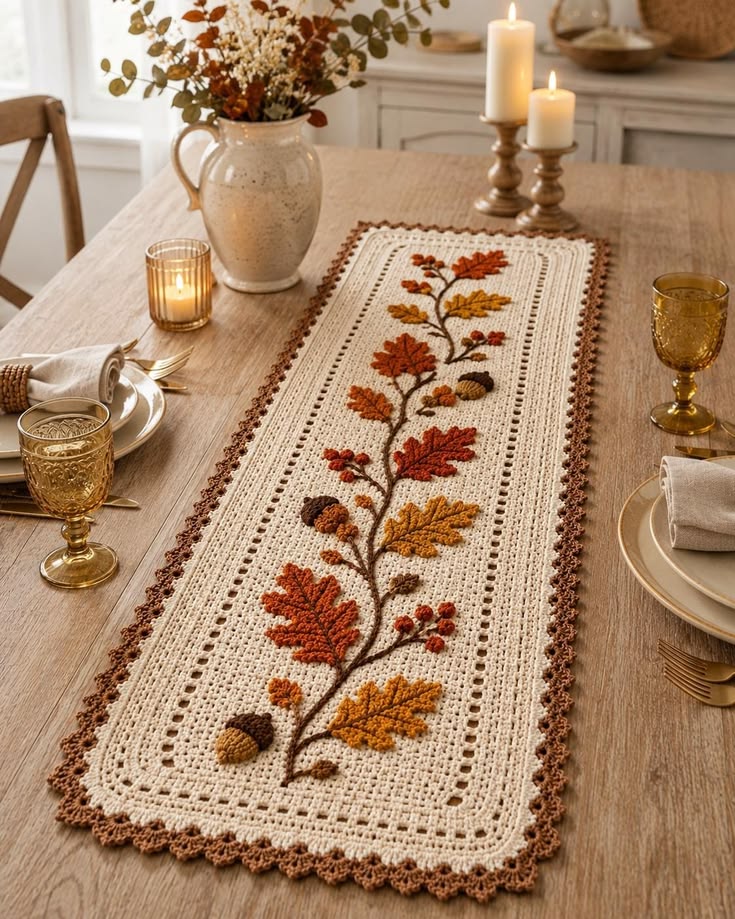
Oak leaves need deep side lobes and a strong center vein or they lose their identity when translated into crochet. This autumn leaves crochet table runner pattern uses an ivory rectangular base with openwork borders, raised brown branches, rust and golden leaves, berry clusters, acorns and a brown scalloped edging. Worked mainly in cotton yarn, the runner is designed for intermediate crochet skills and can be lengthened for different dining tables.
The Design: What Makes This Autumn Table Runner Different
The central decoration is built separately from the runner base. That decision matters because trying to create detailed oak leaves inside ordinary filet crochet would flatten the lobes and restrict color placement. Individual appliqués can instead be positioned along a branching stem after the rectangular foundation is blocked.
A second structural decision is the double openwork frame. Rows of small square openings separate the botanical center from the denser outer bands, making the cream background lighter without weakening the middle of the runner.
Published autumn table runners range considerably in construction and size. One documented filet design measures about 20 × 100 cm using DK cotton and a 3 mm hook, while an acorn-themed worsted-weight runner measures about 24 × 96.5 cm with a 4 mm hook. The pattern below uses the latter proportions as a practical target for the photo-inspired design.
Project Info at a Glance
| Skill Level | Construction | Finished Size | Hook | Yarn |
|---|---|---|---|---|
| Intermediate | Rectangular base + appliqués | Approx. 24 × 96 cm | 4 mm | Worsted cotton |
The photograph does not provide its original pattern, dimensions or yarn specifications. The approximately 24 × 96 cm target is based on a comparable published autumn acorn table runner measuring 9.5 × 38 inches. Adjust the foundation and row count if your dining table requires a different length.
Materials and Tools
Yarn
- Ivory or natural cream — worsted-weight cotton — approximately 250–300 g for the runner
- Dark brown — worsted-weight cotton — approximately 40–50 g for branches, acorns and edging
- Rust orange — worsted-weight cotton — approximately 30–40 g for leaves and berries
- Golden mustard — worsted-weight cotton — approximately 25–35 g for leaves and acorns
- Burnt orange — worsted-weight cotton — approximately 20–30 g for accent leaves and berries
The color quantities are planning estimates for this photo-inspired version. Actual yarn consumption changes with gauge, runner length, appliqué size and border depth.
Tools
- 4 mm crochet hook
- 3.5 mm crochet hook for firmer appliqués if required
- Yarn needle
- Locking stitch markers
- Scissors
- Blocking mats and rust-resistant pins
- Flexible measuring tape
Abbreviations
- MR — magic ring
- ch — chain
- sc — single crochet
- hdc — half double crochet
- dc — double crochet
- tr — treble crochet
- sl st — slip stitch
- st(s) — stitch(es)
- sp — space
- ch-1 sp — chain-1 space
- ch-2 sp — chain-2 space
- RS — right side
- WS — wrong side
For the openwork section, a mesh space is formed by working a double crochet, chain stitch and skipped base stitch in a consistent sequence.
Finished Size and Gauge
Target approximately 24 cm wide × 96 cm long after blocking. A published Autumn Acorn Runner uses these approximate dimensions with worsted-weight cotton and a 4 mm hook, making that combination a useful technical benchmark for a dining-table runner.
Another published autumn filet runner measures approximately 20 × 100 cm with DK cotton and a 3 mm hook. These examples show that runner proportions can remain similar even when yarn weight changes.
For this version, work a small swatch before beginning. The finished fabric should lie flat without becoming so dense that the openwork squares disappear.
Autumn Leaves Crochet Table Runner Pattern
Ivory Center Panel
Yarn: ivory or natural cream.
The main rectangle is worked flat in rows. The botanical decoration is added after the base and border are complete.
Foundation: Ch 51.
Row 1: Dc in 4th ch from hook and in every chain across. Turn.
Row 2: Ch 3. Dc in each stitch across. Turn.
Row 3: Ch 3. Dc in first stitch, *ch 1, skip 1 stitch, dc in next stitch*. Repeat across, adjusting the final repeat if necessary to keep both edges solid. Turn.
Row 4: Ch 3. Dc in each dc and each ch-1 space across. Turn.
Rows 5–8: Dc across. Turn after each row.
Row 9: Repeat the openwork construction from Row 3.
Row 10: Repeat Row 4.
Continue working mostly solid double-crochet rows, inserting an openwork row at regular intervals to reproduce the narrow decorative channels visible along the sides of the reference runner.
Continue until the center panel measures approximately 88–90 cm long before the outer border.
Finish with at least two solid dc rows so both short ends have enough structure to support the edging.
Fasten off.
Openwork Frame
The reference image contains narrow rows of square openings near the perimeter. Adding the openwork frame after the center panel makes it easier to keep the central botanical area uninterrupted.
Frame Round 1
Join ivory yarn at one corner.
Ch 1 and sc evenly around the entire rectangle.
Work 3 sc in each corner.
Join with sl st.
Frame Round 2
Ch 3.
Dc in the next stitch.
*Ch 1, skip 1 stitch, dc in next stitch.*
Repeat along each side.
At each corner work:
(dc, ch 2, dc)
Adjust the last repeat on each side when necessary so the corners remain centered.
Join with sl st.
Frame Round 3
Ch 1.
Sc in each dc and ch-1 space around.
Work 3 sc in each corner ch-2 space.
Join with sl st.
Frame Round 4
Work dc in each stitch around.
At each corner work:
(2 dc, ch 2, 2 dc)
Join with sl st.
Frame Round 5
Repeat the openwork construction from Frame Round 2.
Fasten off ivory.
Brown Scalloped Crochet Border
Yarn: dark brown.
The narrow dark edging creates a clear boundary around the ivory field and repeats the branch color used through the center.
Border Round 1
Join dark brown in any corner.
Ch 1 and sc evenly around.
Work 3 sc at every corner.
Join with sl st.
Border Round 2
*Skip 1 stitch, work 5 dc in next stitch, skip 1 stitch, sl st in next stitch.*
Repeat around to create small scallops.
At the corners, adjust the spacing so one complete shell sits directly over or around each corner.
Fasten off and weave in the tail.
Raised Crochet Branch
Yarn: dark brown.
The long central branch should be installed before any leaves. It establishes the direction of the entire botanical composition.
Ch approximately 150–170, or enough to create a gently curved line running through most of the center panel.
Beginning in the second chain from the hook, sl st in every chain.
Fasten off, leaving a long sewing tail at both ends.
Lay the cord diagonally along the center of the runner rather than positioning it as a rigid vertical line.
Pin several shallow curves into the branch and sew it down with small matching stitches every 1–2 cm.
Small Branches
Make 8–12.
Ch 15–30 depending on the required branch length.
Sl st in each chain back to the beginning.
Fasten off with a long tail.
Attach the small branches to alternating sides of the main stem. Change their angles so the arrangement does not form a repetitive ladder.
Large Crochet Oak Leaves
Make 6–8 using rust, burnt orange and golden mustard.
The reference leaves have pronounced lobes and a central vein. Each leaf is worked around a foundation chain.
Ch 17.
Beginning in the second chain from the hook:
sl st, sc, hdc, dc, tr, dc, hdc, sc.
Now begin forming the lobed edge.
In the next stitch work:
(sc, hdc, dc, hdc, sc)
Sl st in the next stitch.
In the following stitch work:
(sc, hdc, tr, hdc, sc)
Sl st in the next stitch.
Work another smaller lobe:
(sc, hdc, dc, hdc, sc)
Work 3 sc in the final foundation chain to turn around the leaf tip.
Continue down the opposite side of the foundation chain, mirroring the lobes.
Join with sl st at the base.
Do not cut the yarn yet.
Leaf Stem and Vein
Ch 8 for the leaf stem.
Sl st back along the chain.
Surface sl st from the base toward the tip of the leaf to create the central vein.
Fasten off with a long sewing tail.
Block the lobes outward before attaching the leaf to the runner.
Small Crochet Oak Leaves
Make 5–7.
Ch 12.
Beginning in the second chain, work:
sl st, sc, hdc, dc, hdc, sc.
Form two small lobes using:
(sc, hdc, dc, hdc, sc)
Work 3 sc into the end chain and mirror the construction along the opposite side.
Ch 5 for the stem and sl st back toward the leaf.
Fasten off with a long tail.
Crochet Acorns
Make 3–5.
Acorn Nut
Yarn: golden mustard or burnt orange.
Round 1: 6 sc in MR. (6)
Round 2: Inc ×6. (12)
Round 3: (1 sc, inc) ×6. (18)
Rounds 4–6: Sc around. (18)
Round 7: (1 sc, dec) ×6. (12)
Add a very small amount of stuffing if a three-dimensional acorn is desired.
Round 8: Dec ×6. (6)
Fasten off and close.
Acorn Cap
Yarn: dark brown.
Round 1: 6 sc in MR. (6)
Round 2: Inc ×6. (12)
Round 3: (1 sc, inc) ×6. (18)
Round 4: Sc around. (18)
Fasten off with a long tail.
Fit the brown cap over the upper third of the acorn and sew around its lower edge.
For the stem, attach brown yarn at the center of the cap, ch 5 and sl st back along the chain.
Flat Acorn Option
If the runner needs to remain very flat under serving pieces, omit stuffing and work the acorn as two flat appliqué sections.
For the nut, ch 7 and work an oval around both sides of the chain. Use hdc and dc through the widest middle section, then taper toward the lower point with sc and sl st.
Make the cap separately in brown and sew it across the upper edge.
The flatter construction reduces bulk while retaining the acorn silhouette.
Autumn Berry Clusters
Make 15–20 individual berries in rust and burnt orange.
Round 1: 6 sc in MR. (6)
Round 2: Inc ×6. (12)
Round 3: Sc around. (12)
Round 4: Dec ×6. (6)
Fasten off.
For a flatter berry, omit stuffing and pull the final round closed.
Group berries in sets of three along the smaller brown branches. Sew each berry individually so the cluster does not rotate as one unit.
Small Autumn Buds
Make 6–10.
Using mustard or orange:
Round 1: 6 sc in MR. (6)
Round 2: Sc around. (6)
Fasten off and pull the opening closed.
These smaller elements can fill spaces where a full berry cluster or oak leaf would make the arrangement too dense.
Planning the Botanical Layout
Do not sew the leaves onto the runner immediately after making them. Complete the main branch, secondary branches, leaves, acorns and most berries first.
Lay the blocked runner flat and position the main branch through the center.
Place the largest rust leaves first. Distribute them from the lower third to the upper third rather than clustering them around the exact center.
Add golden leaves between the rust sections. Rotate each leaf slightly so their center veins point in different directions.
Position the acorns near branch junctions. The larger acorns work best toward the lower and middle sections because their visual weight can overpower the narrower top of the composition.
Fill remaining spaces with berry clusters and small buds.
Assembly
- Block the ivory runner base to its final rectangular dimensions before attaching any appliqués.
- Pin the long dark brown branch through the center with several shallow curves.
- Sew the main branch down using small brown stitches placed every 1–2 cm.
- Add the secondary branches, alternating their direction along the main stem.
- Position and sew the largest rust and orange oak leaves before adding smaller foliage.
- Add the golden mustard leaves, leaving visible ivory space between neighboring appliqués.
- Sew the acorns near branch junctions and secure both the cap and nut so they do not rotate.
- Add berry clusters in groups of three and place individual buds in smaller gaps.
- Inspect the reverse and weave all yarn tails through stitches of matching color.
- Steam or wet block lightly once more if the appliqués have distorted the runner during assembly.
The completed runner should remain rectangular and flat, with the central branch moving through the length of the ivory field without extending into the openwork border.
7 Technical Tips for a Crochet Table Runner
- Block the base before attaching the leaves. Sewing appliqués onto an unblocked rectangle can lock uneven edges into place and make final correction more difficult.
- Keep at least 2 cm between the appliqués and openwork frame. Leaves extending into the mesh can pull the open squares out of alignment.
- Use a smaller hook for floppy oak leaves. Dropping from 4 mm to approximately 3.5 mm produces firmer appliqués without changing the runner base.
- Secure large leaves at three or more points. Sewing only through the center vein allows the outer lobes to curl excessively during washing.
- Count openwork spaces on opposite sides. Unequal mesh counts can make one long edge appear stretched even when the center panel has the correct stitch count.
- Keep three-dimensional acorns away from place-setting zones. A raised acorn beneath a plate or serving dish makes the surface unstable; use the flat version in those areas.
- Measure both diagonals during blocking. If the two corner-to-corner measurements differ substantially, the runner is skewed rather than rectangular.
How to Lengthen the Table Runner
The central rectangular base can be extended before the border is added. Continue the established solid and openwork row sequence until the required length is reached.
Published autumn crochet runners demonstrate considerable variation in finished length. One filet design is approximately 20 × 100 cm, while another documented acorn runner provides instructions for customizing the finished dimensions.
For a six-seat dining table, a runner around 90–120 cm works for many layouts. Longer tables may require additional center rows and extra botanical motifs so the decoration does not appear concentrated in one small section.
When adding length, increase the number of branches and leaves rather than stretching the original arrangement farther apart.
How to Shorten the Table Runner
For a coffee table, sideboard or smaller dining table, stop the center panel earlier and reduce the number of appliqués.
Remove botanical elements symmetrically from both ends. Cutting only the upper section can leave the central branch visually weighted toward one end.
A compact runner can use four large leaves, two small leaves, two acorns and approximately three berry clusters while retaining the same autumn branch concept.
Choosing Yarn for a Table Runner
Cotton is a practical fiber for this project because it produces defined stitches and responds well to blocking. Published autumn table-runner patterns use cotton in several yarn weights, including size-10 thread, DK cotton and worsted cotton.
For the raised appliqué style shown here, worsted cotton gives the leaves enough substance to remain visible against the cream background.
If a finer heirloom appearance is preferred, move to DK cotton and a smaller hook. Recalculate the foundation width because using the same stitch count with thinner yarn will produce a narrower runner.
Making the Oak Leaves Look Defined
Color alone will not make a generic crochet leaf read as an oak leaf. The side edge needs multiple lobes, a pointed or rounded terminal lobe and a visible center vein.
Block each finished leaf before assembly. Pin the lobes separately instead of pulling only on the leaf tip.
Surface crochet can be used for stronger veins. Work a line of brown or darker matching slip stitches from the base toward the tip, then add short diagonal veins toward the major lobes.
Use this additional detail selectively. Too many contrasting veins can compete with the dark branch beneath the appliqués.
Border Troubleshooting
If the brown scalloped border ruffles, too many shells have been fitted around the perimeter. Remove the affected section and increase the number of skipped base stitches between selected shells.
If the border pulls inward, the opposite problem is occurring. Add a little more spacing or an additional shell where required.
Corners need particular attention. Pin each corner flat after completing several shells rather than waiting until the entire border is finished.
The final runner should rest on the table without requiring the scallops to be stretched outward manually.
Care and Blocking
Follow the washing instructions for the selected cotton yarn. After washing, press excess water out with a towel rather than twisting the runner.
Lay the piece on blocking mats and establish the rectangular shape first. Pin the four corners, then straighten the long edges.
Shape each scallop while the border is damp. Reposition any leaf lobes that folded during washing and allow the runner to dry completely before removing the pins.
Do not apply direct high heat to synthetic yarn substitutions. Cotton can also be damaged or flattened by excessive heat, particularly in the raised appliqué sections.
Conclusion
Complete and block the ivory foundation before arranging the botanical decoration, then install the brown branch as the alignment guide for every remaining motif. Large rust and golden leaves should establish the composition first; acorns, berries and smaller buds can fill the remaining branch spaces without crowding the openwork frame. Measure both diagonals after the final blocking to confirm that the runner remains square. Save this autumn leaves crochet table runner pattern to Pinterest and share the finished version on Instagram with #AutumnOakTableRunner. For this specific design, would you make the largest oak leaves rust orange or golden mustard? “`0