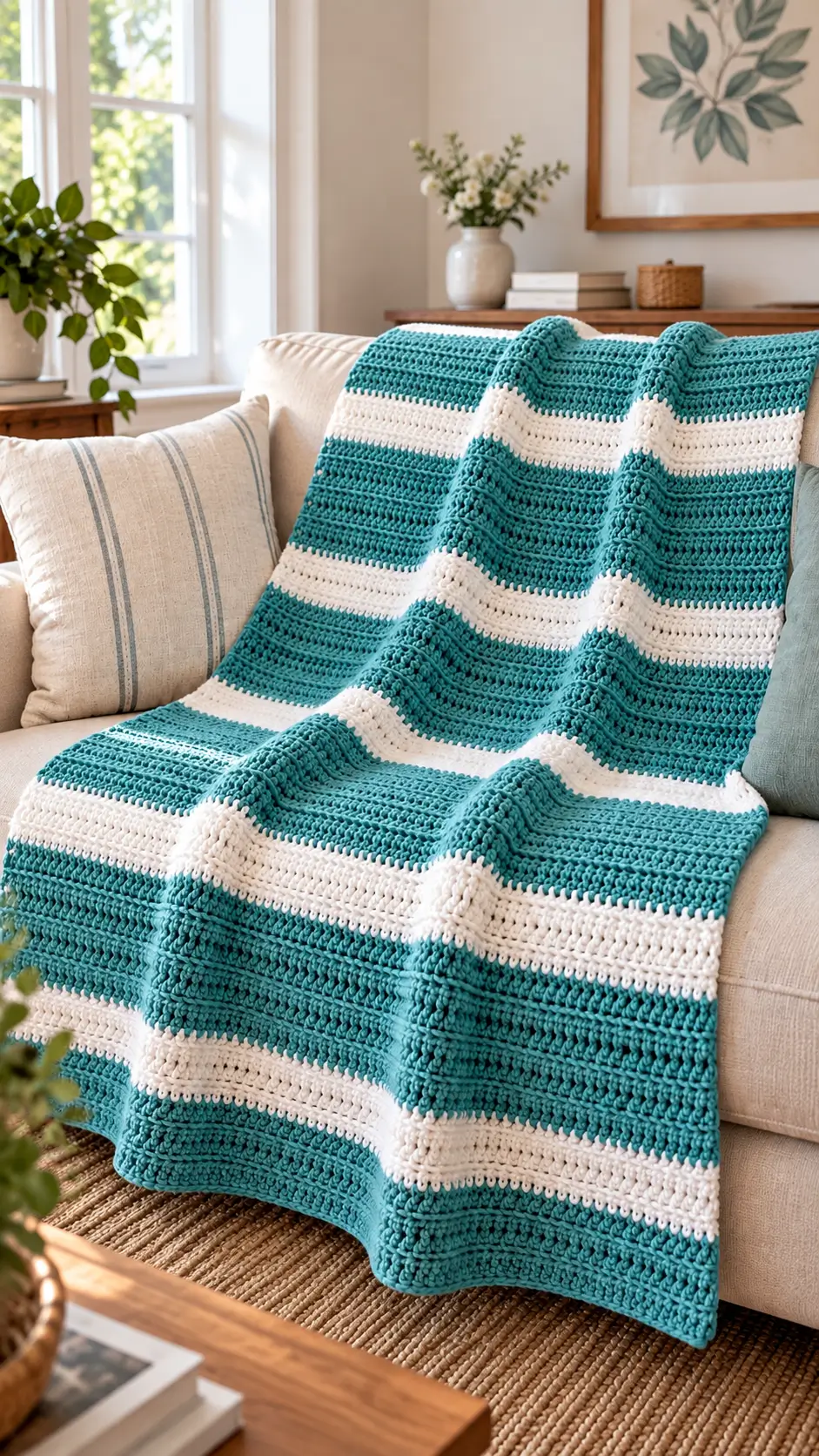
Wide teal fields separated by narrow ivory bands give this blanket its defining geometry. This teal and white striped crochet blanket pattern uses worsted-weight yarn, a 5 mm crochet hook, and a finished reference size of approximately 102 × 139 cm. The repeated stripe sequence limits color changes while producing a practical sofa throw with clearly defined horizontal texture.
The Design: What Makes This Striped Blanket Different
The design depends on proportion rather than a large color palette. Teal occupies most of the surface, while ivory works as a narrow separator. Keeping the contrast stripes smaller prevents the blanket from looking like a sequence of equal color blocks.
Texture is the second structural decision. Alternating standard half double crochet rows with back-loop-only rows creates horizontal relief without changing the basic stitch count. This gives the textured crochet blanket more definition than plain half double crochet while keeping the repeat manageable.
The border remains deliberately narrow. A compact single-crochet perimeter stabilizes the long row edges without competing with the striped surface.
A common mistake in a two color crochet blanket is losing or adding stitches at the turning edge. Repeating that error over several rows gradually produces a tapered rather than rectangular throw.
Project Info at a Glance
| Skill Level | Time | Finished Size | Hook | Best For |
|---|---|---|---|---|
| Advanced Beginner | Multi-session project | Approx. 102 × 139 cm | 5 mm / H | Sofa throw / lap blanket |
The finished dimensions are a reference target. Exact dimensions of the photographed blanket cannot be calculated from the image alone. Your yarn, hook, stitch height, and individual tension will affect the final measurement.
Materials and Tools
Yarn
- Teal — worsted/#4 yarn — approximately 700 g
- Ivory or warm white — worsted/#4 yarn — approximately 300 g
The color quantities are working estimates for this two-color version. Purchase additional yarn when dye-lot consistency is important. Using the same yarn line for both colors also helps maintain identical row height and fabric density.
Tools
- 5 mm / H crochet hook
- Large-eye tapestry needle
- Scissors
- Locking stitch markers
- Flexible tape measure
Abbreviations
- ch — chain
- sc — single crochet
- hdc — half double crochet
- BLO — back loop only
- sl st — slip stitch
- st — stitch
- sts — stitches
- RS — right side
- WS — wrong side
BLO means inserting the hook through only the back loop of the stitch. The unused front loop remains visible and forms the horizontal ridge that gives the blanket much of its texture.
Gauge and Sizing
Make a swatch before beginning the full blanket. Small differences in stitch width become significant when repeated across 126 stitches.
The target finished size for this version is approximately 102 × 139 cm. Treat that measurement as a reference rather than a guaranteed result.
The photographed blanket appears large enough to function as a sofa throw or lap blanket. Its exact centimeter dimensions cannot be established from the photograph.
To change the width, adjust the foundation chain while maintaining an even number of working stitches. Write down your final stitch count before beginning Row 2. Every subsequent row must contain the same number of stitches.
Teal and White Striped Crochet Blanket Pattern
Construction: The blanket is worked flat in turned rows.
Foundation and First Teal Section
Yarn: teal
Foundation: Ch 128.
Row 1: Hdc in third ch from hook and in every ch across. Turn. (126 sts)
Row 2: Ch 2, hdc in each st across. Turn. (126)
Row 3: Ch 2, hdc BLO in each st across. Turn. (126)
Row 4: Ch 2, hdc in each st across. Turn. (126)
Row 5: Ch 2, hdc BLO in each st across. Turn. (126)
Rows 6–13: Repeat Rows 4–5 four times. (126 stitches each row)
Do not count the turning chain as a stitch. Place a locking stitch marker in the first and last working stitch when necessary to prevent the edges from drifting.
First Ivory Stripe
Change to ivory during the final yarn-over of Row 13.
Row 14: Ch 2, hdc in each st across. Turn. (126)
Row 15: Ch 2, hdc BLO in each st across. Turn. (126)
Row 16: Ch 2, hdc in each st across. Turn. (126)
Row 17: Ch 2, hdc BLO in each st across. Turn. (126)
Row 18: Ch 2, hdc in each st across. Turn. (126)
Row 19: Ch 2, hdc BLO in each st across. Turn. (126)
The six-row ivory stripe remains narrower than the main teal sections, matching the visual proportions of the photographed blanket.
Second Teal Section
Change to teal in the final stitch of Row 19.
Row 20: Ch 2, hdc in each st across. Turn. (126)
Row 21: Ch 2, hdc BLO in each st across. Turn. (126)
Rows 22–31: Repeat Rows 20–21 five times. (126 stitches each row)
Second Ivory Stripe
Rows 32–37: Change to ivory. Alternate one standard hdc row with one hdc BLO row, beginning with standard hdc. (126 stitches each row)
Third Teal Section
Rows 38–49: Change to teal and continue the established two-row texture repeat. (126 stitches each row)
Third Ivory Stripe
Rows 50–55: Work six rows in ivory, alternating standard hdc and hdc BLO. (126 stitches each row)
Fourth Teal Section
Rows 56–67: Work twelve teal rows in the established texture repeat. (126 stitches each row)
Fourth Ivory Stripe
Rows 68–73: Work six ivory rows, continuing the alternating standard hdc and hdc BLO sequence. (126 stitches each row)
Fifth Teal Section
Rows 74–85: Work twelve teal rows. (126 stitches each row)
Fifth Ivory Stripe
Rows 86–91: Work six ivory rows. (126 stitches each row)
Sixth Teal Section
Rows 92–103: Work twelve teal rows. (126 stitches each row)
Sixth Ivory Stripe
Rows 104–109: Work six ivory rows. (126 stitches each row)
Final Teal Section
Rows 110–122: Work thirteen teal rows, continuing to alternate standard hdc and hdc BLO rows. (126 stitches each row)
Fasten off after Row 122.
Crochet Blanket Border
The photographed design uses a restrained edge, so this version finishes with a narrow teal single-crochet border.
Border Round 1: Join teal in any corner. Ch 1. Work sc evenly around the entire blanket. Across the foundation and final row, place one sc in each stitch. Distribute stitches evenly along both long edges. Work 3 sc in each corner. Join with sl st.
Border Round 2: Ch 1. Sc in each stitch around. Work 3 sc in the center stitch of each corner. Join with sl st.
Border Round 3: Repeat Border Round 2.
Fasten off, leaving approximately a 15 cm tail. Weave the tail securely through several stitches.
The number of stitches along the long sides depends on actual row height. Do not force a predetermined stitch count along these edges. Too many stitches can produce ruffling, while too few can pull the blanket inward.
How to Change Colors Cleanly
Begin the color change during the final yarn-over of the last stitch in the previous color. Complete that stitch with the new color. The replacement yarn will then be correctly positioned for the following turning chain.
Avoid bulky knots between the teal and ivory sections. Knots can produce hard points along the edge and become difficult to conceal beneath a narrow border.
Leave approximately 15 cm of yarn at each color change for weaving.
Because the ivory bands are six rows deep, cutting the previous yarn usually produces a cleaner edge than carrying it through the complete stripe.
Keeping the Blanket Edges Straight
Straight edges depend on identifying the first and final working stitch correctly.
Place a locking stitch marker into the first working stitch after turning. Move the marker on every row. Repeat on the opposite edge if necessary.
The stitch count for the main rectangle remains 126 stitches on every row.
If the count falls to 125, an edge stitch has probably been missed. If it rises to 127, the turning chain may have been incorrectly treated as a working stitch.
Correct the error at the row where it occurs. Adding or skipping an unrelated stitch several rows later restores the numerical count but does not repair the distorted edge.
Why the Stripe Ratio Works
Equal-width teal and ivory stripes would create a substantially different blanket. In this design, teal remains dominant and ivory functions as a separator.
The wider teal fields also reduce the total number of color changes. Every cut introduces yarn tails that must later be secured.
Narrow contrast bands provide another technical benefit. Their high contrast makes irregular row edges and misplaced stitches easier to identify before many additional rows have been completed.
Maintaining the same six-row depth for every ivory section also establishes a predictable visual rhythm. Measure the first completed ivory band and compare later bands against it rather than relying only on visual judgment.
Yarn Substitution
Use worsted/#4 yarn with a 5 mm hook as the starting combination for this version.
A yarn substitution should be based on more than grams. Compare yarn weight, meterage or yardage per 100 g, fiber composition, gauge, and fabric density.
Switching to chunky or blanket yarn will substantially increase the dimensions if the same 126-stitch count is retained. To make approximately the same finished size with thicker yarn, the foundation chain and total number of rows would need to be reduced.
Using different yarn weights for teal and ivory can also distort the rectangle. A thicker contrast yarn produces taller ivory bands and may increase the blanket width specifically at each color section.
Finishing the Crochet Blanket
Lay the completed blanket on a flat surface without stretching it. Measure across the top, center, and bottom.
The three measurements should be reasonably close. A substantial difference indicates either changing tension or an accidental alteration in stitch count.
Secure every color-change tail before laundering. Stripe patterns contain more joins than single-color blankets, so each transition should be inspected individually.
Follow the care instructions printed on the yarn label. Fiber content determines the appropriate washing and blocking method.
After shaping, inspect the border. A ruffled perimeter generally indicates excessive stitches along the sides. An edge that pulls inward suggests insufficient side stitches.
Assembly and Finishing Order
- Complete all 122 blanket rows.
- Confirm that the final row contains 126 working stitches.
- Inspect both long edges for accidental increases or decreases.
- Secure the teal-to-ivory color-change tails.
- Weave each tail through several stitches on the wrong side.
- Join teal at one corner for the perimeter.
- Work the first single-crochet border round evenly.
- Complete two additional single-crochet border rounds.
- Fasten off and weave in the final border tail.
- Measure and shape the blanket into an even rectangle.
The finished project is a two-color textured crochet throw with broad teal sections, narrow ivory stripes, and a compact teal perimeter.
7 Technical Tips for a Straighter Striped Blanket
- Mark the first working stitch. Missing one edge stitch changes the row from 126 to 125 stitches and gradually pulls one side inward.
- Check the stitch count every six rows. Waiting for 20 or 30 rows before counting can turn a single missed stitch into a clearly diagonal edge.
- Control tension on BLO rows. Working the back-loop stitches substantially tighter than standard hdc can produce horizontal puckering.
- Leave approximately 15 cm tails at color changes. Very short tails are difficult to weave through enough fabric to remain secure after repeated washing.
- Use the same yarn weight for both colors. A thinner ivory yarn changes the height of each six-row stripe even when all rows contain 126 stitches.
- Check the border before fastening off. Ruffling indicates excessive perimeter stitches, while inward curling usually means the side-edge spacing is too sparse.
- Measure the width in three places. A difference greater than roughly 2–3 cm between the top, middle, and bottom points to changing tension or a stitch-count error.
Conclusion
Make a gauge swatch with the 5 mm hook before committing yarn to the complete 126-stitch width, then record the measured dimensions for reference. Keep every ivory section at six rows and check the stitch count whenever the color changes; those two controls determine much of the finished geometry. This teal and white striped crochet blanket pattern can then be adjusted in length by adding or removing complete stripe sections. Save the finished blanket to Pinterest and share your completed version on Instagram with #TealStripeThrow. Would you keep the broad teal and narrow ivory proportions shown here, or reduce the ivory stripes to four rows?