Introduction
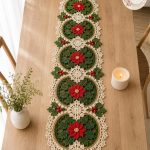
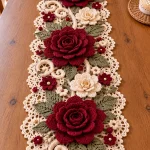
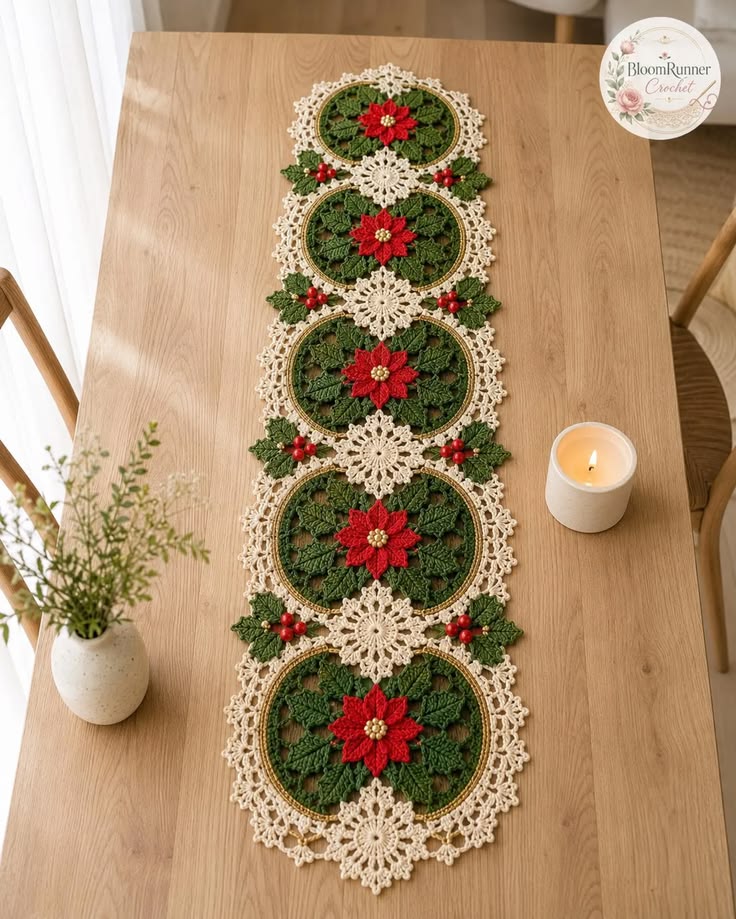
Five red poinsettias divide this runner into repeating botanical medallions instead of a conventional solid strip. This Christmas crochet table runner pattern combines dark green leaf circles, dimensional poinsettias, cream lace connectors, holly sprigs and a pointed openwork border. Worked primarily in cotton yarn, the photo-adapted design measures approximately 110–125 cm long and 28–32 cm wide when five large medallions are joined.
The Design: What Makes This Christmas Table Runner Different
The runner is modular. Five large circular motifs create the central structure, and each circle carries a red poinsettia surrounded by radiating green leaves. Cream lace medallions connect the circles vertically, preventing the runner from becoming a continuous heavy strip of green crochet.
Small holly clusters extend sideways between the major motifs. Their red berries repeat the poinsettia color while pointed leaves broaden the silhouette without increasing the width of every medallion.
A narrow gold-toned round between the green center and cream lace acts as a visual boundary. The outer cream border then changes from circular construction to pointed lace arches. The main construction failure is inconsistent medallion diameter. Block all five circles to the same measurement before joining them; even a 1 cm difference becomes obvious in a straight runner.
Project Info at a Glance
| Skill Level | Construction | Approx. Finished Size | Hooks | Best For |
|---|---|---|---|---|
| Intermediate / Advanced | Joined circular motifs with applied flowers | 110–125 × 28–32 cm | 3–3.5 mm | Christmas dining table, console or sideboard |
The dimensions are practical estimates based on the photographed proportions. Adding or removing one large medallion changes the runner length without requiring the individual motifs to be redesigned.
Materials and Tools
Yarn
- Dark green DK cotton yarn — approximately 140–180 g for medallions and holly leaves.
- Ivory or natural DK cotton yarn — approximately 120–160 g for lace borders and connector motifs.
- Christmas red DK cotton yarn — approximately 50–70 g for poinsettias and berries.
- Mustard or antique-gold cotton yarn — approximately 15–25 g for narrow accent rounds.
- Pale gold yarn or embroidery thread — small quantity for flower centers.
Tools
- 3.5 mm crochet hook for large medallions
- 3 mm crochet hook for poinsettias, leaves and lace connectors
- 2.5–3 mm crochet hook for berries if a compact shape is preferred
- Yarn needle
- Scissors
- Stitch markers
- Blocking mat
- Rust-resistant pins
- Tape measure
Abbreviations
- MR — magic ring
- ch — chain
- sl st — slip stitch
- sc — single crochet
- hdc — half double crochet
- dc — double crochet
- tr — treble crochet
- dtr — double treble crochet
- inc — increase
- dec — decrease
- sp — space
- st / sts — stitch / stitches
Keep the chain spaces slightly relaxed throughout the cream lace sections; short chains pull the medallions inward and can make the completed runner buckle.
Christmas Crochet Table Runner Pattern
The photographed runner contains five major poinsettia medallions arranged vertically. Cream snowflake-style connectors sit between them, while holly sprigs extend from both sides of the joins.
Large Green Medallion — Make 5
Yarn: dark green.
Round 1: 6 sc in MR. Join with sl st. (6)
Round 2: Inc ×6. Join. (12)
Round 3: Ch 3, dc in same st, 2 dc in each remaining st. Join. (24)
Round 4: Ch 4, skip 1 st, sc in next st. *Ch 4, skip 1 st, sc in next.* Repeat around. (12 loops)
Round 5: Sl st into first loop. Work sc, hdc, 3 dc, hdc, sc into each ch-4 loop. Join.
This creates twelve rounded green sections that establish positions for the radiating leaves.
Large Leaf Layer
The central medallion in the reference image uses pointed foliage rather than a flat green circle.
Join dark green yarn behind the previous round.
For each leaf:
Ch 11.
Beginning in second ch from hook work:
Sl st, sc, hdc, dc, tr, tr, dc, hdc, sc, sl st.
Ch 2 and sl st into the second ch from hook to sharpen the leaf tip.
Rotate and work into the unused loops on the opposite side:
Sl st, sc, hdc, dc, tr, tr, dc, hdc, sc, sl st.
Sl st back into the medallion.
Repeat to make 8 evenly spaced large leaves.
Arrange the leaves like spokes, keeping their pointed ends directed toward the outside edge.
Secondary Green Leaf Layer
Place a second, shorter set of leaves between the large leaves.
Ch 8.
Starting in second chain:
Sl st, sc, hdc, dc, hdc, sc, sl st.
Work a ch-2 picot at the tip.
Mirror the stitch sequence along the opposite side.
Make 8 secondary leaves, positioning one between each pair of large leaves.
Fasten off.
Open Green Background Round
Join green yarn behind the outer points of the leaf layer.
Round 1: *Ch 5, sc around the base of the next outer leaf point.* Repeat around.
Round 2: Sl st into first ch-5 sp. Work 3 dc, ch 2, 3 dc into each space. Join.
Round 3: Ch 1. Sc in each dc, working 2 sc, ch 2, 2 sc in every ch-2 space.
Fasten off.
This round creates the dark green openwork visible between the foliage and the narrow accent border.
Gold Accent Round
Yarn: mustard or antique gold.
Join to any outer stitch.
Round 1: Ch 1. Sc evenly around the complete medallion.
Adjust the spacing as required so the circle lies flat.
Join with sl st.
Fasten off.
The accent should remain narrow. Its purpose is to separate the green foliage visually from the ivory lace.
Ivory Lace Border Around Each Medallion
Yarn: ivory.
Round 1: Join ivory yarn. Ch 1 and sc evenly around. Join.
Round 2: Ch 5, skip 2 sts, sc in next. Repeat around, adjusting the final spaces so the arches remain evenly distributed.
Round 3: Sl st into first ch-5 sp. Work sc, hdc, 3 dc, hdc, sc into each space.
Round 4: Sl st to the center of the first shell. Ch 5, sc into the center of the next shell. Repeat around.
Round 5: In each ch-5 loop work sc, ch 3, dc, ch 3, dc, ch 3, sc.
Fasten off.
Block the medallion before attaching its poinsettia.
Large Red Crochet Poinsettia — Make 5
The poinsettias are worked separately and attached over the center of each green medallion.
Poinsettia Center
Yarn: red.
Round 1: 6 sc in MR. Join. (6)
Round 2: Inc ×6. Join. (12)
Inner Petals
Create six ch-4 spaces around the center.
In each space work:
Sc, hdc, dc, tr, dc, hdc, sc.
Six pointed petals form the first layer.
Outer Petals
Working behind the first layer, create six ch-6 spaces.
In each space work:
Sc, hdc, dc, 2 tr, dtr, 2 tr, dc, hdc, sc.
Fasten off with a 30 cm sewing tail.
Position the outer petals between the inner petals rather than directly behind them.
Poinsettia Center Buds
The center can be embroidered entirely with yarn.
Using pale gold yarn, work approximately 6–9 French knots or compact bullion-style stitches in the center.
Alternatively, crochet tiny knots:
Ch 2, work 4 hdc into second ch from hook, sl st into same ch.
Make several and sew them into a tight cluster.
Yarn centers keep the runner completely textile-based and avoid detachable hard embellishments.
Cream Connector Medallion — Make 4
The large circles are joined by ivory snowflake-style motifs.
Yarn: ivory.
Round 1: 12 dc in MR. Join. (12)
Round 2: Ch 4, skip 1 st, sc in next. Repeat around to create 6 loops.
Round 3: In each loop work sc, hdc, 3 dc, hdc, sc.
Round 4: Sl st to the center of the first shell. Ch 6, sc in center of next shell. Repeat around.
Round 5: In each ch-6 loop work:
Sc, ch 3, dc, ch 4, tr, ch 4, dc, ch 3, sc.
Fasten off with a 30 cm sewing tail.
Block into a six-pointed lace shape.
Holly Leaf — Make 16
Each connection between major medallions uses foliage extending to both sides.
Yarn: dark green.
Foundation: Ch 13.
Starting in second chain from hook:
Sl st, sc, hdc, dc, tr, tr, dc, hdc, sc, sc, sl st.
At the tip work:
Ch 3, sl st in first ch.
Rotate the work.
Mirror the stitch sequence down the opposite side of the foundation chain.
Do not fasten off.
Holly Leaf Points
Work sc around the outer edge.
At approximately every third stitch work:
Ch 3, sl st in second ch from hook, sc in next outer stitch.
Repeat along both sides.
Fasten off with a 20 cm sewing tail.
The small picots create the irregular pointed outline associated with holly foliage.
Small Holly Leaf — Make 8
Foundation: Ch 9.
Starting in second chain work:
Sl st, sc, hdc, dc, dc, hdc, sc, sl st.
Work a ch-2 point at the tip.
Rotate and mirror the sequence down the second side.
Add two small picots along each outer edge.
Fasten off with a long tail.
Red Crochet Holly Berries
Make approximately 24–32.
Round 1: 6 sc in MR. (6)
Round 2: Inc ×6. (12)
Round 3: Sc around. (12)
Add a very small amount of fiberfill or yarn scraps.
Round 4: Dec ×6. (6)
Fasten off and close the opening.
Leave a 12–15 cm sewing tail.
Making the Holly Clusters
Use approximately three berries per primary cluster.
Arrange two large leaves behind the berries with their points angled away from the center.
Add one smaller leaf where additional width is needed.
Sew the leaf bases together first.
Attach the berries over the joined bases.
Make approximately 8 clusters for a five-medallion runner.
Joining the Five Main Medallions
Block all five circles before joining.
Lay them in a straight vertical line on a large flat surface.
Leave approximately 4–7 cm between neighboring cream lace edges. The connector medallions will occupy these spaces.
Measure the full arrangement from top to bottom.
Check that the center points of all five poinsettias follow one straight line.
Pin the circles in place before adding the cream connectors.
Attaching the Cream Connectors
Position one cream connector between each pair of green medallions.
Overlap its upper and lower points slightly with the lace edges of the neighboring circles.
Sew the connector through several dense stitches rather than through chain loops alone.
Leave its side points free.
Repeat until all five medallions form one continuous runner.
Side Holly Arrangements
Place one holly cluster on each side of every connector.
The berry cluster should sit near the connector while the leaf tips extend horizontally.
Do not position the leaves directly under the circular lace border. They should extend the silhouette beyond it.
Sew the leaves through their central foundation line.
Leave the pointed outer edges free to preserve their dimensional shape.
Attaching the Poinsettias
Place one red poinsettia in the exact center of each green medallion.
Rotate it until the six outer petals sit between the strongest green leaf lines.
Sew through the flower center and the lower half of each outer petal.
Do not stitch the petal tips flat.
Each poinsettia should remain slightly raised while the surrounding medallion stays flat against the table.
Pointed End Motif
The bottom of the photographed runner finishes with an enlarged cream lace point.
Use the connector medallion pattern, but add one additional round.
Additional Round: Join ivory yarn at one point. *Ch 5, sc in next ch-space, ch 7, sc in next space.* Repeat around.
On the point facing away from the runner, replace one ch-7 loop with:
Ch 5, tr, ch 5, tr, ch 5.
This lengthens one section into a more pronounced terminal point.
Make a matching motif for the opposite end if a symmetrical runner is preferred.
Optional Continuous Lace Edge
If the joined medallions leave visible gaps along the sides, add one final ivory round around the complete runner.
Join ivory yarn to any outer lace loop.
Round 1: Ch 5 and sc into the next available outer loop. Continue around the perimeter.
Where two motifs meet, use shorter ch-3 loops to prevent excessive fullness.
Round 2: In each ch-5 space work sc, ch 3, dc, ch 3, sc.
In each ch-3 joining space work 3 sc.
Fasten off.
This final edging is optional because the individual medallion borders already create a decorative outline.
Assembly
- Crochet all five dark green medallions, add the gold accent rounds and complete their ivory lace borders.
- Block the five major circles to matching diameters before attaching flowers or joining the runner.
- Make five red poinsettias and sew one into the center of every green medallion, leaving the outer petal tips free.
- Arrange the five completed medallions in one straight line and verify that their center points remain aligned.
- Place one ivory connector motif between each pair of major medallions and sew it securely to both lace borders.
- Make the holly leaves and berries, assemble them into approximately eight side clusters and position one cluster on each side of the four joins.
- Sew the holly leaves through their center lines and attach the berry clusters over the leaf bases.
- Add the pointed cream end motifs and check that both ends remain centered on the runner’s longitudinal axis.
- Add an optional continuous ivory edging if the individual medallion borders require additional visual connection.
- Weave every tail into dense stitches, block the completed runner to final dimensions and reshape all poinsettia petals and holly points.
The finished runner should lie flat through its central medallions while the poinsettias, berries and leaf edges remain slightly raised.
Adjusting the Runner Length
The modular construction makes length changes practical.
For a compact centerpiece, use three poinsettia medallions and two cream connectors.
For a standard dining-table runner, use the photographed arrangement of five medallions.
A long dining table can accommodate six or seven medallions, provided the final piece leaves suitable space at both table ends.
Each additional medallion adds its own diameter plus the width of one connector section. Measure one fully blocked repeat before calculating the total length.
Adjusting the Runner Width
The diameter of the large medallions determines most of the finished width.
To make a narrower runner, use sport-weight cotton and a smaller hook rather than removing rounds from the foliage design.
For a wider centerpiece, use worsted cotton with a larger hook.
Keep the poinsettias proportional to the green centers. A flower that extends into the ivory lace obscures the circular construction.
Keeping the Medallions Flat
Round motifs can begin to ripple when the outer lace contains too many stitches.
If the green center lies flat but the ivory border waves, reduce the number of chain arches in the first lace round.
If the medallion cups inward, the border needs additional length. Increase selected chain spaces by one chain rather than adding stitches randomly around the entire circle.
Block the first complete medallion before making the remaining four. Record any adjustments and repeat them consistently.
Positioning the Green Leaves
The large leaves form a radial structure behind each poinsettia.
Use eight primary leaves whenever possible so the foliage can be distributed evenly around the circular center.
Place each secondary leaf between two primary leaves.
During blocking, pull the leaf tips outward rather than widening their bases.
The green layer should remain readable beneath the flower without covering the gold accent round.
Making the Poinsettia More Dimensional
For a fuller flower, add a third petal layer behind the existing twelve petals.
Create six ch-7 spaces around the back.
In each space work:
Sc, hdc, dc, 2 tr, 2 dtr, 2 tr, dc, hdc, sc.
Use the third layer only when the yarn remains light enough for the medallion to stay flat.
A table runner needs less flower depth than a wall hanging because tall petals can interfere with dishes or serving pieces.
Alternative Color Combinations
Red, dark green, ivory and antique gold reproduce the traditional Christmas palette shown in the reference image.
For a softer version, replace bright red with burgundy and use warm cream instead of pure ivory.
A winter version can combine deep forest green, white and silver-gray, with white poinsettias replacing the red flowers.
For a more neutral dining room, use oatmeal lace, muted olive foliage and rust-red flowers.
Keep the narrow accent round darker or warmer than the ivory border so the circular medallions retain a clear outline.
7 Technical Tips for a Christmas Crochet Table Runner
- Block all five medallions to the same diameter. A difference greater than approximately 1 cm becomes obvious once the circles are joined along one straight centerline.
- Keep the poinsettias inside the green field. Leave at least 1–2 cm between the longest red petal and the gold accent round so the medallion retains visible color separation.
- Check chain tension in the ivory lace. Short chain arches cause cupping, while overly loose arches produce a wavy border that will not block cleanly.
- Sew connectors through dense stitches. Attaching them only through open chain loops can stretch the lace and increase the gap between neighboring medallions.
- Position holly clusters in mirrored pairs. Measure from the center connector to each berry cluster so one side does not extend several centimeters farther than the other.
- Leave leaf points unstitched. Sew through the center line and base while keeping the outer 1–2 cm free so the holly retains its pointed profile.
- Block the finished runner along one centerline. Pin the center of every poinsettia first, then shape the outer lace; this prevents the five circular motifs from drifting sideways.
Blocking the Finished Runner
Place the completed runner on a large blocking surface.
Run a tape measure or straight guideline through the centers of all five poinsettias.
Pin each medallion center along that line.
Next, pin the outermost point of every large circle.
Shape the ivory lace one repeat at a time.
Extend the side holly leaves evenly but do not stretch the berry clusters.
Finally, pin the terminal lace motifs so the runner ends remain centered.
Allow the runner to dry completely before removing the pins.
Care and Storage
Follow the care instructions for the yarn selected. Cotton is practical for table linens because it blocks cleanly, but dimensional flowers and berries still require careful handling.
Support the runner when wet rather than lifting it by one medallion.
Dry flat and reshape the lace while damp.
For storage, roll the runner loosely around a clean tube or fold it between the connector sections. Avoid placing a hard fold through the center of a poinsettia.
If the lace loses definition after storage, lightly re-block the perimeter and leaf tips.
Conclusion
Construct the five circular medallions first and treat their diameter as the controlling measurement for the entire runner. Add the red poinsettias only after the green centers and ivory borders have been blocked, then join the circles with cream lace motifs along one straight centerline. Holly leaves and red berries should extend from the joins without increasing every section to the same width. Finish by shaping the pointed ends and blocking the complete piece. Save this Christmas crochet table runner pattern to Pinterest and share the finished runner on Instagram with #PoinsettiaCrochetRunner. Would you keep all five poinsettias red or make the center flower ivory?