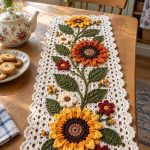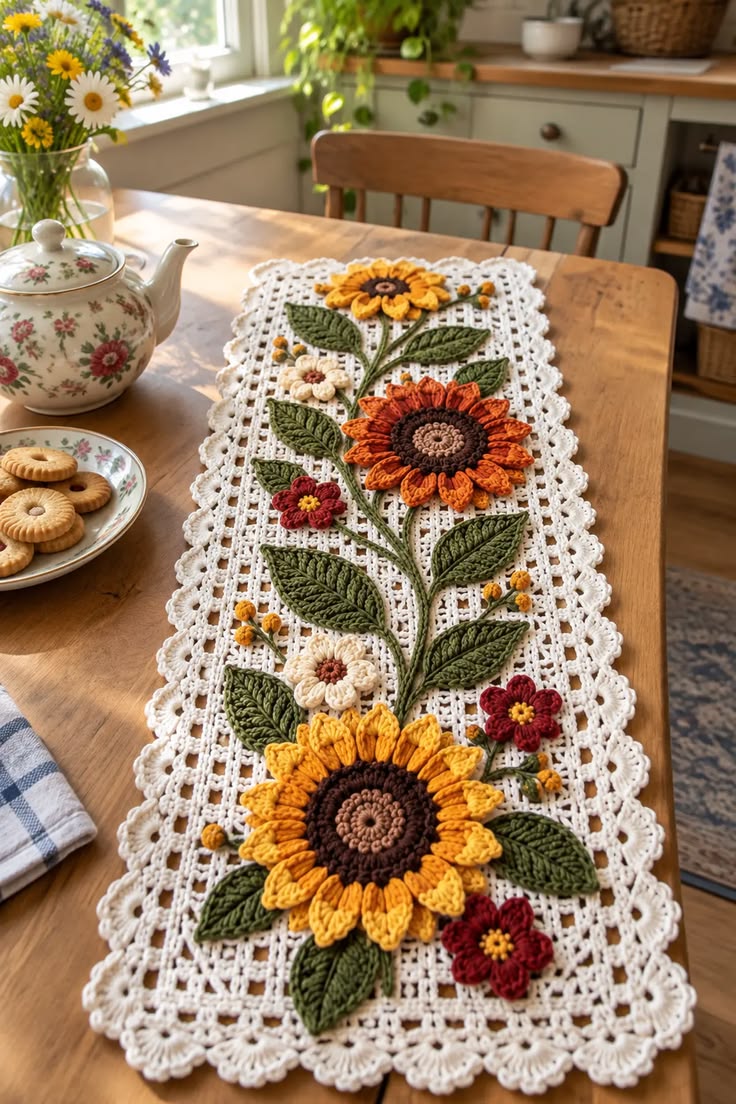
Three sunflowers climb the length of this runner instead of repeating in a conventional row, which makes stem placement as important as the crochet flowers themselves. This sunflower crochet table runner pattern combines a cream openwork base with dimensional sunflowers, olive leaves, branching stems, small burgundy and cream flowers, mustard buds, and a scalloped border. Use worsted cotton with a 4.5 mm hook for a structured, intermediate-level home décor project.
The Design: What Makes This Sunflower Runner Different
The runner is built in two layers. First comes a flat cream openwork rectangle with a wide decorative border. The botanical elements are then crocheted separately and sewn across that foundation. This separation matters because large dimensional flowers worked directly into the base could distort the open mesh.
Three large flowers create the primary visual line. Their positions alternate slightly from side to side rather than sitting on one rigid center axis. Olive stems connect them, while leaves fill the spaces without covering the entire lace background. Smaller cream and burgundy flowers break up the scale.
The main construction error in a 3D sunflower crochet runner is attaching the appliqués before blocking the base. A stretched runner can move every flower several centimeters away from its intended position.
Project Info at a Glance
| Skill Level | Finished Size | Hook | Yarn | Construction |
|---|---|---|---|---|
| Intermediate | Approx. 150 × 35 cm, adjustable | 4.5 mm | Worsted #4 cotton/cotton blend | Openwork base + sewn appliqués |
Materials and Tools
Yarn
Use cotton or a cotton-rich blend for the main runner. A table runner benefits from firm stitch definition and enough weight to remain flat after blocking.
- Cream/ivory — worsted #4 — approximately 250–300 g — runner base and border
- Olive green — worsted #4 — approximately 100–150 g — leaves and stems
- Golden mustard — worsted #4 — approximately 70–100 g — sunflower petals and buds
- Burnt orange — worsted #4 — approximately 30–50 g — alternate sunflower petals
- Dark brown — worsted #4 — approximately 40–60 g — sunflower centers
- Tan — worsted #4 — approximately 20–30 g — inner flower centers
- Burgundy — worsted #4 — approximately 20–30 g — small flowers
These quantities are planning allowances for a long dimensional runner rather than measurements taken from the photograph. Make the base first so the remaining yarn can be allocated accurately to the floral components.
Tools
- 4.5 mm crochet hook
- Tapestry needle
- Sharp scissors
- Locking stitch markers
- Rust-resistant blocking pins
- Blocking mats
- Measuring tape
Abbreviations
- MR — magic ring
- ch — chain
- sc — single crochet
- hdc — half double crochet
- dc — double crochet
- tr — treble crochet
- sl st — slip stitch
- st/sts — stitch/stitches
- sp — space
- RS — right side
- WS — wrong side
Invisible decreases are not required for the flat runner base; keep reductions out of the mesh so the rectangular foundation does not taper.
Gauge and Finished Measurements
A useful target for a dining-table version is approximately 150 cm long × 35 cm wide. The dimensions can be changed without altering the flower construction.
For a shorter runner, remove repeats from the central mesh. For a longer table, add complete pattern repeats before beginning the border.
Make a washed and blocked swatch before calculating the foundation chain. Cotton frequently changes dimensions during the first wash, and the finished floral arrangement depends on an accurately blocked base.
Sunflower Crochet Table Runner Pattern
Openwork Runner Base
Yarn: cream/ivory.
Chain to the required finished width while maintaining an even, loose foundation edge.
For a runner approximately 35 cm wide, determine the chain count from your blocked gauge rather than copying a fixed count from another yarn.
Row 1: Work dc across the foundation to establish a stable lower edge.
Row 2: Ch 3 and turn. Work a repeating sequence of dc and ch-1 spaces across the row to begin the open grid.
Row 3: Continue the mesh, placing dc above the structural stitches from the previous row.
Rows 4 onward: Repeat the established openwork pattern.
Measure the runner every 10–12 rows. Both long sides should remain parallel.
Continue until the central rectangle reaches the planned length minus the depth required for the outer border.
Finish with one solid dc row to stabilize the final short edge.
Do not attach any flowers yet.
Foundation Border
Yarn: cream/ivory.
Join yarn at one corner of the completed rectangle.
Round 1: Work sc evenly around all four sides. Place 3 sc into each corner.
Round 2: Build an open border by alternating dc groups and chain spaces.
Round 3: Continue the openwork border, maintaining the same number of repeats along corresponding sides.
Round 4: Work another stabilizing round, increasing only at the four corners.
Lay the runner flat after every border round. If the border begins waving, too many stitches have been added. If the corners pull upward, additional corner space is required.
Scalloped Outer Edging
Yarn: cream/ivory.
Join at a corner space.
Work a shell consisting of multiple dc stitches into the first suitable chain space.
Anchor the shell with a sl st or sc in the following structural space.
Repeat around the runner.
At each corner, use a larger shell or additional chain space so the edging turns without cupping.
Continue around all four sides and join.
Fasten off.
Block the entire base before beginning final flower placement.
Large Mustard Sunflower — Make 2
Yarn: tan, dark brown and golden mustard.
Round 1: With tan, make an MR. Work 12 dc into the ring. Join. (12)
Round 2: Work 2 dc into each stitch around. Join. (24)
Change to dark brown.
Round 3: Work 1 sc in the first stitch and 2 sc in the next. Repeat around. (36)
Round 4: Work 1 sc in each of the next 2 stitches, 2 sc in the next stitch. Repeat around. (48)
The center should remain flat. Do not add stuffing because this runner needs to remain suitable for tabletop use.
Change to mustard.
Petal Round: Work one petal over a controlled number of base stitches. Chain upward, use hdc, dc and tr stitches to widen the petal, then reverse the stitch heights toward the base.
Repeat evenly around the center.
Aim for approximately 16–20 petals for the large flower, depending on yarn thickness and the finished center circumference.
Fasten off and block only the petal tips, leaving the flower slightly dimensional.
Burnt Orange Sunflower — Make 1
Yarn: tan, dark brown and burnt orange.
Work the center using the same four-round structure as the mustard sunflower.
Round 1: 12 dc in MR. (12)
Round 2: 2 dc in each stitch. (24)
Round 3: (1 sc, inc) around. (36)
Round 4: (2 sc, inc) around. (48)
Change to burnt orange.
Work elongated petals around the center, keeping each petal approximately the same length.
Place the completed flower on the runner before weaving away the longest sewing tails.
Large Olive Leaves
Yarn: olive green.
Chain 12.
Round 1: Beginning in the second chain from the hook, work 1 sc, 1 hdc, dc across the central portion of the chain, then use shorter stitches toward the tip. Work multiple stitches in the final chain and continue along the opposite side of the foundation.
The target is a pointed leaf approximately 8 cm long when using a suitable yarn and hook combination.
Round 2: Work around the leaf again, placing increases near the point while maintaining smooth sides.
Slip stitch down the center or surface-crochet a central vein if additional definition is required.
Fasten off with a long sewing tail.
Make enough leaves to fill the primary branches. The photograph uses leaves in several orientations, so do not sew them all at the same angle.
Small Olive Leaves
Yarn: olive green.
Chain 8–9 instead of 12.
Work around both sides of the foundation using sc near the base, hdc through the transition, and dc through the widest portion.
Place several stitches into the final chain to create the pointed turn.
Mirror the stitch sequence along the opposite side.
Fasten off and leave a sewing tail.
Small Cream Flowers
Yarn: tan/burgundy center and cream petals.
Round 1: Make an MR and work 6 sc into the ring. (6)
Round 2: Increase around. (12)
Change to cream.
Form six petals around the center.
For each petal, work a combination of ch, dc and tr stitches into one or two base stitches, then return to the center with shorter stitches.
Repeat until all six petals are complete.
Fasten off with a sewing tail.
Small Burgundy Flowers
Yarn: mustard center and burgundy petals.
Round 1: With mustard, work 6 sc into an MR. (6)
Change to burgundy.
Round 2: Create one rounded petal from each stitch around.
For a fuller flower, work ch 2, several dc or tr into the same stitch, ch 2, then sl st into the same base position.
Repeat six times.
Fasten off.
Green Stems
Yarn: olive green.
The stems can be crocheted as narrow cords or surface-crocheted directly onto the blocked runner.
For a separate cord, chain to the required stem length.
Slip stitch back along the complete chain.
Fasten off with long tails at both ends.
For thicker main stems, make two parallel slip-stitch cords or work sc back along the chain.
Create one main stem running through each large flower grouping and several shorter branches leading toward leaves, buds, and small flowers.
Mustard Flower Buds
Yarn: mustard and olive.
With mustard, make an MR.
Round 1: Work 6 sc into the ring. (6)
Round 2: Work 1 sc in each stitch. (6)
Fasten off and draw the opening together slightly to form a compact bud.
Join olive beneath the bud and work a short chain stem.
Make buds in groups of two or three rather than spacing them individually across the runner.
Planning the Botanical Layout
Do not begin sewing immediately after completing the appliqués.
Place the largest mustard sunflower near one end of the runner, offset slightly from the center line. Position the burnt-orange sunflower around the central third. Place the remaining mustard sunflower toward the opposite end.
Run an olive main stem diagonally between the flower groups.
Position large leaves beside the stems with their points facing outward. Alternate sides so the arrangement does not develop a rigid ladder shape.
Add the cream and burgundy flowers only after the three large sunflowers and major leaves are positioned.
Use the mustard buds to occupy small gaps where another full leaf would make the composition too dense.
Leave visible areas of cream mesh. The openwork background is part of the design rather than empty space that needs to be covered.
Assembly
- Wash and block the completed cream runner base to its final dimensions before placing any appliqués.
- Position the three large sunflowers first and mark each center with a removable stitch marker.
- Arrange the main olive stems between the flowers, allowing gentle curves instead of sharp directional changes.
- Pin the large leaves beside the main stems and keep their pointed ends directed away from the central branches.
- Add the smaller leaves, cream flowers, burgundy flowers, and mustard bud clusters to the remaining spaces.
- Photograph the complete arrangement before removing individual pieces for sewing.
- Sew the stems first, catching structural mesh stitches without pulling the openwork base inward.
- Attach leaves through their center veins and selected outer points while allowing the leaf surfaces to retain slight dimension.
- Sew each flower around its center and selected petal bases rather than flattening every petal against the runner.
- Weave all tails into matching colors, steam or lightly block the completed runner as permitted by the yarn label, and check that the scalloped border remains flat.
The completed runner should lie flat while the petals and leaves retain enough relief to make the botanical arrangement visibly dimensional.
7 Technical Tips for a 3D Crochet Flower Table Runner
- Prevent a wavy lace border. Excess stitches around the long edges produce ripples that blocking cannot fully correct. Lay the runner flat after every border round and remove repeats as soon as persistent waves appear.
- Keep sunflower centers flat. An overfilled increase round creates a center that ruffles beneath the petals. Check the circle after the 24-, 36-, and 48-stitch stages before beginning the petal round.
- Control leaf curl. A leaf that twists before attachment usually has excessive tension along its foundation chain. Make the starting chain loosely and block each leaf before sewing.
- Protect the open mesh. Pulling sewing yarn tightly through a chain space can collapse the rectangular opening. Anchor appliqués around structural stitches and use several light attachment points instead of one tight stitch.
- Mark flower positions before sewing. Moving a 15 cm flower only 2–3 cm can change the balance of the entire botanical arrangement. Mark all three large centers before attaching the first stem.
- Keep the scallops consistent. Unequal shell spacing becomes particularly obvious along a long straight table-runner edge. Count the available border spaces before beginning the final round and distribute any adjustment symmetrically.
- Do not flatten every petal. Sewing through each petal tip removes the dimensional effect visible in this design. Secure the sunflower around its center and lower petal edges while allowing the outer portions to lift naturally.
Conclusion
The construction order determines whether this floral runner remains flat: complete the cream mesh first, add the scalloped border, block it to its final measurements, and only then arrange the botanical layer. Position the three large flowers before the stems, followed by olive leaves, smaller flowers, and mustard buds. That sequence keeps the composition balanced while preserving enough uncovered lace to define the background. For a longer table, add mesh rows rather than enlarging the appliqués. Pin this sunflower crochet table runner pattern to Pinterest or share the completed version on Instagram with #SunflowerGardenRunner. Would you keep the center sunflower burnt orange, or make all three sunflowers golden mustard?