A flower runner with thirty-plus green leaves fails quickly if its circular motifs cannot control the border width. This crochet flower table runner pattern uses DK cotton, a 4 mm hook and modular flowers and leaves to build an approximately 37 cm-wide runner with adjustable length. It suits an intermediate crocheter. Separate motifs also make the project practical for using partial skeins without forcing unrelated colors into one large fabric panel.
The Design: What Makes This Floral Runner Different
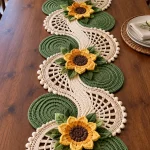
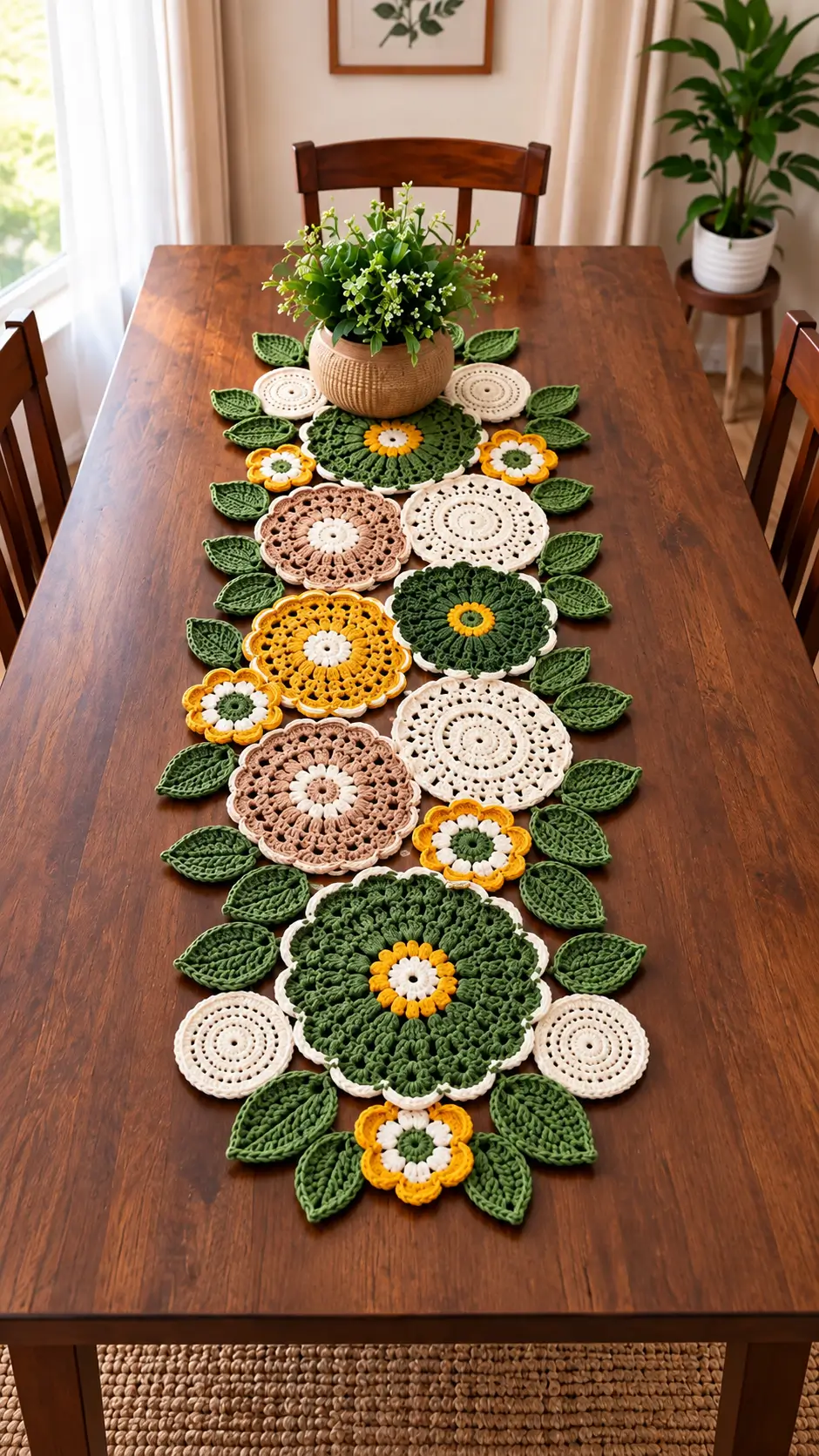
The runner is built as a botanical chain rather than a conventional rectangle. Large dark-green medallions establish the center line, while cream and taupe circles prevent the darker motifs from becoming one continuous mass. Small mustard flowers then cover selected transitions and introduce a smaller scale.
Leaves do structural work too. Each crochet leaf motif extends sideways from the central medallions, producing the irregular outline visible in the design without requiring a background mesh. This makes the floral crochet table runner easier to lengthen because another motif cluster can be inserted before final joining.
A frequent mistake is joining every component before blocking. Circular motifs can gain several millimetres in diameter after wet blocking, and repeated errors accumulate along a long runner. Block first. Join second.
Project Info at a Glance
| Skill Level | Time | Finished Size | Hook | Best For |
|---|---|---|---|---|
| Intermediate | Approx. 12–18 hours | Approx. 37 cm wide; length adjustable | 4.0 mm | Dining tables, consoles and sideboards |
The modular construction makes the finished length adjustable. Add or remove complete motif clusters rather than changing the diameter of individual flowers.
Materials and Tools
Yarn
Use DK cotton or a DK cotton blend for defined flowers, stable leaves and circular motifs that respond well to blocking.
- Dark botanical green — DK cotton — approximately 90–120 g
- Cream/ivory — DK cotton — approximately 60–80 g
- Mustard yellow — DK cotton — approximately 25–35 g
- Warm taupe — DK cotton — approximately 30–45 g
- White — DK cotton — approximately 20–30 g
The quantities are working estimates for this modular layout. A longer runner will require additional green and cream because those colors appear in the greatest number of components.
Tools
- 4.0 mm crochet hook
- Tapestry needle
- Sharp scissors
- Locking stitch markers
- Blocking mats
- Rust-resistant pins
- Measuring tape
Stuffing and safety eyes are not required because all components are worked as flat crochet motifs.
Abbreviations
- MR — magic ring
- ch — chain
- sc — single crochet
- hdc — half double crochet
- dc — double crochet
- tr — treble crochet
- inc — 2 stitches in the same stitch
- sl st — slip stitch
- st/sts — stitch/stitches
- BLO — back loop only
- sp — space
- sk — skip
Invisible decreases are normally used for three-dimensional shaping and are not required for these flat floral motifs.
Crochet Flower Table Runner Pattern — Step by Step
Work the circular components in joined rounds unless stated otherwise. Make and block several test motifs before producing the complete set, particularly if substituting yarn.
Large Green Floral Medallion
Make 3–4. Yarn: dark botanical green with mustard and cream accents.
R1: With cream, 6 sc in MR. Join. (6)
R2: Inc ×6. (12)
R3: Change to mustard. (1 sc, inc) ×6. (18)
R4: (2 sc, inc) ×6. (24)
R5: Change to dark green. (3 sc, inc) ×6. (30)
R6: (4 sc, inc) ×6. (36)
R7: Ch 3, 2 dc in same st, sk 1 st, then work 3 dc in next st and sk 1 st around. Join. (18 clusters)
R8: Sl st to first gap, ch 3, 4 dc in each gap around. Join. (18 shells)
R9: Ch 1, sc in first shell, ch 3, sc between shells; repeat around. (18 ch-3 spaces)
R10: Work 5 dc in each ch-3 space. (90 dc)
R11: Change to cream. Sc in center dc of shell, ch 4, sc in center dc of next shell; repeat around. Join.
Fasten off. Leave a 20 cm tail when the medallion will be sewn directly to another motif.
The 36-stitch foundation provides enough circumference for a broad central medallion while keeping the center compact.
Cream Lace Circle
Make 4–6. Yarn: cream.
R1: 6 sc in MR. (6)
R2: Inc ×6. (12)
R3: (1 sc, inc) ×6. (18)
R4: (2 sc, inc) ×6. (24)
R5: (3 sc, inc) ×6. (30)
R6: (4 sc, inc) ×6. (36)
R7: Ch 3, dc in same st, then ch 1, dc in next st around. Join. (36 dc)
R8: Sl st into ch-1 sp, ch 3, dc in same sp, ch 1. Work 2 dc in next ch-1 sp, ch 1; repeat around.
R9: Sc between each 2-dc group, ch 2; repeat around.
R10: Work 3 dc in each ch-2 sp around.
R11: Sc in middle dc, ch 3; repeat around.
Fasten off and weave in the end.
Keep these circles flat. They separate the denser green sections and prevent the center line from becoming visually heavy.
Taupe Lace Flower
Make 2–3. Yarn: warm taupe and cream.
R1: With cream, 6 sc in MR. (6)
R2: Inc ×6. (12)
R3: Change to taupe. (1 sc, inc) ×6. (18)
R4: (2 sc, inc) ×6. (24)
R5: Ch 3, dc in same st, ch 1, sk 1; repeat around.
R6: Work 3 dc, ch 1 in each previous ch-space.
R7: Sl st to first space, ch 3, 4 dc in space. Sc in next space, 5 dc in following space; repeat around.
R8: Ch 1 and sc evenly around the outer edge. Place an additional sc at a shell peak only when needed to keep the motif flat.
Fasten off. Leave a 15 cm tail when sewing the motif into the runner.
Mustard Accent Flower
Make 4–6. Yarn: mustard, white and green.
R1: With green, 6 sc in MR. (6)
R2: Inc ×6. (12)
R3: Change to white. (1 sc, inc) ×6. (18)
R4: Sl st in next st, 4 dc in following st, sl st in next st. Repeat six times to form six white inner petals.
R5: Change to mustard. Working behind R4, sl st around the base of the next petal, ch 4. Repeat six times.
R6: In each ch-4 space work sc, hdc, 3 dc, hdc, sc.
Fasten off. Leave a 20 cm joining tail.
Keep the accent flowers substantially smaller than the primary medallions. The size difference separates the focal motifs from the joining flowers.
Pointed Green Crochet Leaf
Make approximately 24–36. Yarn: dark botanical green.
Foundation: Ch 13.
R1: Starting in second ch from hook, work sc, hdc, dc, dc, tr, tr, tr, dc, dc, hdc, sc. Work 3 sc into the final chain. Continue along the opposite side of the foundation with sc, hdc, dc, dc, tr, tr, tr, dc, dc, hdc, sc. Join at the base.
R2: Ch 1. Sc around the leaf, placing 3 sc at the pointed end. Join.
R3: Sl st through the center foundation chain from the base toward the tip to create a raised central vein.
Fasten off. Leave 15–20 cm for attaching the leaf.
Block the leaves to consistent dimensions. Small differences multiply quickly when more than twenty leaves form the border.
Large Mustard Lace Medallion
Make 1–2. Yarn: mustard with cream center.
R1: With cream, 6 sc in MR. (6)
R2: Inc ×6. (12)
R3: (1 sc, inc) ×6. (18)
R4: Change to mustard. (2 sc, inc) ×6. (24)
R5: (3 sc, inc) ×6. (30)
R6: (4 sc, inc) ×6. (36)
R7: Ch 3, dc in same st, ch 1, sk 1, 2 dc in next st; repeat around.
R8: Work 3 dc in every ch-1 space.
R9: Ch 4, sc between the next two 3-dc groups; repeat around.
R10: Work sc, hdc, 3 dc, hdc, sc into every ch-4 space.
Fasten off and weave in the yarn tail.
Block this medallion to approximately the diameter of the taupe circles rather than matching the oversized green flowers.
Small Cream Joining Circle
Make 2–4 as required. Yarn: cream.
R1: 6 sc in MR. (6)
R2: Inc ×6. (12)
R3: (1 sc, inc) ×6. (18)
R4: (2 sc, inc) ×6. (24)
R5: Ch 3, dc in each stitch around. (24 dc)
R6: Sc, ch 2, sk 1; repeat around. (12 spaces)
R7: Work 3 dc in every ch-2 space.
Fasten off and weave in the end.
How to Assemble the Crochet Flower Table Runner
- Block the motifs. Block every circular motif separately and allow each component to dry completely before establishing the final layout.
- Build the center line. Position the largest green medallions along the longitudinal center of the runner. Leave enough room for cream, taupe or mustard circles between selected green sections.
- Add secondary circles. Arrange cream and taupe motifs so identical colors do not form one uninterrupted central row. Measure the total width before sewing.
- Position the small flowers. Place mustard accent flowers at narrow transitions between larger circles. Pin them before joining because small motifs can pull larger circles out of alignment.
- Arrange the leaves. Position green leaves in pairs or groups of three around the outer edges. Direct most leaf tips away from the center line.
- Check the width. Keep the runner close to 37 cm wide if following the reference proportions. Increase the length by adding motifs instead of continually increasing the width.
- Join the large motifs. Sew neighboring circular components together at two or three outer-round contact points with matching yarn. A single contact point allows a circular motif to rotate.
- Attach the leaves. Sew approximately the lower 2–3 cm of each leaf to the adjacent motif. Keeping most of the leaf free maintains the irregular botanical outline.
- Secure the tails. Turn the runner over and weave each joining tail through at least 4 cm of same-color stitches before trimming.
- Complete the final blocking. Block the assembled runner again. Measure both sides from the central axis to correct any uneven leaf placement.
The completed runner has a modular structure, so its overall length can be changed without rewriting the individual motif patterns.
7 Technical Tips for Better Floral Motifs
- Prevent motif drift. Put a locking stitch marker in the first stitch of every solid round. A misplaced join can shift later shells by one stitch and produce a visible spiral.
- Correct domed circles. A 36-stitch foundation that rises into a shallow bowl indicates excessive tension for the selected yarn and hook. Block one test motif before making the remaining circles.
- Stop ruffled edges. Rippling around the perimeter usually indicates excess stitches or chain length. Compare every repeated medallion with the first correctly blocked sample.
- Control leaf asymmetry. Mark the center foundation chain before crocheting the second side of a leaf. Both halves need the same stitch sequence or the pointed tip can rotate sideways.
- Prevent rotating joins. Connect large circles across two or three neighboring contact points. One-point joins permit the motifs to pivot when the runner is lifted or washed.
- Control border width. Pin all leaves before sewing and keep neighboring leaf bases roughly 2–4 cm apart, depending on the diameter of the adjacent medallion. Excessive leaf density can push the runner beyond the planned width.
- Secure joining tails. Weave every tail through at least 4 cm of matching stitches and reverse direction once before trimming. Short straight tails can work loose during washing and repeated blocking.
Adjusting the Size of the Table Runner
The modular construction makes resizing easier than changing the stitch count of every circular motif. For a shorter runner, remove one large medallion and its associated secondary circles, flowers and leaves. For additional length, repeat a complete motif group.
Keep the width relatively consistent. Enlarging only selected circles changes the spacing between the leaves and can create an uneven outer edge.
Before joining, arrange the complete set of motifs directly on the intended table. Measure the composition rather than relying only on the dimensions of individual circles. Joining points overlap slightly, so the final runner will normally be shorter than the combined diameters of all unjoined motifs.
Blocking the Finished Runner
Cotton motifs respond particularly well to wet blocking. Place the completed runner on blocking mats and establish a straight central axis first. Pin the large circles next, followed by secondary motifs and finally the leaves.
Do not stretch individual leaves simply to fill empty areas. Their tips should extend naturally from the circular motifs while remaining similar in length.
Allow the runner to dry completely before removing the pins. If one section contracts after drying, dampen and reblock that section rather than stretching the entire runner again.
Final Notes
Measure one blocked green medallion before committing yarn to the complete runner. That measurement determines how many circular motifs and leaf groups will fit the target table more accurately than an assumed gauge.
For a longer version, add another central motif cluster instead of enlarging every component. This keeps the botanical proportions consistent. Photograph the finished crochet flower table runner pattern flat before placing bowls or planters on top so the joining layout remains visible.
Save the finished project to Pinterest or share the completed color combination on Instagram with #BotanicalFlowerRunner. For a second version, consider one specific design change: keep every outer leaf dark green, or alternate two shades of green to separate the leaf groups.