Introduction
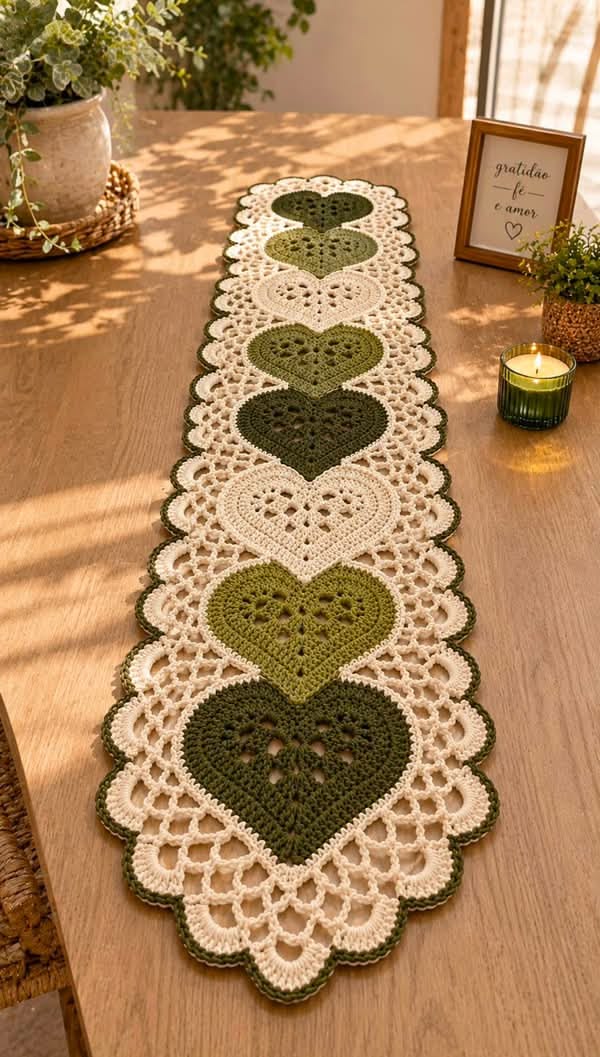
Nine oversized hearts have to share one narrow centerline without turning the surrounding lace into a series of pinched diamonds. This crochet heart table runner pattern uses DK cotton, a 4 mm hook, alternating olive and cream heart motifs, open chain lace, and a scalloped green edge. The intermediate runner finishes at approximately 100 × 30 cm. Its modular construction also makes the length easy to adjust for different tables.
The Design: What Makes This Heart Table Runner Different
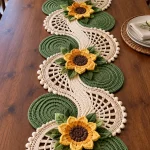
The photographed runner is built around a single column of large hearts rather than filet blocks or dozens of tiny appliqués. Each heart is dense enough to remain readable against the open cream background, while small eyelets near the upper center prevent the motifs from looking heavy. A second decision is the lace connection: chain arches spread from both sides of every heart and merge into scallops along the perimeter. Finally, a narrow olive outline repeats the heart colors at the outside edge and gives the cream lace a defined boundary.
Published heart table runner crochet patterns range from a 21 × 8.5 inch thread runner using a 1.75 mm hook to a 15 × 40 inch sport-weight runner using a 3.75 mm hook. The main construction error with this wider motif style is tightening the side arches, which pulls the runner inward between hearts.
Project Info at a Glance
| Skill Level | Time | Finished Size | Hook | Best For |
|---|---|---|---|---|
| Intermediate | Approx. 8–12 hours | Approx. 100 × 30 cm | 4 mm | Dining tables, consoles, coffee tables |
A published Ravelry Heart Table Runner measures approximately 38 × 101.5 cm after blocking with 12.5 cm motifs and a 3.75 mm hook. Another Ravelry Granny Heart Table Runner uses DK yarn, a 4 mm hook, and approximately 274 m. Those specifications provide useful benchmarks for the length, yarn weight, and hook selected here.
Materials and Tools
Yarn
- Warm cream / natural — DK #3 cotton or cotton blend — approximately 150–180 g
- Dark olive green — DK #3 — approximately 45–55 g
- Medium moss green — DK #3 — approximately 25–35 g
- Light olive green — DK #3 — approximately 25–35 g
Plan for approximately 275–350 m total yarn. A published DK Granny Heart Table Runner lists 274 m, while the larger sport-weight Heart Table Runner by Kim Kotary and Linda Gerstein uses multiple colors and measures about 101.5 cm long after blocking.
Tools
- 4 mm crochet hook
- 3.5 mm crochet hook — optional for the final olive edging
- Tapestry needle
- Locking stitch markers
- Scissors
- Blocking mats
- Rust-resistant blocking pins
- Tape measure
Abbreviations
- MR — magic ring
- ch — chain
- sc — single crochet
- hdc — half double crochet
- dc — double crochet
- tr — treble crochet
- inc — increase
- sl st — slip stitch
- sp — space
- st/sts — stitch/stitches
An invisible decrease is not required because the hearts and lace are constructed as flat expanding motifs rather than shaped amigurumi pieces.
Gauge and Measurements
Gauge is less important than finished motif dimensions because the runner is assembled from individual hearts and open chain arches.
Target the following measurements after light blocking:
- Large heart: approximately 13–14 cm wide × 12–13 cm high
- Visible heart overlap: approximately 2–3 cm
- Lace width beyond hearts: approximately 7–8 cm per side
- Finished runner: approximately 100 × 30 cm
Published heart motifs in one Ravelry table-runner design measure approximately 12.5 cm square after blocking, making a 13–14 cm target appropriate for the large motifs visible here.
Pattern — Step by Step
Use US crochet terminology. Make all nine heart motifs first, block them to matching dimensions, and then join them into the central column.
Heart Color Layout
For a runner close to the photographed arrangement, make:
- Dark olive hearts: 3
- Medium moss hearts: 2
- Light olive hearts: 2
- Cream hearts: 2
Arrange the values irregularly rather than repeating a strict two-color sequence. Keep at least one cream heart between darker groups so the central column has visible contrast.
Large Heart Motif — Make 9
Yarn: cream, dark olive, medium moss, or light olive.
Heart Center
R1: 6 sc in MR. (6)
R2: inc ×6. (12)
R3: (1 sc, inc) ×6. (18)
R4: (2 sc, inc) ×6. (24)
The first four rounds create a flat central disc that becomes the lower body of the heart.
Form the First Upper Lobe
Do not fasten off.
R5: Sc in next 6 sts, hdc in next 2 sts, 2 dc in each of next 3 sts, hdc in next 2 sts, sc in next st.
Sl st in the next 2 stitches.
Form the Second Upper Lobe
Sc in next stitch, hdc in next 2 stitches, 2 dc in each of next 3 stitches, hdc in next 2 stitches, sc in next 6 stitches.
Join with sl st.
The two increased double-crochet sections form the rounded upper lobes.
Heart Shaping Round
Ch 1.
Sc evenly around the first upper curve.
At the center indentation, work sl st, ch 1, sl st.
Sc evenly around the second upper curve.
Continue down the first lower side with hdc stitches.
At the bottom point work:
hdc, dc, ch 2, dc, hdc in the same lower stitch.
Work hdc evenly up the second lower side.
Join.
Heart Eyelet Round
The reference contains small openings in the upper-middle area of several hearts.
Ch 3.
Work dc in the next 3 stitches.
*Ch 2, skip 2 stitches, dc in next 3 stitches.*
Repeat across the upper interior portion until three or four eyelets have been formed.
Work ordinary dc around the lower curves.
At the bottom point work:
2 dc, ch 2, 2 dc.
Continue around the second side while mirroring the eyelets.
Join.
Final Heart Edging
Ch 1.
Sc around the complete heart.
Work 2 sc into each ch-2 eyelet space.
At the center indentation, work one sl st.
At the bottom point work:
sc, ch 2, sc.
Join and fasten off with a 25 cm tail.
Block each heart to approximately 13–14 cm wide.
Alternative Openwork Heart Center
For a more lace-like heart matching the open sections visible in the photograph, replace the solid R3 with:
R3: *sc in next stitch, ch 2, skip next stitch.* Repeat 6 times. (6 ch-2 spaces)
R4: Work 4 sc into each ch-2 space. (24)
Continue with the same upper-lobe construction.
This creates six small openings near the center without changing the 24-stitch outer count.
Blocking the Nine Hearts
Block the motifs before joining.
Pin the bottom point first.
Next, pin both upper lobes so their outside widths match.
Define the center indentation with a separate pin.
Measure from the center indentation to the bottom point.
All nine motifs should finish within approximately 5 mm of one another.
Allow them to dry fully before assembly.
Joining the Heart Column
Lay all nine hearts vertically on a flat surface.
Overlap the lower point of each upper heart over the center indentation of the heart below by approximately 2–3 cm.
Check the complete length before attaching anything.
Thread the matching yarn tail onto a tapestry needle.
Sew through the back loops of the overlapping areas.
Use approximately 4–6 small stitches per connection.
Do not sew across the complete width of either heart.
The joined column should remain flexible.
Cream Lace Foundation
Yarn: warm cream.
Join cream yarn near the upper side of the first heart.
Work around the exposed outer edge of the complete heart column.
*Sc into the heart edge, ch 5, skip approximately 2 cm of edge.*
Repeat down the first side.
At every narrow point between two hearts, reduce the arch to ch 3.
Continue around the lower end and return along the opposite side.
Join.
The exact number of arches depends on the blocked heart dimensions. Both sides must contain the same number.
Lace Round 2
Sl st into the first ch-5 space.
Work:
sc, ch 6, sc into the same space.
Move to the next ch-5 space.
Repeat sc, ch 6, sc.
In each ch-3 joining space between hearts, work:
sc, ch 4, sc.
Continue around.
The longer ch-6 arches begin forming the wide open lace seen along both sides of the runner.
Lace Round 3
Sl st into the first ch-6 arch.
Work:
3 dc, ch 3, 3 dc into the arch.
Ch 3.
In the next arch work:
3 dc, ch 3, 3 dc.
Repeat around both sides.
At the narrow spaces between adjacent hearts, use 3 dc, ch 2, 3 dc to prevent excess fabric.
Lace Round 4
Join cream in any ch-3 space.
Work:
sc, ch 5, sc in the same space.
Ch 3.
Move to the next ch-3 space.
Repeat around.
The alternating fans and arches should now form an open mesh approximately 6–7 cm wide beside the heart column.
Outer Cream Scallops
Sl st into the next ch-5 space.
Work:
sc, hdc, 4 dc, hdc, sc in the same arch.
Sl st into the next ch-3 space.
Repeat the scallop in the following ch-5 arch.
Continue around the runner.
At both narrow ends, distribute the scallops so the central point of the runner has one full fan rather than two overlapping fans.
Olive Contrast Edging
Yarn: dark olive green.
Join olive yarn at the base of any cream scallop.
Sl st in the first stitch.
Sc in each stitch across the scallop.
At the top of each scallop work:
sc, ch 1, sc.
Continue around the complete perimeter.
Use sl st in the valleys between scallops.
Join and fasten off.
This narrow green line should outline the lace rather than form another heavy border.
Optional Picot Finish
For a sharper perimeter, add a picot at the peak of every second scallop.
At the scallop center work:
sc, ch 3, sl st into first ch, sc.
Continue normally.
Avoid adding picots to every stitch because the runner already contains substantial openwork.
Assembly
- Crochet all nine heart motifs in the selected cream and olive shades, keeping the final dimensions close to 13–14 cm wide.
- Block every heart separately and compare its width, center indentation, and bottom-point length before joining.
- Arrange the nine hearts in one vertical column and test the full color sequence before attaching any motif permanently.
- Overlap adjacent hearts by approximately 2–3 cm and join each connection with 4–6 hidden stitches through the back loops.
- Work the first cream chain-arch foundation around the complete heart column, matching the arch count on both long sides.
- Add the second lace round and reduce the chain length at narrow spaces between neighboring heart motifs.
- Build the cream fan and mesh rounds until the lace projects approximately 6–7 cm from the heart column.
- Work the outer cream scallops and check that both long sides contain matching numbers of complete fans.
- Add the narrow dark-olive edging around every scallop, maintaining relaxed tension at the runner’s two pointed ends.
- Weave all tails into matching dense stitches, wet-block the complete runner to approximately 100 × 30 cm, and allow it to dry flat.
The completed runner should form one continuous column of nine large hearts surrounded by symmetrical cream lace and a narrow olive scalloped outline.
7 Technical Tips
- The heart point curves sideways: place a marker in the ch-2 point before beginning the final edging. The lower increases must remain centered beneath the indentation between the two upper lobes.
- The runner narrows between adjacent hearts: keep each overlap close to 2–3 cm and shorten only the lace arches immediately beside the join. A larger overlap removes usable length and forces the cream mesh inward.
- The lace begins ruffling: reduce ch-6 arches to ch-5 in the affected section before adding another round. Excess chain length becomes more pronounced after the dc fans are worked into it.
- One side finishes longer than the other: count the foundation arches on both long edges before starting Lace Round 2. A difference of even one full arch can shift the end scallops by several centimeters.
- The heart lobes flatten during blocking: pin the center indentation and both outside lobe points separately. A 13–14 cm heart needs three upper control points rather than being stretched only from side to side.
- The olive outline puckers the cream scallops: change to a 4 mm hook or relax the final-round tension. The contrast edging should follow the existing circumference rather than shorten it.
- The finished runner curves along the table: compare both diagonal measurements during wet blocking and correct any difference greater than 1 cm. Pin the centerline first so the nine heart points remain aligned while the lace dries.
Choosing the Heart Colors
The reference uses several related greens rather than repeating one shade.
A practical palette is dark olive, moss, sage-olive, and warm cream.
Keep the greens muted. Bright emerald or lime changes the visual character of the runner and produces much stronger contrast against the natural lace.
Arrange the darkest hearts toward both ends and the middle rather than grouping them together. This distributes visual weight along the complete table runner.
Why DK Cotton Works Well
DK cotton provides enough body for the large heart motifs while retaining definition in the chain lace.
A Ravelry Granny Heart Table Runner uses DK yarn with a 4 mm hook and lists approximately 274 m. Other heart runners use sport yarn with a 3.75 mm hook or much finer size-10 thread with a 1.75 mm hook.
The photographed runner sits between those extremes. Its hearts are substantial, but the open border remains fine enough to show the tabletop through the mesh.
Using Worsted Yarn
Worsted-weight cotton can be substituted for DK.
Start with a 5–6 mm hook according to the yarn label and swatch.
A published free Heart Table Runner by Sheila Alexander specifies worsted cotton or cotton-blend yarn, a 6 mm hook, and approximately 165–183 m.
Another open-work heart runner made with #4 yarn measures approximately 23 × 104 cm and uses a 5 mm hook.
Expect the nine-heart version to become substantially wider if the stitch counts remain unchanged.
Making a Shorter Runner
Remove heart motifs from the center column.
For a compact coffee-table runner, make 5 hearts.
For a medium dining-table runner, make 7 hearts.
Keep an odd number whenever possible so one heart sits at the exact center.
Do not shorten the runner by overlapping the motifs more deeply. Heavy overlap hides the points and changes the open spaces between the heart lobes.
Making a Longer Runner
Add hearts in pairs.
For a runner approximately 20–25 cm longer, make 11 hearts.
For an extended dining-table runner, make 13 hearts.
Block all motifs before calculating final length.
The joined measurement is shorter than nine individual heart heights because each connection overlaps by 2–3 cm.
Making a Narrower Runner
Reduce the lace width rather than changing the hearts.
Work the foundation arches and Lace Round 2.
Skip Lace Round 3 or replace the large dc fans with:
2 dc, ch 2, 2 dc.
Add the cream scallops immediately afterward.
This reduces the side expansion while keeping the central heart column unchanged.
Making the Lace Wider
Add another mesh round before the scallops.
Work:
sc in next ch-space, ch 6
around both long sides.
At the pointed ends, increase selected arches to ch 7 so the added circumference can turn smoothly.
Measure both sides after the additional round. The runner should remain flat before any scallops are added.
Creating a Two-Color Version
Use only dark olive and cream.
Alternate:
olive, cream, olive, cream, olive, cream, olive, cream, olive.
Keep all lace cream.
Finish with olive edging.
This produces a more regular rhythm than the multi-green reference while preserving the same structure.
Creating a Monochrome Version
Work all nine hearts and all lace in natural cotton.
Use texture rather than color to separate the motifs.
Add the optional openwork center to every heart.
Finish the outer scallops with the same natural yarn.
A monochrome runner depends more heavily on blocking because the boundaries between the hearts and background cannot rely on color contrast.
Heart Placement and Color Balance
Lay the nine blocked hearts on the table before joining.
Step back far enough to see the complete sequence.
Avoid placing the three darkest motifs directly beside one another.
Use the cream hearts as visual breaks.
Place the medium and light greens between high-contrast areas.
Take a quick photograph of the arrangement before sewing so the selected sequence is not lost during assembly.
Keeping the Centerline Straight
Run a measuring tape down the middle of the work surface.
Align every heart indentation and lower point with the tape.
Pin the hearts temporarily.
Join them only after all nine points fall on the same line.
A 5 mm error at each connection can accumulate into a visibly curved runner by the opposite end.
Joining Without a Bulky Seam
Use the long finishing tail from the upper motif whenever possible.
Catch only back loops or small portions of the stitch bodies.
Do not whipstitch through both full layers along a wide horizontal line.
The connection needs only enough strength to keep the motifs aligned while the surrounding lace adds further stability.
Flatten each join with your fingers before beginning the next heart.
Making the Scallops Even
The outer border is highly visible because it creates the runner silhouette.
Every standard scallop should contain the same sequence:
sc, hdc, 4 dc, hdc, sc.
Mark the peak of every fourth scallop while working around the perimeter.
After one long side is complete, count the fans before starting the second side.
Matching fan counts help keep the runner symmetrical.
Blocking the Finished Runner
Wet the completed runner according to the yarn’s care instructions.
Remove excess water without twisting.
Lay it on blocking mats.
Pin the complete centerline first.
Target approximately 100 cm from end to end.
Next, pull both long sides outward evenly to approximately 30 cm total width.
Pin each scallop individually.
Check the width at the top, center, and bottom before leaving the runner to dry.
Starching the Lace
Cotton lace can be lightly starched when a firmer table runner is preferred.
A published heart table-runner tutorial recommends wet blocking and notes that starch can be used for additional firmness.
Apply starch after the runner has been arranged to its final dimensions.
Use only enough to stabilize the scallops.
Heavy starch can make the thick heart motifs disproportionately stiff compared with the open mesh.
Using the Pattern for Placemats
Make one large heart.
Add the same cream foundation arches and lace rounds around the complete motif.
Continue until the piece measures approximately 30–35 cm across.
Finish with the olive scalloped outline.
Make matching placemats in different green shades to coordinate with the full table runner.
Using the Heart as a Doily
A single heart can become a smaller decorative mat.
Work the heart in dark olive.
Add three or four cream lace rounds.
Finish with the green edging.
Block the point sharply and keep the two upper lobes symmetrical.
The resulting motif works independently without requiring the full nine-heart column.
Yarn Tail Management
Each heart produces at least one finishing tail, and the color changes can create many loose ends.
Weave the heart tails before assembling the column except for tails reserved for joining.
Run each tail through approximately 5–7 cm of dense matching stitches.
Change direction once.
Avoid weaving through chain arches because the tail remains visible in the open spaces.
Fixing a Heart That Is Too Wide
Measure the motif after the final edging.
If it exceeds the target width by more than approximately 1 cm, check the upper lobe increases.
Reducing hook size can help, but changing only one motif creates inconsistent fabric density.
If all nine hearts are equally oversized, keep them and reduce the surrounding lace width instead.
Fixing a Heart That Curls
A curling lower point usually indicates tight edging.
Increase the point from:
sc, ch 2, sc
to:
2 sc, ch 2, 2 sc.
If the upper lobes curl, add one extra stitch around each outside curve rather than increasing the complete perimeter.
Block the corrected heart before making the remaining motifs.
Care and Storage
Follow the washing directions for the selected DK cotton.
Support the runner when wet because the open chain arches can stretch under their own weight.
Reshape the heart points and scallops while damp.
Dry the runner flat.
Do not hang it vertically from one end while wet.
For storage, roll the runner loosely around a cardboard tube or fold it along the spaces between motifs rather than across the center of a heart.
Conclusion
The central heart column controls the geometry of this runner, so finish and block all nine motifs before building the cream lace around them. Keep each overlap near 2–3 cm, match the foundation-arch count on both sides, and correct any ruffling before adding the outer scallops. DK cotton with a 4 mm hook gives the motifs enough structure while retaining the open background visible in the reference. Make one 13–14 cm heart first and use it as the size template for the remaining eight. Save this crochet heart table runner pattern to Pinterest or share the finished runner on Instagram with #OliveHeartTableRunner. Would you keep the mixed olive hearts or alternate only dark green and cream?